Samudraagam
Where Sri Lanka's Sea Finds Its Many Voices Marian de Silva
Everything is deeply personal about the Ocean surrounding Sri Lanka. For many, it is the rhythmic sound that accompanies childhood evenings. For others, it is a source of livelihood, a place of worship, a keeper of family histories, or even a silent witness to tragedy. Encircling an island nation, the ocean has long shaped not only the country's geography but also its identity, culture and collective memory.
It is this profound relationship that Samudraagam seeks to explore.
Derived from the Sanskrit words Samudra, meaning sea, and Raagam, meaning rhythm or melody, the exhibition invites visitors to look beyond the shoreline and into the many narratives that the ocean carries. Rather than presenting the sea as a picturesque landscape, Samudraagam reimagines it as a living archive, one that holds stories of resilience, spirituality, environmental change, political history, memory and transformation.
Stepping into the exhibition, one is immediately struck by the diversity of artistic languages on display. Ceramics stand alongside delicate watercolours, embroidered textiles converse with sculptural installations, while layered mixed-media works and oxidised metal sculptures each contribute their own interpretation of the ocean. Yet despite the differences in material and technique, every artwork returns to the same expansive subject: the sea, not simply as water, but as an enduring presence that continues to shape human lives.
The exhibition brings together seven contemporary Sri Lankan artists, each approaching the ocean from an entirely different perspective. Some draw upon deeply personal memories passed down through generations, while others confront pressing environmental concerns or examine the political realities surrounding Sri Lanka's coastline. Together, their works form a conversation that is as layered and fluid as the sea itself.
For curator, Mandira Ranatunga and viewers alike, Samudraagam becomes less about observing the ocean and more about listening to it. Every piece reveals another rhythm, sometimes calm and meditative, sometimes urgent and unsettling.
Among the first narratives visitors encounter is that of artist Catharina Danial, whose relationship with the sea is rooted in family history. Growing up in Jaffna, Catharina was deeply influenced by her grandfather, a fisherman and diver whose stories transformed the ocean into something far greater than a physical space. Through those memories, the sea became a place of healing, belonging and quiet reflection.
Her ongoing Soul series reflects this intimate relationship through layered mixed-media compositions that blur the boundaries between memory and emotion. Working with Congro board, transparent sheets, painting, drawing and coral-inspired forms, Catharina creates pieces that feel almost dreamlike. Colours overlap, textures emerge and dissolve, while translucent layers mimic the way memories surface, never entirely clear, yet never truly lost.
Rather than depicting recognisable seascapes, the works invite viewers into an emotional landscape. They explore how experiences are carried within us, much like the sea carries stories across generations. There is an unmistakable sense of vulnerability within the series, but it is accompanied by resilience, suggesting that healing often grows from remembering rather than forgetting.
While Catharina's work speaks of personal memory, textile artist Hasindu Jayasinghe shifts the conversation towards collective identity.
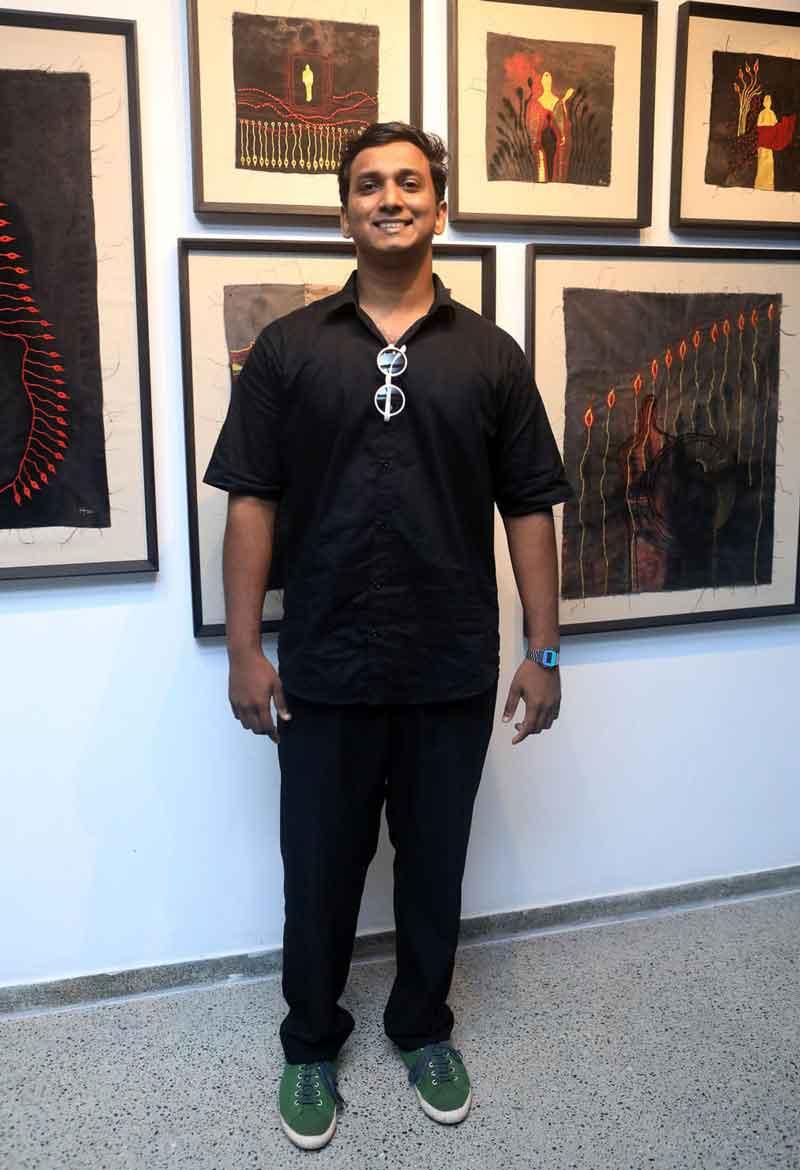
Drawing inspiration from Sri Lanka's Karava community, whose lives have long been intertwined with the ocean, Jayasinghe approaches the sea as a living archive of labour, belief and tradition. His works remind viewers that coastal communities are not defined solely by geography but by generations of inherited knowledge and customs that continue to shape their way of life.
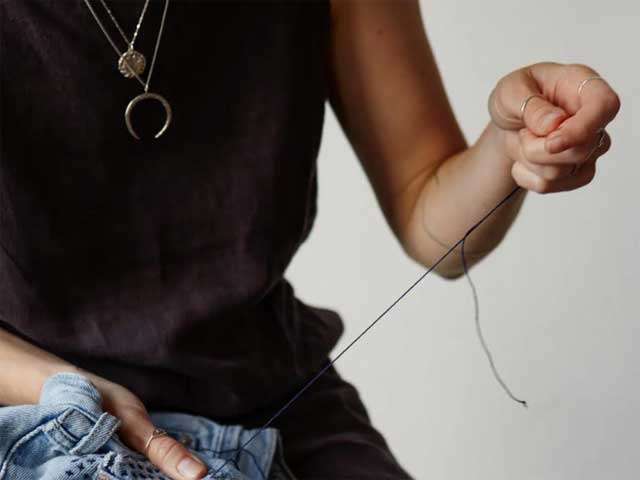
Using organic cotton, experimental dyeing techniques and intricate embroidery, his Kaurava series transforms textiles into visual records of memory. Every stitch appears deliberate, echoing fishing nets, weathered fabrics and the quiet marks left behind by time. Layers of natural and synthetic dyes evoke shifting tides, salt-stained surfaces and changing coastal landscapes, allowing the material itself to become part of the narrative.
What makes Jayasinghe's work particularly compelling is its tactile quality. Visitors may instinctively resist the urge to reach out and touch the embroidered surfaces, drawn in by their richness and depth. His practice demonstrates how textiles can preserve stories just as effectively as photographs or written histories, recording fragments of lives that have unfolded along Sri Lanka's shores for centuries.
Although Catharina Danial and Hasindu Jayasinghe approach the sea through different mediums and experiences, both artists reveal a common truth: the ocean remembers. It remembers families, communities, traditions and lives that continue to ebb and flow with every generation.
As Samudraagam unfolds, however, these quieter reflections gradually give way to more urgent conversations. Beyond memory and heritage lies another sea, one increasingly shaped by pollution, environmental destruction and human intervention. It is here that the exhibition begins to ask difficult questions, challenging viewers not only to admire the beauty of the ocean, but also to confront the responsibilities that come with living alongside it.
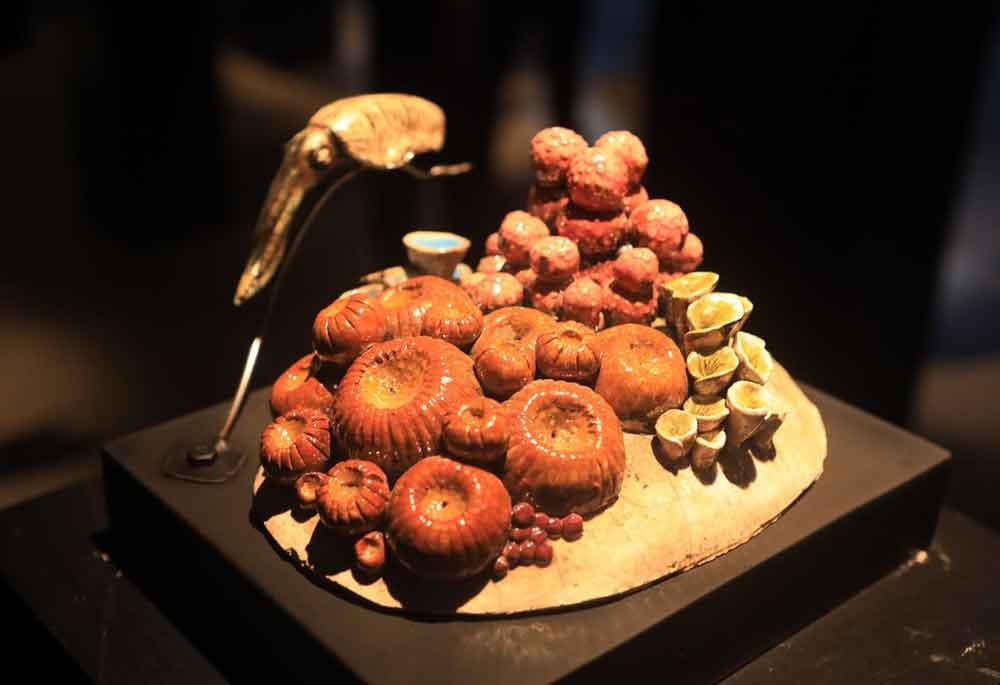
The exhibition's tone takes a dramatic turn with ceramic artist Janaka Herath's Choking the Blue series, arguably one of the exhibition's most confronting bodies of work.
For many Sri Lankans, the memory of the X-Press Pearl disaster remains vivid. What was once a thriving stretch of ocean became synonymous with oil, plastic pellets and devastating ecological loss? Rather than documenting the tragedy literally, Herath translates its aftermath into sculptural form, forcing viewers to confront the vulnerability of marine life in a way that statistics and headlines rarely can.
His ceramic fish and coral formations appear scarred, cracked and consumed by contamination. Created using the traditional Japanese Raku firing technique, the sculptures possess unpredictable surfaces that mirror the uncertainty of nature itself. Darkened textures creep across once-organic forms, suggesting suffocation rather than survival.
There is an unsettling irony in the series. The ocean, often imagined as limitless and powerful, suddenly appears fragile. Herath reminds viewers that despite its vastness, the sea remains deeply susceptible to human negligence. Standing before these works, admiration quickly gives way to discomfort, a reminder that environmental destruction is neither distant nor abstract, but painfully close to home.
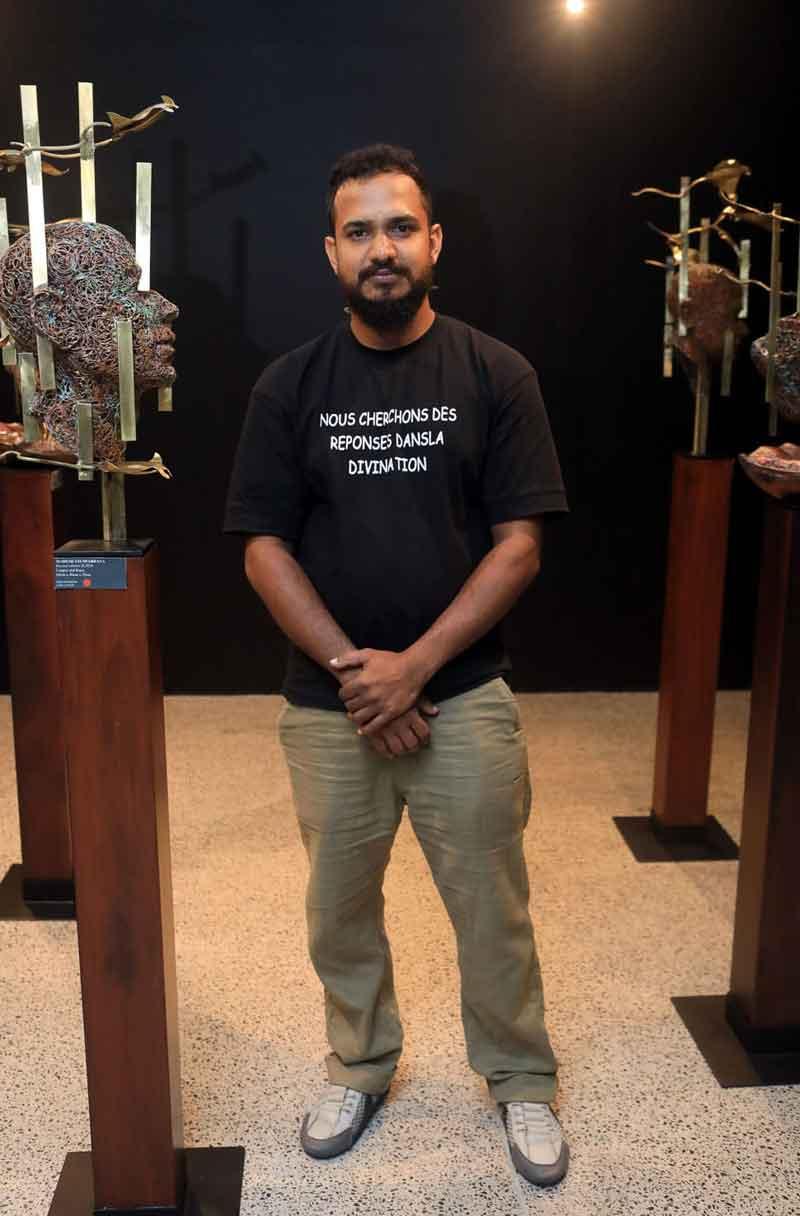
While Herath examines the visible wounds inflicted upon the sea, sculptor Mahesh Jayawardana journeys beneath its surface, into quieter and more contemplative waters.
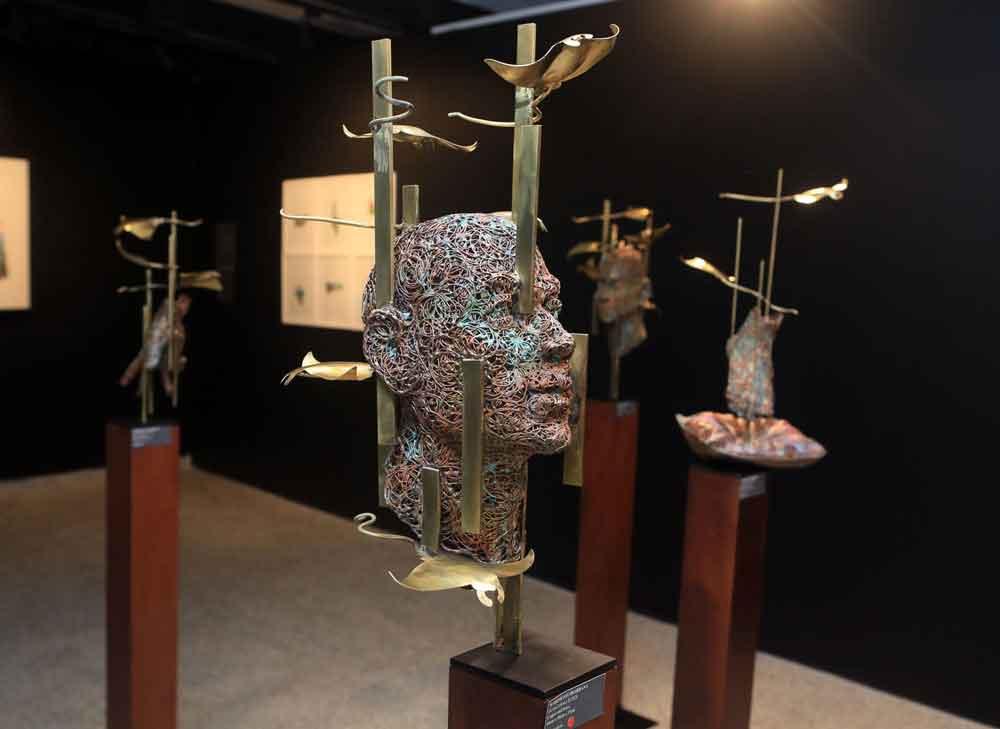
His Eternal Silence series presents the ocean as a metaphor for the human mind, suggesting that beneath apparent stillness lies an intricate world of emotions, memories and reflection.
Crafted from copper, brass and wood, the sculptures possess an almost fluid quality despite the rigidity of their materials. Oxidised surfaces shimmer with deep blues, greens and earthy tones, echoing the constantly changing colours of the sea itself. Depending on where one stands, each sculpture appears to shift in character, much like water responding to changing light.
Unlike the urgency found in Choking the Blue, Jayawardana's works encourage viewers to slow down. They are less concerned with what the sea has endured and more interested in what it reveals about ourselves. Dreams, emotions and fragments of memory emerge through abstract forms that resist immediate interpretation, inviting visitors to spend time observing rather than simply looking.
The contrast between Herath and Jayawardana is striking. One exposes the sea's suffering; the other embraces its silence. Yet together they demonstrate the remarkable emotional range of Samudraagam, proving that the ocean can simultaneously embody grief and tranquillity.
The conversation shifts once again through the work of Prasad Hettiarachchi, whose paintings remind visitors that the sea has never been merely a natural landscape. It has always been intertwined with commerce, empire, migration and power.
In From the Starting Point, Hettiarachchi examines familiar landmarks such as the Colombo Harbour, Port City development and the historic Chatham Street Clock Tower, revealing how Sri Lanka's coastline has continually evolved alongside political and economic change.
Executed in delicate watercolour, with subtle applications of gold paint and gold leaf, the works possess a deceptive calmness. At first glance they appear almost architectural in their precision. Yet beneath their restrained compositions lies a commentary on transformation, how coastlines become contested spaces where history, development and identity constantly intersect.
Hettiarachchi's background in conserving traditional temple paintings becomes evident through his meticulous attention to detail. Every line feels intentional, every empty space carefully considered. Rather than overwhelming viewers with symbolism, his paintings invite quiet contemplation, encouraging them to reconsider places they may pass every day without a second thought.
Collectively, these three artists reveal very different oceans. One is polluted and struggling to breathe. Another is silent, introspective and deeply personal. The third is political, carrying centuries of trade, colonial influence and urban expansion within its tides.
Together, they broaden Samudraagam beyond environmental or aesthetic conversations. The exhibition becomes a meditation on everything the sea has witnessed, and everything it continues to shape.
If Ravindu Sandaruwan's paintings lend the sea a mythological voice, Poornima Samarasinghe's installation reminds visitors that beneath its beauty lies an ecosystem in a constant state of change.
Inspired by the intricate forms of coral reefs, Poornima's large-scale sculptural installation immediately transforms the gallery space. Constructed using wire, pipe cleaners and soft chenille stems, the work appears almost weightless despite its scale, creating the illusion of an underwater landscape suspended in time.
Her series, Time, Death and Transformation, explores the interconnected cycles that define both coral ecosystems and human existence. Growth and decay are presented not as opposing forces but as parts of the same continuous journey. Corals flourish, bleach, regenerate and disappear, echoing the fragile balance that exists throughout nature.
What is particularly compelling is Poornima's choice of materials. Objects that might ordinarily be dismissed as everyday craft supplies are transformed into remarkably organic forms, blurring the line between the artificial and the natural. The installation serves as a subtle reminder that nature's most extraordinary creations are often also its most vulnerable.
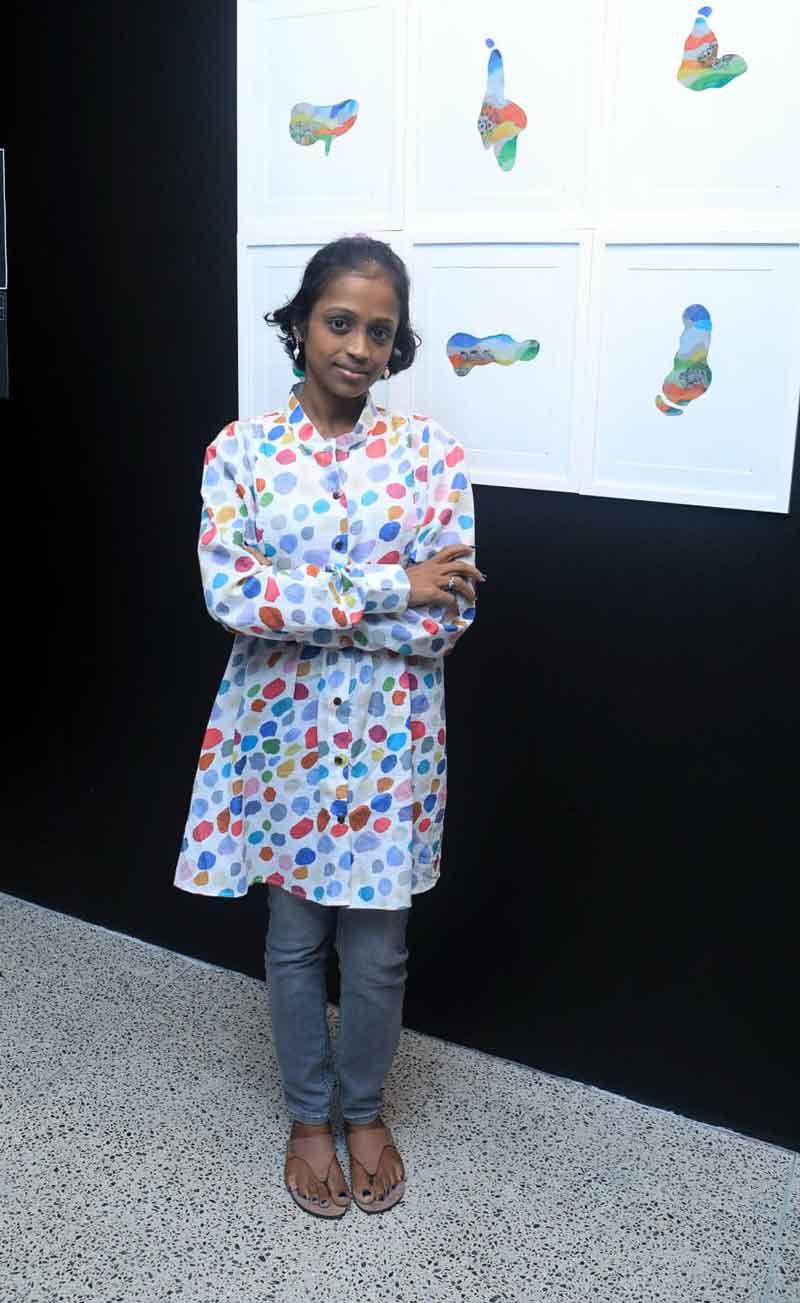
Moving from sculptural forms to watercolour, Ravindu Sandaruwan offers perhaps the exhibition's most poetic interpretation of the sea.
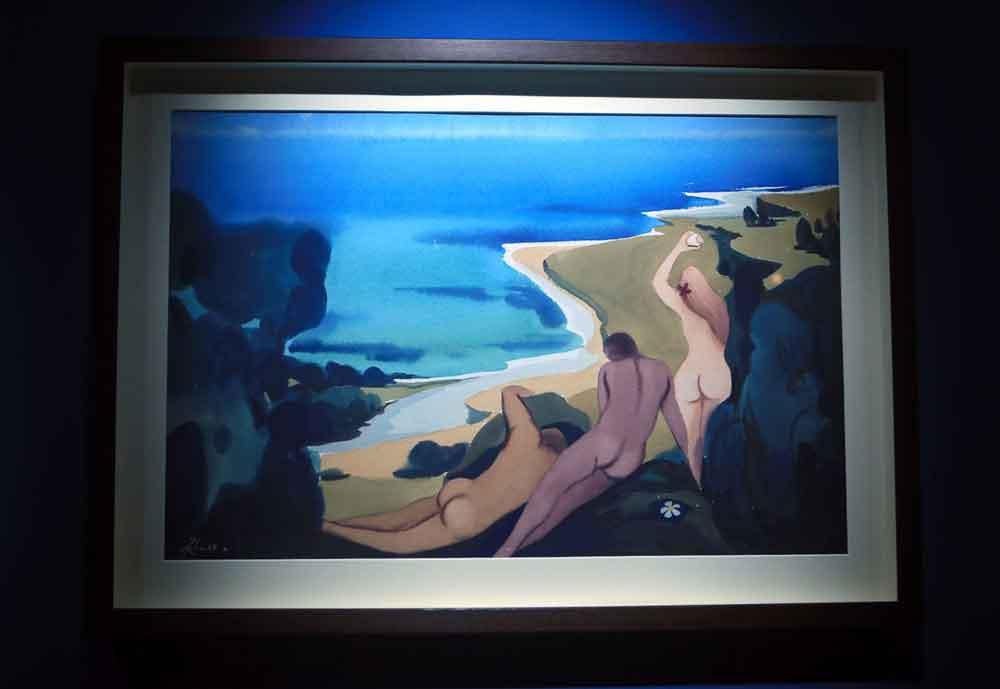
His Manimekala series draws inspiration from Sri Lankan mythology, personifying the ocean as the female deity Manimekala, long associated with protection, endurance and compassion. Rather than depicting the sea as an inanimate landscape, Ravindu presents it as a living, feeling presence that exists in conversation with the land, represented symbolically through a male figure. The recurring Araliya flower quietly weaves these relationships together, appearing throughout the series as a motif of connection and continuity.
Across fifteen watercolour paintings, colour itself becomes a narrative device. The earlier works glow with luminous blues that evoke calm seas and abundant life. As the series progresses, however, the palette gradually deepens into darker, moodier tones. The transformation is almost imperceptible at first, yet by the final paintings the ocean feels heavier, carrying the weight of environmental degradation and human intervention.
It is this gradual shift that gives the series its emotional power. Rather than confronting viewers outright, Ravindu allows them to experience the sea's changing condition through colour and atmosphere. His delicate wet-on-wet technique creates soft, fluid transitions that mirror the movement of water itself, allowing forms to emerge and dissolve with remarkable subtlety.
Together, Ravindu and Poornima offer two distinct yet complementary perspectives. One draws upon mythology and symbolism to reveal the emotional soul of the sea, while the other looks towards marine ecosystems to explore cycles of life, death and renewal. Both ultimately speak of transformation, suggesting that the ocean is never static but constantly evolving alongside the people and environments it touches.
What makes Samudraagam particularly memorable is not simply the quality of the individual artworks, but the dialogue they create with one another. Memory flows into mythology. Ecology meets politics. Personal histories intersect with collective experience. Each artist contributes a different rhythm to the exhibition, yet none competes for attention. Instead, they work in harmony, much like the tides themselves.
For an island nation surrounded by water, it is easy to take the sea for granted. It is often admired for its beauty, celebrated for its beaches and relied upon for its resources. Yet Samudraagam gently challenges this familiarity. It asks visitors to pause and recognise the ocean as something infinitely more complex, a keeper of ancestral memory, and a witness to environmental catastrophe, a source of spiritual belief, a space of contemplation and a landscape shaped by politics, history and human ambition.
By the time visitors leave the gallery, the sea no longer feels like a distant horizon. It lingers in the mind through embroidered threads, weathered ceramics, quiet watercolours, layered memories and sculptural corals. The exhibition succeeds not because it offers definitive answers, but because it encourages reflection. It reminds us that every wave carries stories that stretch far beyond what the eye can see.
In the end, Samudraagam is more than an exhibition about the ocean. It is an invitation to reconsider our relationship with the waters that surround us, to listen more closely to their rhythms, acknowledge their scars and appreciate the countless lives, histories and hopes they continue to hold. Long after leaving the gallery, it is these stories, rather than the artworks alone, that remain with the viewer.