Beyond the Visible: Ifadha Hassen at “Take a Chillpill”
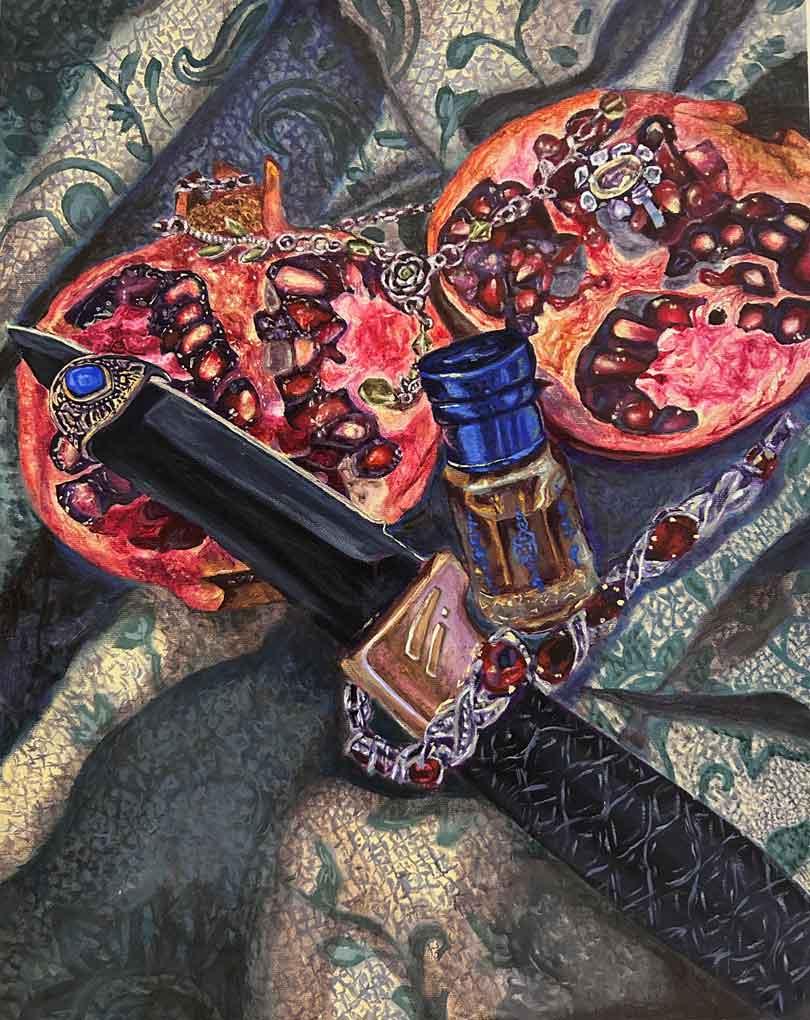
Fathima Ifadha Hassen, trained under the guidance of Sedireng Mothibatsela in Botswana, is an artist whose practice centres on still life painting, using objects as a form of narrative and emotional portraiture rather than depicting the human figure directly. In a fast-moving world where objects are often overlooked or quickly discarded, her work, presented at “Take a Chillpill,” invites viewers to pause and look closer. Through her paintings, everyday items become quiet storytellers, carrying memory, care, and inherited emotion. Rooted in personal history and cultural symbolism, her work reflects on how identity is shaped not only through people, but also through the objects that hold their presence across generations.
1. Your work replaces the human figure with objects. What do these objects reveal about women’s lives that portraits sometimes cannot?
I am less interested in the face than in the objects that gather around a life, because I think they often reveal a person more truthfully than a portrait can. Fadwa Tuqan’s poem I Found It inspired this idea in me. She describes finding herself not through the body, but through the natural world, in an evergreen bough sheltering birds, in water carrying the moon’s reflection. As I read it, I imagined a woman discovering herself diffused through the world around her rather than confined to her physical form. I loved that idea, that the soul might disclose itself through what it touches, tends to, and keeps close. I also wanted to move away from the burden of appearance. I’m 23, and very conscious of how quickly women, especially young women, are visually assessed, how the face becomes something to evaluate before anything else. I did not want my work to begin with beauty in that conventional sense. Objects felt more honest to me. A perfume bottle, a pashmina hijab, cut fruit, inherited jewellery. These things reveal taste and memory. They tell us how a woman moves through the world, not simply how she appears to it.
2. In a world that treats objects as disposable, your paintings frame them as carriers of memory and care. Do you see this as a quiet resistance to how women’s labour is often overlooked?
Yes, I see it as a resistance to the invisibility of women’s labour. In my paintings, the cut pomegranate is always central. I am drawn to it at the moment it is opened and made ready for others, because it holds both intimacy and labour. It is such a familiar domestic act, preparing food, yet it carries time and work that usually go unnoticed. The idea came to me in a jurisprudence class at university while reading Marx’s Capital. He distinguishes between labour that produces exchange value, which is recognised within capitalism because it can be sold, and labour that produces use value, which sustains life directly but is not economically recognised. Domestic work done by mothers falls into this second category. Cooking, cleaning, preparing food, and caring for children are essential to society, yet they are naturalised as private or emotional rather than understood as labour in a structural sense. This labour is deeply undervalued and often treated with condescension. Growing up, I noticed how people would ask my mother what she did for work, and when she said she was a housewife and a mother, there was often a shift in tone, as if it carried less worth. I remember a relative once laughing when I said she had less time to read because she was constantly busy. They insisted she “had nothing but free time” because she did not have a job, as if the work of running a home and caring for a family did not count as work at all. So, when I paint something like a cut pomegranate, I am trying to make that hidden labour visible. It is an ordinary domestic moment, but it is part of a larger system of women’s unacknowledged labour that holds our whole world in place.
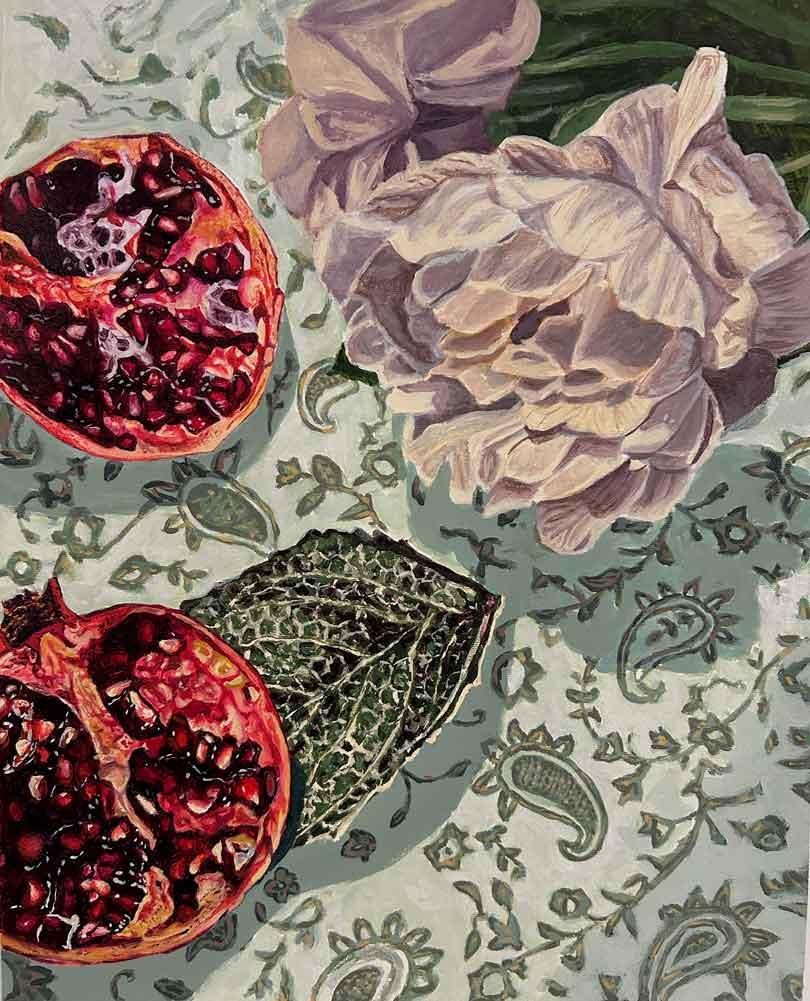
3. The pomegranate appears as a deeply personal self-portrait. How does this symbol connect your identity to maternal lineage and inherited care?
I chose the pomegranate for a very personal reason. When my mother was pregnant with me, she constantly craved pomegranates, and my grandmother would prepare them for her. After I was born, my mother’s craving faded, but I grew up loving them. Whenever I visited Sri Lanka as a child, my grandmother would cut pomegranates for me, and there were always seeds waiting at the breakfast table without me asking. For me, the pomegranate connects my mother, my grandmother, and me, holding a lineage of repeated care. It reflects how my identity has been shaped by their labour and love long before I could recognise it as such.
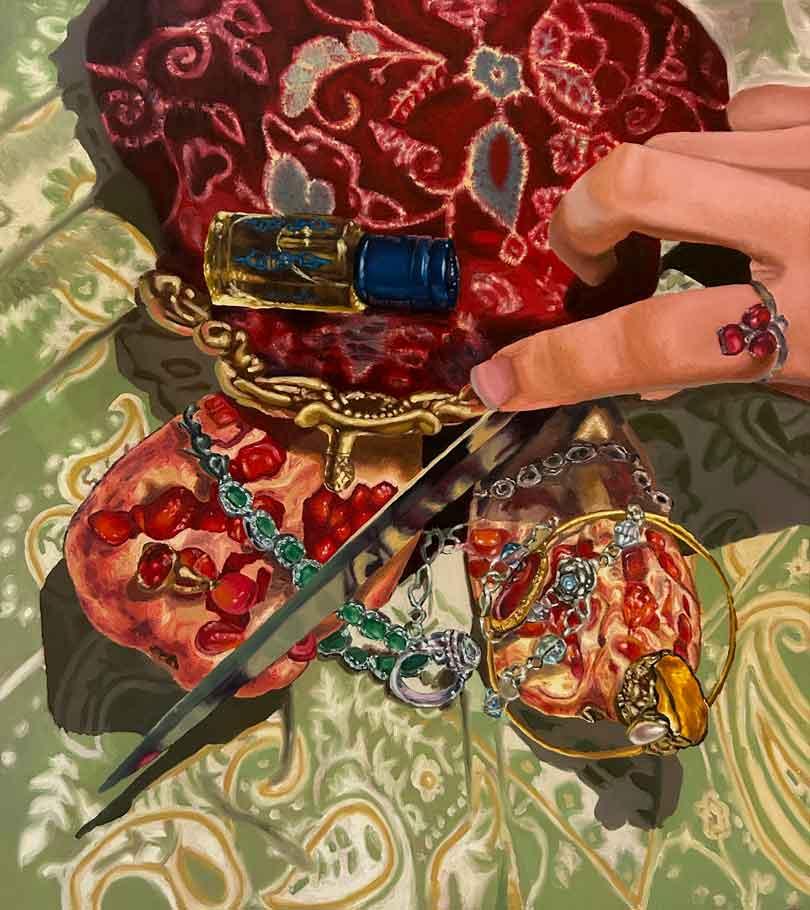
4. “Take a Chillpill” questions how much a woman is allowed to feel or express. How does your focus on tenderness and softness challenge that idea?
“Take a Chillpill” questions how much a woman is allowed to feel or express, and my work responds by refusing to reduce that emotional intensity. My work has a lot of energy in it. There are objects crowded together, a bag spilling out, swirling patterns, muted and deep reds. I use this density deliberately because I wanted the feeling of emotion to be impossible to ignore. Women are often told we are too sensitive or too emotional, but I wanted to show that sensitivity as something vibrant, active, tender, and visually powerful, not something weak or excessive.
5. Your work is rooted in heirlooms and generational memory. Do you think preserving these stories is a way of reclaiming space for women who were historically unseen?
Oh, that’s a lovely way of putting it. I’ve mostly thought about the work in relation to my mother and grandmother, but your question makes me see it differently. A lot of the jewellery and objects I paint were worn by women across my family, including my paternal grandmother and her mother, who are no longer alive. I hadn’t fully framed it like that before, but there is something about their presence continuing through these objects. I like the idea of lineage being held in things that are kept, worn, and passed down. That’s what I enjoy about exhibiting as well, hearing other people’s readings of it, and seeing how these private histories can open up into something wider.
6. Your practice ties personal memory to broader Islamic visual traditions. How do you balance the intimate and the universal in your work?
I balance the intimate and the universal by grounding the work in my own lived memory while placing it within the shared visual language of Islamic art. The work is deeply personal to me, as the pomegranate is linked to my mother and grandmother.
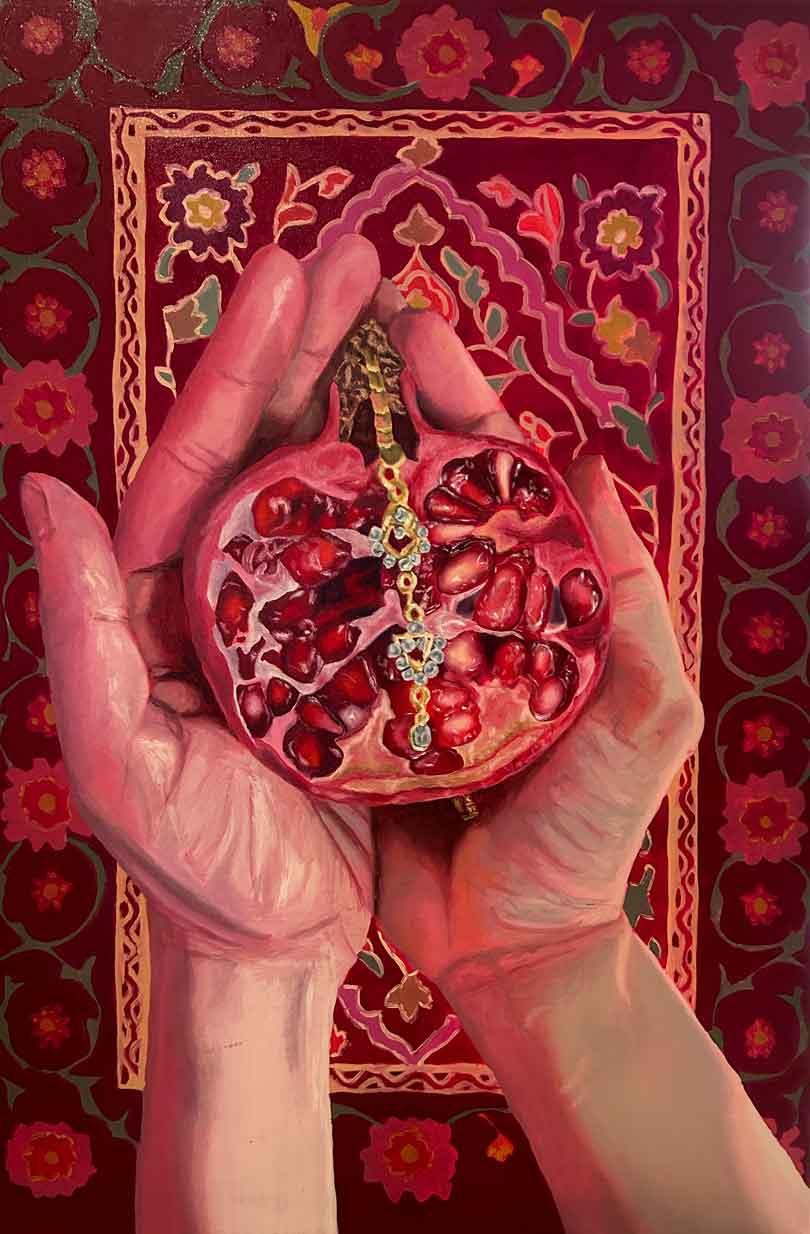
At the same time, the pomegranate allows the work to open outward. It is a motif that recurs across Islamic visual traditions. Seen as a fruit of paradise, it appears in Mughal miniatures, Ottoman tiles, Persian carpets, and the decorative language of mosques. In that sense, it is both symbol and story, both personal and inherited. So, the intimate and the universal meet rather than oppose each other, my private history unfolding within a wider tradition, like a single voice held inside an older, shared song.