Is Privacy the Price for Safety?

In a quiet yet deeply consequential shift, Instagram has removed end to end encryption from its direct messaging system, fundamentally changing the nature of how more than a billion people communicate online. There was no dramatic announcement or widespread public outrage. No urgent notification appeared on users’ screens. Instead, the change arrived almost silently, slipping into the digital lives of millions with little resistance. Yet the implications are enormous. For years, many users operated under the assumption that their private messages were truly private. That assumption no longer holds the same certainty.
For a long time, end to end encryption represented one of the strongest protections available in the digital world. Privacy advocates, cybersecurity experts, and technology companies alike described it as the gold standard of secure communication. In simple terms, end to end encryption ensures that only the sender and the intended receiver can read a message. Not even the platform hosting the conversation can access its contents. This promise became central to the identity of applications such as WhatsApp and Signal, which built their reputations on the assurance of secure and private communication.
Instagram, however, never fully embraced encryption in the same way. Although encrypted chats existed in limited forms and were available as an optional feature, they were never integrated into the core messaging experience. Most users continued to communicate through ordinary direct messages without enabling extra protections. Now, even that optional layer has disappeared entirely.
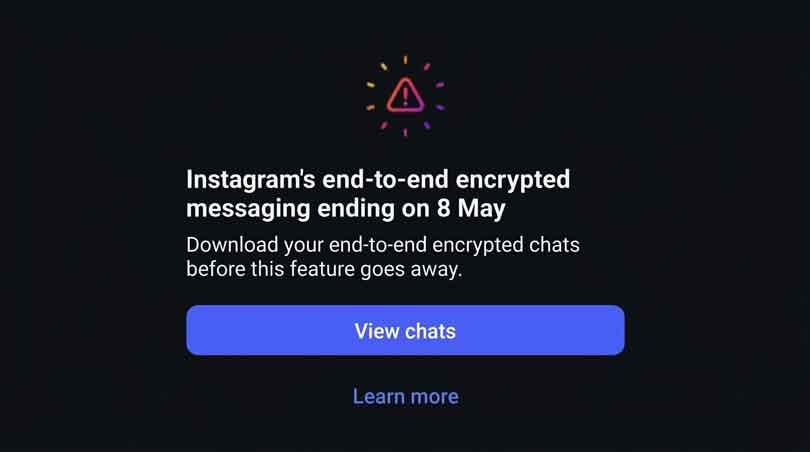
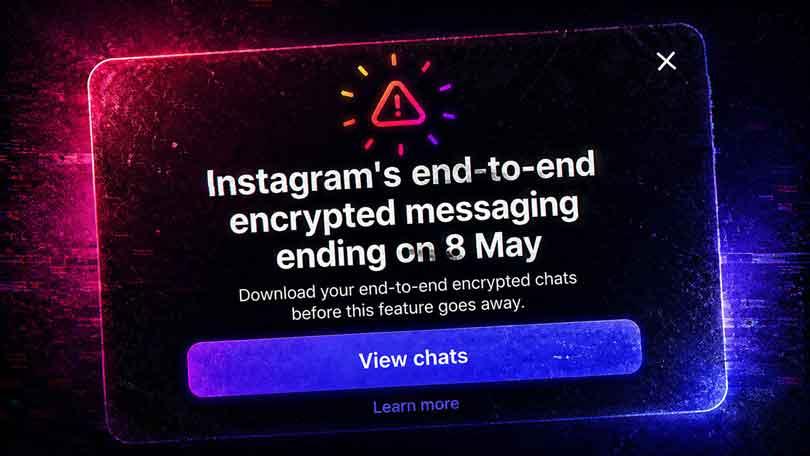
As of May 8, 2026, Instagram officially switched off this protection. On the surface, the decision may not appear significant. After all, many users were unaware that encrypted chats existed in the first place. Others simply never activated them. Yet the removal carries symbolic and philosophical weight far beyond the technical details. It signals a broader transformation in how one of the world’s most influential social media platforms views privacy, communication, and control.
At the heart of this decision lies a return to visibility. Without end-to-end encryption, Meta, Instagram’s parent company, regains the technical ability to access the content of user messages. Text conversations, shared photographs, voice notes, videos, and media attachments all become potentially visible to the platform once again. Companies often stress that such access is heavily restricted and governed by strict internal policies. Nevertheless, the essential reality remains unchanged. A barrier that once made large scale surveillance and data extraction technically impossible has now been removed.

Meta has justified its decision through two primary arguments. The company first claims that encrypted chats were not widely used, making the feature unnecessary. More importantly, Meta argues that encryption made it more difficult to identify and prevent harmful activity occurring within private conversations.
According to the company, scams, harassment, exploitation, and other forms of abuse become significantly harder to detect when platforms themselves cannot view message content. In other words, privacy was beginning to interfere with moderation and enforcement.
To some extent, this argument is understandable. The tension between safety and privacy has existed for years and continues to divide governments, technology companies, and civil rights advocates around the world. Law enforcement agencies have repeatedly expressed concerns about encrypted platforms creating safe havens for criminal activity. When messages are inaccessible even to the companies hosting them, authorities argue that investigations become more difficult, and intervention becomes limited. By removing encryption, Instagram is positioning itself alongside growing international pressure for greater accountability and stronger oversight in digital spaces.
Yet the trade-off involved is deeply personal, and this is where the issue becomes far more complicated. Instagram is no longer simply a platform for sharing photographs or following influencers. It has evolved into a central communication hub woven into everyday life. Friendships are maintained through direct messages. Romantic relationships unfold through late night conversations. Business negotiations, creative collaborations, networking opportunities, and emotional support all take place within Instagram chats.
What once felt intimate and confidential now exists within a system where messages can theoretically be accessed, analysed, or exposed. Sensitive financial discussions, private photographs, emotional confessions, and personal struggles no longer carry the same expectation of privacy they once did. Even if companies insist, they are not actively reading individual conversations, the knowledge that they technically can changes the relationship between users and the platform itself.
Cybersecurity experts have also warned about the broader vulnerabilities created by removing encryption. Without end-to-end protection, messages become more susceptible not only to internal access but also to external threats such as hacking, security breaches, and data leaks. In recent years, countless major corporations and institutions have suffered cyberattacks exposing private user information. In a digital era where data breaches have become alarmingly common, weakening message security raises understandable concerns about the safety of personal communication.
The implications stretch even further when examined through the lens of data economics. In today’s world, data is one of the most valuable resources any technology company can possess. Access to private conversations offers opportunities that extend well beyond moderation and safety. It allows for deeper behavioural analysis, more sophisticated advertising strategies, and increasingly detailed user profiling. Every interaction becomes a source of insight into human behaviour, preferences, emotions, and decision-making patterns.
Critics argue that removing encryption risks transforming private communication into yet another form of exploitable content. Messages that users once considered personal may increasingly become part of the enormous data ecosystems that fuel advertising algorithms and artificial intelligence systems.
In an age where companies race to develop more advanced AI technologies, private conversations hold immense value as training material capable of improving language models, predictive systems, and engagement tools.
This growing overlap between communication and data collection reflects a larger shift within the technology industry itself. Privacy, once promoted as a fundamental right and a defining feature of digital trust, is increasingly being reframed as something conditional. Companies now speak about balancing privacy against safety, regulation, profitability, and growth. Encryption is no longer viewed as untouchable. Instead, it has become one factor in a broader negotiation involving corporate interests, government pressure, and public expectations.
Perhaps the most unsettling aspect of Instagram’s decision is not the removal of encryption itself, but the silence surrounding it. There was no major campaign explaining the change. No widespread effort was made to educate users about how their privacy expectations might be affected. The update arrived gradually, almost quietly, with little public scrutiny. For a decision impacting the private communications of billions of people, that silence feels deeply revealing.
It reflects a defining reality of modern digital life. Some of the most important changes shaping human behaviour now occur invisibly, hidden behind updates, revised policies, and altered terms of service that few people fully read or understand. Technology companies increasingly shape the boundaries of privacy not through dramatic declarations, but through subtle adjustments that slowly redefine what users come to accept as normal.
Still, users seeking stronger privacy protections are not entirely without options. Platforms such as WhatsApp, Signal, and Telegram’s secret chats continue to provide end to end encryption either by default or as a core feature. Interestingly, WhatsApp itself remains owned by Meta, the same company removing encryption from Instagram. This contradiction raises important questions about the differing priorities assigned to various platforms within the same corporate ecosystem.
The answer may lie in the distinct ways these applications function. WhatsApp is primarily designed as a communication platform built around private conversations. Its value depends heavily on user trust and secure messaging. Instagram, by contrast, operates as a hybrid environment blending social networking, entertainment, commerce, influencer culture, and messaging into a single ecosystem. Visibility, engagement, and data driven interaction are central to its business model.
In such an environment, encrypted communication presents not only technical complications but also commercial limitations. Messages that cannot be analysed offer fewer opportunities for moderation, targeted advertising, recommendation systems, and behavioural tracking. From a business perspective, unrestricted visibility becomes valuable. This reality reveals that Instagram’s decision is not solely about protecting users from harmful activity. It is also about strategy, economics, and the evolving priorities of large technology companies navigating increasingly competitive digital markets.
For ordinary users, the lesson is both simple and uncomfortable. The word “private” no longer guarantees true privacy online. Increasingly, individuals themselves must understand the differences between platforms, security features, and communication systems. People may need to become more intentional about where they share sensitive information and more aware of how companies manage their personal data. It may also force a broader reconsideration of the role social media platforms play in modern life. These applications are no longer merely tools for communication. They are powerful infrastructures shaping relationships, commerce, identity, entertainment, and even political discourse. Within these spaces, the boundaries separating public and private continue to blur.
Ultimately, the debate extends far beyond Instagram alone. The deeper question is whether safety and privacy can truly coexist in the digital age, or whether society is gradually being pushed toward accepting one at the expense of the other. Governments demand accountability. Companies seek growth and control. Users desire both security and freedom. Somewhere within that tension lies the future of digital communication. And perhaps that is the most profound consequence of all. Because encryption was never only about technology. It was about trust. It represented the belief that some conversations belonged solely to the people having them. As that belief weakens, the nature of privacy itself begins to change.