Pallegama Hemarathana Thero Case: Where Were the Women as Principled Men Confronted the State Over a Broken Child?
By Thaliba Cader
The ancient stones of Anuradhapura have stood witness to centuries of human frailty, but they have rarely overseen a crime as cold, as systematic, or as structurally protected as the one currently happening in the light of Sri Lanka’s courts.
When Atamasthanadhipathi Venerable Pallegama Hemarathana Thero, the supreme custodian of the sacred Atamastana and the pinnacle of religious power in a country that tethers its entire national identity to the defense of the Buddhist clergy, was arrested for the repeated sexual abuse of a minor, the collective conscience of a nation was supposed to fracture.
This is not a conventional story of a crime and its subsequent punishment. This is the chronicle of an 11-year-old child who found herself trapped in an intersection of absolute domestic betrayal, ecclesiastical impunity, and systemic state corruption. It is an account that forces Sri Lanka to look into a mirror and confront a terrifying reality. When the elite are accused of destroying the innocent, the entire machinery of the state, from the local police bureau to the highest echelons of political power, will instinctively mobilize to protect the patriarch.
Why This is Rape, Not Complicity
In the immediate aftermath of the arrest, certain factions within the public discourse and the legal defense attempted to introduce an insidious, transactional vocabulary to the narrative. Because court records revealed that the child’s mother had allegedly accepted financial sums, including a payment of Rs. 100,000 from the monk which she claimed to have taken out of absolute, desperate poverty or perhaps driven by sheer greed, the language of prostitution and complicity began to taint the periphery of the case.
Let us be completely, unequivocally clear. A child cannot be a prostitute. A child cannot consent to her own exploitation. When a minor is sold by her guardian to a figure of absolute authority, that act is not a commercial transaction. It is a continuous, aggravated act of statutory rape and human trafficking.
The details that emerged from the Anuradhapura Chief Magistrate’s Court describe a routine of torture. Judicial Medical Officer Dr. Chaminda Rajakaruna officially certified that the child had been subjected to severe, long-term, repeated sexual trauma. The forensic submissions painted an unbearable picture, revealing that the child was taken to the inner, restricted chambers of the temple every three days.
She was a child so utterly isolated, so paralyzed by fear of both her mother and the revered religious icon she was forced to endure, that her only recourse was a silent, desperate attempt to preserve evidence of her own destruction. On the days she was assaulted, she took her blood-stained underwear and buried it in the earth.
Following the assaults, the suspect reportedly used a rug-like cloth to clean the crime scene, which was a piece of evidence that was later recovered by forensic teams and found to be stained with biological material.
To characterize this as anything less than a brutal, state-enabling systemic rape is to participate in the moral cover-up. The child did not choose this path; she was hunted within a space that society commands her to revere. Her childhood was bartered away by a mother who surrendered her maternal duty for cash and a religious leader who used his robe as an absolute shield against accountability. If she had not finally fled her home out of raw survival instinct, this horrific routine would still be occurring beneath the silent gaze of the temple walls.
Police Deviance and the Hospital Shield
The legal landscape of this case provides a textbook demonstration of how structural power maneuvers to obstruct justice when an untouchable figure is placed in jeopardy. Under ordinary circumstances, when a JMO confirms the long-term sexual abuse of a child and forensic data is clear, an arrest is instantaneous. Yet, the Nittambuwa and Western Province police departments engaged in a calculated policy of institutional evasion.
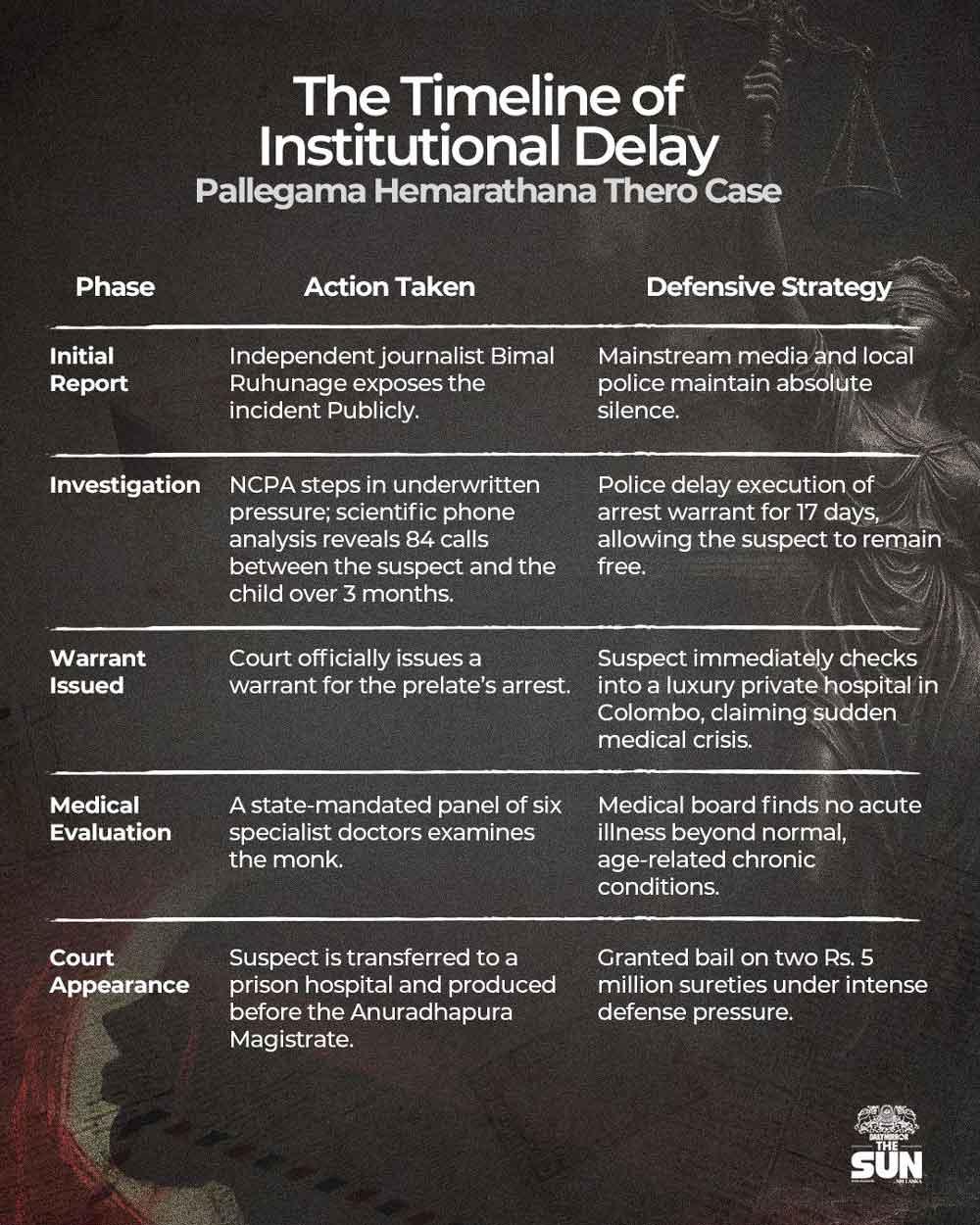
The Director of Law Enforcement for the NCPA, Attorney Sajeewani Abeykoon, stated directly in open court that the authority literally had to chase the police with a crowbar to force them to implement the law. Senior Deputy Inspectors General and local commanders have yet to provide a coherent explanation for why the suspect was allowed to roam free for over two weeks while the evidence mounted.
Furthermore, the legal team representing the child discovered that the very questionnaire sent by the police to forensic analysts was structurally compromised. The questions were framed not to extract objective truth, but to provide the defense with semantic escape routes during cross-examination.
Where Were the Women Leaders? Support groups? Female activist? Feminist?
For the last several decades, the mainstream social justice discourse in Sri Lanka has centered heavily on the doctrine of gender representation. Non-governmental organizations, progressive political parties, and civil society collectives have poured immense resources into fighting for quotas. If we put more women in corporate boardrooms, if we elect more women to provincial councils, and if we elevate women to the cabinet and parliament, the state will naturally become a safer, more empathetic environment for women and children. The Anuradhapura crisis has exposed this entire framework as a performative illusion.
When the details of this child’s systemic rape were laid bare in court, the silence from Sri Lanka’s female political establishment was deafening. Not a single prominent female Member of Parliament stood up to demand an expedited trial. No female cabinet ministers held press conferences to condemn the institutional cover-up by the police. The major social organizations that regularly host high-society galas for children's rights suddenly developed an acute case of collective amnesia. Mainstream media networks, dominated by executives terrified of a nationalist or religious backlash, systematically suppressed the details of the case.
The Myth: More women in power lead to automatic protection for vulnerable girls.
The Reality: Systemic hierarchy leads to complicit silence to protect personal status.
This total abandonment proves that representation without moral courage is nothing more than a cosmetic exercise. When a political system is fundamentally built upon the preservation of elite authority, individuals who climb to the top of that system will almost always choose to protect the hierarchy over the vulnerable, regardless of their gender. They allowed themselves to be entirely absorbed by the patriarchal machinery of power they were originally elected to dismantle.
The Irony of Advocacy: Are Men Better Representatives for Female Victims?
This absolute collapse of female institutional solidarity brings us to a highly controversial, deeply uncomfortable question. In the raw, corrupt reality of the Sri Lankan legal system, are principled men proving to be better, more effective representatives for abused female children than the women elected to speak for them?
The visual reality inside the Anuradhapura Magistrate’s Court provides a stark answer. On one side of the room stood a literal wall of defense consisting of over twenty of the country's most expensive senior lawyers, including elite President’s Counsel figures. They were flanked by nearly thirty powerful, high-ranking monks from the Maha Sangha, including the Ruwanweli Chaityaramadhipathi. This was the patriarchy in its purest, most intimidating form, deployed to ensure that a single child’s voice could not disrupt an ancient power structure.
Yet, who stood in the gap to counter this immense weight? The institutional defense of the child was mounted by the NCPA, driven by the unwavering ethical spine of retired High Court Judge Inoka Ranasinghe. And when the child sat in a total legal vacuum after being abandoned by the state, with the Attorney General’s Department completely and inexplicably absent from the prosecution bench, it was a voluntary, self-organized group of pro-bono attorneys who stepped forward to fight for her. Many of these dedicated lawyers were men, such as Senior Attorney Asith Siriwardena.
These men did not have a gendered mandate. They did not have NGO funding dedicated to representation quotas. What they had was a profound sense of institutional disgust and the structural immunity to fight the establishment without fearing the immediate loss of their political careers. When the system is this profoundly compromised, identity politics becomes entirely irrelevant.
The Blind Eyes of Lady Justice
The decision of the Anuradhapura Chief Magistrate to grant bail to Pallegama Hemarathana Thero on two surety bails of Rs. 5 million each, while imposing a travel ban, may technically conform to the letter of bail regulations for non-capital offenses. But to the public watching from the streets, it felt like a declaration of bankruptcy by the legal system.
As the suspect left the court surrounded by a massive entourage of elite lawyers and cheering supporters, the child was quietly moved back within four walls, isolated from the world, and left to ask if the law in Sri Lanka is merely a tool that changes its shape depending on the bank account and the social stature of the accused.
The judiciary must explicitly establish that no religious vestment, historical title, or political alignment grants an individual a single millimeter of immunity from the Penal Code.
The profound power imbalance inside the courtroom must be corrected by state mandate. Every single line of future testimony and forensic presentation must be conducted in a strictly closed court. The public exposure, victim-blaming, and systematic re-traumatization of child survivors by corporate defense walls must be legally categorized as a separate, actionable offense.
The investigation must not stop with the prelate and the mother. The senior police officers who orchestrated the 17-day delay, the supervisors who approved the defective forensic questionnaires, and the media corporations that intentionally enforced a policy of silence to protect their commercial relationships with the clergy must be investigated for criminal obstruction of justice. Systemic silence must be made expensive.
The Anuradhapura child abuse case has pulled back the skin of Sri Lankan society to reveal the raw, decayed anatomy of its power structures. It has shown us a country that, when pushed to its absolute limit, will comfortably allow a contingent of thirty powerful monks, a wall of expensive attorneys, and a compromised police department to stand between an accused predator and a traumatized a now 14-year-old child.