In Conversation With Avishka Wijesiri Executive - Compliance and Operations, Homelands Skyline
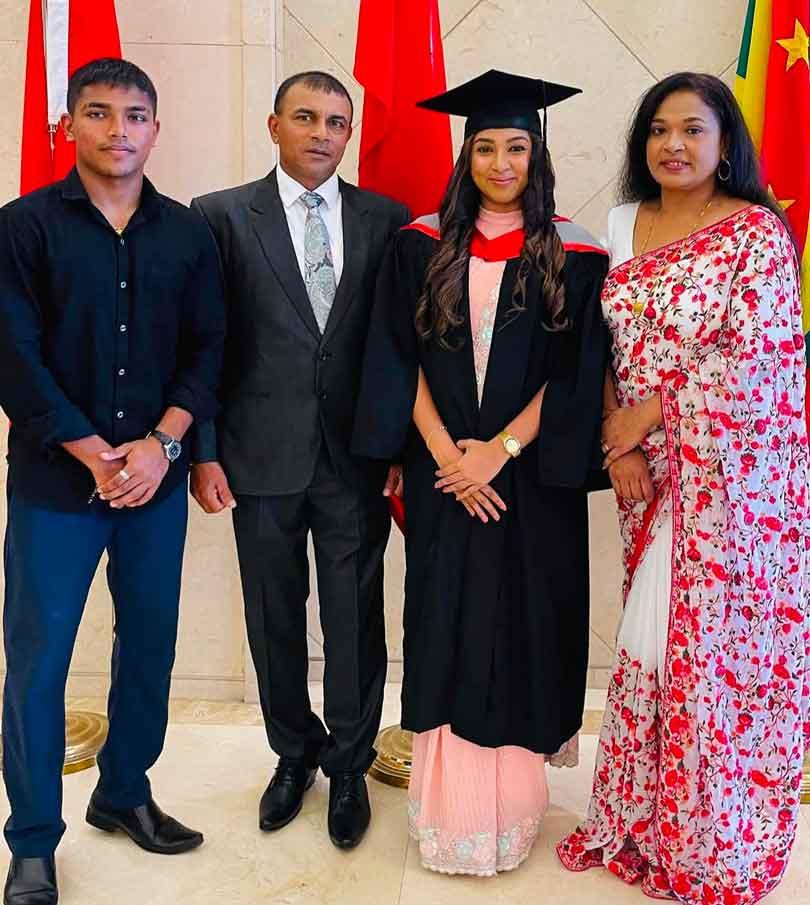
Avishka Wijesiri is building a career at the intersection of law, leadership, peacebuilding and youth development. Currently Executive, Compliance and Operations at Homelands Skyline, she is also preparing for her Attorney at Law examinations and has completed her Master’s in Conflict and Peace Studies, awaiting her results. Her professional experience spans corporate compliance, notarial practice and personal injury litigation with a Canadian law firm, giving her a broad perspective on the legal profession. Beyond her career, Avishka has long embraced sport, culture and community leadership. Mentored by her father, former Sri Lankan national rugby player Lal Wijesiri, she captained the APIIT Women’s Basketball Team and was named Most Outstanding Sportswoman in 2022. She has also represented Sri Lanka through traditional dance internationally and remains actively involved in youth mentorship through New Generation Sri Lanka. For Avishka, leadership is ultimately about discipline, empathy, service and creating opportunities for others to grow.
With a solid background in Law and International Relations, you currently serve as Executive, Compliance and Operations at Homelands Skyline, while preparing for your Attorney at Law exams and completing a Master’s in Conflict and Peace Studies. How do you manage your time and maintain peak performance across these demanding professional and academic domains?
I have always believed that hard work is a privilege rather than a burden. Much of that mindset comes from my mother. Her work ethic, determination and ability to balance responsibilities have always inspired me, and she remains one of my greatest sources of strength.
For me, managing multiple commitments comes down to planning, discipline and having a clear sense of purpose. During working hours, my focus is entirely on my responsibilities at Homelands Skyline. Outside work, I dedicate structured time to my legal studies and follow a weekly schedule that allows me to use my time effectively. I have now completed my Master’s in Conflict and Peace Studies and am awaiting my results.
What motivates me is knowing that these experiences complement one another. My professional work develops my practical judgement, legal studies strengthen my analytical thinking, and Peace Studies has broadened my understanding of people, governance and conflict resolution.
My parents’ continued support also keeps me grounded. I have realised that when you genuinely love what you are working towards, hard work can become a source of energy rather than exhaustion.
Your professional journey spans corporate legal compliance, personal injury litigation for a Canadian law firm and working under a senior Notary Public. How has this diverse exposure shaped your critical thinking and professional adaptability?
Working across different areas of law has taught me that there is rarely a single way to approach a problem. Each experience has required a different form of thinking and has contributed to the professional I am becoming.
Corporate compliance has taught me about governance, risk management and the importance of balancing legal obligations with commercial objectives while maintaining integrity. My experience with a Canadian law firm introduced me to an international professional environment, where attention to detail, client care and clear communication were essential.
Working under a senior Notary Public gave me another perspective, particularly on accuracy, ethics and the level of public trust associated with legal work.
Together, these experiences have strengthened my adaptability. They have taught me to assess each situation on its own merits, understand the people involved and approach legal and professional challenges with both analytical thinking and practical judgement.
As an active member of New Generation Sri Lanka, the youth division of Women in Management, how has this association empowered you to advocate for the next generation of Sri Lankan professionals?
Being part of New Generation Sri Lanka has contributed significantly to my own growth. I have always enjoyed connecting with people from different backgrounds, and the organisation has given me opportunities to strengthen my leadership and teamwork while learning from inspiring professionals.
Under the leadership of Dr Sulochana, I have seen how valuable it is to create environments where young people can access guidance, networks and opportunities. New Generation encourages young people not only to pursue professional success, but also to develop integrity, confidence and social responsibility.
That is what I value most about the organisation. It creates a community where young people can learn from one another and from established leaders.
It has also strengthened my desire to contribute to the development of other young Sri Lankans. I want to continue learning throughout my own journey while helping others recognise their potential and gain the confidence to pursue it.
As a Committee Member of WINSPIRATION, the professional youth mentorship programme under NGSL, what do you find most impactful about this mentorship model, and how can initiatives like this reach underserved youth nationwide?
Mentorship can provide something that academic knowledge alone cannot. Books give us knowledge, but mentors can offer perspective, encouragement, practical guidance and confidence.
WINSPIRATION creates that connection by bringing young people together with professionals who can help them understand leadership, career readiness, technology, entrepreneurship and the realities of the workplace.
I believe the next step is making mentorship more accessible. Digital platforms can connect mentors with young people regardless of geography, while partnerships with schools, universities and companies can extend programmes into communities that may not traditionally have access to professional networks.
We should particularly focus on reaching young people in rural areas. Another powerful approach would be encouraging successful mentees to become mentors themselves.
Sri Lanka has an incredibly talented younger generation. Often, what is missing is not ambition or ability, but access to the right people, guidance and networks. Expanding mentorship can help create a more inclusive and prepared workforce.
You captained the APIIT Women’s Basketball Team, were named Most Outstanding Sportswoman of the Year 2022, and achieved podium finishes in athletics and swimming. How has sport shaped your leadership style and resilience?
My understanding of leadership began at home with my father, Lal Wijesiri, a former Sri Lankan national rugby player. Through his experiences, he taught my brother and me that success is built through discipline, humility, consistency, resilience and respect.
My brother represented the Trinity College First XV Rugby Team, while my own sporting journey included basketball, athletics, track and field, and swimming from school through university. Our father never taught us to measure success purely through trophies. Character and the way you respond to challenges mattered just as much.
Sport taught me how to win, but importantly, it also taught me how to lose and continue trying. Becoming APIIT’s Most Outstanding Sportswoman was the result of persistence through obstacles rather than an easy journey.
Captaining the basketball team taught me that leadership is about bringing people together and helping others perform at their best. In my professional life, I carry those lessons with me. I value teamwork, remain composed under pressure and try to lead with empathy and respect for the people around me.

Your participation in IMUN saw you representing Chile, Turkey and Cambodia in forums including UN Women and WHO. How did these diplomatic simulations influence your understanding of international policy, peacebuilding and human rights?
Participating in IMUN was an important learning experience because it required me to consider global issues from perspectives beyond my own. Representing Chile, Turkey and Cambodia in forums such as UN Women and WHO taught me to listen carefully, negotiate, research different positions and respect cultural and political differences. Discussions around gender equality, public health, sustainable development and human rights demonstrated how interconnected global challenges have become. The experience also reinforced my belief that peacebuilding begins with understanding. Sustainable peace requires more than legislation or political agreements. It also depends on inclusive governance, international cooperation, cultural awareness and mutual respect. With my background in Law and International Relations and my studies in Conflict and Peace Studies, these simulations strengthened my interest in human rights and peacebuilding. They taught me that meaningful leadership requires empathy and the willingness to listen as much as the confidence to speak.
Having represented Sri Lanka at cultural festivals in France, Sweden and South Korea, and winning the Heart of Sri Lanka award for traditional dance, how do you see performing arts as a form of global diplomacy and mutual understanding?
Dance has been part of my life since childhood. I was a member of my college senior dancing troupe and had the privilege of representing Sri Lanka at cultural festivals in France, Sweden and South Korea. Receiving the Heart of Sri Lanka award for traditional dance was particularly meaningful because it represented more than personal recognition. It demonstrated how our cultural heritage can cross language and geographical boundaries and create genuine connections between people. I believe performing arts can be one of the most powerful forms of soft power. Dance, music and cultural performance communicate history, identity, values and emotion in ways that people can understand without necessarily sharing the same language. These experiences taught me that diplomacy does not happen only in formal meetings. It can happen through culture, art and shared human experiences. I am grateful to the teachers who shaped my journey and proud that I have been able to represent Sri Lankan culture internationally.
From serving as a Prefect and House Games Captain at Hillwood College to becoming Sports VP of the APIIT Student Activity Club and taking on leadership roles in Rotaract, what advice would you give students about making the most of cocurricular activities?
My advice is to get involved with purpose rather than simply collecting achievements for your résumé. Every leadership role I took on presented different challenges. Organising events, motivating teams, representing students and working with people from different backgrounds taught me that leadership is not about having a title. It is about service, listening, taking responsibility and creating a positive impact.
My parents, particularly my mother, gave me the courage to face challenges, while also allowing me the independence to pursue opportunities on my own. Students should be willing to step outside their comfort zones. Volunteer for responsibilities, participate in competitions, organise events and accept that not everything will go perfectly. Those experiences develop confidence, emotional intelligence, adaptability and problem-solving skills. Ultimately, cocurricular activities are not simply about awards. Their real value lies in how they prepare you to work with people, respond to challenges and become a more capable and responsible person.
For young readers who want to create meaningful local or global impact but do not know where to begin, what is your ultimate advice?
Start where you are, with what you have. Meaningful impact does not always begin with a major organisation, a prestigious title or a global platform. It begins with identifying something you genuinely care about and deciding to act. Look at your school, workplace, community or country and identify an issue that matters to you. Learn about it. Speak to the people affected by it. Volunteer, ask questions and take small but consistent steps towards contributing to a solution. You do not need to have every answer before you begin. You need the courage to start, the humility to keep learning and the commitment to serve others. Whether your strengths are in law, business, education, sport, art, technology or community work, there will always be a way to use them to solve real problems and improve someone else’s life. Do not wait for the perfect moment or for someone to give you permission. Start now, remain consistent and remember that even the smallest meaningful actions can create ripples that eventually lead to lasting change.