How is Black July 1983 Still a Controversy?
I taught the poem 'Big Match, 1983' by Yasmin Gooneratne, for two batches who sat for their O/Ls a few years ago. When I had started it for the third and fourth batches, I was called to the principal's office where I was told there is an order to discontinue teaching this poem from their anthology, that it is not in the syllabus anymore. My very first thought was, what was important then? Teaching them John Keats? Oscar Wilde's Nightingale? The history books refuse to teach the real history to the children, they fumble around which king built which tank but never about what stirred Black July. A poem that ignites thoughts in young minds, that opens their mind to think, was out of syllabus. Because it threatened who?
I began teaching the poem anyway, as an "extra." I told my students it will not come up as a question in their exams, but that they need it as a life lesson, that they have to do their own extra reading on these matters. Nobody was going to hand it to them.
And today, years later, we still have youngsters replying to posts on Black July saying, "we live in a peaceful Sri Lanka now, don't talk about all these problems and stir racism." I don't know if that is what privilege sounds like exactly but looking at the horrifying excavations coming out of Chemmani right now, I am certain anyone in their sane mind cannot be at rest over it.
The question, still, forty-three years on, is about who started it, about the thirteen soldiers. Barely a fraction of that conversation is about the thousands of innocent civilians killed, the thousands displaced, the thousands disappeared, and the hundreds of families today still holding onto old photographs of their sons and brothers and fathers and husbands, hoping every single government that comes into power will be the one that finally helps them find their people. Somehow accountability is a foreign concept in this country. Especially when it comes to the marginalized.
Accountability
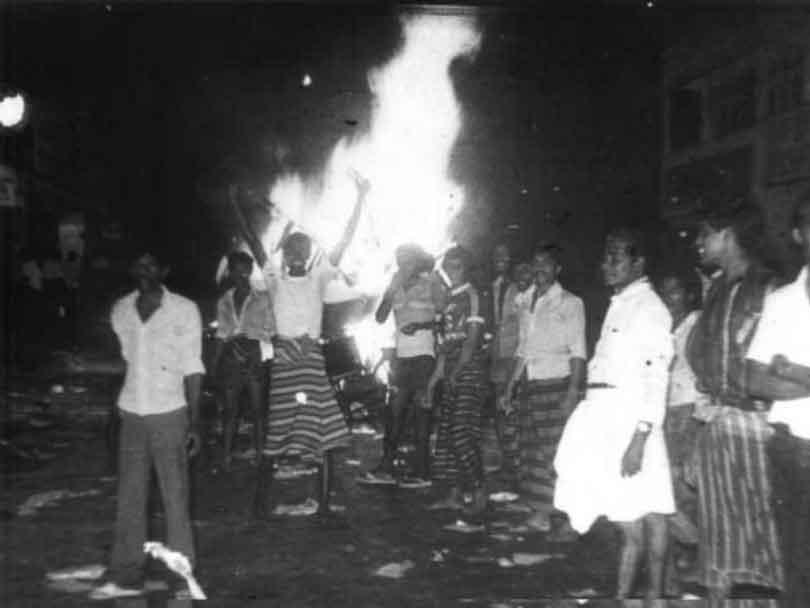
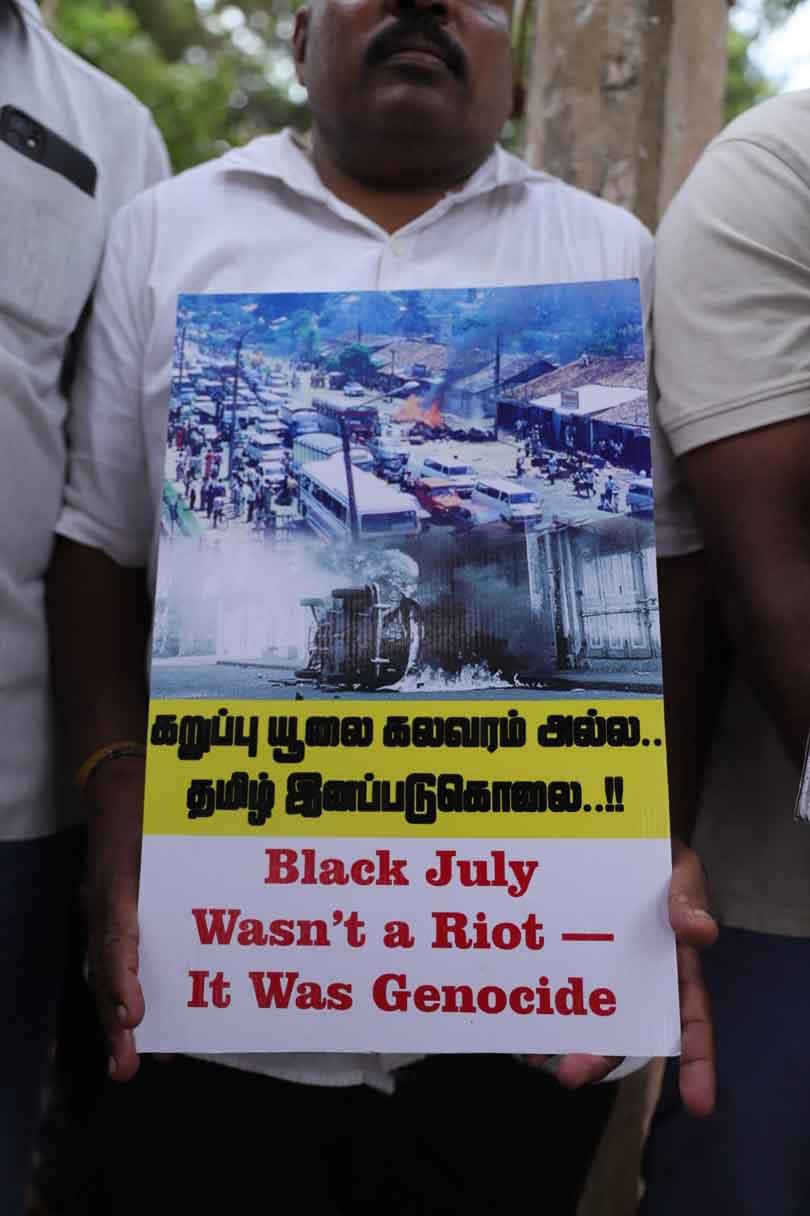
The first framing starts with "who started it," because that framing is doing work. It lets a country begin the story on 23rd July 1983 with a Tamil Tiger ambush that killed thirteen soldiers in Jaffna, as though that single act arrived out of nowhere and everything after it was reaction rather than a plan already in motion. The Sinhala Only Act of 1956 had already told an entire community its language did not matter in its own country. The 1958 riots had already shown what Sinhalese mobs would do to Tamil neighbors with state security standing by. The standardization policy in university admissions through the 1970s had already told Tamil youth that merit would not save them either.
The 1977 riots had already rehearsed the exact choreography that would play out again in 1983, mobs, lists, look the other way policing. None of these excuses an ambush. But none of it supports the idea that Black July was a spontaneous outburst of "racial tension" either. Survivor testimony has been consistent for over forty years that mobs moved through Colombo and beyond with electoral registers and business directories in hand, identifying Tamil homes and shops with a precision that spontaneous rage does not produce.
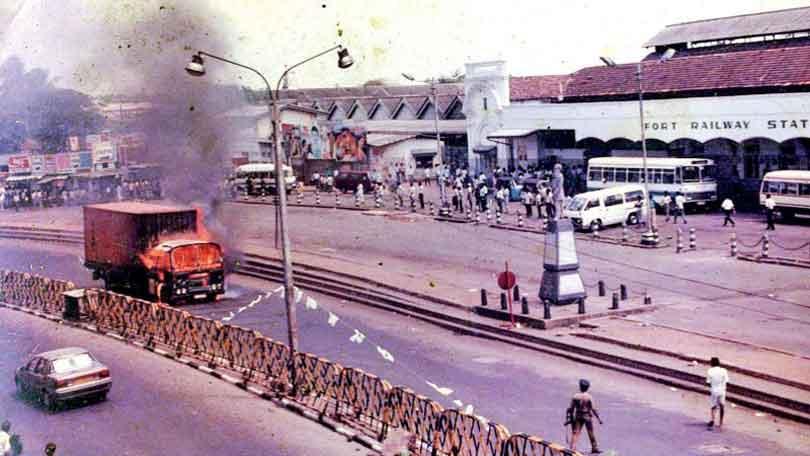
Thousands of Tamil owned shops and homes were burned across Colombo and beyond, entire streets of businesses that families had built over generations gone in days. Tens of thousands of people were displaced inside the country, and tens of thousands more left Sri Lanka entirely, some of them for good, seeding the diaspora communities in Toronto, London, and Chennai that still carry this history forward because their own country made it impossible to stay. That exodus is not a footnote. It reshaped who gets to call themselves Sri Lankan from a safe distance and who had no distance to retreat to at all. It also fed the war that followed for the next twenty-six years directly, because a generation of young Tamils who watched their neighbors burn their houses down while the police looked away did not conclude that the state could be reasoned with. They concluded the opposite, and the LTTE grew accordingly. You cannot tell this story honestly and leave out that the violence of 1983 manufactured the very insurgency the state would then spend decades using to justify further violence against Tamil civilians. Inside all of that violence sits an episode that somehow gets even less airtime than the rest.
The Welikada Prison massacre
On 25th July, thirty-five Tamil political prisoners held in the Chapel Ward of Welikada Prison in Colombo were pulled from their cells and beaten to death by Sinhalese inmates, inside a high security facility, under the supposed custody of the state. Two days later, on 27th July, eighteen more were killed the same way. Fifty-three Tamil prisoners, murdered inside a prison, with cell doors reportedly left open on purpose and prison authorities either complicit or conveniently absent. Two of the men killed, Kuttimani and Jegan, had their eyes gouged out before they died. This did not happen in a dark alley during a chaotic night of mob violence outside. This happened inside a state institution, with state employees present. And to this day, no one has been convicted for it. The 2001 Truth Commission called it one of the most agonizing moments in the country's collective memory and then the case closed the way every other case closes here, the state settling civil claims from relatives quietly, without ever admitting liability, without a single prosecution.
Dealing with Black July
Nothing, for eighteen years. Then in 2001, a Presidential Truth Commission was finally appointed to look into the ethnic violence between 1981 and 1984. Eighteen years is not a delay, it is a decision. And when the commission did arrive, it came with no power to investigate anyone, no power to prosecute anyone, its job capped at identifying grievances and recommending compensation.
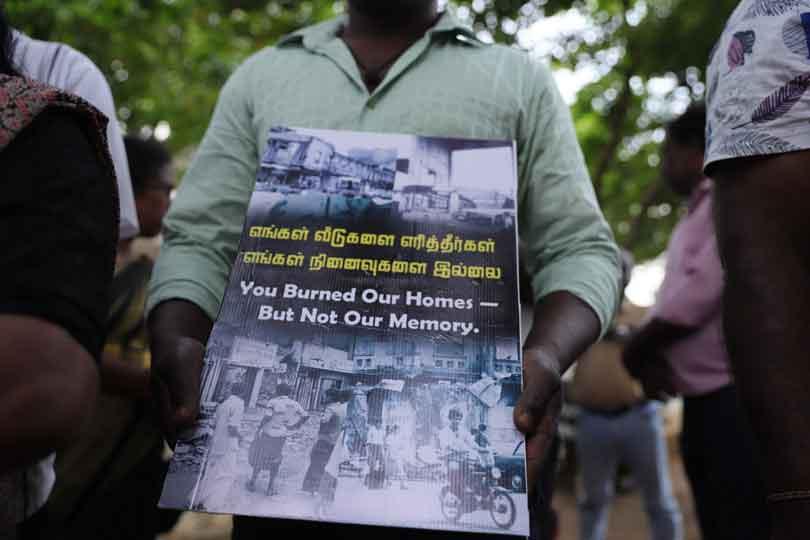
Compensation eventually reached about thirty families, at an average of roughly 77,000 rupees a person. That number should sit uncomfortably with you. It is not a number that reflects a burned home, a disappeared brother, a raped daughter, a life rebuilt from nothing in a foreign country because your own no longer wanted you alive in it.
No one has ever been convicted for organizing or directing the violence of July 1983. Not a single person, not for the streets, not for Welikada, not for any of it. President Kumaratunga's 2004 apology likened it to Nazism and still nothing followed, no prosecutions, no structural reckoning. This year, forty-three years on, there has been no official commemoration and no apology at all. When the international community has offered to step in where the domestic system clearly will not, Sri Lanka has said no. It has resisted international judges, resisted hybrid courts, and insisted every single time that this stays domestic, even after the UN's own human rights office found the domestic legal framework inadequate to handle crimes at this scale. How is that sovereignty?
The Pattern
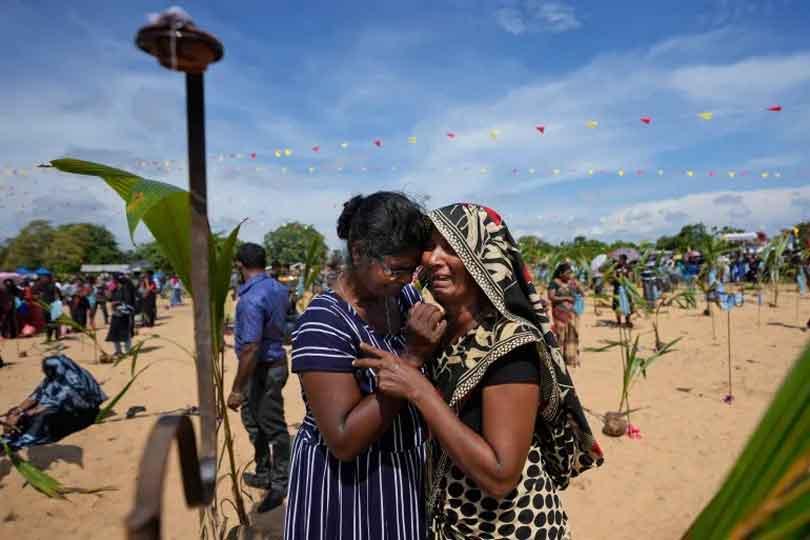
Sri Lanka has one of the highest numbers of enforced disappearances in the world, tens of thousands of cases, most of them Tamil. In 2017, women led families of the disappeared began sitting by the roadside in Kilinochchi demanding to know what happened to their sons and husbands. That protest spread to Vavuniya, Trincomalee, Mullaitivu, Maruthankerny. The Vavuniya vigil alone has now run for over three thousand two hundred days. Over four hundred parents have died during these protests without ever learning what happened to their children. The Office on Missing Persons, set up in 2017 specifically to answer these families, has resolved almost none of their cases, and rights groups say families are instead pressured to accept compensation payments that quietly close their files instead of investigating them.
The Chemmani Excavations
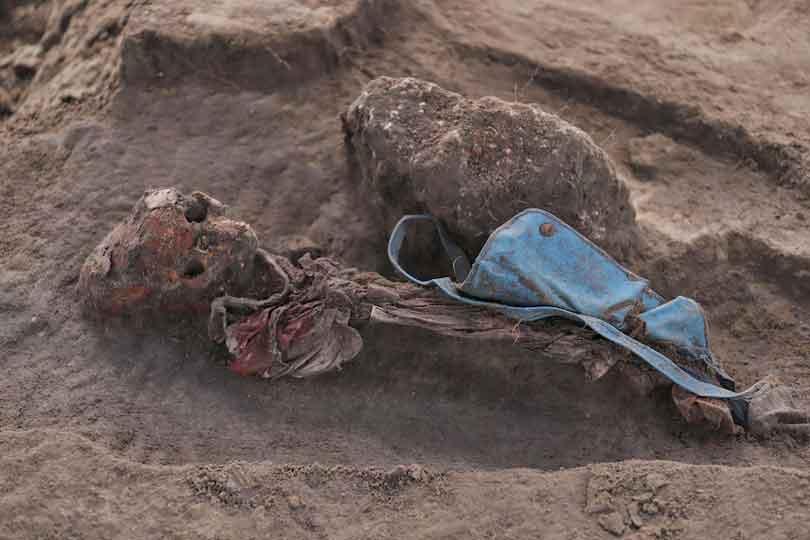
At Chemmani in Jaffna, court ordered excavation has been ongoing since 2025, and the number of skeletal remains recovered has climbed past four hundred, including infants and small children found still with their toys and their schoolbags. Families are being asked to identify their disappeared from belongings pulled out of the ground, decades after they last saw them alive. A journalist who has been documenting the excavation daily was pulled in for nearly seven hours of questioning by the Counter Terrorism Investigation Division, for the act of showing the public what was being dug up. Members of the US Congress have called for an international probe. The Sri Lankan government's response has largely been to manage the optics of a visiting minister rather than open the kind of independent investigation the scale of this discovery demands.
So no, the debate was never actually a debate. A debate implies two sides building toward some kind of resolution.
What we have had instead is one side, the state, refusing every single mechanism that could ever hold it accountable, whether that mechanism is a war crimes tribunal, an Office on Missing Persons with actual teeth, or a poem in an O/L anthology, and calling that refusal reconciliation. Commissions with no prosecutorial power are not reconciliation. An apology with no prosecution behind it is not reconciliation. Removing a poem from a syllabus because it makes children ask why it is not reconciliation, it is propaganda.
The Propaganda
President Anura Kumara Dissanayake's government came into power promising a clean break from decades of corruption and impunity, promising accountability as its entire brand. Forty-three years to the day since Black July began, that government issued no official statement, no commemoration, no apology, nothing. Commentators have pointed out, fairly, that this government bears no personal responsibility for what the Jayewardene administration did in 1983. But every government that continues to hold this office inherits the responsibility to say, at minimum, that it happened and that the state was at fault. Meanwhile foreign governments with no historical stake in this at all, Canada among them, have issued formal statements marking the anniversary in years past, naming the violence for what it was. It says something uncomfortable about a country when the clearest official acknowledgment of its own atrocity comes from somebody else's parliament instead of its own.
I still don't have an answer for what replaced that poem in my students' textbooks. I don't think it matters. What matters is that a country will teach a child which king dug which reservoir a thousand years ago, and call that history, while making sure the same child graduates without ever being told why their neighbors' grandparents don't talk about what exactly happened in July 1983. That is not an accident of curriculum design but exactly how a state keeps a monopoly on its own impunity, one syllabus revision at a time, one generation at a time, until "we live in a peaceful Sri Lanka now" stops sounding naive and starts sounding like the intended outcome.
It isn't peace. It is a country that has spent forty-three years getting very good at making sure nobody, not a mob leader, not a prison official, not a commander, not a minister, ever has to answer for anything. And every family still sitting by a roadside with a photograph in their hands knows that better than any commission ever will.