Sexualizing Women is NOT Buzz Marketing Strategy.

By: Nuha Faiz
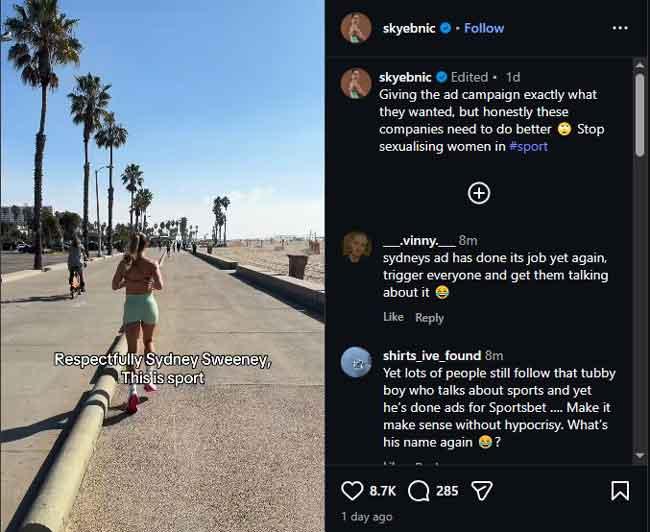
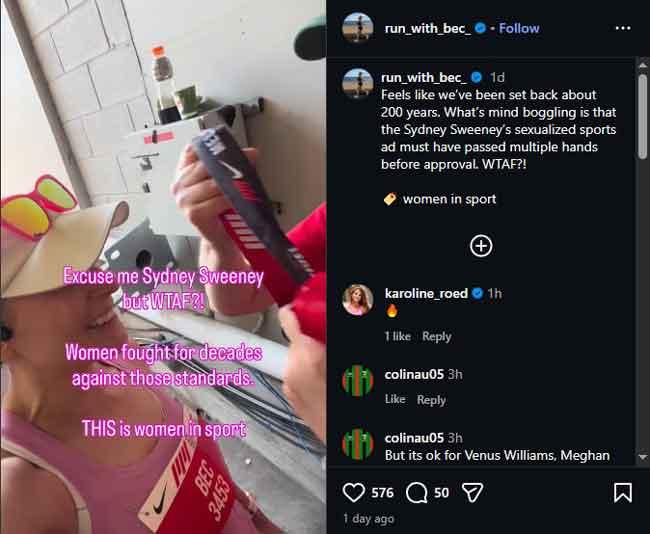
You all saw Sydney Sweeney is on all fours in a Novig ad, naked, balancing a basketball on her back and a tennis ball on her foot. The tagline says, "Just Sports." The subtext says something else entirely. This is not new or shocking anymore. What is shocking is that in 2026, after every panel, every diversity pledge, every "femvertising" campaign brands rolled out over the last decade to prove they had evolved, this is still the easiest sell in the room. A naked woman. A product barely visible behind her.
Years ago, at a travel company, a manager told me flatly that no one clicks on anything that isn't a half dressed or naked woman. And the frustrating part is that he wasn't entirely wrong about the data, because the industry has spent decades training audiences to respond to exactly that stimulus, then pointing at the resulting numbers as proof the strategy works. It is a closed loop. You build the appetite, then you cite the appetite as justification for feeding it more.
That is the actual scandal buried inside the Novig campaign. Not only that Sydney Sweeney chose to do it, because she is a grown woman, an equity holder in the company now, and entitled to make business decisions about her own image and body. The scandal is that an entire sports trading platform, trying to establish credibility in a crowded prediction market space, looked at every possible creative direction and landed on a naked woman covered in balls as the smartest move available. Out of every tool in modern marketing, that was the one picked. Not clever copywriting. Not a genuinely differentiated product story. Not an appeal to the actual sports fans this platform claims to serve.
The Buzz Marketing Strategy
In marketing language, this is strategic. Disruption. Cultural conversation. Earned media. Thumb-stopping content. Strip away the vocabulary and what remains is a much simpler confession: we could not think of anything else that would make people look, so we used a body instead. Buzz marketing works precisely because it requires no creative labour beyond finding someone willing to take their clothes off on camera. It does not need a clever insight about the audience. It does not need craft. It needs controversy, and controversy is cheap to manufacture when you are willing to sexualize a woman to get it.
Sweeney's own history makes this pattern impossible to ignore. The American Eagle "great jeans" campaign leaned on a wordplay so thin it only worked because of who was wearing the jeans, not what was written about them. Before that, her Syrn lingerie brand. Now Novig. This is not a series of unrelated creative choices from an actress exploring different brand partnerships. This is a formula, repeated because it keeps generating headlines, and headlines get mistaken for success in an industry that increasingly cannot tell the difference between attention and impact.
Attention is not the same thing as trust or brand equity. A campaign that gets people talking is not automatically a campaign that gets people buying, or believing, or coming back. Novig wants to be taken seriously as a sports trading platform, an alternative to Polymarket and other prediction markets, built specifically for people who actually understand sports. Yet the launch campaign undermines that exact positioning by treating a female body as the product's real spectacle. You cannot simultaneously claim you built something for serious sports fans and open with an ad that female athletes and Olympians are publicly furious about, calling it precisely the reason women in sports are not taken seriously. That is a contradiction the marketing team either did not notice or did not care about.

Who This Actually Serves
Every time one of these campaigns lands, the same defence appears. She chose this. She is empowered. It is her body, her decision, her business partnership. All of that can be true and it still does not answer the actual question, which is why this remains the default creative direction across an entire industry, decade after decade, brand after brand, regardless of what the product is. Sports betting apps, jeans, fragrance, cars, even financial services have all reached for the same lever. It is not that individual women are wrong to make individual choices about their own image. It is that the industry has built an entire creative economy around one narrow answer to the question of how to get attention, and that answer almost always involves a woman's body being the spectacle rather than the product.
Ask yourself honestly how many campaigns you have seen this year that used a shirtless, sexualized man the exact same way, marketed toward a general audience, generating the exact same cultural conversation. They exist, but they are the exception, treated as a novelty or a joke, not the default creative playbook reached for by every category from beer to banking apps. That asymmetry is the actual data point worth sitting with. It tells you whose body the industry has decided is expendable for a click, and whose body still requires more than a well-lit photo shoot to be worth advertising around.
The women who work in sports, the athletes speaking out against the Novig ad, are not being prudish or missing the joke. They are pointing at a much more specific harm. Every time a campaign like this dominates the sports conversation, it reinforces exactly the framing that women in sports have spent decades trying to dismantle, the idea that a woman's value in that space is measured by how she looks rather than what she knows or does. A female sports trading platform ambassador covered in balls does not read as playful to someone who has spent her career trying to be taken seriously as an athlete or analyst. It reads as regression wearing a marketing budget.
What Digital Marketing Has Actually Become
Digital marketing today runs almost entirely on a metrics culture that rewards volume of reaction over quality of connection. Engagement rate. Impressions. Share of voice. Every platform algorithm rewards content that stops the scroll, and nothing stops a scroll faster or more reliably than a sexualized image, so the algorithm and the shock strategy have essentially merged into a single feedback loop. Brands are not choosing controversy because they believe in the message. They are choosing it because the platforms they depend on for visibility are mathematically biased toward rewarding exactly this kind of content, and marketers are graded on numbers that do not distinguish between a person who clicked because they were genuinely interested and a person who clicked because a body was on display.
This is the part that should worry anyone who cares about where the profession is heading. We have built an entire generation of marketing strategy around what generates a reaction rather than what builds actual brand value over time. Short term spikes in engagement get presented in decks as proof of success, while the harder, slower work of building genuine trust, product understanding, and customer loyalty gets deprioritized because it does not produce a viral screenshot. A campaign can be simultaneously a PR disaster and a commercial win by the industry's own broken scoreboard, because negative attention still counts as attention in a system that cannot tell the difference.
I have sat through enough strategy meetings to know that when a creative team is out of ideas, sexualized imagery becomes the fallback, the thing that always tests well in isolation even when it damages the brand in the long run. It is the marketing equivalent of a jump scare. Effective in the moment, forgettable afterward, and increasingly it is the only tool some teams reach for because it is the one tool guaranteed to produce a measurable spike by Monday's report.

Where This Leaves Us
I do not think campaigns like this stop until brands feel actual financial consequences for choosing shock over substance, and right now the industry has not built the incentive structure to make that happen. Backlash generates its own engagement, which the algorithm rewards just as generously as praise, so even the criticism ends up functioning as free promotion. That is the trap. There is no clean way to punish a brand for sexualized marketing through outrage alone, because outrage is exactly what the strategy was designed to harvest in the first place. What might actually shift this is marketers themselves refusing to default to this playbook, refusing to accept the excuse that nothing else will get clicks, and refusing to let lazy creative thinking hide behind the language of empowerment or disruption. It requires people inside these rooms saying what needs to be said when a manager insists nothing sells without a half-dressed woman attached to it. That claim is not proof of consumer behavior. It is proof of a creative team that stopped trying decades ago and never had a reason to start again, because nobody in the room was willing to say no.