Is Shariah Being Misunderstood? An Appeal to Release Sivarasa Anojan.

By: Nuha Faiz
I know there are some of you who will comment under posts appealing for Anojan's release that the death sentence is the right decision, correctly made by the Saudi government. Some of you may even bristle at a Muslim woman questioning Shariah. Let me be clear before you ask: this article does not question Shariah. It questions those in power today who are misunderstanding and misusing it. Islam has been widely misunderstood, not because the religion preaches extremism, but because the people in charge pick selectively from Qur'anic verses and prophetic teachings and reinterpret them to serve their own ends. That is exactly what this article condemns, and it is why I am demanding the release of Sivarasa Anojan.
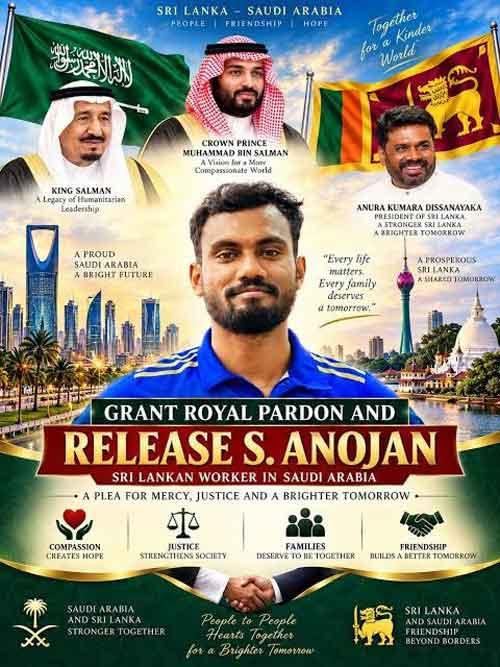
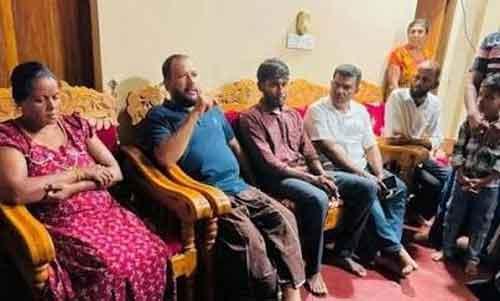
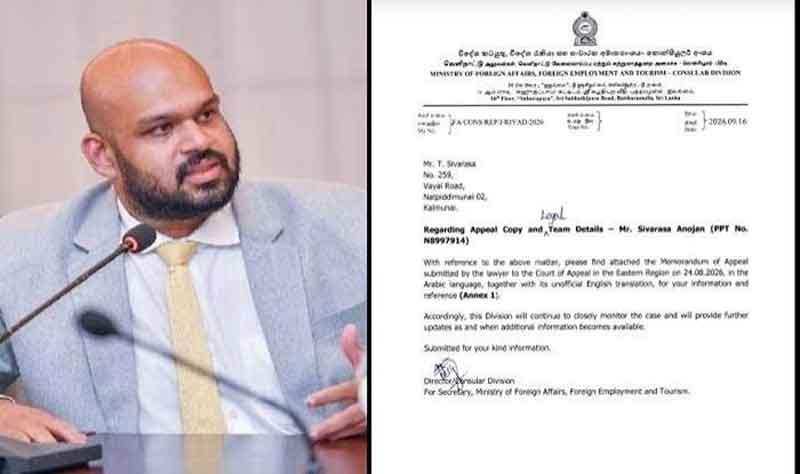
Now, for context, Sivarasa Anojan is a young Tamil man from Natpiddimunai in Kalmunai, Ampara District, who travelled to Saudi Arabia nine months ago for work. In July 2026, the Criminal Court in Al-Ahsa convicted him on two counts arising from a Facebook exchange, verbally insulting the Prophet Muhammad, and a related charge tied to religiously offensive content. He was sentenced to five years in prison and fined three million Saudi riyals, roughly 800,000 dollars, an amount his family could never realistically raise. Deputy Foreign Affairs Minister Arun Hemachandra intervened to help arrange legal representation, and Anojan's lawyer filed an appeal in late August, seeking a reduction of the sentence. On September 17, the appellate court reportedly increased it to death.
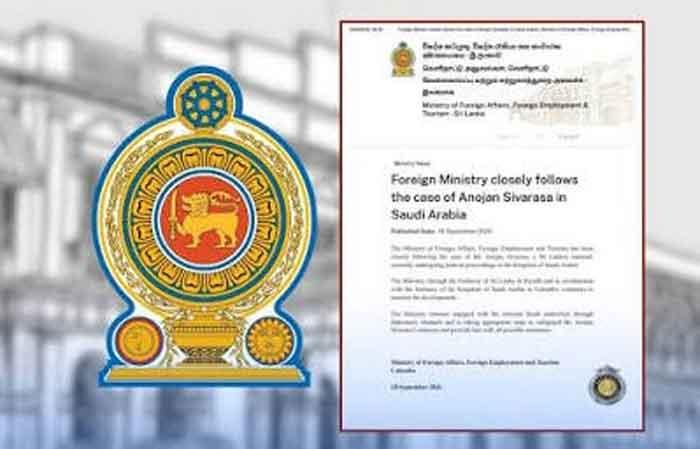
I want to be exact about what is confirmed and what is not, because a case like this deserves precision, not outrage alone. Sri Lanka's Ministry of Foreign Affairs has still not officially confirmed a death sentence. What exists, as of this writing, is the account of the lawyer present in that courtroom, relayed verbally to the Sri Lankan Embassy in Riyadh, which now awaits the formal written judgment. If the reports are confirmed, two judicial safeguards remain. The sentence must be affirmed unanimously by a five-judge appellate panel, then again by a five-judge Supreme Court panel, and even then, it can only proceed after the king personally ratifies it by royal order. Anojan's embassy has roughly a one-month window to bring the case before the Supreme Court. I am writing before that window closes.
Two wrongs, and neither of them warrants a life
This case did not begin near a mosque or in a theological argument. It began with a dog.
During this year's Pada Yatra, the Hindu pilgrimage to Kataragama, a stray that had walked hundreds of kilometres alongside the pilgrims became a small local celebrity in Kalmunai. Devotees had named him Subramaniam. A video showing a young Muslim man kicking the dog spread online and provoked genuine anger in the community. He was arrested and later released on bail. What followed was an ugly, multi-sided social media fight between people from different religious communities, the kind that spirals faster than anyone involved can control once it starts.
Somewhere inside that fight, Anojan posted a comment about the Prophet that Saudi authorities have treated as blasphemy. Reports indicate he deleted the post and apologised publicly once the anger it caused became clear to him.
I will not pretend either young man acted well. The one who assaulted a defenceless animal was wrong and rightly faced arrest and consequences for it. Anojan, in the heat of an argument he did not start, said something about a figure sacred to over a billion people that he should not have said, and it caused real hurt to people who hold the Prophet dear. Both men made a mistake born of anger, not premeditation, not an organised campaign of hatred against a faith. That distinction matters. An impulsive comment made in anger, later deleted and apologised for, cannot be measured on the same scale as a deliberate, sustained assault on a religion. A death sentence does not fit what actually happened here. Nothing in this sequence, a dog, a video, a flame war between neighbours, justifies ending a young man's life.

What will the Prophet Muhammad have done in this case?
This is the part that troubles me most as a Muslim, because the sentence against Anojan is being carried out in the name of a man whose own recorded conduct, when he was personally wronged far more severely than this, was mercy, again and again, even when he held total power to do otherwise.
When Muhammad, peace be upon him, preached in Ta'if, the townspeople set children and vagrants on him, who stoned him until his sandals filled with blood. It is recorded in Sahih al-Bukhari, hadith 3231, and Sahih Muslim, hadith 1795, both considered the two most authenticated hadith collections in Islam, that the angel of the mountains came to him afterward and offered to crush the town between two mountains if he wished it. He refused, saying he hoped God would bring believers from among their descendants instead. He had every justification for retribution against the people who had physically attacked him, and he chose mercy instead of vengeance.
Years later, when a pagan poet named Ka'b ibn Zuhayr composed verses mocking and insulting the Prophet directly, a sentence of death was pronounced against him. This episode is recorded in the classical Sirah literature and in Ibn Hajar al-Asqalani's al-Isaba. When Ka'b later travelled to Medina, repented, and recited a poem in the Prophet's presence expressing his remorse, the very poem now known as the first Qasidat al-Burda, the Prophet did not have the earlier sentence carried out. He forgave him completely and, in a gesture of extraordinary honour, removed his own cloak and placed it on Ka'b's shoulders. A man who had insulted him in verse, under sentence of death for it, was pardoned the moment he showed genuine remorse. This is, as far as a case can be, almost a mirror of what Anojan has already done: he deleted his comment and apologised.
Then there is the conquest of Mecca itself, eight years after Ta'if. Muhammad returned to the city that had tortured his companions, besieged his clan into starvation, and killed and mutilated the body of his beloved uncle Hamza. He had complete power over the people gathered before him. He asked them what they expected of him.
When they answered that they hoped for his generosity, he answered in words that echo Prophet Yusuf's own act of forgiveness in the Quran, there is no blame upon you today, go, you are free, a phrase understood by scholars to directly echo Surah Yusuf, verse 92. Among those pardoned that day were Abu Sufyan, who had led three separate armies against him, Wahshi ibn Harb, the man who had killed his uncle Hamza, Ikrimah ibn Abi Jahl, son of his fiercest enemy, and Safwan ibn Umayyah, who had personally offered money to have him assassinated. Hind bint Utbah, who had commissioned Hamza's killing, pledged her allegiance that same day and was accepted into the fold, unpunished.
None of this is a fringe or revisionist reading. It sits at the very centre of how the Prophet's character has been taught for fourteen centuries. The Quran itself instructs this conduct directly, not as an aspiration but as a command. In Surah Fussilat, it says, repel evil with what is better, and the one between you and whom there was enmity will become like a close friend, verse 34. In Surah Ash-Shura, among the qualities it names for true believers, those who avoid major sins and immoralities, and when they are angry, they forgive, verse 37.
A man stoned until he bled chose not to have his attackers crushed by mountains when God offered him the power to do so. A poet under a death sentence for openly insulting him was pardoned and honoured the moment he repented. A man whose uncle was killed and mutilated chose to pardon the people responsible when he held their lives entirely in his hands. Measured against that standard set by the Prophet himself, a death sentence for an angry comment, posted in the middle of an unrelated online dispute and then deleted, followed by a public apology, is not proportionate to anything he modelled. It is a contradiction of the very example it claims to be defending.
Where Shariah is being misapplied
Like I had mentioned at the opening of my article, I am not arguing that Shariah as a legal tradition is without value, or that insulting the Prophet is a trivial matter to Muslims. It is not, and Anojan's words caused genuine pain to people who hold him dear. But there is a real difference between Shariah as a centuries-old body of jurisprudence, built through debate among scholars and differing schools of thought over generations, and Shariah as it is sometimes applied today, as a blunt instrument against foreign workers who have no fluency in the legal language of the court, no financial means to mount a defence, and no diplomatic weight behind them.
Reporting on the Al-Ahsa judgment indicates that the specific charge of verbally insulting the Prophet, as distinct from apostasy, carries no fixed, written penalty under the law the court itself cited. Where the law is silent, what fills that silence is judicial discretion, and discretion applied to the most powerless person in the room tends to produce the harshest outcome, not the most considered one. A punishment invented in a gap in the law is not Shariah. It is what happens when institutional power meets someone with no capacity to push back, and Anojan, a migrant labourer nine months into a job in a foreign country, had none.
He is also not an isolated case. Saudi Arabia's record on blasphemy and apostasy charges includes other names that never fully left the shadows, among them a teenager sentenced to death decades ago for a remark deemed blasphemous, and a foreign television psychic sentenced to death for sorcery after a secret hearing with no legal counsel present. The pattern repeats. The accused are almost always outsiders in some way, foreign, poor, from a minority community, with the least capacity to defend themselves against a system stacked far above them.
The Appeal
Sivarasa Anojan should be released and returned to his family in Kalmunai. Not because what he said was right, it was no. But because the faith in whose name this sentence is being carried out was built by a Prophet who, when he was mocked, stoned, and bereaved by the very people standing before him, chose mercy every single time he held the power to choose otherwise. A state that invokes his name and then abandons his example is not protecting Islam from insult. It is misrepresenting it to the entire world watching this case unfold.
Sri Lankans across the political spectrum have said as much since the reported sentence. Former Foreign Minister Ali Sabry has called a death sentence for an offensive comment grossly disproportionate and inhumane and has urged Saudi authorities to show mercy. Opposition MPs including Mano Ganesan and Shanakiyan Rasamanickam have pressed the government to escalate the case diplomatically. Parliamentarian Faizer Mustapha has said plainly that Sri Lanka must not lose another citizen this way. That this appeal comes from Sinhala, Tamil, and Muslim voices alike says something about who we actually are to each other here.
Sri Lanka is a country that has lived, imperfectly but persistently, with its Tamil, Sinhala, Christian, Muslim and other communities bound to the same soil for generations. Ampara District, where Anojan's family is waiting for news, they pray will never come, is itself one of the most religiously mixed places in the country. This case began with a Hindu pilgrimage and a Muslim man's anger at an assault on a dog the pilgrims had come to love. It should never have become a referendum on one young Tamil man's life. I appeal to Saudi authorities, ahead of the Supreme Court review, to look again at what their own Prophet did when he held the power to destroy the people who had wronged him far more gravely than this, and to show that same mercy now. Let Anojan come home.