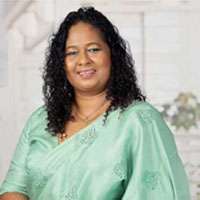
Debbie Edirisinghe: The Woman Behind the Mission
 HER STORY, HER STRENGTH. BY: DR. SULOCHANA SEGERA
Some stories of leadership begin with ambition, carefully drawn plans and a clear destination. Debbie Edirisinghe’s story began somewhere much simpler: with compassion. Long before Child Action Lanka became an organisation reaching vulnerable children, women and families across Sri Lanka, there was a young girl who noticed suffering and instinctively wanted to respond. That instinct has remained at the heart of Debbie’s life. As a woman of faith, a mother, social entrepreneur, humanitarian and lifelong learner, she has spent years turning compassion into meaningful action. Her journey has not been about having every answer or achieving a perfect balance between family, work and purpose. It has been about finding a rhythm, remaining curious, persevering through uncertainty and believing deeply in the value and potential of every human being. In Her Story, Her Strength, Debbie reflects on the experiences that shaped her and the lessons she continues to learn.
Debbie, before we speak about Child Action Lanka, tell us about Debbie the woman. What shaped you into the person and leader you are today?
First and foremost, I am a woman of faith, a mother, and someone who has always believed that every person has value and potential. Those parts of my identity have shaped everything else in my life. My journey has included both struggles and blessings, and I think we need both to grow. From an early age, I became aware of social inequalities and the difficulties experienced by vulnerable communities. Seeing those realities created a deep sense of compassion in me and made me question why some people had opportunities while others had so few. Life itself became a teacher. Success taught me gratitude and responsibility, while failure taught me resilience and humility. Difficult seasons taught me patience. The people I encountered taught me that leadership is ultimately about service. I am still learning and evolving. I do not see leadership as arriving at a destination. For me, it is about continually becoming more aware, more compassionate and more capable of serving others well.
You have built an impressive professional journey, but where did your passion for helping others begin? Was it something you discovered early in life?
I believe it began very early. I was always drawn to situations where someone was struggling and needed support. I remember being only seven or eight years old and going on holiday with my parents. I saw a little girl working in someone’s home. I did not know her or the family, but something about her situation deeply saddened me. In my little mind, I decided she needed my sweater more than I did, so I gave it to her. There were other moments too. My best friend and I noticed parents at church struggling when their babies cried during services. Although we were still children ourselves, we decided to create a little creche and look after the babies. Looking back, I think I was always searching for an answer. I wanted to know what could be done when something was not right. As I grew older, I realised compassion alone was not enough. Sustainable change requires commitment, action and solutions that address the deeper causes of vulnerability. What began as a simple desire to help eventually became a lifelong commitment to community development and empowering children and families.
When you look back at your journey from 2006 to today, what has been the greatest transformation, not only in Child Action Lanka, but in yourself?
Perhaps the greatest transformation has been moving from being someone who simply wanted to help into someone who understood the importance of building systems, teams and partnerships capable of creating lasting impact. Child Action Lanka began in a small room caring for eight street connected children. Today, its work reaches thousands of children and women across Sri Lanka. The scale has changed enormously, but what matters most is our ability to serve people in ways that are sustainable and empowering. Personally, I still describe myself as a work in progress. I would like to think I have grown, maybe even a little, in patience, confidence and leadership. I have learned that meaningful change rarely happens quickly. It requires persistence. You need to keep showing up, particularly when progress feels slow. I have also learned that leadership is not about doing everything yourself. It is about building people, creating opportunities and trusting others to carry the vision forward.
You have combined social development, entrepreneurship, humanitarian work and academic achievement. What continues to drive you to keep learning and evolving?
I believe learning is a lifelong responsibility. Communities change, challenges evolve and the solutions that worked yesterday may not necessarily work tomorrow. If we want to remain effective, we have to continue growing. I am naturally curious. When something crosses my mind, I immediately want to understand why it happens, how it works and what can be done about it. That curiosity leads me into research, analysis and constant questioning. My motivation is ultimately about serving people better. I want to understand complex social problems and explore innovative ways of addressing them. Education and experience are valuable only when they help us create stronger solutions and leave a better foundation for the generations that follow.
How do you think Sri Lankan society views women who choose social entrepreneurship as their professional path?
I think perceptions are improving, although we still have a long way to go. Social entrepreneurship itself is sometimes misunderstood. Traditional business success can be easier to recognise because there are familiar measures such as profit and growth. Social impact is more complex. Its success can be seen in transformed lives, stronger families, improved communities and opportunities created over many years. More women are demonstrating that social enterprises can combine sustainability with genuine community transformation. Women are building organisations, creating livelihoods and addressing problems that might otherwise remain overlooked. As these stories become more visible, I believe society will increasingly recognise the contribution women social entrepreneurs make, not only economically but socially.
Do you believe women social entrepreneurs receive the same recognition, credibility and opportunities as men? Why or why not?
Not always. Progress has certainly been made, but women can still find themselves working harder to establish credibility or gain access to certain opportunities. Unconscious biases around leadership, authority and decision making continue to exist. Sometimes women have to demonstrate their capability repeatedly before receiving the same confidence that might be given more readily to others.
At the same time, women bring tremendous strengths into leadership. Empathy, resilience, collaboration and the ability to understand different perspectives can be incredibly powerful in social entrepreneurship. I believe change will continue as more women succeed, become visible and intentionally create opportunities for other women. Progress becomes stronger when women do not simply enter spaces themselves but help widen those spaces for those coming behind them.
What happens when a woman becomes more visible, ambitious or influential? Do other women automatically support her, or can women sometimes become each other’s greatest critics?
Both realities exist. I have encountered women who are extraordinary supporters, encouragers and mentors. I have also seen situations where success creates insecurity, criticism or competition. Perhaps much of this comes down to confidence and how we see ourselves. A confident woman does not need to feel threatened by another strong woman. Someone else succeeding does not diminish our own value or possibilities. I believe we need to move away from competition and towards collaboration. When women genuinely celebrate each other, share opportunities, mentor one another and create space for others to grow, everyone benefits. True leadership is not about standing above people. It is about lifting others as you rise and understanding that another woman’s strength does not take anything away from your own.
How did you balance motherhood, family responsibilities and the demands of building an organisation from the ground up?
At some point, I stopped searching for balance because trying to achieve it was becoming stressful. Instead, I started searching for rhythm. That rhythm was sometimes messy, but it kept me sane. I remember having my newborn baby in a Moses basket at the office. I remember my amazing mother-in-law sitting outside an examination hall so that between papers I could quickly come out and breastfeed my baby. I remember work coming home with me because trying to completely separate work and family sometimes felt as though it was tearing me apart. So, I stopped expecting everything to fit perfectly into separate boxes. As long as I could find a rhythm that kept things moving, I felt we could manage. At least, I hope we all survived it reasonably well. Motherhood and leadership were never about doing everything perfectly. They were about making choices, setting priorities and understanding that different seasons require different things from us. My family has been an extraordinary source of encouragement and support throughout that journey.
What concerns you most about the future of vulnerable children and families in Sri Lanka?
Economic pressure is a major concern, particularly because it connects with so many other challenges. Growing inequality, difficulties accessing quality education and increasing mental health needs can place enormous pressure on vulnerable households. When families are continually struggling simply to survive, children can lose opportunities that should be fundamental to their development. My hope is that we build stronger communities in which children are protected and families are empowered rather than becoming permanently dependent on assistance. We need environments where people have genuine opportunities to develop their abilities, support themselves and participate fully in society. Every child deserves more than survival. Children deserve safety, education, dignity, opportunity and the freedom to imagine a future beyond the circumstances into which they were born.
What do you hope another woman reading Her Story, Her Strength will take away from your journey, not just about leadership, but about finding the courage to create change?
I hope she understands that creating change does not require having all the answers before you begin. It starts with taking one step. We sometimes imagine that courageous people are fearless, but I do not think courage means living without fear. Courage is choosing to act even when fear is present. It is believing that something matters enough to try, even when you cannot see exactly where the journey will lead. Every woman has unique gifts, experiences and perspectives. Never underestimate the impact of your voice, your vision or your willingness to serve. You do not need to become someone else before you can contribute. Start with what is in your hands, what you understand and what matters deeply to you. There will be difficult seasons. There will be mistakes, uncertainty and moments when you question yourself. Keep learning. Keep asking questions. Keep growing. Most importantly, remember that leadership is not measured simply by how far you rise. It can also be measured by how many people are stronger because you chose to serve. Change can begin quietly. Sometimes it begins with noticing a little girl who needs a sweater, caring for a crying baby, asking why something is unfair, or refusing to walk past a problem because it seems too difficult to solve. You may not know where that first act of compassion will lead. Take the first step anyway.