Abdul El-Sayed, the Man Who Told America to Call Him Senator
- “JD, habibi!” Two Arabic words, delivered with a mischievous smile, brought an already jubilant audience to its feet.
- Yet the most revealing moment came earlier, when he introduced himself with unmistakable pride. "My name is Abdulrahman Mohamed El-Sayed."
From the son of Egyptian immigrants to the first Muslim elected to the United States Senate, the extraordinary story of a doctor, political rebel and a new voice in American democracy.
THE NIGHT ABDULRAHMAN MADE HISTORY
“JD, habibi!” Two Arabic words, delivered with a mischievous smile, brought an already jubilant audience to its feet. It was election night in Michigan, 3rd of November 2026, and Abdul El-Sayed had just achieved something once considered almost unimaginable. The Egyptian-American physician and progressive Democrat had become the first Muslim elected to the United States Senate. His playful greeting was directed at Vice President JD Vance, who had fiercely opposed his candidacy. Habibi, an Arabic expression of affection meaning dear friend or beloved, became the unlikely catchphrase of a remarkable political victory. El-Sayed reminded Vance that he would be constitutionally required to administer his oath of office in January 2027. Then came another message, this time for President Donald Trump, who had repeatedly mocked his name. The president, he suggested, could simply call him senator. Yet the most revealing moment came earlier, when he introduced himself with unmistakable pride. “My name is Abdulrahman Mohamed El-Sayed.” It was a declaration of identity as much as a political introduction. His full name, his Muslim faith and his Egyptian ancestry were not details to conceal. They were part of the story he wanted America to hear.
AN EGYPTIAN FAMILY AND AN AMERICAN CHILDHOOD
Born on the 31st of October 1984 in Michigan, Abdulrahman Mohamed El-Sayed grew up between two cultural worlds. His father, Mohamed El-Sayed, had emigrated from Alexandria, Egypt, seeking academic opportunity and greater political freedom. An engineer and university professor, he pursued doctoral studies at Wayne State University in Detroit. His biological mother, Fatten Elkomy, also came from Egypt. His parents separated during his early childhood, and Abdulrahman was principally raised by his father and American stepmother, Jacqueline, known as Jackie. This unusual family combination helped shape his understanding of America. His father brought memories of political repression in Egypt, while his stepmother connected him to a family with roots stretching back to America's revolutionary period. Visits to Alexandria exposed the young Abdulrahman to poverty and inequality. His grandmother reminded him that his greatest advantage over his Egyptian cousins was the opportunity to return to America. Back in Michigan, life was not always comfortable. Following the September 11 attacks, he encountered anti-Muslim prejudice, including racial insults during school sporting competitions. Rather than abandon his identity, he developed the confidence to defend it.
THE ATHLETE WHO BECAME A RHODES SCHOLAR
El-Sayed was not simply an academically gifted student. At high school, he excelled in football, wrestling and lacrosse, combining intellectual curiosity with competitive athleticism. At the University of Michigan, he studied biology and political science, graduating with distinction in 2007. His academic achievements earned him a prestigious Rhodes Scholarship to the University of Oxford, where he completed a doctorate in public health.
He subsequently attended Columbia University, receiving his medical degree in 2014. His interests increasingly centred on epidemiology, the study of disease patterns and the social conditions that influence human health. For El-Sayed, medicine was never merely about treating individual patients. He believed poverty, housing, pollution and unequal access to healthcare could determine a person's prospects long before a doctor entered the picture. This conviction would become the foundation of his political philosophy.
AN EGYPTIAN-INDIAN LOVE STORY BEHIND THE POLITICAL SPOTLIGHT
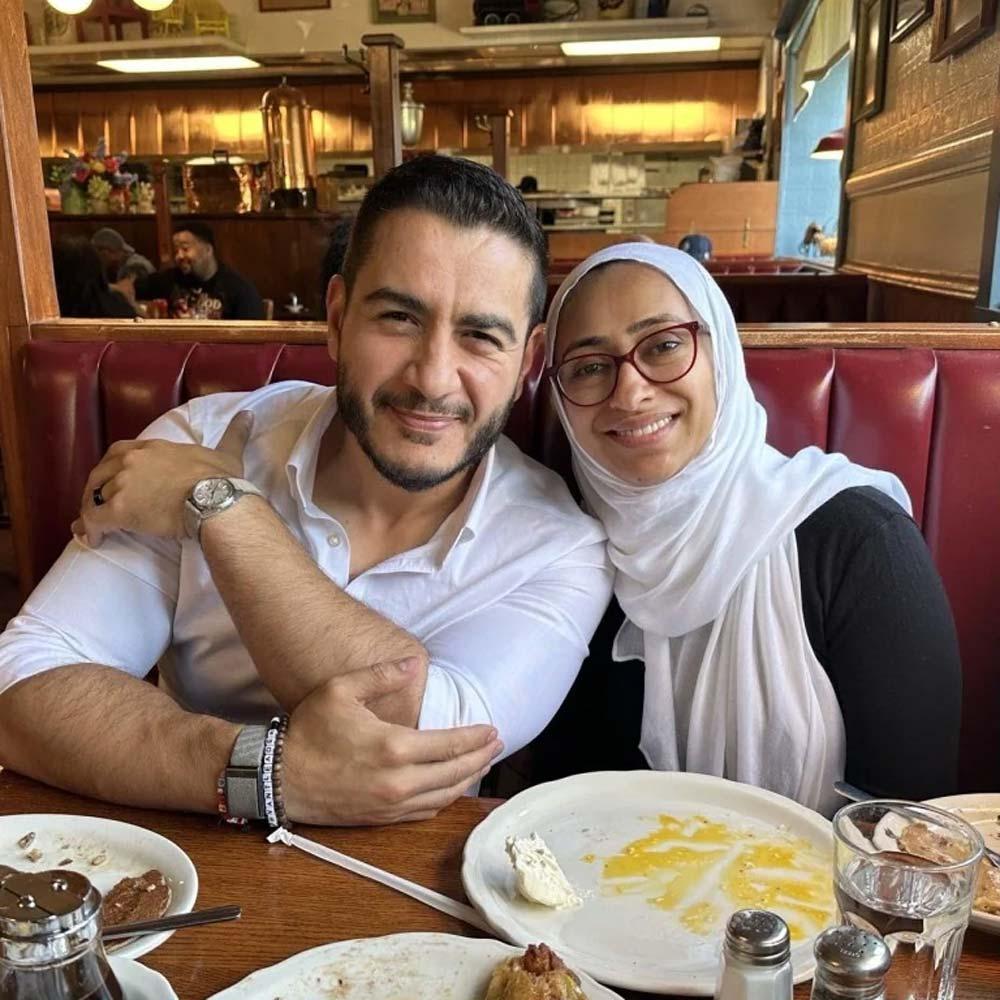
Behind Abdul El-Sayed’s political ambitions lies a family story connecting Egypt and India. While studying at the University of Michigan, he met Sarah Jukaku, an American Muslim of Indian heritage. They married in May 2006, and Sarah later became a psychiatrist. The couple live in Ann Arbor, Michigan, with their daughters, Emmalee and Serene. Sarah’s ancestral roots lie in Bhatkal, a coastal town in Karnataka, southern India. Her father, Dr Tayeb Jukaku, is a nephrologist who emigrated to America, while her grandfather, Jukaku Shamsuddin, was a prominent lawyer and former Deputy Finance Minister of Mysore State. El-Sayed often jokes about his Indian connections. Recalling an Egyptian uncle who questioned why he married an Indian woman rather than an Egyptian, he humorously pointed to India's enormous population. After two decades of marriage, he has even joked that he might be more Indian than Arab. Sarah has displayed similar humour on the campaign trail, once declaring, “Nobody tells him what to do except me!” Their marriage reflects America's multicultural character, bringing Egyptian and Indian traditions together through a shared Muslim faith. For El-Sayed, family remains central to his political convictions and hopes for future generations.
THE DOCTOR WHO WANTED TO HEAL A CITY
In 2015, Detroit Mayor Mike Duggan appointed El-Sayed executive director of the Detroit Health Department. Still in his early thirties, he became one of America's youngest major-city public health leaders. Detroit was emerging from bankruptcy, with serious challenges involving poverty, childhood health, environmental hazards and inadequate public services. El-Sayed helped rebuild public health programmes and promoted preventive healthcare. His work attracted recognition, including an environmental leadership award in 2016. Yet his administrative career also invited criticism. Opponents questioned aspects of his management and the effectiveness of particular initiatives. He later served as Wayne County's director of Health, Human and Veterans Services. Another dispute concerned his professional credentials. Although he earned a medical degree, El-Sayed did not become a licensed practising physician in Michigan. Critics questioned whether his use of the title doctor might confuse voters, while supporters emphasised his legitimate medical qualifications and public health expertise.
BERNIE SANDERS, A DEFEAT AND A POLITICAL AWAKENING
El-Sayed's first major electoral challenge came in 2018, when he sought the Democratic nomination for governor of Michigan. He campaigned on universal healthcare, environmental justice, affordable education and reducing corporate influence over politics. His energetic approach attracted endorsements from Bernie Sanders and Alexandria Ocasio-Cortez. He nevertheless lost the primary to Gretchen Whitmer. Rather than disappear from public life, he developed a national following through writing, podcasts and political commentary. His books, including Healing Politics and Medicare for All, explored the connection between health, inequality and democratic government.
His podcast, America Dissected, examined public health through a political and social lens. These ventures established him as an articulate progressive commentator and helped prepare the ground for his next campaign.
A PROGRESSIVE WHO CHALLENGES THE ESTABLISHMENT
El-Sayed's politics belong to the left of the Democratic Party, although he does not identify as a democratic socialist. He supports Medicare for All, stronger labour protections, higher taxes on concentrated wealth and reducing the influence of wealthy donors. He has advocated sweeping immigration enforcement reforms and stronger action against climate change. His central argument is that ordinary Americans are being squeezed by an economic system favouring corporations and powerful interests. During his Senate campaign, he translated this philosophy into a memorable three-part message about removing money from politics, improving household finances and guaranteeing healthcare. His supporters regard him as a politician willing to confront institutions that conventional Democrats hesitate to challenge. Critics question whether his ambitious proposals are financially practical or politically achievable.
ISRAEL, PALESTINE AND THE CONTROVERSIES
El-Sayed's views on Israel and Palestine have generated some of the fiercest opposition to his political career. He has strongly criticised Israel's military operations in Gaza, called for restrictions on American weapons assistance and argued that Palestinian civilians deserve the same rights and security as Israelis. These positions have won admiration among Palestinian-rights advocates but provoked criticism from pro-Israel organisations and some Jewish Democrats. A particularly serious controversy followed the March 2026 attack on Temple Israel synagogue in Michigan. Although El-Sayed condemned the violence, he referred to cycles of suffering and used the expression, “hurt people hurt people,” when discussing the attacker's reported personal losses. Critics argued that his words appeared to rationalise antisemitic violence. El-Sayed later apologised, acknowledging that his comments had caused pain and that the moment required an unequivocal expression of solidarity with the Jewish community. His association with left-wing streamer Hasan Piker created another controversy. Piker had made inflammatory statements about September 11, Israel and Jewish Americans. El-Sayed appeared alongside him during campaign events but subsequently distanced himself from particular remarks, insisting that Piker did not represent his campaign. Republican opponents also raised allegations involving his family's purported historical connections to the Muslim Brotherhood. Reporting examined his mother's past associations and political activities, but no credible evidence established that El-Sayed himself belonged to the organisation. He categorically denied membership. These controversies raised legitimate questions about political judgement, rhetoric and associations, while also revealing how readily religious identity can become a political weapon.
FROM INSHALLAH TO ALHAMDULILLAH
El-Sayed's 2026 Senate campaign proved that his progressive appeal extended beyond university campuses and activist circles. After defeating Congresswoman Haley Stevens in the Democratic primary, he faced Republican Mike Rogers in a bitterly contested general election. His victory on the 3rd of November made history and delivered a significant triumph for progressive Democrats. His election-night speech was carefully crafted yet strikingly personal.
Having spent the campaign saying inshallah, meaning God willing, when discussing victory, he told supporters that the moment had arrived to say alhamdulillah, praise be to God. Then came “JD, habibi,” followed by a playful reference to the rivalry between Michigan's Wolverines and Ohio State's Buckeyes. The humour travelled rapidly across social media, particularly among Arab and Muslim audiences. More importantly, his speech presented Muslim identity as an ordinary and confident part of American political life.
BEYOND THE HISTORIC FIRST
Abdul El-Sayed enters the Senate carrying enormous expectations. For many Muslim Americans, his victory represents recognition after decades of suspicion and exclusion. For progressives, it demonstrates that economic populism can succeed in a competitive state. Yet symbolism alone will not deliver affordable healthcare, higher wages or meaningful legislation. His greatest challenge will be transforming passionate speeches into practical achievements while representing constituents who disagree with him. He remains a complex figure, academically accomplished, politically ambitious, sometimes provocative and occasionally mistaken. His willingness to apologise has demonstrated an awareness of responsibility, even as his confrontational style continues to divide opinion. The boy who grew up between Alexandria and Michigan has reached one of the highest offices in American democracy. Whether he becomes an effective legislator remains to be seen. For now, the man who proudly announced himself as Abdulrahman Mohamed El-Sayed has given America a new political story, one that begins with immigrant ambition and arrives, quite memorably, at “JD, habibi.”