SINCE WHEN DO 4-YEAR-OLDS MAKE UP SEXUAL ABUSE?
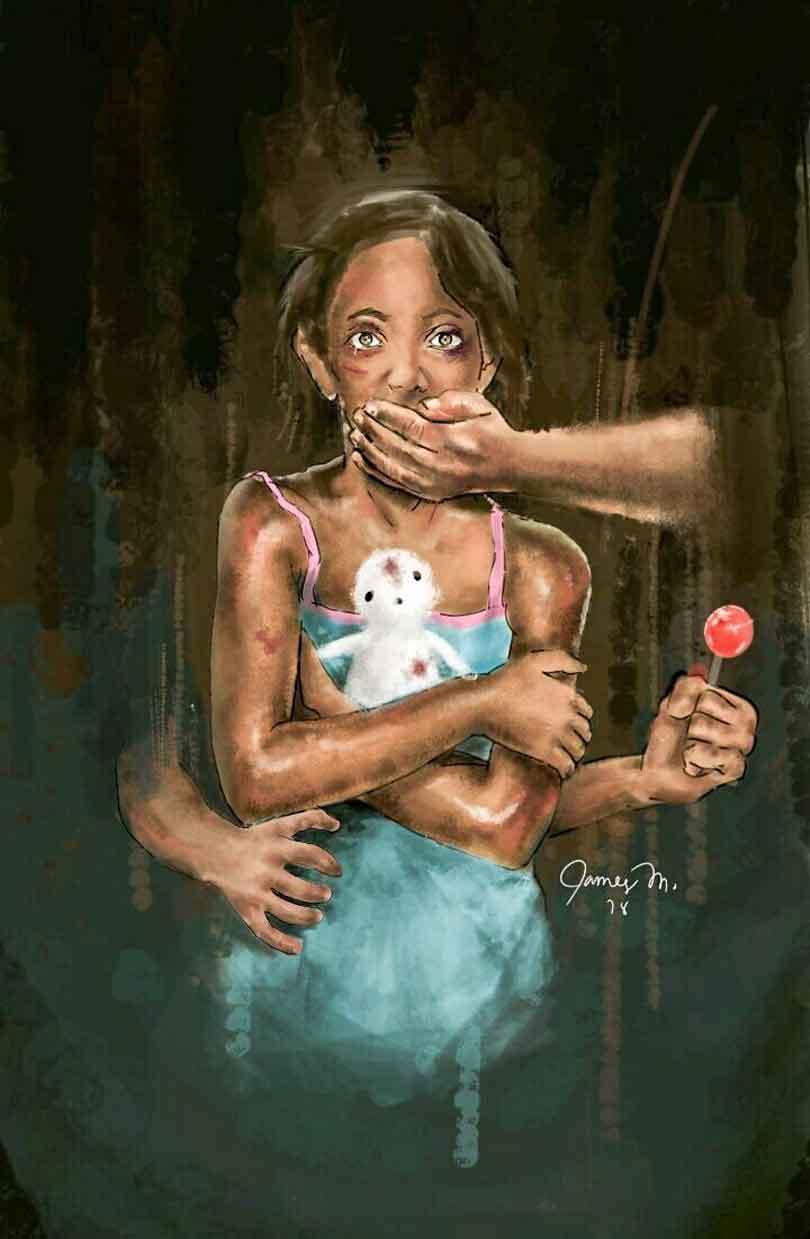
A four-year-old’s world is cartoons, snacks, a favourite cup and the fear of the dark. Where does such a child find the words, the details and the shame to describe something no small child should know exists? A child that age cannot spell “fabricate.” Yet a school that has been teaching this country’s children for 37 years now wants us to believe a little girl did exactly that.
THE INCIDENT
She had been at the preschool for three days. She spent her first day at the welcome ceremony and loved her second day so much she didn’t want to go home. On the third day, September 16th, she clung to her class teacher while she waited to be picked up. At home that afternoon, she became frightened when her mother tried to change her clothes. After a nap, she told her mother what had happened.
She climbed onto the coffee table to show how tall the man was. According to her mother, she said the school’s caretaker tickled her in the play area while the other children were in dancing class a few metres away, then took her to a “dark room.” What she later described to the National Child Protection Authority is something no adult should have to read, and no child should have to say. Her mother says she saw cracks on her daughter’s lip and a bruise on her right knee.
Sit with those details for a moment. A child showing her mother a man’s height by climbing on furniture because she has no other way to measure. A child afraid to be undressed by her own mother. This is not a four-year-old performing a story. This is a four-year-old trying to explain one.
And there is one more detail worth noticing: her mother had taught her about “good touch, bad touch” since she was two. The lesson worked. The child recognised what happened, named it, and told. Everything we ask children to do, she did. The adults are the ones who failed.
THE SCHOOL’S RESPONSE
It responded with a public letter of ‘defense’. The letter opens by assuring parents that children’s safety has always been among the school’s highest priorities. A few lines later it says: “A fabricated incident had occurred within our Montessori section on 16 September 2026.”
A fabricated incident had occurred. The school can’t decide whether something happened or not, yet it has already decided who to blame. In one sentence, an institution with no power to rule on the evidence has issued its verdict: the child invented it.
The next line promises that the “allegation by a parent will be taken up seriously.” Which is it? You can’t call something fabricated and promise to take it seriously in the same breath. One of those statements is public relations, and parents can tell which.
The letter then offers the accused man’s record as if it settles the matter: more than 27 years at the school, “with no complaints.” It mentions, almost as reassurance, that he has been released on bail. Bail is not innocence. It is a routine procedural step while a case is pending, and every lawyer who signed off on this letter knows that. Mentioning it in a letter about a child’s “fabricated” claim has one obvious purpose: to suggest the court is on the school’s side. It isn’t. The court hasn’t decided anything yet.
Then the letter introduces the school’s senior counsel by name and title. A school writing to frightened parents about the possible sexual abuse of a four-year-old chose to make its lawyer part of the message. That tells you who the letter was really written for.
WHO EXACTLY IS THE SCHOOL PROTECTING?
In a conversation with the media portal, which first reported this case, the school’s head of operations went further than the letter did. He said the school was cooperating with the authorities but had “doubts” about the allegations. He also said the school’s own lawyers are representing the accused caretaker. A school whose letter claims it is cooperating “without any undue influence” is, by its own staff’s account, providing the legal defence for the man accused of abusing a child in its care. The child is in its care too or was. She has no lawyer from the school. He does.
Asked why this mattered so much, he explained: “There’s a problem for the school as our name is involved.” That’s the most honest line in the whole affair. Not the child. The name. He also had said he wished the parents had come to him first instead of going to the NCPA, even though, by his own account, the school’s official policy when the director receives a complaint is to inform the police. If the school would have gone to the police anyway, why does it matter that the parents went first? What would have been different if the school had heard it before the authorities did? Every parent in this country should think hard about that question, because the answer says everything about what “handling it internally” means.
THE TEACHER, THE STATEMENT AND THE RECORD BOOK
This case is not only about one man. It’s also about how a four-year-old disappeared on her third day of school without anyone noticing. Her mother alleges the class teacher didn’t notice her missing from dance class. When the teacher found her and the child said a man had done “bad touch,” the mother says the teacher hugged her, told her not to go outside, and said nothing at pickup. The school denies the child complained to the teacher. But the authorities heard something different. An NCPA official, speaking anonymously, said its officers learned from the teacher’s own statement that she hadn’t been paying attention when the child went missing, and said the school must hold an inquiry into the failure in its duty of care.
The school’s response was not to announce that inquiry. Instead, its head of operations claimed the teacher had “mistakenly” told the NCPA the child went missing outside the classroom that Wednesday, and that her record book showed outdoor time only happened on Thursday. He said the teacher was suddenly called in and questioned, that the mistake happened then, and that she later wanted to change her statement, but the NCPA refused.
So, the official account is this: a teacher with more than a decade at the school made a statement to child protection officers, and afterwards the school says she wanted to take it back, with the school’s paperwork now offered to contradict her. Who did that teacher speak to between giving her statement and wanting to change it? And where is the inquiry into supervision that the NCPA says the school owes? The school’s letter to parents doesn’t mention the teacher at all.
THE LAW ALREADY SPEAKS. IS ANYONE LISTENING?
People like to say Sri Lanka lacks laws. In this case, the law is clearer than the school’s letter.
Section 286C of the Penal Code requires anyone in charge of premises who knows those premises are being used to abuse a child to inform the police. A school that would rather parents “come to us first” should read it carefully.

The offence itself is no minor matter. As one Sri Lankan attorney recently noted, when an adult over 18 commits such an act against a child under 16, the mandatory sentence is 10 to 20 years in prison. Since 1999, the law has also allowed a child’s recorded interview to be used as evidence, precisely so a small child doesn’t have to repeat the worst moment of her life in a courtroom full of strangers.
The case is now before the Colombo Chief Magistrate’s Court. If it goes the way serious child abuse cases usually go here, it will eventually move to the High Court, and from there into the long wait every Sri Lankan lawyer knows. Consider one case that did finish. A tuition master in Embilipitiya was convicted of grave sexual abuse of a 10-year-old boy. He was sentenced on May 20, 2022, to 12 years’ rigorous imprisonment for offences committed between April 2010 and January 2011. More than a decade passed between the crime and the verdict.
Apply that timeline here. A child who is four today could be a teenager before any verdict. Through all those years, a school letter calling her account “fabricated” will stay in screenshots and group chats, waiting for her to find it.
So, the questions are not complicated. Was this child interviewed once, properly, by someone trained to speak to a four-year-old, and will that recording be used as the law allows? Will this case be heard in months or in years? Is anyone in authority troubled that a school publicly called a child’s account fabricated while a criminal case is open and a key staff witness is said to be trying to change her statement? Has the Ministry of Education, which oversees schools, looked at any of this? These questions decide whether our child protection laws mean anything at all.
THE ROLE OF SEX EDUCATION
One mother, teaching her toddler the difference between good touch and bad touch from the age of two, did more to protect that child than an institution with 37 years of history and a senior counsel on call.
Yet every time someone proposes proper sex education in Sri Lankan schools, a predictable chorus says it’s against our culture, that it will corrupt children, that it’s a Western import. Which part of our culture says a four-year-old should not have the words to report abuse?
Age-appropriate body safety and sex education doesn’t teach small children about sex. It teaches them the correct names for their body parts, so their report can’t be dismissed as “confused” or “fabricated.” It teaches the difference between safe and unsafe touch, that secrets about touching are never okay, and which adults to tell. As children grow, it teaches consent, boundaries, how grooming works and where to get help.
TO THE SCHOOL
You had a choice. You could have written: a serious allegation has been made, the staff member has been removed from all contact with children, we are cooperating fully with the police and the NCPA, and we are reviewing how a child in our care went unsupervised. That would have cost you nothing that matters. Instead, you called a four-year-old’s account fabricated, placed your lawyers behind the accused, and told the press your concern was your name. That choice will follow your name far longer than any trophy, scholarship or famous alumnus. Your history is long and your reputation is grand. Neither one is worth a single child.
TO EVERY PARENT
Stand by your children. Tell them that if someone ever touches them in a way that feels wrong, it isn’t their fault. Telling is not tattling. Telling is brave. If the first adult doesn’t listen, they should tell another and keep telling until someone does. Teach them the names of their body parts. Teach them who they can go to. Then, when they come to you, believe them, and go to the authorities, not to the institution that has every reason to protect itself. In Sri Lanka, you can call 1929, the National Child Protection Authority’s child helpline. A four-year-old was brave enough to speak. The least the rest of us can do is make sure that bravery isn’t wasted.