Stronger Boundaries or an Autoimmune Disease?

By Thaliba Cader
Every day, thousands of women walk into clinical settings carrying an invisible, crushing weight. They present with a constellation of debilitating symptoms: severe joint pain, profound exhaustion, unexplained skin rashes, chronic brain fog, and erratic heart rates. Yet, remarkably often, they walk out holding nothing but a handful of dismissive platitudes. “It’s just stress,” they are told. “You are probably just anxious.” “Have you considered that you might be exaggerating your pain?”
For centuries, the medical establishment has relied on these blanket statements to explain away the complexities of the female body. Historically, these symptoms were neatly filed away under the catch-all diagnosis of “hysteria,” a word derived from the Greek hystera, meaning uterus. The ancient Greeks believed the uterus was a wandering, erratic organ capable of disrupting a woman’s entire mental and physical stability. Though Sigmund Freud and modern psychoanalysis later shifted the blame from the uterus to the mind, the fundamental premise remained unchanged: if a woman is sick in a way that is difficult to diagnose, the problem must be entirely in her head.
Emerging research in psychoneuroimmunology reveals that these illnesses are not imagined. They are tangible, biological consequences of prolonged emotional suppression, systemic gender biases, and an overtaxed nervous system. For the archetype of the people-pleasing eldest daughter, the woman conditioned to prioritize everyone else’s needs above her own, the body eventually pays the bill for the boundaries her mouth was never allowed to set.
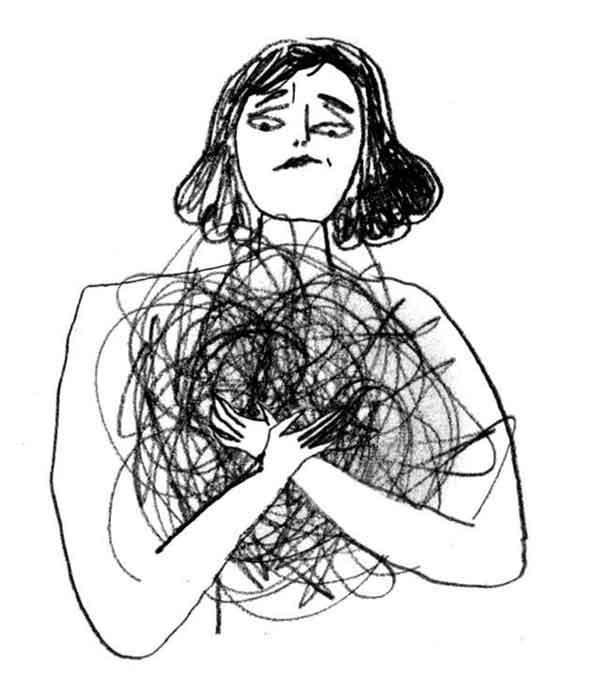
The relationship between personal boundaries and chronic illness is not just a psychological metaphor; it is a literal blueprint for how the body maintains its physical integrity. The primary function of the human immune system is to act as a highly sophisticated molecular border-control network, constantly determining what is "self" and what is "other." When a woman spends a lifetime erasing her personal boundaries, self-silencing, and absorbing the emotional labor of those around her, she blurs this distinction on a psychological level. Over decades of chronic hyper-vigilance, this psychological blurring translates into a biological crisis, desensitizing the nervous system and confusing the immune system until it loses its ability to discriminate perfectly. Because the mouth was never allowed to say "no," the immune system attempts to establish a boundary the only way it knows how: by misidentifying the body's own tissues as a threat and turning inward.
Choosing to implement thick boundaries is therefore not a moral failing or an act of cruelty, but a radical and lifesaving medical necessity. It requires a woman to dismantle the deeply entrenched conditioning that ties her worth to self-sacrifice and instead accept the social penalty of prioritizing her own physical and spiritual well-being. Practicing this shift means refusing to regulate the emotions of others, rejecting unreciprocated demands, and treating "no" as a complete and non-negotiable sentence.
While setting these boundaries will initially trigger an intense wave of guilt because the overtaxed nervous system has been trained to find safety in people-pleasing, it is the only way to send a biological safety signal to the body. Every time a woman stops shrinking and starts protecting her peace, she lowers systemic inflammation, calms her nervous system, and gives her immune system permission to stand down. If she does not actively choose to build these thick boundaries with her actions, her body will eventually step in and build them for her by forcing a complete physical shutdown.

The Genetic Loaded Gun and the Double X Chromosome
To understand why the chronic illness epidemic targets women so aggressively, one must first look at human genetics. The biological blueprint of a woman includes two X chromosomes. While the Y chromosome carries relatively little genetic material, the X chromosome is a powerhouse, containing roughly 800 to 900 protein-coding genes. Crucially, a significant percentage of these genes are responsible for regulating and executing immune responses.
This genetic architecture gives women a distinct evolutionary benefit: an incredibly robust, highly reactive immune system. Women generally fight off infectious diseases, bacterial invasions, and viral pathogens much faster and more efficiently than men. However, this evolutionary advantage carries a devastating structural drawback. Because the female immune response is so powerful, it is also uniquely prone to dysregulation. When the dial of the immune system is permanently turned up, the likelihood that it will malfunction increases exponentially.
This genetic predisposition explains why nearly 80 percent of all autoimmune disease occurrences are documented in women. In specific conditions, the divide is even more stark. Women make up roughly 90 percent of all lupus cases. Similarly, Postural Orthostatic Tachycardia Syndrome, a disorder of the autonomic nervous system that leaves patients dizzy and fatigued, affects a population that is nearly 80 percent female. Mast Cell Activation Syndrome, which causes the immune system to launch severe, allergic-type overreactions to ordinary environmental stimuli, shows a female dominance ranging from 65 to 91 percent.
When this hyper-reactive genetic framework interacts with chronic, unremitting stress, the immune system loses its capacity to discriminate perfectly. It stops defending the self and begins attacking the self.
The Hormonal Master Dial
The structural vulnerability of the double X chromosome does not exist in a vacuum; it is continuously modulated by a fluctuating hormonal landscape. The endocrine system acts as a massive amplifier, taking the baseline reactivity of the female immune system and scaling it up or down depending on life stages and stress levels.
Estrogen
Estrogen is a potent immune stimulant. It actively enhances antibody production and boosts the body's natural defense mechanisms. While this helps women ward off acute infections, it also acts as the primary fuel for autoimmune inflammation and symptom flares. This is precisely why systemic lupus erythematosus is vastly more common and significantly more severe in women of reproductive age, coinciding with the years when estrogen levels are at their absolute peak.
Progesterone
Conversely, progesterone acts as the body's natural immune-calming agent. During pregnancy, progesterone rises dramatically to suppress the maternal immune system, preventing it from identifying and rejecting the fetus as a foreign invader. However, immediately after childbirth, progesterone levels drop off a cliff. This sudden hormonal vacuum frequently triggers massive postpartum autoimmune flares or marks the exact onset of a lifelong chronic illness.
Cortisol
Cortisol, the primary stress hormone, is designed to be a short-term savior. In acute moments of danger, cortisol floods the bloodstream alongside adrenaline, sharpening focus, raising blood sugar for quick energy, and temporarily suppressing non-essential immune functions so the body can survive an immediate threat. But when a woman lives in a state of persistent, long-term stress, this mechanism breaks down. Chronic high levels of cortisol eventually cause the body's glucocorticoid receptors to desensitize. The immune system becomes blind to the hormone's regulatory signals, resulting in widespread, systemic inflammation rather than immune suppression.
Prolactin
Prolactin, a hormone that rises significantly during both psychological stress and the postpartum lactation period, further complicates this matrix. Prolactin directly stimulates the immune system, and its elevation is closely linked to a heightened risk of developing rheumatoid arthritis and lupus.
When these four hormonal forces interact with an overactivated nervous system, the physical tissues of the body become the ultimate battlefield. In rheumatoid arthritis, the immune cells mistakenly attack the delicate synovial lining of the joints, causing swelling and stiffness. In psoriasis and vitiligo, the target is the skin cells and pigment-producing cells. In Hashimoto’s thyroiditis or Graves’ disease, antibodies relentlessly assault the thyroid gland. In type 1 diabetes, the immune system destroys the insulin-producing beta cells of the pancreas. In multiple sclerosis, it ravages the myelin sheath protecting the nerves. In Sjögren’s syndrome, it targets the salivary and tear glands, while in lupus, it wages a systemic war against the blood vessels, kidneys, brain, and heart.
The Gender-Pain Gap and Medical Gaslighting
Despite the rigorous biological evidence mapping this feedback loop, women seeking treatment must fight through a deeply entrenched cultural and clinical bias. The road to medical dismissal begins long before a physician even enters the examination room.
According to a report published in the Proceedings of the National Academy of Sciences, there is a pervasive "gender-pain exaggeration bias" embedded in modern healthcare. The study detailed that women consistently wait longer than men in emergency rooms to be evaluated for identical symptoms. More alarmingly, a woman’s reported pain is systematically perceived by healthcare providers as less intense than a man’s. Even if a woman and a man both rate their pain as an eight out of ten, the woman’s score is routinely judged to be lower, driven by the lingering historical belief that women are naturally more dramatic, emotional, or easily overwhelmed.
For those navigating the labyrinth of autoimmune disorders and illnesses like endometriosis, the timeline to an accurate diagnosis is notoriously long. Historically, clinical trials and basic medical research have used male biology as the universal default. It was only in recent decades that the National Institutes of Health mandated adequate representation of women and minority groups in clinical trials. Because diagnostic criteria were built around how symptoms manifest in male bodies, women take significantly longer to receive a formal diagnosis, even when presenting with the exact same disease markers as men.
In her memoir, The Invisible Kingdom: Reimagining Chronic Illness, author and journalist Meghan O’Rourke chronicles her harrowing, decade-long journey to secure diagnoses for three distinct chronic conditions, including autoimmune thyroiditis. O'Rourke describes an exhausting reality familiar to millions of women: being forced to become her own primary medical researcher, turning over every stone, and consulting an endless procession of specialists just to find someone who would not write her off as "normal."
The Social Phenomenon of Self-Silencing
If genetics and hormones load the gun of autoimmunity, the sociocultural expectations of womanhood pull the trigger. There is an unmistakable social phenomenon linking chronic illness to the psychological act of self-silencing, the systematic suppression of one's own anger, grief, and needs to maintain interpersonal harmony.
From early childhood, women are heavily conditioned by family dynamics, cultural traditions, and societal expectations to be the primary emotional caretakers of the world. The eldest daughter, in particular, is frequently drafted into a role of premature responsibility. She learns that her value is directly tied to her utility, her pleasantness, and her ability to absorb distress without making a scene.
But human biology is incapable of separating emotional boundaries from physical ones. When a woman spends a lifetime erasing her psychological boundaries to accommodate others, her immune system reflects that confusion. The loss of the ability to say no on an emotional level mirrors the immune system's loss of the ability to distinguish self from non-self on a cellular level.
On contemporary platforms, women dealing with the realities of POTS, fibromyalgia, and lupus have begun speaking about this connection with raw candor. A phrase currently dominating the narrative summarizes the stark reality of the situation: “You either become a devil, or you get an autoimmune disorder.” A woman’s cultural dilemma has long been structured as a choice between two paths: obey social expectations and get physically sick, or claim your autonomy and accept the social penalty of being labeled difficult.