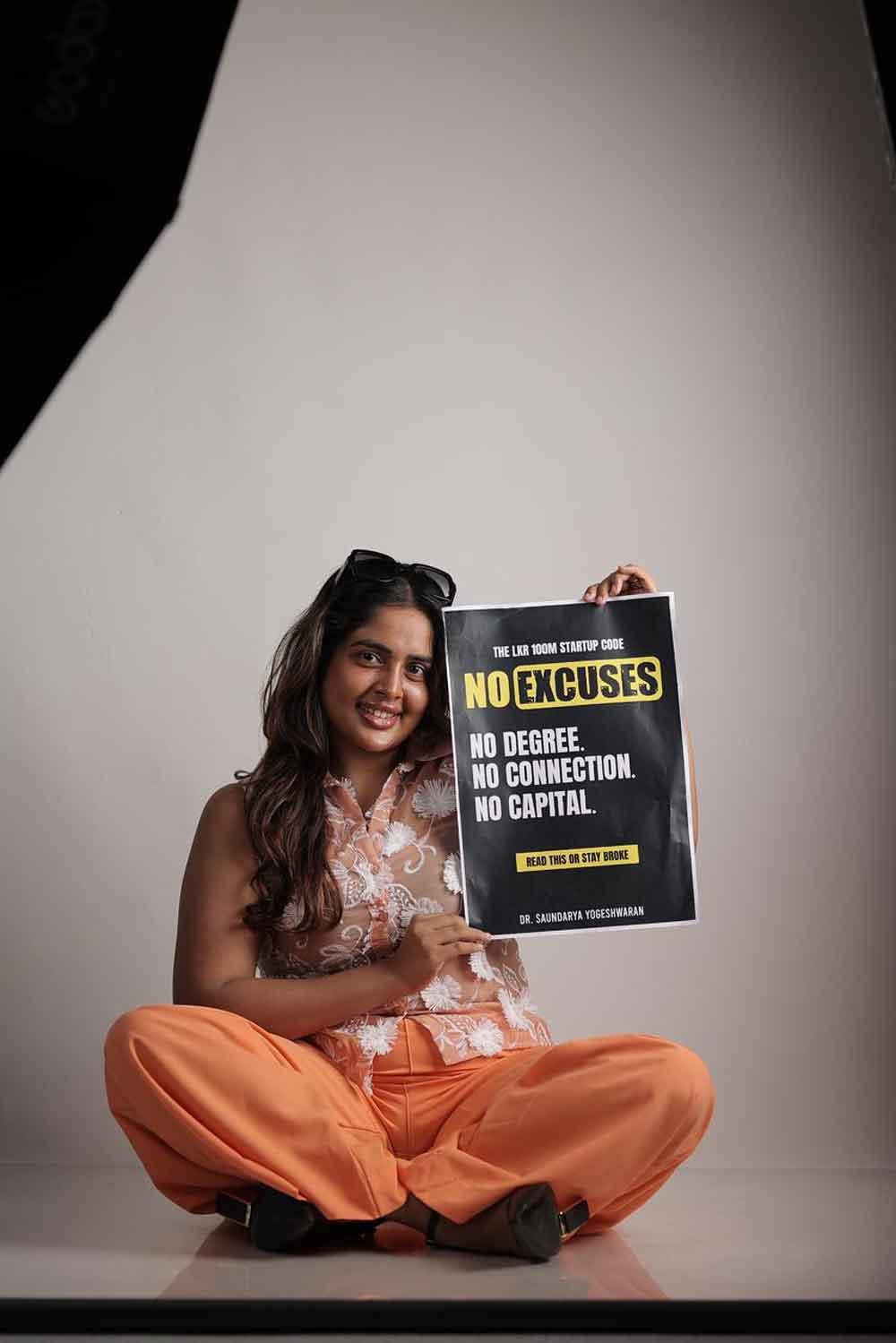
The New Currency Is Capability In Conversation with Dr. Saundarya Yogeshwaran

By Thaliba Cader
At a time when education is being reshaped by artificial intelligence, careers are becoming less linear and the meaning of financial security is changing, Dr. Saundarya Yogeshwaran is interested in a question that sits beneath all three: what makes a person capable of navigating a changing world? Her work spans education, entrepreneurship, business and personal development, but she sees these not as separate pursuits, but as different ways of examining the same thing: human potential. Through her work with Future by ITA and her broader engagement with education and entrepreneurship, Yogeshwaran argues for a shift away from an education system built primarily around qualifications and towards one that develops people who can think, adapt, create and contribute. For young people entering a world where artificial intelligence can perform tasks once considered uniquely human, that shift is becoming increasingly urgent. Yogeshwaran believes the question is no longer simply what a person has studied, but what they can do with what they know. She speaks, too, about money as a form of knowledge rather than merely a measure of success, about failure as information rather than identity, and about the danger of asking young people to discover a single lifelong “passion” before they have had the opportunity to explore the world. Ultimately, her argument is about people. Sri Lanka, she believes, must begin to see its citizens not simply as a labour force, but as human capital capable of creating value well beyond the country's borders.
1. Your work spans education, entrepreneurship, business and personal development. What is the idea that connects all of these pursuits?
For me, the common thread has always been human potential. Whether I am building a business, working in education, speaking about money or studying human behaviour, I keep coming back to the same question: how do we help a person become more capable than they were yesterday? I don't see education as something that ends when someone receives a certificate. I see it as a process of economic and personal transformation. What a person learns should translate into better decisions, better businesses, better careers and, ultimately, greater value. That is also why my work in education has increasingly moved towards human capital development. Sri Lanka doesn't simply need more qualified people. We need more people who can create measurable value, both locally and globally.
2. You have spoken about the future of education and the need to rethink how we prepare people for work. What do you believe the traditional education model gets wrong?
The traditional model was designed for a world where information was scarce, and qualifications were a useful proxy for capability.
That world is changing very quickly. Today, information is abundant. Artificial intelligence can explain almost anything, generate content and help people acquire knowledge almost instantly. So the question can no longer simply be, What did you study? The more important question is, What can you actually do with what you know? Future education has to move beyond memorizing knowledge and focus much more on capability: critical thinking, problem-solving, communication, creativity and the ability to work with technology. At Future by ITA, this is one of the ideas behind what we are building. I don't want to create another institution that simply produces certificate holders. I want to help build people who remain economically relevant in the future.
3. Artificial intelligence has created both enormous excitement and considerable anxiety. How do you see its effect on the way people work and learn?
I think both the excitement and the fear are understandable, but neither should dominate the conversation. AI is not simply another software tool. It is changing the economics of knowledge work. The people who will struggle are not necessarily those who cannot compete with AI. They are the people who don't learn how to work with it. I see AI as an augmentation layer for human intelligence. The real competitive advantage will come from people who can combine human judgement, AI capability, domain knowledge and creativity. So, I don't want young people to ask, Will AI take my job? I want them to ask, What could I accomplish if I knew how to use AI better than the person competing with me? That is a much more powerful question.
4. You have chosen entrepreneurship over a conventional career path. What has building businesses taught you about success, uncertainty and learning?
Entrepreneurship taught me that an idea is almost worthless until it survives contact with reality. You can have a beautiful business plan, a great product and enormous ambition, but the market doesn't owe you anything. The market gives you feedback, and sometimes that feedback is brutally honest. You learn, adapt, test again and keep moving. That is why I don't believe successful entrepreneurship is a straight line. It is iterative. You build. You fail. You learn. You rebuild. One of the biggest misconceptions about entrepreneurship is that successful founders simply “know” what to do. In reality, many of them are extremely good at learning faster than the environment changes. That is a capability I value enormously.
5. You often speak about money and financial intelligence. Why do you think financial education should become a bigger part of how young people are educated?
Because earning money and understanding money are two completely different capabilities. Someone can have a very good income and still make poor financial decisions. Financial intelligence is about understanding how money moves, how assets work, how businesses create value, how risk operates and how to make capital work rather than simply working for money. I also think we need to change the way we speak to young people about wealth. We shouldn't simply tell them, “Get a good job and save.”
We should teach them how economies work, how businesses work, how investments work, how technology creates new markets and how skills can become income. Money is not the ultimate purpose of life. But understanding money gives people choice, freedom and negotiating power.
6. You have experienced both success and setbacks. How has failure shaped the way you think and work?
Failure is useful only if you are intelligent enough to extract information from it. I don't romanticise failure. Failure can cost you money, time, relationships and opportunities. It can hurt. But every failure contains data. The important question is not, Why did this happen to me? It is, What is this experience teaching me about the system? That shift in thinking changed the way I operate. Instead of seeing every setback as a personal judgement, I try to treat it as information. Sometimes the business model was wrong. Sometimes the timing was wrong. Sometimes I was wrong. And sometimes the market simply told me, “Not this way.” The smartest response is not ego. It is iteration.
7. With a growing public presence comes scrutiny. How do you distinguish between criticism worth listening to and criticism that should simply be ignored?
Once you become visible, people will have opinions about you whether you invite them or not. I learned quite early that you cannot build your life around managing other people's perceptions. Of course, constructive criticism matters. I listen carefully when someone can show me something I genuinely need to improve. But criticism and truth are not automatically the same thing. Sometimes people criticise what they don't understand. Sometimes they criticise what they are uncomfortable seeing. And sometimes they are right. My responsibility is to know the difference. I don't want to be universally liked. I would rather be intellectually honest, useful and impactful.
8. What would you say to an 18-year-old who feels they need to have their entire future figured out?
I would tell them to stop believing that one decision at 18 has to determine the next 50 years of their life. Your first degree doesn't have to define your entire identity. Your first job doesn't have to be your final career. Your first business doesn't have to be your biggest business. At 18, your greatest asset is not certainty. It is optionality. Experiment. Learn technology. Build communication skills. Understand money. Meet people outside your immediate environment. Build things. Travel if you can. Read beyond your syllabus. And most importantly, learn how to learn. Because the world you will work in at 30 may be radically different from the world you are preparing for at 18.
9. Young people are often told to “follow their passion”. Do you think that remains useful advice?
Not completely. I think “follow your passion” is one of the most incomplete pieces of career advice we give young people. Passion matters, but passion alone doesn't create economic value.
You need to find the intersection between what you are interested in, what you are good at, what the world needs and what the market is willing to pay for. And sometimes passion comes after competence, not before it. You become good at something. You see the impact you can create. You receive recognition. You gain confidence. And suddenly, you become passionate about it. So, I would tell a young person: don't chase passion blindly. Build capability. Explore widely. Find problems worth solving. Passion often follows purpose and mastery.
10. Looking beyond individual careers and businesses, what do you believe Sri Lanka needs most over the next decade?
I believe Sri Lanka needs to stop thinking of its people simply as a labour force and start thinking of them as human capital. Our biggest opportunity is not only attracting foreign investment or increasing traditional exports. It is building a generation of people who can participate in the global economy from Sri Lanka and create businesses, technology, services, intellectual property and solutions that the world is willing to pay for. Imagine a Sri Lankan young person sitting in Colombo, Kandy or Jaffna, working with a company in New York, London, Dubai or Singapore, not because they left Sri Lanka, but because their capability is globally valuable. That is the future I want to contribute to. And ultimately, my ambition is bigger than building successful companies. I want to help build people who can build successful futures. Because countries don't transform themselves. People do.