From Flour to Fiction.. My Journey with a Reluctant Writer.
The most profound professional development I ever attended did not introduce a new grading app or a data tracker. It introduced me to a simple sentence that changed everything.
 "Kids do well if they can." Those words, from Dr. Ross Greene, landed in my chest and stayed there. They reframed every child I had ever struggled with. They reframed me. And then a child named Alex walked into my classroom and put that sentence to the test.
The Child Who Hated Pencils
Alex had a story before he even arrived. His previous school had introduced writing too early, at the wrong developmental age. They meant well. They wanted him to get ahead. But their good intentions had done something terrible. They had taught Alex to hate writing. Not dislike. Not resist. Hate. The mere sight of a pencil triggered a meltdown. His body remembered what his mind could not yet name: the pressure, the failure, the feeling of being asked to do something he simply could not do. By the time he came to me, the word "write" was a trigger. A worksheet was a weapon. A pencil was an enemy. My challenge was not to teach Alex to write a sentence. My challenge was to first dismantle the fear response that had shut down his learning entirely.
What Traditional Interventions Could Not Do
I tried what I knew. Gentle encouragement. Breaking tasks into smaller steps. Offering rewards. Nothing worked. The moment a pencil appeared, Alex shut down. I realised something had to change. Not Alex. Me. I paused the curriculum. I stopped asking Alex to write. Instead, I went back to research. I revisited the work of A. Jean Ayres on sensory integration and fine motor development. I reminded myself that the hand cannot do what the body cannot support. That fine motor control is built on gross motor foundations. That a child who cannot make a mark is not being stubborn. They are being blocked by something deeper.
Dr. Greene's words echoed in my mind: "Kids do well if they can." Alex was not doing well with writing. That meant something was getting in the way. My job was not to push harder. My job was to find the barrier and remove it.
The Quiet Sequence of Unlearning
I began to prepare the environment for play. Not worksheets. Not instruction. Just invitations. Quiet, pressure-free invitations to explore. Every morning, a new invitation awaited Alex. No commands. No expectations. I would simply say, "Would you like to help clean this up?" The choice was his. The pressure was gone.
One morning, I covered a table with flour. I added twigs and feathers, scattered like an invitation from another world. I did not say "write." I did not say "draw." I simply placed the materials and stepped back. Alex hesitated. I watched him from across the room, trying not to stare. His hand hovered over the flour. Then, a finger touched. Then a twig. Slowly, tentatively, he began to make sweeping marks in the flour. He was not writing. But he was making marks. Pre-writing strokes hidden as play. His muscles were remembering how to move. His brain was rebuilding pathways that fear had blocked. And he did not even know it.
From Flour to Shaving Cream to Chalk
We progressed slowly. Shaving cream on trays, swirled and smoothed and marked again. The sensory feedback was rich. The pressure was zero. Alex began to smile when he saw the morning invitation. We moved to giant chalk on the pavement. Whole-body movements that built shoulder stability. Large arcs and circles that would later become letters. His body was learning what his mind could not yet trust. Each activity strengthened his muscles and rebuilt his neural pathways. None of it looked like writing. All of it was writing preparation.
I celebrated the act of mark-making, not the product. A swipe of flour was enough. A line in shaving cream was a victory. A circle on the pavement was cause for quiet celebration. Alex did not need to know why I was smiling. He just needed to feel that trying was safe.
The Broken Crayon
After six weeks of this gentle, patient work, something happened. I had left a basket of broken crayons on the table. No invitation. No expectation. Just crayons, sitting there like ordinary objects. Alex walked past the table, stopped, and picked one up. Voluntarily. Without prompting. Without fear. I held my breath. I did not move. I did not speak. I just watched. He put the crayon to paper and made a mark. Then another. Then another. He was writing. Not letters yet. But marks. Intentional, deliberate marks. And he had chosen to make them himself.That broken crayon was not a teaching tool. It was a miracle.
The First Sentence
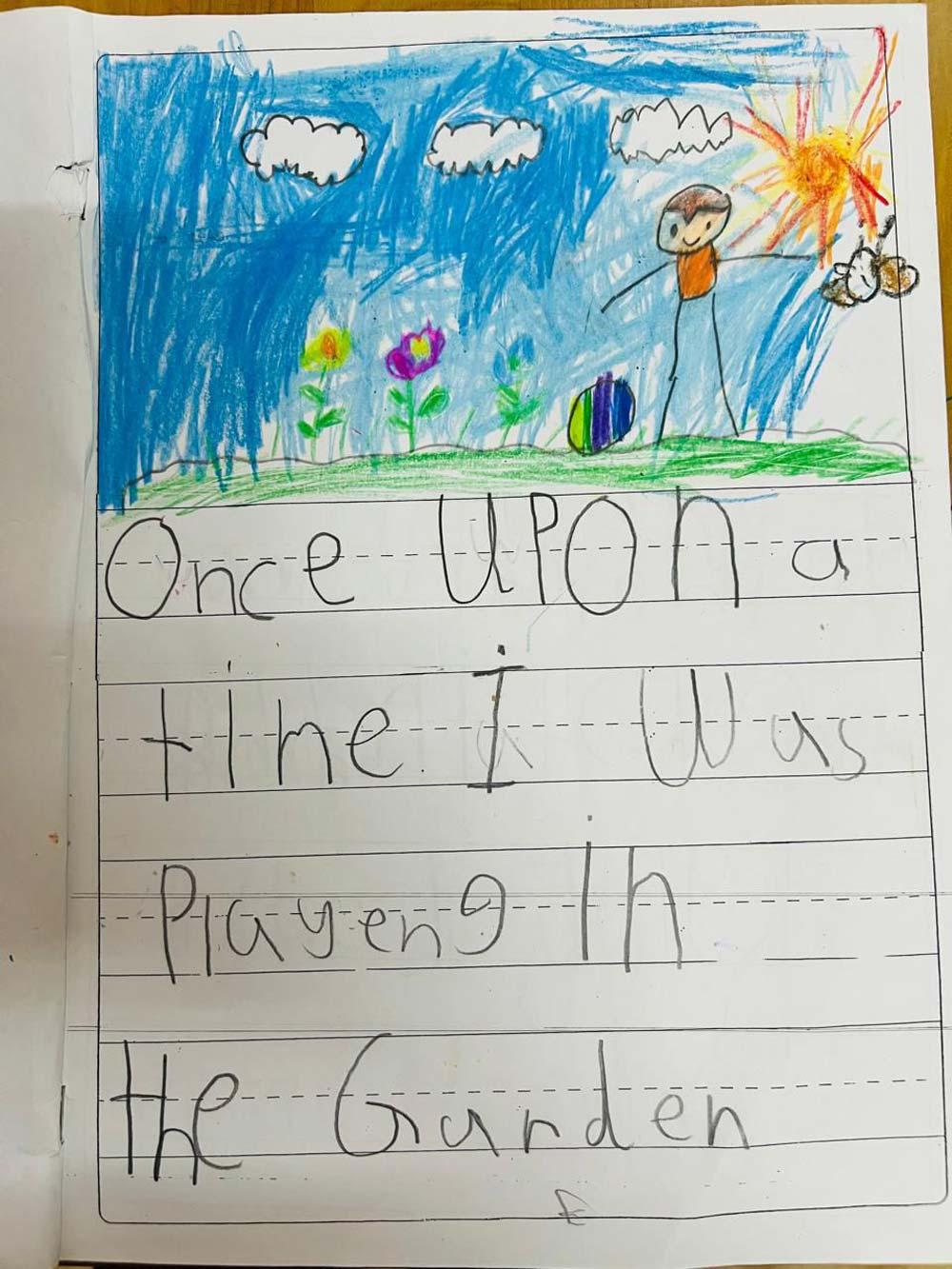
Three months after we began, Alex wrote his first complete sentence.It was not long. It was not perfect. The letters wobbled across the page like a child learning to walk. But the words were there. The meaning was there. And Alex looked up at me with something I had never seen before. Pride.
Not relief that the task was over. Not compliance to avoid punishment. Real, glowing, I-did-this-myself pride.
By the end of the year, Alex had authored a three-page illustrated story. The spelling was inventive. The drawings were simple. But the story had a beginning, a middle, and an end. It had characters who wanted things. It had a problem and a solution. And Alex had written every word himself. The impact on his learning was transformative. Alex went from a child who broke down at the word "write" to one who whispered, "Can I finish my story at recess?" Recess. He wanted to write during recess.
What This Taught Me
Alex taught me something I will never forget. Professional learning is not about collecting strategies. It is about collecting lenses. Different ways of seeing children. Different frameworks for understanding what is really happening when a child struggles. Dr. Greene's framework gave me the "why." Kids do well if they can. If they are not doing well, something is getting in the way. My job is to find it, not to punish it.
Sensory integration research gave me the "how." The hand cannot do what the body cannot support. Fine motor control is built on gross motor foundations. You cannot rush the body. You can only prepare it.
And Alex gave me the proof. When we stop forcing and start inviting, every child can find their voice.
The Lesson for All of Us
How many children like Alex are sitting in classrooms right now, labelled as lazy or resistant or difficult, when really they are just blocked? How many have been broken by good intentions, pushed too early, asked to do what their bodies were not ready for? The answer is too many.
We need more teachers who understand that behaviour is communication. Who know that a child who refuses is not being naughty; they are protecting themselves. Who have the patience to pause the curriculum and address the real problem.
We need more professional development that gives teachers lenses, not just lists. Frameworks, not just strategies. Understanding, not just techniques. And we need more parents and educators who believe that every child can do well. Not when they are fixed or forced or pushed. But when the barriers are removed and the invitations are offered and the time is given.
The Bottom Line
When we stop forcing and start inviting, children show us what they can do. Not because we made them. Because we made space. That is the lesson of Alex. That is the power of believing that kids do well if they can. And that is the kind of professional development that changes everything.