Brushstrokes of Heritage Take a Chill Pill: Iromie Wijewardena
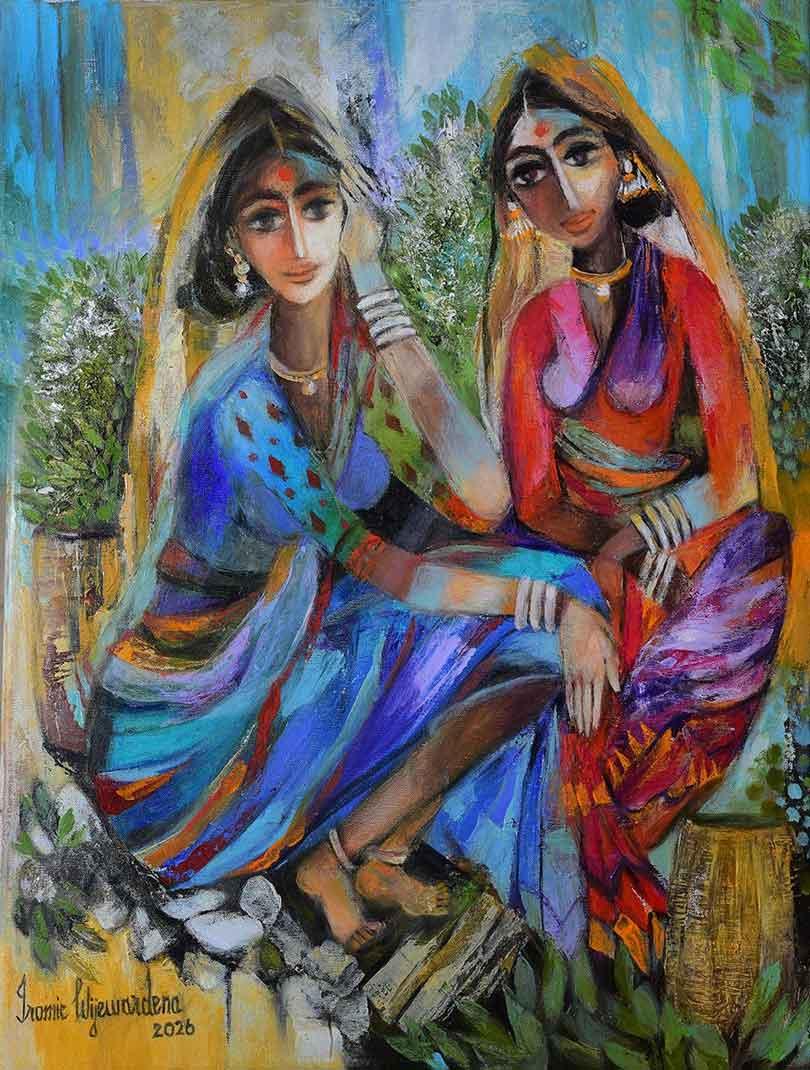
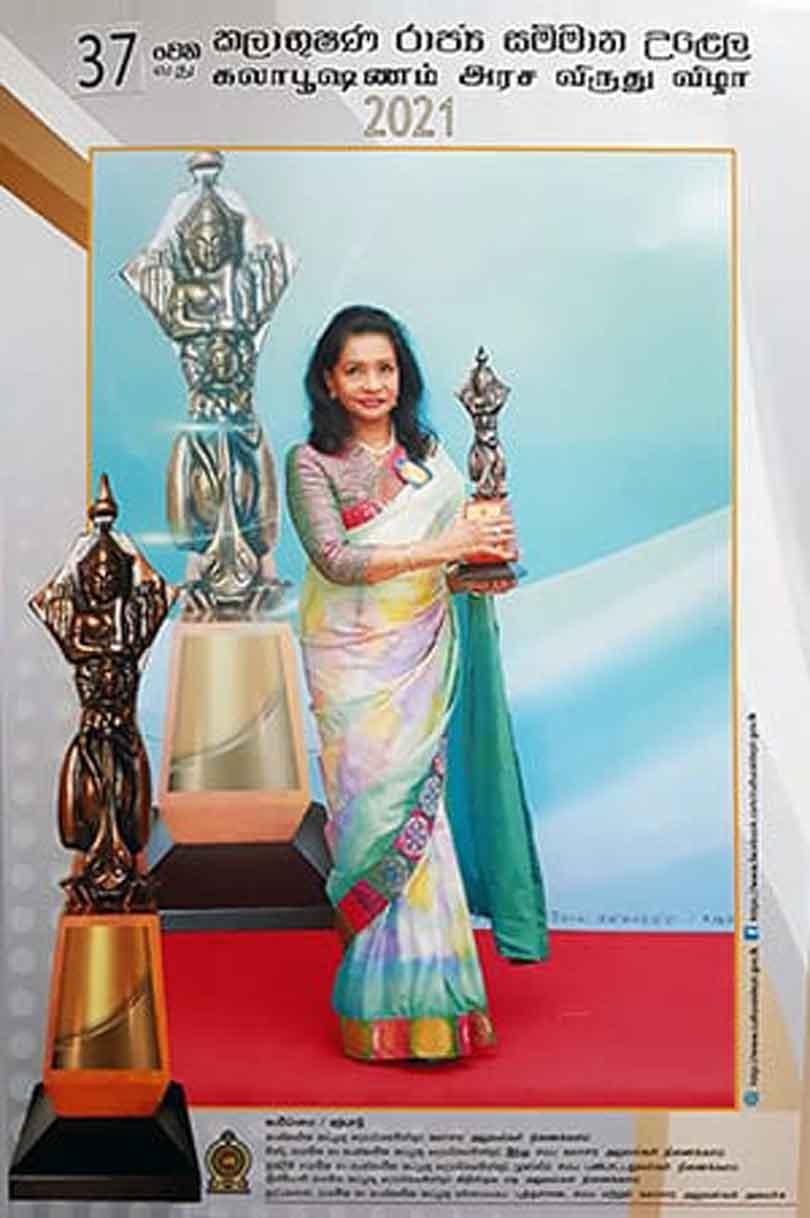
Sri Lanka’s very own, Iromie Wijewardena, has spent decades bringing the essence and soul of South Asian womanhood to life through sarees, traditional attire, lotus blooms, and authentic jewellery. Using richly textured oils and mixed media, she transforms these elements into vivid canvases that feel both deeply indigenous and profoundly alive. Her artworks celebrate cultural heritage and identity, speaking languages far beyond borders. In 1985, her art was reproduced on a Yugoslav postage stamp, marking an extraordinary international recognition of her work. Her remarkable artistic journey was further honoured in 2021 when she received the “Kala Bhushana State Award”, the highest lifetime achievement honour bestowed upon senior artists in Sri Lanka.
It is with immense gratitude and honour that I share this conversation with her, whose work continues to preserve, celebrate, and redefine the spirit of Femininity and South Asian artistry across generations.
Your work has such a distinct visual language, the elongated faces, the jewellery, the lotus motifs. At what point did you realise this had become your signature style? Was there ever a conscious moment where you thought, “This is how I want to paint?”
I don’t believe that my style of painting has ever been a conscious decision. In my earlier years, my art leaned heavily towards more traditional styles and concepts but over the years and over many different seasons of painting, my style has become what it is now. I don’t believe that you can ever truly decide how you “want” to paint, it is something that comes intuitively and evolves naturally into a style that is deeply personal and distinct.
You are Sri Lankan, yet your subjects often seem to reflect a broader perspective on South Asian womanhood. How do you balance celebrating your own cultural roots while also speaking to something more universal and shared among women across the region?
The beauty of art is that it is universal and has no boundaries! As Sri Lankans, our cultures and traditions share so much with other South Asian countries, and as South Asian women our lived experiences overlap in ways that are hard to separate. Therefore, while I’m never consciously trying to be ‘regional’ or ‘universal’, and simply paint what feels true to me, and true to the stories of Sri Lankan women that have inspired me, these shared experiences, allow for the art to resonates more widely and speak to audiences, no matter where they are from.
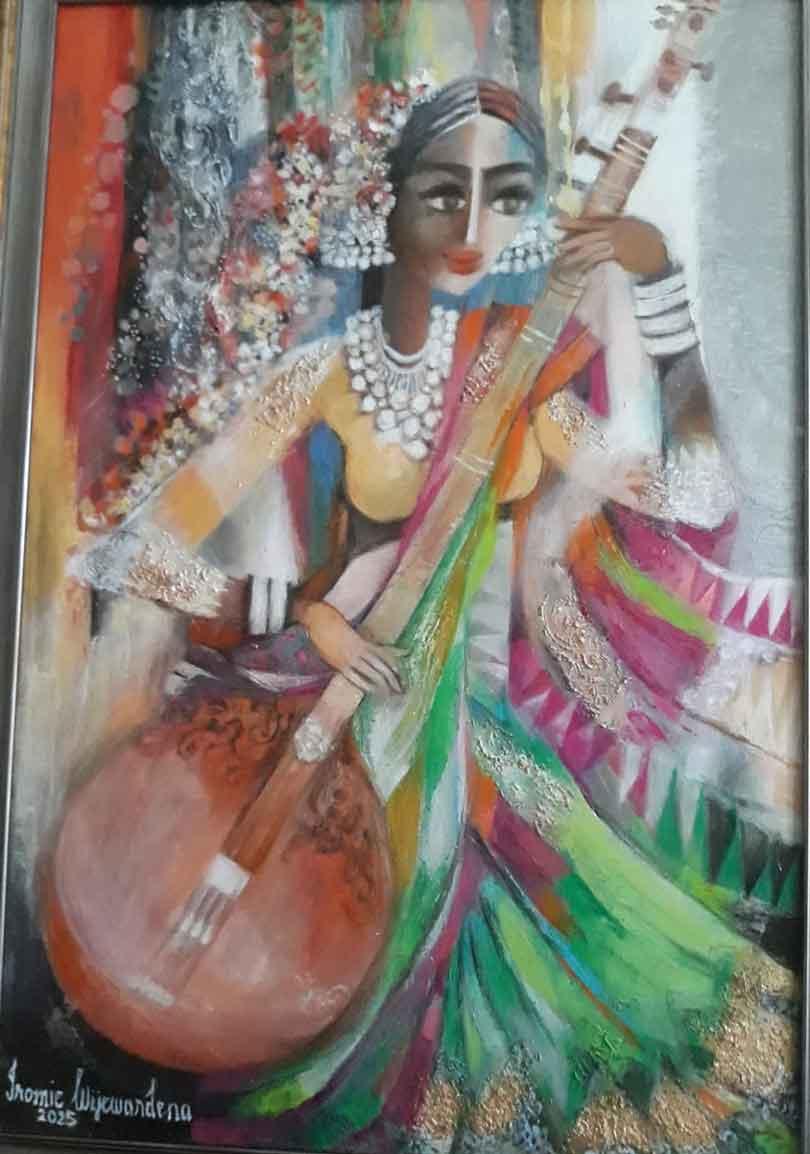
Most of your paintings carry such a striking textural quality, almost sculptural at times. Could you walk us through your creative process? Do you work with mixed media, and how do you know when a piece, or even the surface itself, feels complete?
My process usually starts the moment I see anything that inspires me to paint, which can happen at unexpected moments! From there, I keep playing with colours and different mixed media to see what feels right. Then starts the process of sketching and gradually building different layers and textures to draw out and emphasise the different elements of the piece. As for knowing when a painting is complete - there is fixed formula or set path. I can only describe the moment of knowing when a painting is complete as an “intuitive feeling”, when you look at the paper or canvas and see everything you want to express in front of you.
You seem to move so fluidly between rich, vibrant palettes and cooler, almost monochromatic tones. Is that choice driven more by emotion and mood, or does the subject itself decide the colour world of the painting?
While the subject plays a part in the colours and textures I choose, I think that emotion is the biggest factor that decides the overall feel of the painting. I think it's important to follow your intuition when you paint and allow it to take you in whichever direction that it needs to.
Your 2026 drawing “Flowers & Maiden” feels quite different from your oil paintings, lighter, more delicate, and far more linear in style. Was that a conscious exploration of a new medium or approach? And what does drawing allow you to express that painting perhaps cannot?
I have always enjoyed switching between composing on paper and canvas as it allows me to explore and play with different techniques and textures. In terms of texture, drawing on paper allows for softer and more delicate nuances to come out within a composition that may be harder to convey on canvas. However, in terms of expression, I don’t personally feel that there is a distinction between “drawing” and “painting”. For me, they are intertwined, and both play a part in bringing an artistic vision to life.
Women appear almost exclusively throughout your work, as musicians, flower-bearers, companions, even devotional figures. Would you say this is rooted in a feminist perspective, a personal artistic instinct, or something far more intimate and layered than that?
I think for the most part, the women I portray and how I portray them are rooted in personal instinct. From the very beginning of my artistic journey, I have always been drawn to the female form, and more specifically women rooted in rural life. I feel very strongly about their stories of quiet strength and resilience that are so often overlooked and unacknowledged.
While many may simply see a woman selling flower, fruits or vegetables, these women are often the breadwinners and the backbone of their families, who, without appreciation or applause and against considerable odds, have persevered. My goal is to portray and celebrate their pivotal role, not just as breadwinners for their families, but in the way they shape and sustain society as a whole. It gives me great satisfaction at the end of an artistic creation when subjects that are otherwise overlooked or underappreciated are given the stature and admiration they so rightly deserve, and they are seen as the vibrant forces of life that they are. I hope my work invites viewers to engage with the intrinsic beauty of femininity and its inner strength and reignites within female audiences a deep sense of dignity in being a woman.
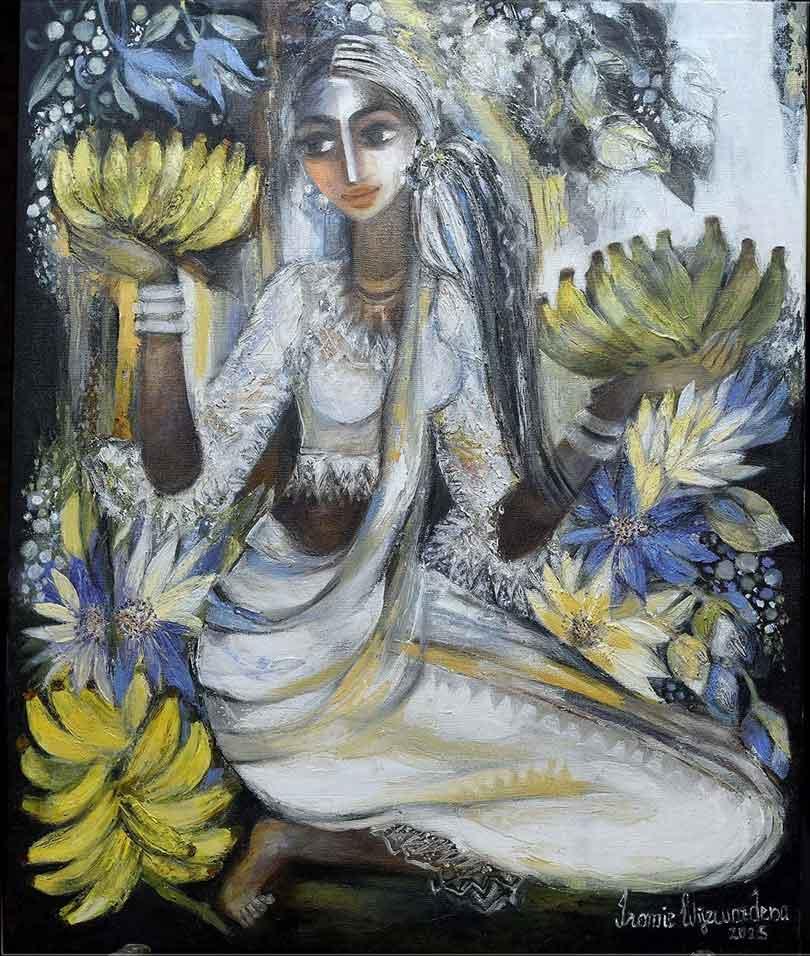
The lotus appears throughout your work again and again, in white, blue, purple, yellow. Do these different colours hold different emotional or symbolic meanings for you, or has the lotus itself become something of a personal visual signature within your art?
The lotus has become something of a visual signature in my work, and I think that's happened quite naturally because of how deeply it resonates with the women and stories I depict. The parallels are hard to ignore. In many cultures, the lotus is a symbol of strength, resilience and quiet grace. It takes root in mud, endures harsh and heavy conditions, and yet rises above the water to bloom with extraordinary beauty. To me, that is the story of the rural woman. She too is rooted in difficult, often unforgiving conditions, carrying the weight of her family and her community, her daily labour, and yet there is a grace and a beauty to how she moves through the world that is impossible to overlook. While the colours used are more intuitive than purposeful, it is the lotus as a whole that holds meaning. It is perseverance and quiet dignity, which is how I hope to capture in the women I paint."
The painting, The Pottery Stall, carries an almost ritualistic atmosphere. When composing a work like that, do you draw from specific stories, myths, or spiritual traditions, or are those elements shaped more intuitively through the painting process itself?
Most of my works are inspired by either scenes that I see in day-to-day life or specific stories that have been told to me. “The Pottery Stall” came from my visit to Molagoda, where I was fortunate enough to spend time with artisans, having conversations not just about their craft but also their lives and experiences. What struck me most was the care, detail and pride that went into every piece. What I wanted to capture through the painting was not just the scene itself but also the emotion behind it and the almost sacred relationship between an artist and her work.
Having your work reproduced on a Yugoslav postage stamp in 1985 is such a remarkable distinction, your art quite literally travelling across the world through millions of letters and envelopes. How did that opportunity come about, and what did that moment mean to you personally at the time?
My painting, “The Royal Procession” was selected by the Ministry of Cultural Affairs for the inauguration of the Non-Aligned Countries Gallery in Titograd in 1984. One year after that, the Government of Yugoslavia selected five artists for the galleries for postage stamps and “The Royal Procession” was one of them. It is the only occasion that a Sri Lankan artist’s work has been selected to be on a foreign postage stamp and so that moment was, and still is, one of my most rare and cherished achievements, and one of the highlights of my career!
Looking at that 1985 postage stamp alongside your more recent works from 2025–2026, how do you feel your artistic approach to subject matter has evolved over the decades? And perhaps more importantly, what do you feel has remained constant within your work despite the passage of time?
As I mentioned briefly before, my earlier works were heavily influenced by the traditional styles of painting, however with the passage of time, I believe my style has become more fluid and perhaps vibrant. I incorporate more textures, mediums and layers to add more depth and emotion to the piece. However, despite my style having evolved, the one thing I believe has remained constant and will remain constant is my depiction of rural life and rural women, and my constant endeavour to depict them in strength and dignity.
Sri Lankan fine art doesn’t always receive the international visibility it deserves. Do you feel that’s beginning to change in recent years, and what role do you think artists like yourself have in helping shift that visibility on a global stage?
Sri Lankan has many highly talented artists who deserve much more exposure than they are currently receiving. However, I think slowly but surely Sri Lankan art is on its way to getting the recognition it deserves. I think the main thing artists can do is to keep honing their craft and not being afraid to put themselves out there to gain global visibility and use that platform to champion Sri Lankan art and spark curiosity in it worldwide.
If you could have one person, living or dead, sit with your paintings and tell you honestly what they see, who would that be and why?
The late Amrita Sher-Gill! She was one of the pioneers of the modernist art movement in India and someone whose artistic journey serves as great inspiration.
--------------------------------
In a rapidly changing world, her work continues to stand as a timeless tribute to South Asian culture and the enduring spirit of its women. My heartfelt gratitude to Iromie Wijewardena for sharing her time, story, and extraordinary artistic journey with us.