Baby Dolls, Bathwater, and Leashes: How Popular Culture Keeps Reducing Women to Objects

There's a pattern in how women in entertainment get marketed, and it's easy to miss if you look at each story in isolation. A soap made from an actress's actual bathwater. An album cover of a pop star on all fours with a leash. A pink baby-doll dress that sets off a two-week argument about whether a 23-year-old is dressing like a child. Different products, different women, different scandals, but the same underlying move: take an adult woman, strip away her personhood, and repackage her as something easier to consume. A commodity. A pet. A child. Anything but a full adult with interiority of her own.
That pattern is worth examining directly, because it explains something the individual controversies don't: why these stories keep happening, why the backlash to them keeps looking the same, and why blaming the individual woman at the centre of each one almost always misses the actual target.
It also explains why these controversies never really resolve. Each one gets treated as a standalone scandal, a bad decision, a tasteless campaign, an ill-advised photo shoot, and then the news cycle moves on until the next one arrives wearing a different costume. Nobody connects the soap to the leash to the baby-doll dress, because on the surface they don't look related. One is a product launch, one is album art, and one is a red-carpet outfit. But strip away the packaging and all three are doing the same job: taking a woman who is, contractually and legally, an adult professional, and re-presenting her as something the audience doesn't have to reckon with as a full person.
The commodity: Sydney Sweeney's bathwater
In June 2025, Dr. Squatch launched a limited-edition soap called "Sydney's Bathwater Bliss," advertised as infused with actress Sydney Sweeney's actual bathwater, following an earlier campaign in which she appeared in a tub promoting the brand's body wash. The $8 bar sold out within seconds and crashed the site, a clean commercial win, and by some measures a clever one: it turned online fascination with her body into a literal, purchasable object.
That's the thing worth sitting with. The soap didn't sexualize Sweeney through insinuation or innuendo. It did something more literal: it took a by-product of her physical body and sold it as a novelty item, packaging her as raw material rather than a person doing a job. Sweeney later noted that "it was mainly the girls making comments about it," pointing out that a nearly identical product built around a male actor's bathwater the year before had been treated as a fun, low-stakes joke rather than a scandal. Her own response was breezy rather than defensive; she didn't seem to experience it as a crisis, which raises a fair question about why so many observers did.
Neither reaction resolves the deeper issue: a woman's body became a consumer product, with her cooperation, inside an industry that will always find a buyer for that. It's worth noting this wasn't the first bathwater product to go viral: a candle tied to a male actor's bathwater, referencing a film scene, had circulated online the year before to widespread amusement rather than outrage. The gender of whose bathwater is being sold changes almost nothing about the product itself, and yet it changed almost everything about how the product was received, which suggests the discomfort was never really about bathwater.

The pet: Sabrina Carpenter's album cover
On June 11, 2025, Sabrina Carpenter revealed the cover of her album Man's Best Friend: she's on her hands and knees in a mini dress and heels, while an anonymous man in a suit grips her hair like a leash. A domestic-abuse charity in Glasgow called the image "regressive," and other critics read it as trivializing real abuse rather than satirizing it. Carpenter's defenders countered that she was in on the joke, a knowing wink at male-gaze imagery rather than a submission to it.
Carpenter herself said she was surprised by the backlash and took it "with a grain of salt," framing the cover as being about a woman's ability to choose when she's in or out of control. That's a coherent defence, but it doesn't erase what the image is actually depicting: an adult woman restyled, visually, as an animal on a leash, the title itself makes the framing explicit. Whether that's satire or just repackaged submission depends entirely on who's looking, which is exactly what makes the image so useful commercially. Ambiguity sells.
The same dynamic shows up in criticism of her live shows, where she's performed sexually charged bits nightly despite a young fanbase, and where she's pushed back by noting that being cast as a "childhood figure" isn't something she can help, having started working at twelve.
Worth noting: Sweeney herself hit this same leash imagery from the other direction this year. On the final season of HBO's Euphoria, a show rated TV-MA, made explicitly for adult audiences, despite its high-school setting, her character Cassie built an OnlyFans persona partly around a dog costume: collar, leash, ears, tail, and lapping water from a bowl on the floor. It's fiction, played by an adult actress on an 18-plus show, which is a meaningfully different thing from a real-world marketing image. But it's the same visual grammar as the album cover, showing up twice in the same year: a woman recoded as a pet as shorthand for being led, watched, and owned.
The child: the "Lolita aesthetic" and the infantilizing trend
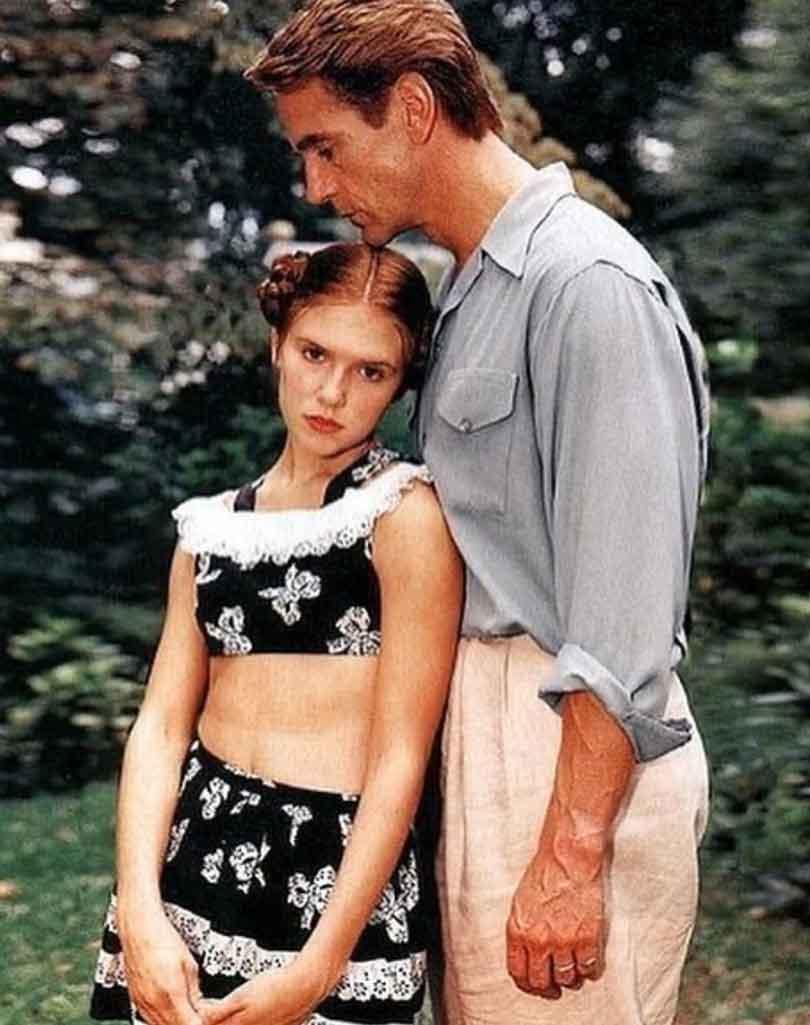
The third version of this pattern doesn't reduce a woman to a product or an animal, it reduces her to a child, aesthetically, while keeping the marketing squarely adult. Critics have a name for this: the "Lolita aesthetic," a fashion and pop-culture shorthand, heart-shaped sunglasses, lollipops, baby-doll dresses, knee socks, that borrows the visual language of childlike innocence and repurposes it as a register of desirability. The style takes its name from Nabokov's novel, though critics note its pop-culture usage has drifted far from the book itself, which was a portrait of a predator's self-justifying obsession with a twelve-year-old, not a fashion statement.
Lana Del Rey is the artist most closely associated with mainstreaming this look, particularly through her 2012 song "Lolita," and the broader "coquette" subculture that grew out of it, light colors, bows, baby-doll silhouettes, draws directly on that same visual well. Critics have argued for over a decade that the aesthetic works by aestheticizing a story about the exploitation of a child until the origin gets bleached out, leaving only the sweetness, marketed to grown women and consumed by everyone else as a register of desirability rather than a warning.
The debate resurfaces every time a young female artist wears anything in that visual family. Olivia Rodrigo's babydoll dresses sparked exactly this argument this year: critics on one side called the look a regressive nod to "sexy baby" infantilization; critics on the other pointed out that the babydoll silhouette has its own separate fashion history, dating to 1940s wartime rationing, later adopted by riot-grrrl and punk scenes specifically to reclaim fragility from the male gaze, and that flattening every version of the look into "grown woman dressed as a child" erases that history and, ultimately, still puts the burden of a stranger's interpretation on the woman wearing the dress.
Both sides of that argument can be right at once. The aesthetic genuinely has a subversive lineage. It's also genuinely been used, repeatedly, to make adult female sexuality more palatable by coding it as young, and audiences can rarely tell, from the outside, which one they're looking at in any given case, because the commercial appeal of the aesthetic depends on that ambiguity never fully resolving. A heart-shaped pair of sunglasses reads as playful right up until it's paired with a specific pose or lyric, at which point the same object slides closer to the original, uncomfortable source material, and there's rarely a clean line marking exactly where that slide happens.
This is also the part of the pattern most likely to implicate the audience rather than the artist. A soap or an album cover is produced and marketed by a company; the intent, whatever it is, sits with that company. An aesthetic that reads as childlike gets its meaning assigned largely by the viewer, which means the same dress can be an innocent nod to 1990s riot-grrrl fashion to one observer and something closer to costuming for "sexy baby" territory to another, with both responding to the identical image through genuinely different cultural references.
The common thread
Three different moves, commodifying, animalizing, infantilizing, and one shared function: each one makes a woman easier to market by making her less than a fully autonomous adult in the frame. A product doesn't have to be respected. A pet doesn't get a say. A child-coded image gets to have adult sexuality projected onto it while dodging the discomfort of depicting adult desire plainly.

None of this requires believing any specific woman set out to do something sinister. Sweeney pitched her own soap. Carpenter has defended her cover as satire. Del Rey has spent over a decade defending the coquette aesthetic as a genuine, if uncomfortable, artistic register rather than a come-on. Individual intent is close to unknowable from the outside, and it's also close to beside the point. The pattern doesn't run on any one woman's motives, it runs on an industry that has learned these three specific framings reliably generate attention, and that attention reliably converts to sales, and that any backlash generated along the way is, from a commercial standpoint, still attention.
Why the backlash keeps landing in the wrong place
It's tempting, watching any one of these controversies unfold, to conclude the problem is a specific woman's bad judgment, she shouldn't have done the soap, she shouldn't have used that cover, she shouldn't have worn that dress. But that framing does the industry's work for it. It turns a structural pattern, an entertainment economy that profits from reducing women to products, pets, and children on command, into a referendum on one woman's choices, which then gets litigated, exhaustively, in her comments section, very often by other women who are just as boxed in by the same set of options.
The more useful question was never which woman crossed a line. It's why the industry has built exactly three profitable ways to visually diminish an adult woman, and why the loudest reckoning with that keeps happening in public comment sections instead of in the marketing departments that keep reaching for it.
That reckoning also tends to land hardest on other women, because they're the ones most likely to feel the discomfort of the image and say so out loud, and then get blamed for the pile-on, as if the criticism itself were the aggression rather than a response to it. A marketing department can run the exact same playbook three more times next year with three different women and absorb whatever backlash comes, because backlash is priced into the strategy. The individual women involved don't have that luxury. They absorb the commercial upside and the reputational cost in roughly equal measure, while the decision-makers who green lit the soap, the cover, and the styling rarely appear in a single headline.
None of this is an argument for exempting any of these choices from criticism. A cover that stages abuse imagery is fair to criticize regardless of intent, and so is a marketing campaign that trades on a decades-old exploitation narrative dressed up as fashion. It's an argument for aiming the criticism at the right altitude, at the executives, brands, and incentive structures that keep manufacturing this choice for women to make, rather than treating each instance as an isolated referendum on one woman's self-respect.