
Fives And Sevens Plus Mandatory Dogs.
I somehow grew up missing out on an essential aspect of childhood experience: The Five Find-Outers (and Dog) by Enid Blyton. I had read all The Famous Fives, and Secret Sevens, and Malory Towers, and the Naughtiest Girl books (my favourite). But their formulaic nature led me to lose interest after a while and categorize them as holiday reading. And move into the darker bookscapes of Fantasy and Science Fiction.
However, recently, a friend said the Find-Outers were his favourite books growing up, and I was able to access the audio recordings of all 15 books. And they were the best, in terms of characterisation, in terms of character arcs, group dynamics, evocation of setting and incident, and also a highly entertaining mandatory dog, this one called ‘Buster’, a jet-black Scottish Terrier so vividly described I can almost hear him growl when I read the words on the page.
I say ‘mandatory’ because every childhood book by Enid Blyton - and Tintin and Asterix - contains a dog friend. Snowy and Dogmatix are also terriers, if I’m not mistaken. And in childhood, however urbanized and airbrushed and neatly contained and put together we are today, we roamed gardens and woods and lanes in our respective villages and towns, unafraid and unmolested.
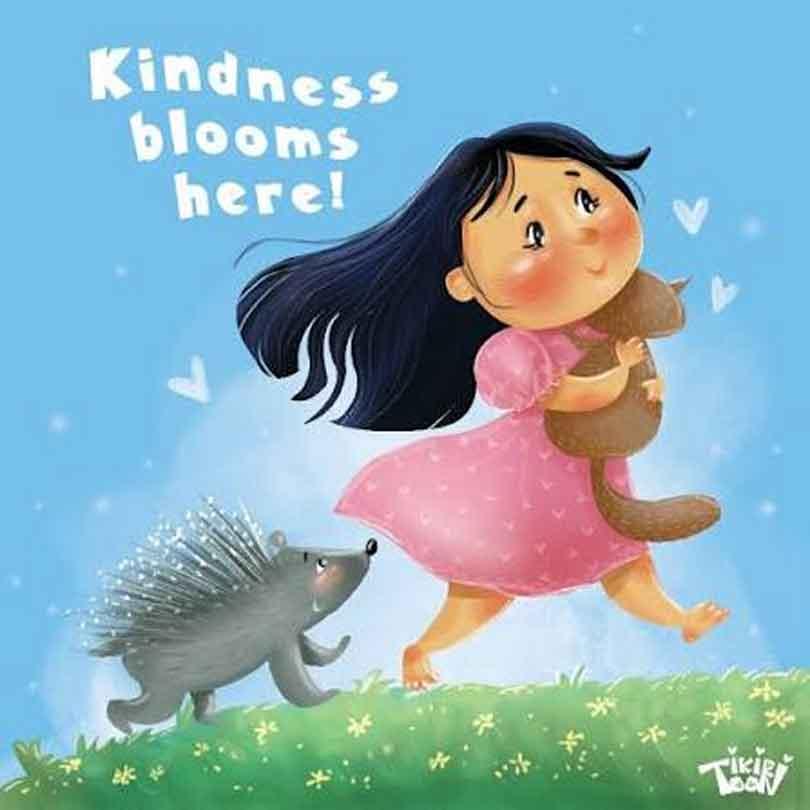
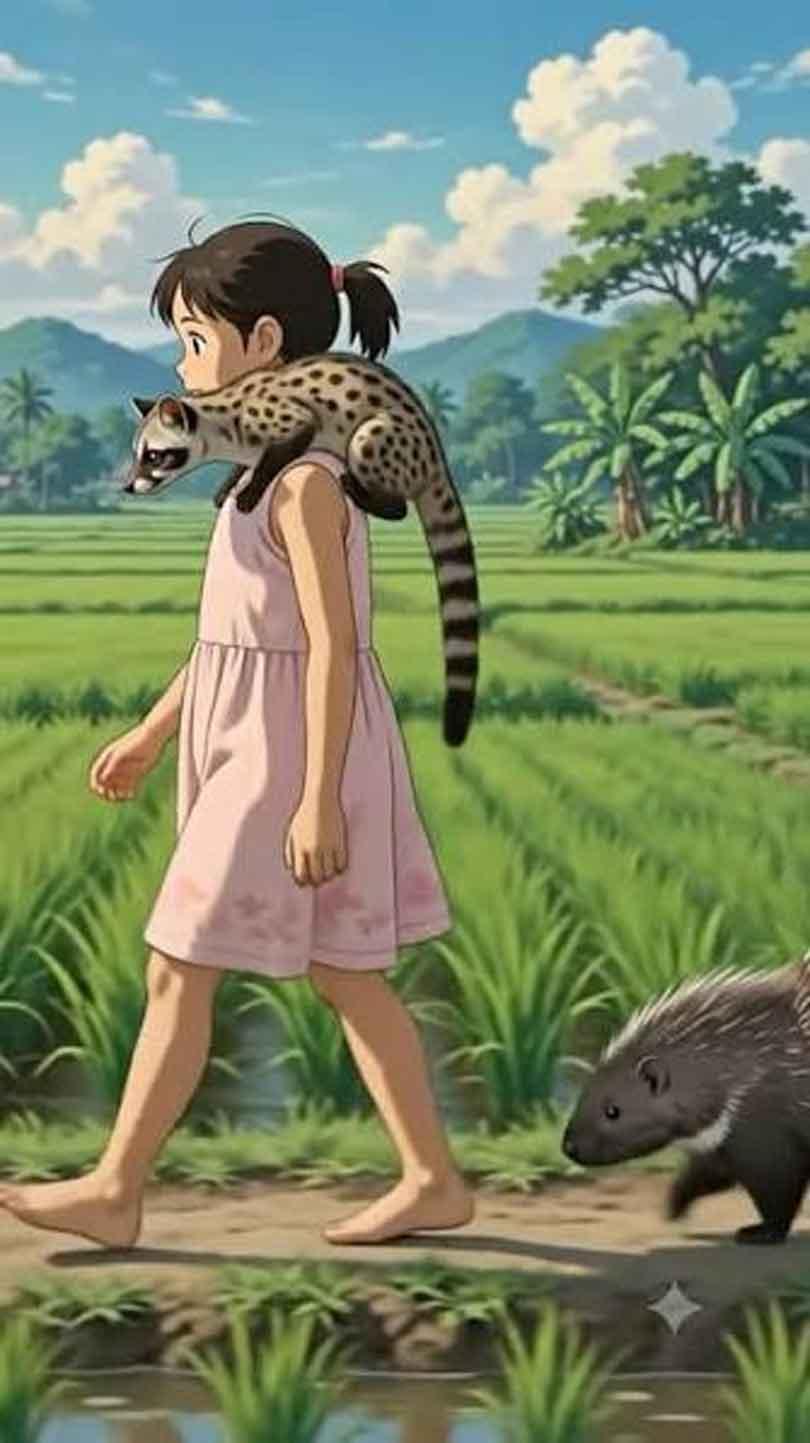
Recently, a video taken on a phone showing a little girl from rural Sri Lanka carrying a large cat in her arms and being doggedly followed by an affectionate Sri Lankan porcupine through muddy fields, has gone viral. Artists have rendered the image from many different countries, and their versions are very telling of the way people from all cultures respond to this picture.
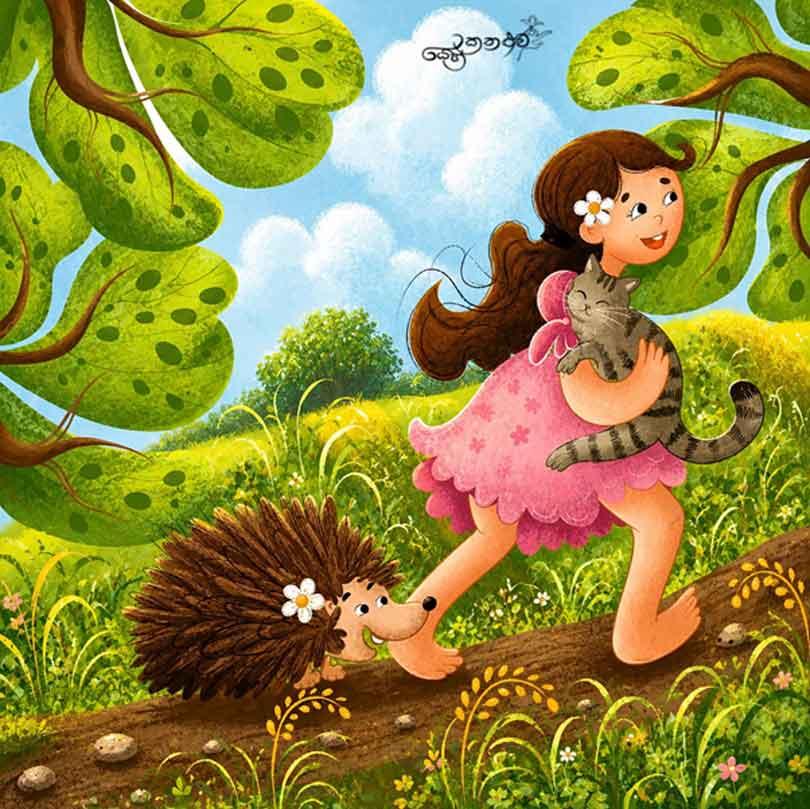
Both the little girl in this version and the porcupine have a frangipani flower behind their ear. The porcupine’s quills are blunted and modified. The girl’s skin colour is lightened, her hair is made more luxuriant, and the teeth which are missing in real life are modified. In fact, the porcupine is given a tooth. We see this because all three friends are smiling. They are roaming not precariously in real life through muddy fields of water, but through verdant green fields and bountiful, over-arching trees. Everyone looks well-nourished, happy and content. The sky is blue, and there are fluffy, puffy clouds in the sky. Everything is softened.
I believe we all respond to this adorable vista so positively because as adults we are stressed, and we are starved. Stressed by our city-bound pedestrian lives and starved of connection and innocence and a sense of freedom and belonging that many of us felt in childhood. Estranged too from the natural world and the simple life, where, as children, we could explore the world in a tactile and intensely sensory way, be curious and engaged, without fearing for our safety, or being in threat to our bodies or our souls.
Adults existed on the peripheries of this world. And they dispensed meals, advice, scoldings and praise as the children’s actions warranted. There was natural justice: robbers, thieves, and those engaged in nefarious activities were discovered, and rapidly brought to order. This was a golden world, where ‘Heaven lies about us in our innocence’, as Wordsworth said. Any breaches of the peace were temporary, and everyone concerned knew it.
The spontaneous joys of childhood, the pleasures of sensory connection, and nature itself are being packaged and sold to us tellingly as escapes and retreats. Having destroyed the natural environment, and the lives of many children, through commercialism and exploitation, we glorify the very things we have taken and used.
I remember being told once of countries where all the animals have been killed but the soft toy industry is booming. No birds sing over those industrialized skies.
In the Find-Outers, the children are sworn enemies of the local policeman, Mr. Goon, who is exasperated by their meddling and interfering. In all the books, the children are curious, intrepid, fearless and enthusiastic to discover what is going on under the smooth and placid surface of their local town. Together, they spy and stickybeak and mess with the nefarious activities of adults who are engaged in criminal activities. And all their midnight espionage activities seem to occur within a radius of about 100 metres. The Find-Outers early on impress Inspector Jenks, who has a high opinion of their skills, and this canny ability to go to the top and sidestep the middle management is very impressive.
Their life is full of colour and verve, and goes on underground, unknown largely by their parents, who are strict and respectable and law-abiding. And privileged. Everyone has maids and cooks. And aunts who come to afternoon tea, with sandwiches and cakes.
It is an insulated world. And that is what we remember, and what we are glorifying and what we yearn for, in the frankly chaotic and violent scenario we have to now negotiate as adults, full of natural disasters and manmade wars and famines and all the atrocities by which we are besieged in newspaper headlines and the 24/7 news cycle on TV and our smartphones.
It is nostalgic, yes, but it is also something more. It is slapstick. It is dodgem cars. It is rubber swords. It is bouncy castles. It is gentle relief for us, now, who are witnessing so much actual cruelty, heedlessness and suffering.
The archetype we are resonating with here is the Pre-Lapsarian world theory proposed by Northrop Frye. That in the world before human beings fell from grace, due to their ignorance, idiocy and greed, when they were closely connected to God, the Creator, that everything was good. There was no pain in childbirth, there was no disease or violence or cruelty or anything ugly or evil to make us cringe. We were aligned, and all was good. After the fall, the golden world became debased. Now we buy and sell and try to profit, now we suspect instead of trust, and we have to protect ourselves from the world around us.

Children have a tolerance we do not have, for oddness, eccentricity, wrinkled faces, larger sized bodies and imperfection. They have not yet learned to associate these human flaws with anything contemptible. Their inner GPS is strong and clear. For them, what they see is what it is. And they have their mandatory pets by their sides to guide them.
We don’t have to vicariously tap into those wonderful childhood memories, and attitudes, though. We can find those qualities in ourselves, through doing simple things like letting our senses guide us and making choices based on how something or someone makes us feel, directly, without second-guessing or modifying our direct perceptions.
For example, one day recently a friend of mine and I were driving through an area called Arcadia in late summer. In that part of the world, people grow fruit, and the harvest was abundant that year. Roadside stalls were selling boxes of peaches and cherries. The two of us stopped and bought boxes of each, and the fragrance from the fresh fruit from the back of the car was literally too much for us.
We stopped the car by mutual agreement, and ate some of the fruit directly, so sweet, so pure, and it was one of the best experiences ever, for both of us. We didn’t have to even talk about that. We just knew it.