Who Protects the Child When the State Protects the Robe?
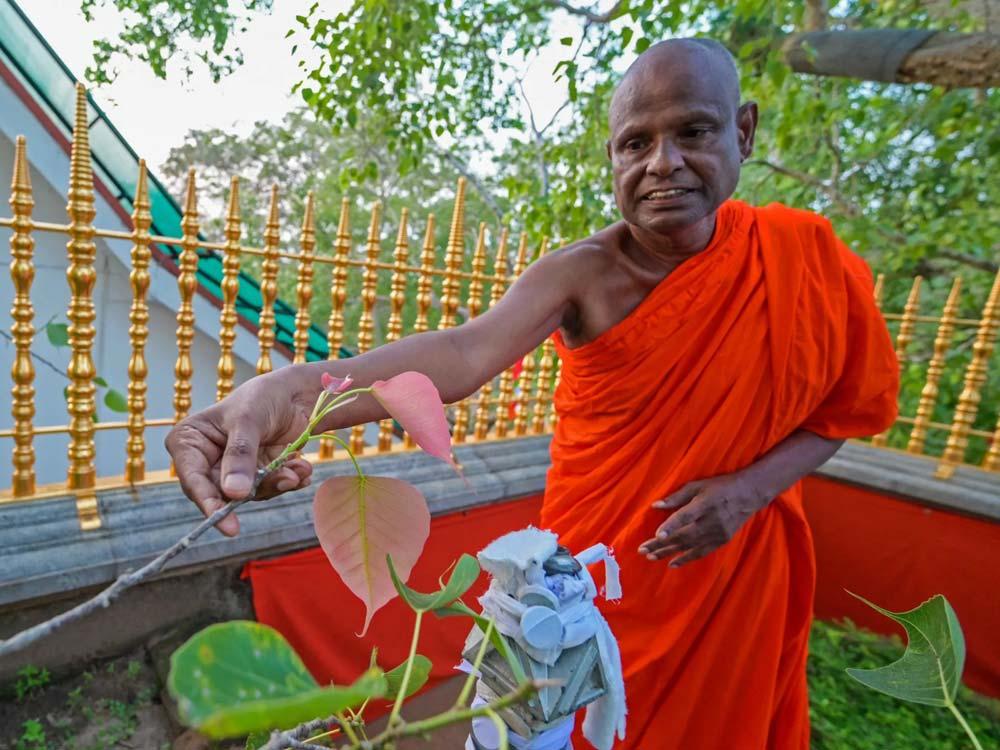

Somewhere in the same country that just celebrated Eid-Al-Adha and Vesak, a fifteen-year-old girl who says she was raped starting at age eleven sat as a ward of the state with no personal legal representation. The man she named as her abuser sat at home on bail. The institution that claims stewardship over one of the holiest Buddhist sites on earth issued a statement that day announcing it had suspended him but was careful to frame that decision not around what had allegedly happened to the child, but around the need to protect the reputation of the tradition. The President, at the State Vesak Festival, spoke about spiritual renewal and the need for a disciplinary tribunal for monks, at the monks' own request, and did not say this girl's name. Sixty-one prisoners were granted presidential pardon in the spirit of Buddhist compassion. She was not mentioned in that either. I want to ask, as plainly as I know how: what, precisely, are the lanterns for?
The Sociology of Sacred Impunity
What is happening in Sri Lanka is a textbook exercise in what sociologists call the sacralization of power, and it is worth understanding because it is not unique to Sri Lanka, but Sri Lanka is one of the most vivid living examples of it in the world today. When a society fuses religious identity with ethnic and political identity so completely that they become indistinguishable, the result is not a purer religion or a stronger national identity. The result is a power structure that becomes immune to accountability by declaring itself sacred. And once a power structure is declared sacred, any challenge to it becomes blasphemy. This is how a country can look at a police team that surrounded a temple and went home without arresting a named rape suspect and not explode with rage. Because in the logic of the sacralized state, the police were not failing a child. They were being appropriately deferential to the sacred. That is what the hesitation was. The political language of this country does not have a register for saying: an institution that produces this is not sacred, it is corrupt. That sentence cannot be formed.
This is how an Instagram user can respond to a Muslim who voices out for the rape of an eleven-year-old girl by typing "what about your prophet's wife" and genuinely believe they have said something meaningful. Because in the worldview that decades of Sinhala Buddhist nationalism constructed, every accusation against the clergy is not a legal matter to be examined on its facts. It is a sectarian attack to be repelled. The child is a soldier in someone else's war against Buddhism, whether she knows it or not. The sociologist Max Weber wrote about charismatic authority, the kind of power that derives not from law or tradition but from a perceived sacred quality, a divine mandate. Weber's insight was that charismatic authority is inherently unstable because it cannot be institutionalized without becoming ordinary, but Sri Lanka found a solution to that problem: it wrote the sacred mandate into the constitution itself.
Article 9 of the Constitution of Sri Lanka states that the Republic shall give Buddhism the foremost place and that it shall be the duty of the state to protect and foster the Buddha Sasana. Not a religion in general. Buddhism specifically. The duty of the state. Those words do real legal and political work. They tell every institution in the country, from the police to the parliament to the presidency, that their relationship to the Buddhist establishment is not neutral. It is obligatory. The state is constitutionally required to protect and foster Buddhism, and the Buddhist establishment, over decades, learned to treat that clause as a liability waiver.
Where the Law Actually Fails
Rape is a non-bailable offence under Sri Lankan law. This is not ambiguous. The Code of Criminal Procedure defines non-bailable offences clearly, and both Section 364(2), rape of a minor, and Section 365B, grave sexual abuse, are listed as child abuse offences under that code. A magistrate court has discretion to grant bail in extraordinary circumstances, but the threshold is meant to be high, and the burden is meant to be on the accused to justify why they should be released rather than on the state to justify why they should be held.
On May 22, the Anuradhapura Chief Magistrate granted Pallegama Hemarathana Thero bail on a cash surety of Rs. 100,000 and two personal bonds of Rs. 5 million each. Rs. 100,000 is approximately 330 US dollars. For the custodian of one of the wealthiest and most visited Buddhist precincts in Asia. The cash component of his bail costs him less than a return business-class ticket from Colombo to Singapore. The Law and Society Trust has formally noted this. The North-East Women's Collective cited it in their public statement. And the magistrate is not necessarily wrong in law, because bail is discretionary. That is precisely the problem. In a system where discretion exists, discretion will be exercised in favour of the person with twenty lawyers in the room. Every time.
Sri Lankan law does not require that a child victim of abuse be legally represented in court proceedings.
It does not require the court to formally hear or take into account the wishes and views of the child in abuse and neglect proceedings. This is documented by Yale Law School's Representing Children Worldwide project. Sri Lanka ratified the United Nations Convention on the Rights of the Child in 1991. Article 12 of that convention explicitly guarantees every child the right to express their views in any judicial or administrative proceeding affecting them. Thirty-five years after ratification, there is still no domestic legal requirement that this actually happen in court.
Article 27(13) of Sri Lanka's own constitution obliges the state to protect children from exploitation. Section 260 of the Code of Criminal Procedure entitles every aggrieved party to legal representation. The Law and Society Trust, in their formal statement on this case, cited both provisions and noted, without euphemism, that they represent binding legal obligations, not aspirations.
This girl came to court against twenty lawyers and a President's Counsel. She was represented, in the initial proceedings, by a small number of volunteer lawyers and one woman from the NCPA's legal unit. The Attorney General's Department was reportedly absent during certain proceedings. Sri Lanka signed a treaty in 1991 promising this child would be heard. In 2026, she sat in a courtroom where the law did not require anyone to make sure of it.
The Constitution That Works Against the Child
Article 9 of the Sri Lankan Constitution states that the Republic shall give Buddhism the foremost place and that it shall be the duty of the state to protect and foster the Buddha Sasana. Article 12 states that all persons are equal before the law and are entitled to equal protection.
These two articles are in fundamental tension with each other, and that tension has never been honestly resolved. The courts have interpreted Article 9 to restrict religious minorities from proselytizing. The Supreme Court has ruled that Article 9 can limit the activities of a Catholic organization providing shelter to orphans, on the grounds that offering material support while spreading faith constitutes an infringement of religious freedom. Buddhism's foremost place, in practice, means other traditions' diminished one.
Now apply that same constitutional logic to the Hemarathana case. The state is constitutionally obligated to protect and foster the Buddha Sasana. The Atamasthanadhipathi is among the most senior administrative figures of that Sasana. Every police officer, every magistrate, every public servant who interacted with this case did so inside a constitutional framework that tells them, in black letter, that their institutional duty includes protecting the institution this man heads.
That is not me making an argument. That is me reading the constitution. Article 12 says all persons are equal before the law. The child is entitled to its protection. The monk is also entitled to its protection. But only one of them has an Article that names his institution specifically and makes it the duty of the state to foster it. And only one of them walked into that courtroom with twenty lawyers. Equality before the law, in a constitutional framework that is structurally unequal, is not equality. It is the formal language of equality without its substance. It is the kind of equality that looks the same in the text and functions entirely differently in practice, and everyone in the system knows it, and no one says it out loud.
What Reform Actually Requires
I want to be specific here, because general demands for accountability are easy and change nothing. What this case reveals requires specific, nameable interventions. Sri Lankan law must require legal representation for child victims in abuse proceedings. Not advisory representation through the NCPA. A lawyer who answers only to the child, mandated by law, before any hearing begins. Sri Lanka ratified the UNCRC in 1991. It has had 35 years. This is not complicated to write into statute.
The Buddhist Temporalities Ordinance amendment that the government is proposing must not simply create an internal disciplinary body for monks. It must include, as a minimum: mandatory registration and regular welfare inspection of all children living in monasteries, a minimum age for residential ordination, mandatory reporting obligations for temple administrators when a child in their care shows signs of abuse, and formal safeguarding standards equivalent to those applied to state-regulated childcare institutions.
The bail framework for non-bailable offences involving child victims must be reviewed. Magistrate-level discretion to grant bail in non-bailable cases is appropriate in principle. But the application of that discretion cannot continue to function as a power-weighted exercise in which the accused's status, connections, and legal resources silently determine outcomes that the law does not explicitly authorize. The NCPA must be given the statutory authority and funding to act as the legal guardian of child victims whose parents are absent, deceased, or themselves accused. Right now, when a child's parent is the co-accused, as in this case, there is no automatic legal mechanism to fill that representation gap. There should be. It should be the first thing that happens, not an afterthought raised in a formal letter by civil society weeks into proceedings. Article 9 of the constitution must be read alongside Article 12, in every courtroom, in every police station, in every government ministry. The duty to protect and foster the Buddha Sasana does not include, has never included, and cannot include the protection of individuals within that Sasana from the legal consequences of crimes committed against children. Any police officer, judge, or government official who behaves as though it does is not following the constitution. They are betraying it.