
Reform UK Surge and Political Fragmentation Define the 2026 Local Council Elections.
The 2026 local elections in England marked one of the most significant political realignments in recent British history, exposing growing public dissatisfaction with the country’s traditional parties and confirming the emergence of a far more fragmented political landscape. Held on the 7th of May 2026, the elections were widely interpreted as the first major nationwide electoral test of Prime Minister Keir Starmer’s Labour government since its landslide victory in the 2024 general election.
More than 4,800 council seats were contested across England, alongside mayoral contests and devolved parliamentary elections in Scotland and Wales. By the end of the counting process, the results revealed a dramatic surge for Reform UK, major losses for both Labour and the Conservatives, and further gains for smaller parties including the Greens and Liberal Democrats.
The elections represented a sharp departure from the traditional dominance of Britain’s two largest parties. Instead, voters across many parts of England appeared increasingly willing to support smaller and insurgent political movements that they believed better reflected their economic anxieties, frustrations with Westminster politics, and concerns about immigration, public services, and living standards.
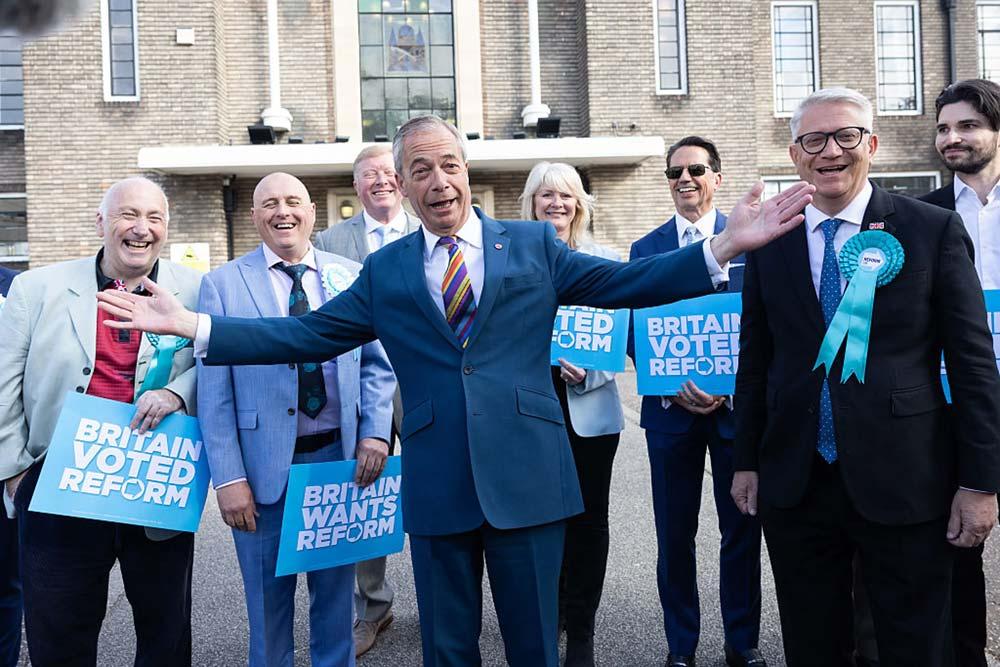
The most striking development of the elections was the extraordinary performance of Reform UK under Nigel Farage. The party secured approximately 1,400 council seats, transforming itself from a protest movement into a major electoral force with a substantial local government presence. Reform UK gained control of several councils and achieved some of its strongest results in post-industrial towns, coastal communities, and economically struggling areas across northern and eastern England.
The party’s campaign focused heavily on immigration, economic insecurity, dissatisfaction with political elites, and criticism of both Labour and the Conservatives. Reform UK also benefited from the continuing erosion of voter loyalty toward the traditional parties. In many areas, the party successfully attracted former Conservative voters while also winning support from working class communities that had historically backed Labour.
Political analysts noted that Reform UK’s support was particularly strong among older voters and in areas experiencing economic decline or social deprivation. The elections therefore confirmed that the political coalition behind Brexit continues to shape British politics years after the 2016 referendum.
For Nigel Farage, the elections represented the most important electoral breakthrough of his career outside European Parliament contests. Reform UK’s success immediately intensified speculation about the party’s prospects at the next general election and raised questions about whether the Conservatives could continue to compete effectively on the political right.
Labour entered the elections hoping to consolidate support after nearly two years in government. Instead, the party suffered a damaging setback. Labour lost approximately 1,400 councillors across England, with some of the heaviest losses occurring in areas once regarded as secure Labour territory.
The results exposed growing frustration among voters over the pace of economic improvement since Labour returned to power in 2024. Concerns about the rising cost of living, housing shortages, pressures on the National Health Service, and broader economic uncertainty all contributed to Labour’s difficulties. In several working-class communities, Reform UK succeeded in presenting itself as the main vehicle for protest votes against the government.
Although Labour retained strong support in major cities and parts of metropolitan England, the elections highlighted tensions within the party’s electoral coalition. Some progressive and younger voters shifted toward the Green Party, while more socially conservative voters increasingly moved toward Reform UK. The outcome created new strategic challenges for Keir Starmer as he attempted to balance competing political pressures within Labour’s support base.
The Conservative Party also endured another severe electoral defeat. After suffering its worst general election result in modern history in 2024, the party continued to lose support across many traditional Conservative areas. Hundreds of Conservative councillors lost their seats, and the party lost control of additional local authorities.
The elections demonstrated the extent to which Conservative support had fragmented since leaving government. Some former Conservative voters shifted toward Reform UK, particularly on issues relating to immigration and national identity, while more moderate and affluent voters increasingly supported the Liberal Democrats in southern England.
The results intensified internal Conservative debates about the future direction of the party. Some senior Conservatives argued that the party needed to adopt tougher positions on immigration and cultural issues in order to recover voters lost to Reform UK. Others warned that moving further to the right risked alienating moderate voters and deepening the party’s electoral problems in suburban and southern constituencies.
The Green Party achieved one of the strongest performances in its history, gaining more than 350 councillors and expanding its influence in urban areas, university towns, and younger communities. The party benefited from growing concern over environmental issues, housing affordability, and dissatisfaction among progressive voters who believed Labour had become too cautious on climate policy.
Green candidates performed particularly well among younger voters, renters, and university educated populations. In several councils, the party moved beyond symbolic representation and became an influential part of local governing coalitions.
The Liberal Democrats also recorded important gains, especially in southern England and suburban areas where the party has steadily rebuilt support in recent years. Liberal Democrat campaigns focused heavily on local issues including sewage pollution, planning disputes, healthcare access, and opposition to unpopular housing developments.
The elections reinforced the growing regional divisions within English politics. Reform UK performed strongest in economically struggling towns and coastal communities, while Green and Liberal Democrat gains were concentrated in cities, university centres, and affluent southern districts. Labour maintained dominance in some large urban areas but faced increasing pressure across many of its traditional industrial heartlands.
In Scotland and Wales, voters participated in devolved parliamentary elections rather than English style local council contests. The results there also reflected continuing political fragmentation, with nationalist and regional parties maintaining strong positions alongside growing competition among multiple parties.
One notable feature of the elections was the relatively low turnout compared with general elections. However, participation appeared strongest in areas experiencing major political change, particularly where Reform UK or the Green Party were making substantial advances.
The wider political significance of the elections quickly became clear. The results suggested that Britain’s political system is entering a period of sustained multi-party competition in which Labour and the Conservatives can no longer rely on traditional voting loyalties. Economic pressures, cultural divisions, distrust of established political institutions, and regional inequalities are increasingly reshaping electoral behaviour across the country.
For Labour, the elections served as an early warning that victory in the 2024 general election did not guarantee long term political stability. For the Conservatives, the results highlighted the continuing challenge of rebuilding credibility after years of political turmoil in government. For Reform UK, the elections represented a breakthrough moment that established the party as a major force in English politics.
As political attention gradually turns toward the next general election, the 2026 local elections are likely to be remembered as a pivotal moment in the transformation of Britain’s political landscape. The elections demonstrated that the era of stable two-party dominance is weakening rapidly, and that British politics has entered a more volatile and unpredictable period defined by fragmentation, voter dissatisfaction, and the rise of alternative political movements.