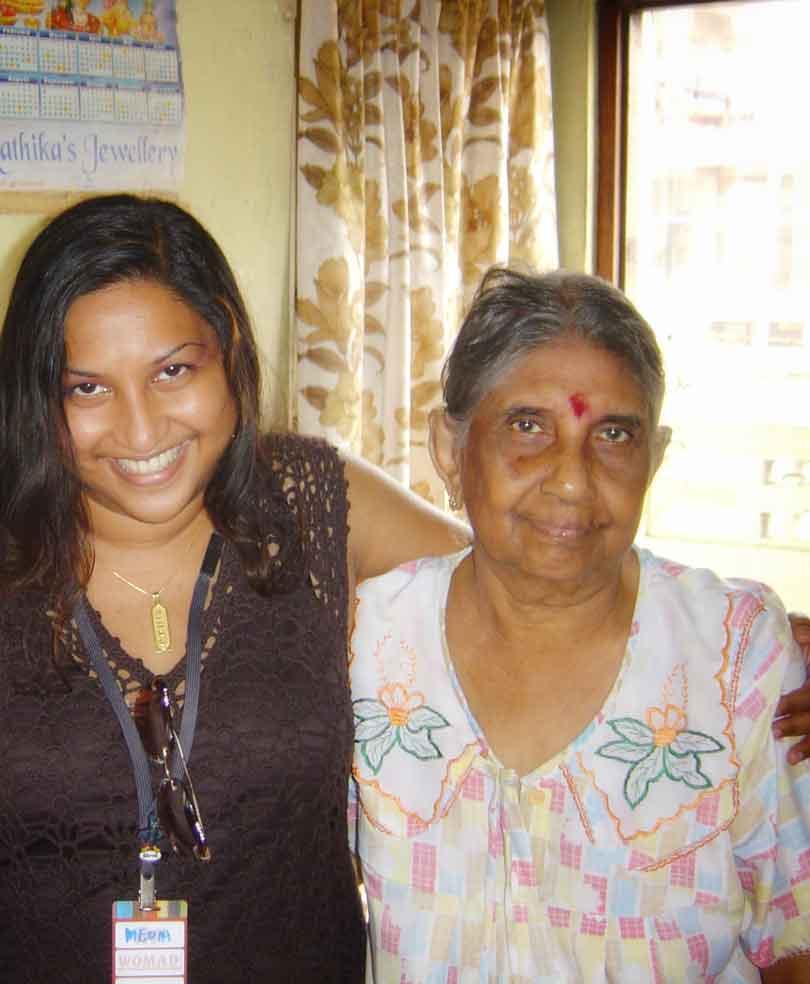
ASHANTI OMKAR: CARVING A CAREER OUT OF PASSION

There is something quietly disarming about looking back on childhood and realising how little we understand of what lies ahead. When you are playing hide and seek in the fading light, or sitting cross-legged on a picnic mat somewhere between laughter and impatience, the world feels contained, almost predictable. You do not imagine that one of you will one day step into a life that stretches far beyond those small, familiar spaces. You certainly do not imagine that the things which seemed incidental then - the music lessons, the discipline, the expectations - are already at work, shaping something far more enduring. In the story of Ashanti Omkar, what emerges is not a dramatic break from that early life, but a quiet unfolding of it. Not a rejection of structure, but a reimagining of what it was always preparing her to become. Born to Sri Lankan Tamil parents Raji Yogachandran and Dr. Chinniah Yogachandran, and raised in Denmark and Nigeria before eventually settling in the United Kingdom at the age of twelve, hers was a childhood shaped as much by expectation as it was by inheritance. Academic rigour was a given, sharpened by a father rooted in mathematics and a life lived within university spaces. But alongside that ran something less rigid, though no less formative: music. Carnatic music (a form of South Indian classical music, for those not in the know!), in particular, was not introduced as a casual pursuit, but as discipline. A system. A way of listening. It was also, unmistakably, a legacy.
Her paternal grandfather was a violinist; her maternal grandfather a tabla player. Her great aunt Balambigai Nadaraja, who lived in Colombo, was a playwright, a Saraswati Veena player and sitarist, and notably, a presence on Radio Ceylon. Long before algorithms and streaming platforms curated taste, this was a station that carried sound across borders, into homes that had never seen the places its music evoked. Founded in 1925 by Edward Harper, it was the oldest radio station in Asia and one of the earliest in the world, its Hindi film music and commercial programming captivating audiences across the Indian subcontinent through the 1950s and 60s. It is tempting, then, to ask whether what followed in Ashanti’s life was coincidence, or something quieter and more insistent. Because when a child grows up in an environment where music is not only practised, but broadcast, discussed, and absorbed almost unconsciously, where The Beatles, Bach, Beethoven, Hindi melodies, Tamil songs and South Indian compositions drift in and out of everyday life, it does not simply pass through them. It settles. It forms a kind of internal archive. And years later, when instinct begins to present itself as insight, it is worth asking whether it was ever instinct at all. And yet, like so many children of Asian diaspora households, she followed the expected path.
She studied. She conformed. She earned a degree in Marketing, Management and Technology from the University of London and stepped, with quiet precision, into the corporate world, working with global companies such as Oracle, PepsiCo, and the Hilton Group. It was a life that made sense on paper. Stable. Structured. Sensible. But passion, when cultivated early, does not disappear. It waits. What is striking is not that she eventually left the corporate world, but how she moved on. There was no dramatic rupture, no sweeping declaration of intent. Instead, there was a conversation at a chance encounter with a reggae magazine editor at the Urban Music Seminar in the 2000s. Encouraged to share her insights on the Asian music industry by interviewing British singer-songwriter Apache Indian, she produced her first byline for Gargamel magazine. At the time, it was little more than an aside, simply being something to pursue alongside the steady rhythm of corporate life. But what she brought to that moment was not casual enthusiasm. It was years of listening. Years of training her ear through Carnatic music. Years of absorbing structure, improvisation, nuance.

She was not simply writing about culture, film, food, lifestyle and music; she understood it. And that distinction, subtle at first, would prove decisive. From there, the progression was gradual, almost incidental in appearance. Contributions to the national UK newspaper The Asian Post followed, and then the editorship of Asian Woman magazine. Her name too is a reflection of her journey. Ashanti, a nod to her African upbringing and the famed Ashanti tribes. Omkar, a reference to the primordial sound ‘Om’, anchoring her Hindu roots. Even in this, there is a pattern: identity not abandoned, but layered, carried forward rather than left behind. Her entry into the BBC in 2008 as a broadcaster marked another shift. However, it was her work with the BBC Asian Network that would quietly redraw the boundaries of what “Asian entertainment” could mean in the UK. At a time when it was largely confined to Bollywood and Punjabi music, she expanded the frame, making BBC history. South Indian music, Sri Lankan artists, diasporic voices from Canada, USA, Europe, Malaysia and Australia - all found space within her programming. She recognised Priyanka Chopra at a time when global recognition had not yet arrived, placing her on the Asian Woman glossy magazine cover during the remake of the Bollywood movie Don in 2006, long before the world would come to know her as Priyanka Chopra Jonas. She worked extensively with A. R. Rahman and Dr L. Subramaniam, and helped showcase their immense talent on UK stages and in the media. She spotlighted S. S. Rajamouli before Baahubali would redefine Indian cinema’s reach.

She gave airtime to the compositions of Sri Lankan musicians such as Ashanthi, Aaryan Dinesh Kanagaratnam, Bathiya and Santhush, Pasan Liyanage and Hirushi Jayasena, not as tokens of representation, but as voices worth hearing. This was not trend-chasing. It was perception - shaped, perhaps, by that lifetime of listening. And yet, beneath this trajectory lies a quieter, more difficult truth. To walk away from a secure corporate career is not merely a professional risk; it is a cultural one. For many traditional Asian families, stability is not simply encouraged; rather, it is expected. That she chose to step away from it, into an industry where she risked being reduced to a singular identity (“brown”, to call a spade a spade!), required something more enduring than ambition. Today, she occupies a space that is no longer confined by that expectation. Her work spans global pop culture and films. She is seen on BBC TV, Sky news and UK’s ITV and 5 News, and heard on various BBC radio stations like BBC London, BBC Oxford, Scotland and Wales, BBC 5 Live and Times Radio, commentating on The Oscars and BAFTA awards, amongst other Hollywood and pop culture subjects. She is a full BAFTA member (film, TV games), and has sat on the prestigious BAFTA jury four times to date. She has also served on the Asian Academy Creative Awards and Kerala Film Festival juries. The label did not disappear; instead, she expanded beyond it. It is easy, in retrospect, to frame such a journey as one of simply “following your passion”. But that reading is both convenient and incomplete. Because passion, on its own, is rarely sufficient.
What her story reveals instead is something more demanding: the interplay between passion and discipline, between instinct and structure. I usually advocate that students pursue a degree, and there is little here to suggest that those years were misplaced, either at university or within the corporate world she first inhabited. They would have cultivated skills less visible, but no less essential: the discipline of deadlines, the clarity of structured thinking, the resilience required to function within systems that are not built for creativity. But there is another truth that sits alongside this. That what we do, repeatedly, becomes the shape of our lives.

And if most of our waking hours are spent working, then it is not unreasonable to ask whether that work holds meaning. Passion, in this sense, is not indulgence. It is what sustains endurance. Because success, stripped of its mythology, is rarely anything more than consistency over time - the ability to show up, again and again, long after novelty has worn thin. And it is passion that makes that repetition possible. It is what allows discipline to hold. In the end, what the life of Ashanti Omkar offers is not a dramatic lesson, but a quiet one. That the things we are shaped by early, even those we accept without question, do not confine us. They prepare us. And that sometimes, the longest road is not a detour at all, but the very path that allows passion to endure.