In Search of a Horizon: Anoma’s Climate Vision, Ahead of Its Time
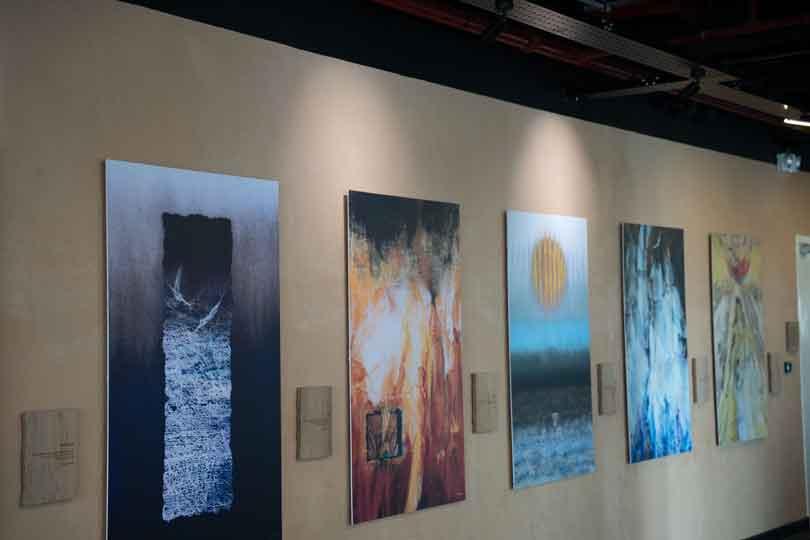
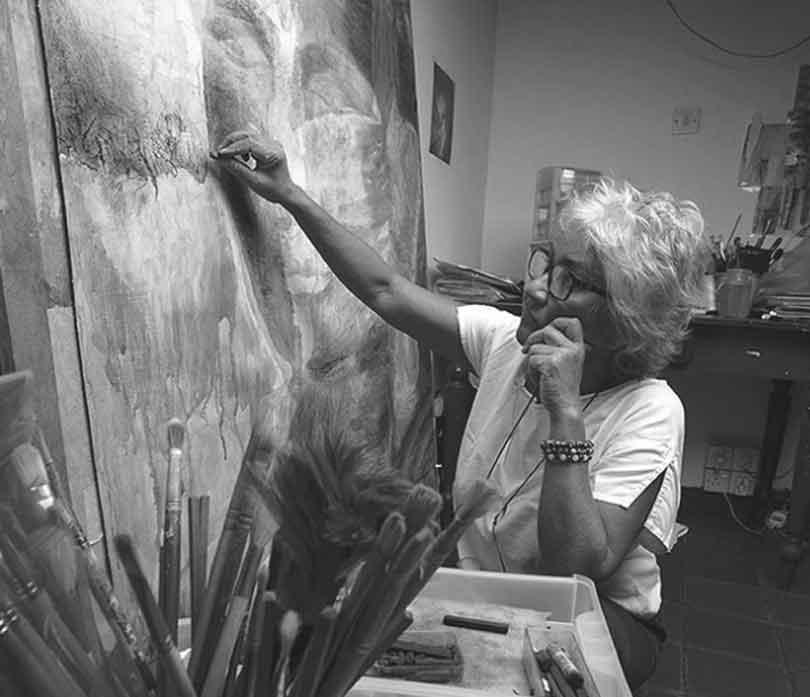
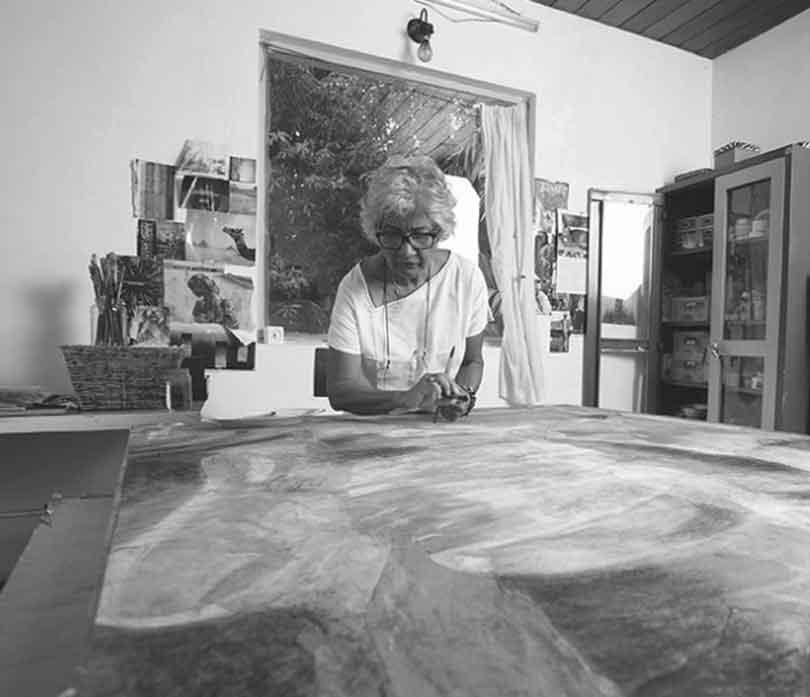
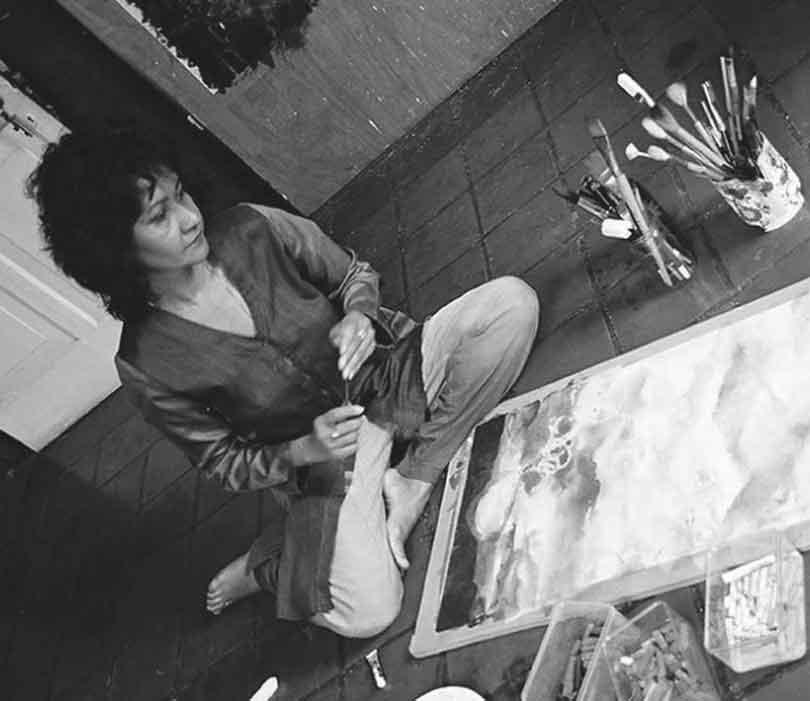
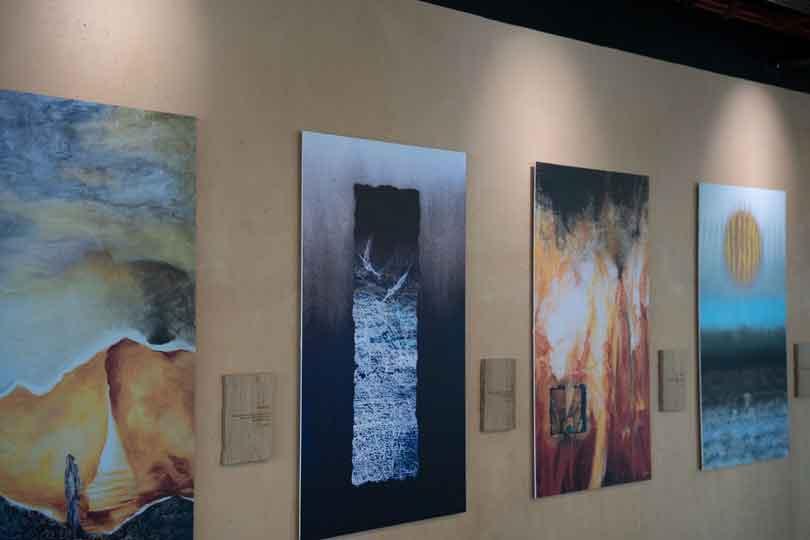
Anoma Wijewardene's engagement with climate change did not begin when the crisis entered the mainstream vocabulary. It began with an instinctive artistic recognition that the relationship between humanity and the natural world was already shifting. Her first solo exhibition addressing climate change was held in Sydney in 2005, years before climate anxiety became the defining cultural and political language it is today. Alongside this ecological inquiry ran another enduring concern: diversity, unity and the fractured human condition. Her first solo exploring these ideas was held in Delhi in 2002.
These were not isolated themes, but the beginnings of two long-running bodies of inquiry. Each subject continued to unfold across her practice, inspiring a succession of further solo exhibitions in the years that followed. Quest and Deliverance, among her significant second solo explorations of these two thematic territories, deepened that engagement, examining not only the visible wounds of conflict and environmental destruction but the psychological and existential landscapes left in their wake.
By the time Anoma presented her most recent works on unity at the Venice Biennale in 2019 and returned to climate change as a central concern in a London exhibition that same year, the subjects had travelled with her for nearly two decades. What is striking in retrospect is not simply the longevity of these concerns, but their prescience. Ideas that once existed at the margins of public consciousness had gradually become defining questions of our time.
It is this continuity that gives her work its particular urgency today. Anoma has not arrived at climate change because the world has caught up with her. Rather, the world has slowly moved towards questions her art has been asking for decades.
Her multimedia trilingual installation on reconciliation, incorporating writings on peace, music, performance and video, was exhibited at the National Gallery of Sri Lanka, further reflecting her long-standing engagement with memory, humanity and collective healing. Her artistic journey has also extended beyond the gallery into fashion and design, with creations displayed at the Victoria and Albert Museum and the House of Commons in London. Her clients have included iconic fashion houses such as Yves Saint Laurent, Pierre Cardin, Calvin Klein and Ralph Lauren, while her work has also appeared in international publications, including the cover of Vogue UK. In 2016, her work was exhibited at Sotheby's Hong Kong Gallery, adding another significant chapter to her international artistic trajectory. She was also selected by India for the SAARC Art Exhibition, which toured all seven capitals of the SAARC region, and later spent more than a decade as a visiting lecturer at leading British art institutions, including Central Saint Martins.
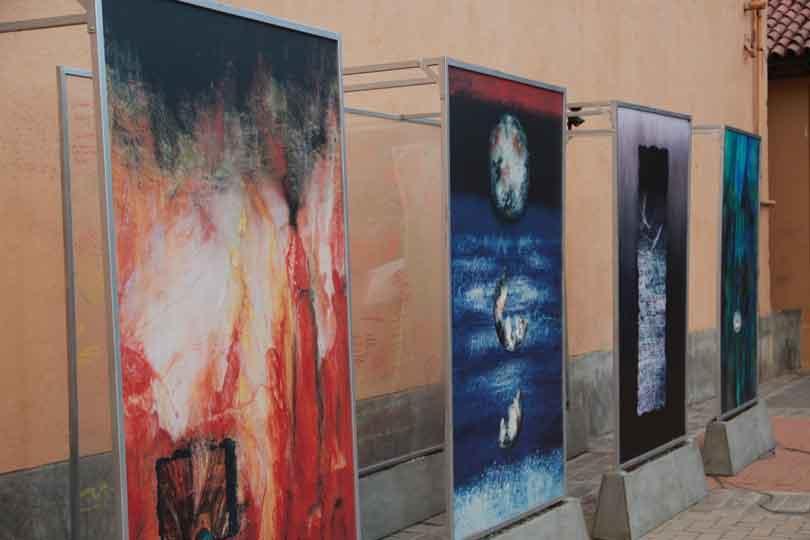
Anoma’s Quest and Deliverance return as works that seem uncannily attuned to the present. Their prescience is difficult to ignore. Brought together again under In Search of Horizon, the two bodies of work occupy a space between memory and renewal, asking what remains when the events that shaped us have passed, but their consequences have not.
“I consider quest and deliverance not as a wake-up call, but rather as a slow moving and generative cultural resolution to the dance of interdependence between the innumerable elements of this blue planet and the lethal limitations of a species”. - Natasha Ginwala
For curator Natasha Ginwala, the exhibition offers an opportunity to encounter Anoma’s practice anew. Having first worked with the artist during Colombo scope’s Way of the Forest, Ginwala describes an artist deeply committed to her craft, but equally driven by an enduring curiosity about the contradictions of human existence. Across painting, digital intervention, video and performance, Anoma has repeatedly returned to questions of fragility, violence, ecological damage and the possibility of coexistence.
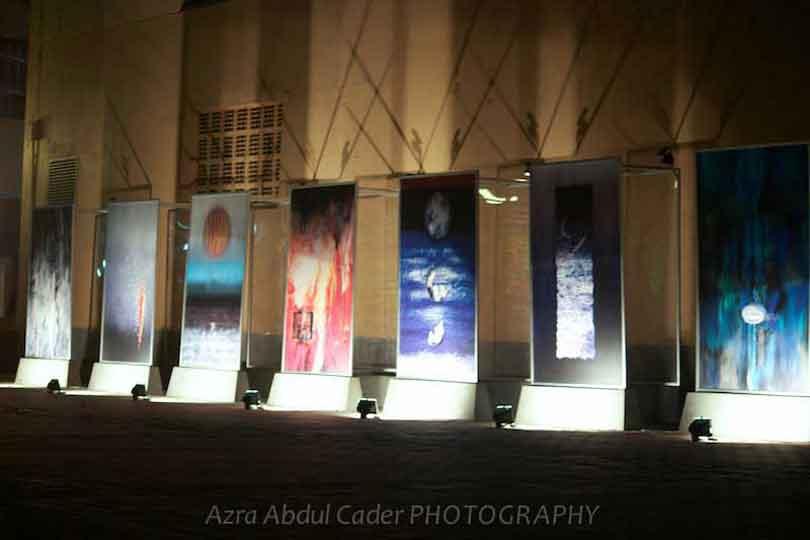
That inquiry is particularly resonant in Quest and Deliverance. Conceived around the years of Sri Lanka’s war, by Anoma’s visit to the North at the beginning of the 2002 ceasefire, where she witnessed the devastation left by years of conflict, and later by the aftermath of the 2004 tsunami. Moving through landscapes and histories marked by displacement, ethnic oppression and environmental rupture, the works resist becoming straightforward documents of catastrophe. Instead, they remain open-ended, searching for what might emerge from the wreckage. Perhaps this is what gives the two series their unusual longevity.
They were born from particular historical circumstances, yet the questions they ask have refused to remain in the past.
Conflict, displacement, ecological uncertainty and fractured relationships continue to shape the contemporary world. The circumstances have changed, but the underlying unease remains recognizable.
The scale of these projects also reflects a practice that has never been confined to a single medium or discipline. Their making involved poets, scientists, anthropologists, designers, analysts, translators, actors, composers and others, turning them into expansive encounters between different forms of knowledge. Their history is therefore not solely Anoma’s, but also that of the many people whose labor and imagination allowed them to exist.
The return of Deliverance is especially significant because the series now appears to inhabit a different historical moment from the one in which it was conceived. When Anoma developed the body of work in 2012, climate change had already become an urgent scientific and political concern, but its consequences had not yet acquired the visceral immediacy they possess today. More than a decade later, the vocabulary of climate crisis has become almost unavoidable. Yet Deliverance does not feel like an old environmental statement being brought forward to meet a new crisis. If anything, the present has moved closer to the questions the work was asking all along.
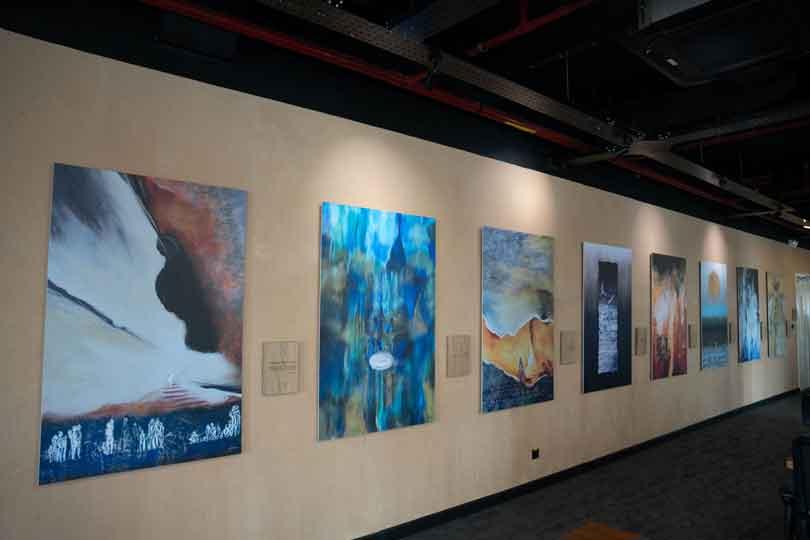
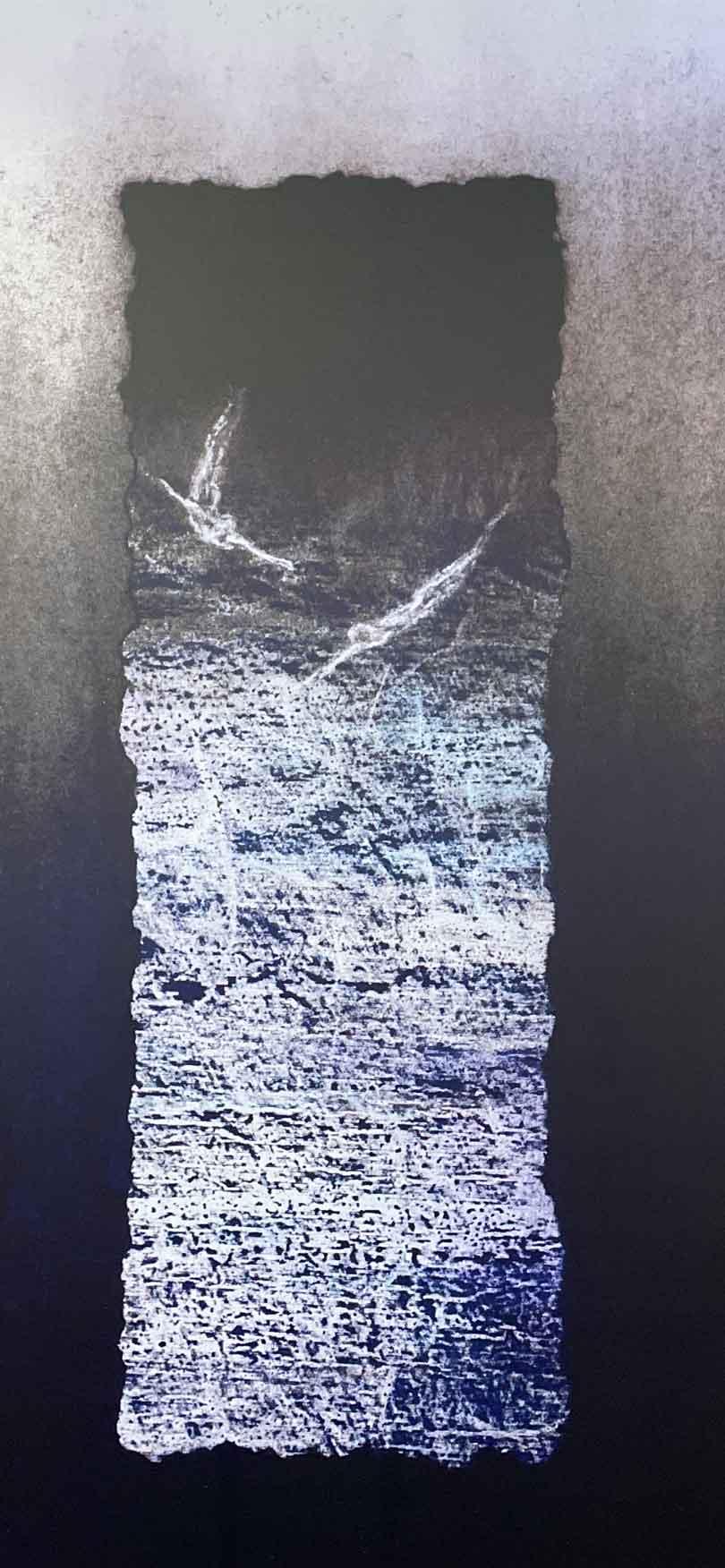
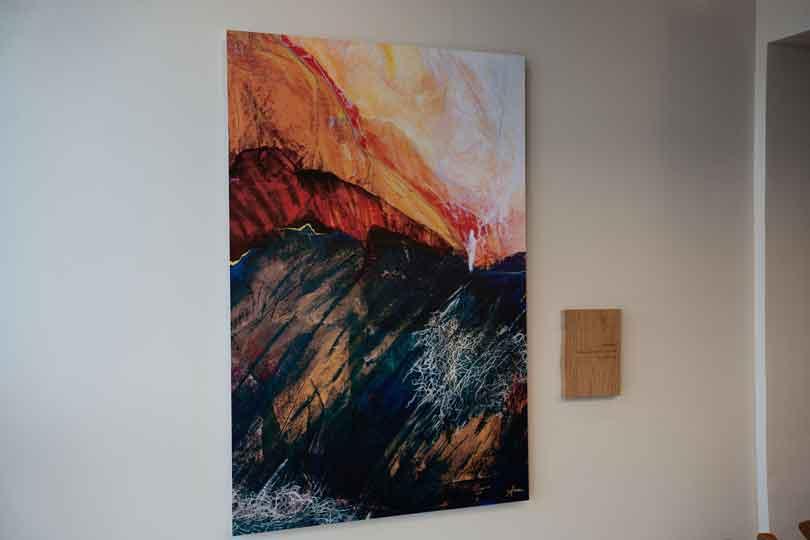
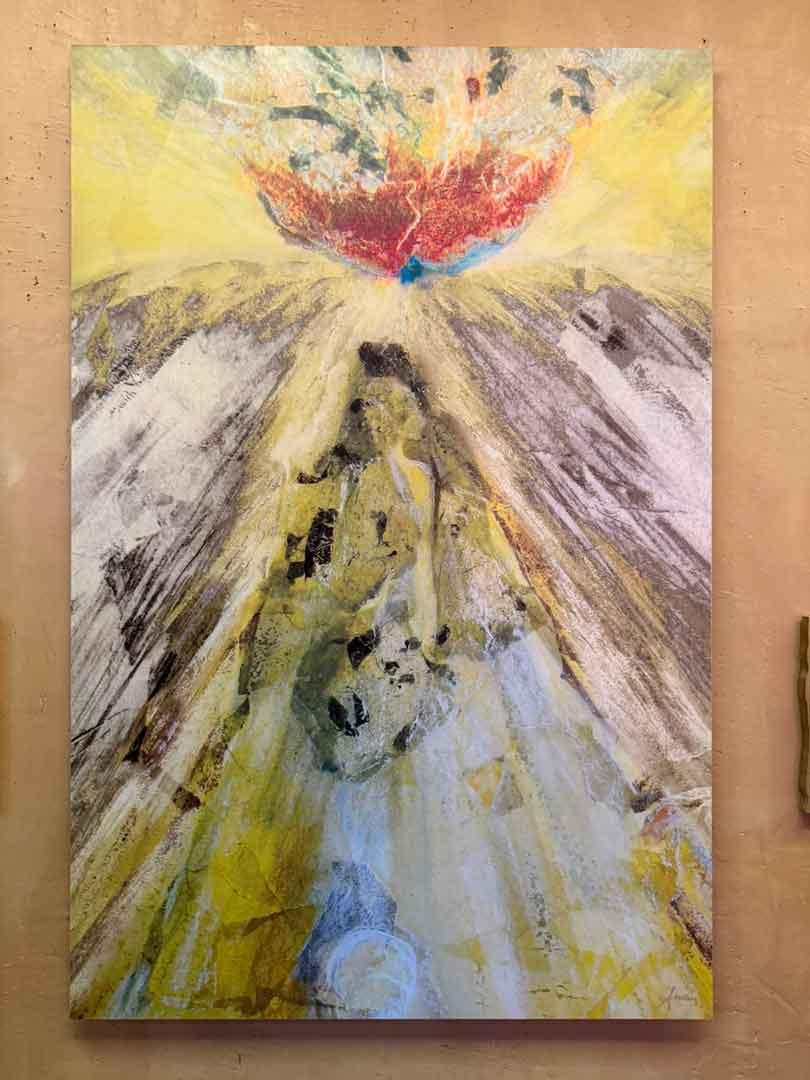
In Deliverance, the Earth becomes the protagonist. This inversion of scale is central to Anoma’s visual language. The human presence is often deliberately miniature, to place it within a larger temporal and ecological order. A human life, measured against geological processes, is extraordinarily brief. Mountains, oceans, forests and climatic systems operate according to temporalities that exceed individual existence. Anoma brings these radically different scales into the same frame: the immediate time of the human body against the almost incomprehensible duration of the Earth.
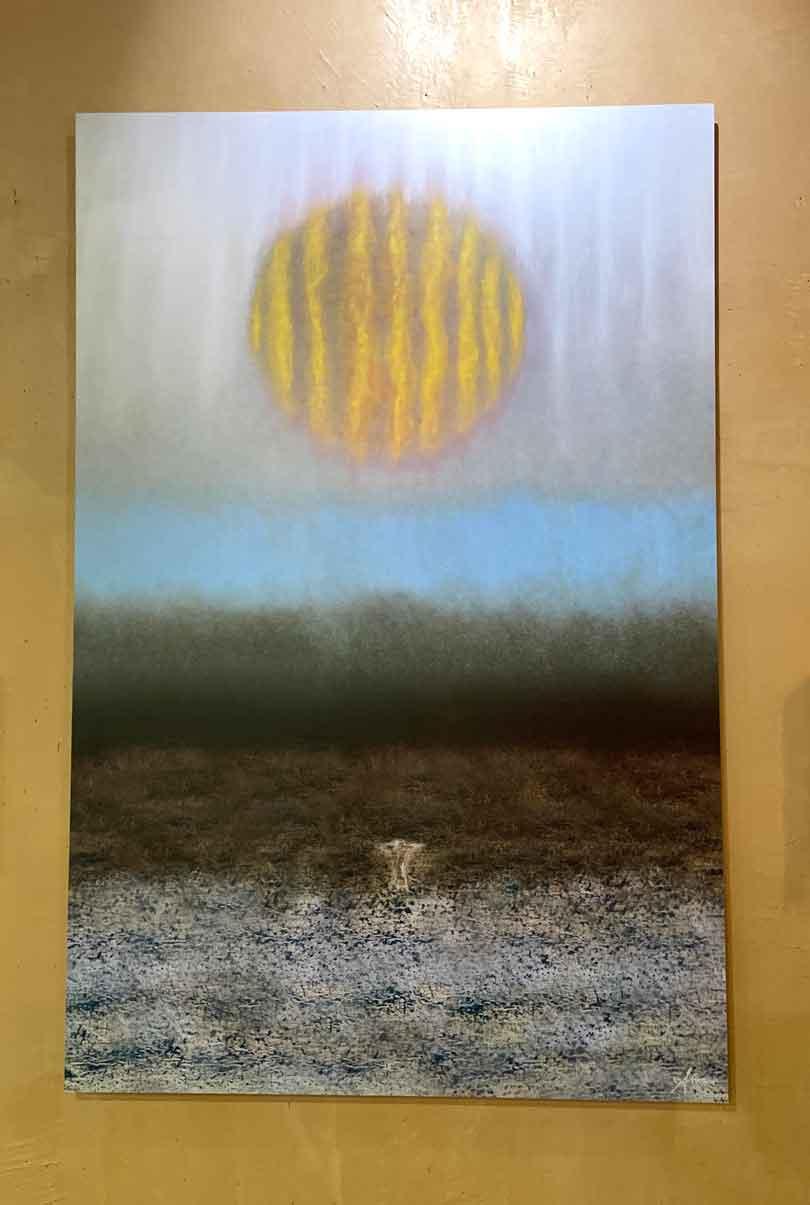
Her miniature figures consequently carry more than symbolic weight. They become instruments of scale. They remind us that what feels historically immense to a human being can be almost imperceptible within planetary time. This is particularly striking in The Earth Is Our Raft, where the human figure appears within an environment that seems simultaneously vast and fragile.
The metaphor of the raft introduces an immediate sense of precariousness. A raft floats because it must. It exists between land and water, neither entirely secure nor entirely surrendered to the elements. To imagine the Earth as a raft is therefore to dismantle the familiar idea of the planet as an immovable foundation beneath civilization. The Earth becomes a vessel carrying us.
The words of Vandana Shiva offer an illuminating counterpoint: “You are not Atlas carrying the world on your shoulder. It is good to remember that the planet is carrying you.” Anoma’s image quietly reverses the mythology of human mastery. We are not carrying the world. We are passengers upon it.
A passenger who damages the raft ultimately endangers everyone aboard it. Pollution, climate disruption, species loss and resource depletion are therefore not external problems occurring somewhere else. They are damage to the vessel upon which all of us depend. The human being is neither master nor merely victim of the Earth. The human being is dependent upon it.
That dependency becomes more complex in Coexistence, where floating assumes another meaning. To float is to relinquish the illusion of complete self-sufficiency. The body must trust the medium that holds it. Yet floating is inherently ambiguous. It can suggest freedom, release and weightlessness, but also drift, rootlessness and the absence of fixed ground.
Water throughout Deliverance intensifies this argument. It is not simply scenery. It functions as an elemental intelligence, a carrier of memory, a life-giving force and an agent of transformation. It can sustain, erode, absorb, separate and overwhelm. Its presence destabilizes the human desire for permanence. A coastline is never entirely fixed; a river is defined by movement; an ocean possesses no stable boundary in the way a constructed human environment does.
To paint water, therefore, is also to paint impermanence.
This concern connects Deliverance to the wider trajectory of Anoma’s practice. Her work repeatedly returns to landscapes marked by rupture: war, tsunami, displacement, environmental degradation and historical violence. Yet she resists representing catastrophe as a single frozen event. Her layered surfaces suggest instead that destruction has a duration. Trauma remains embedded in landscapes, just as memory remains embedded in material. The works operate almost as palimpsests, where one temporal layer is never entirely erased by another.
Seen alongside Quest, this becomes particularly significant. In Quest, violence is encountered through fractured images, disrupted narratives and landscapes carrying the residue of conflict. Deliverance extends that inquiry beyond the specifically human history of violence towards a planetary register. The wound becomes larger.
Ethnic violence, environmental violence and planetary instability begin to appear not as entirely separate crises, but as manifestations of a deeper failure to recognize interdependence.
This is why Anoma’s engagement with climate cannot be reduced to a plea for the preservation of picturesque landscapes. Her concern is fundamentally relational.
Who has the right to land? Who bears the consequences of environmental destruction? What happens when natural resources are treated as commodities rather than shared conditions of life? And, perhaps most importantly, what forms of knowledge have been marginalized by systems that have taught us to regard nature as something external to ourselves?
The influence of Ray Wijewardene, Anoma’s father, is inseparable from the philosophical core of Deliverance. A “fresh paradigm” in which human life exists in concurrence with nature rather than in opposition to it. His insistence on attending to nature’s own pace and rhythms finds visual expression in Anoma’s meditations on water, planetary time, interdependence and impermanence. This creates an important distinction between restoration and control. To restore an ecosystem is not necessarily to return it to a previous fixed state. Nature itself is dynamic. Repair means allowing relationships to regenerate.
In that sense, repair is more meaningful than reconstruction. Reconstruction imagines a return to what existed before. Ecological repair acknowledges that the world is continually changing and asks instead how damaged relationships might become viable again.
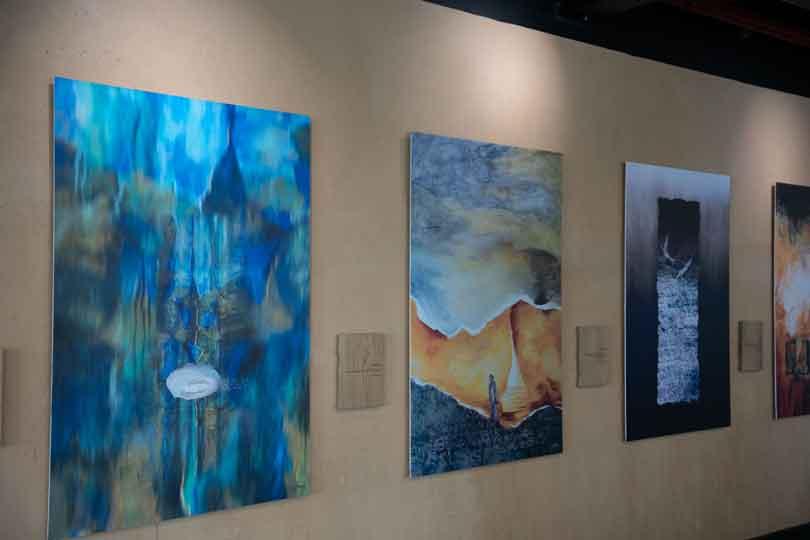
The work’s deepest force lies in this inversion. Humanity imagines itself as the master of nature, yet civilization exists entirely within the systems it is capable of destroying. The polluted sky is not an external landscape; it is our atmosphere. The threatened earth is not scenery; it is our foundation. The ecological warning recalls Rachel Carson’s enduring challenge to the idea that human progress can be separated from the natural systems that sustain it. What does it mean to call ourselves civilized if the very conditions that sustain life are being sacrificed in the name of progress?
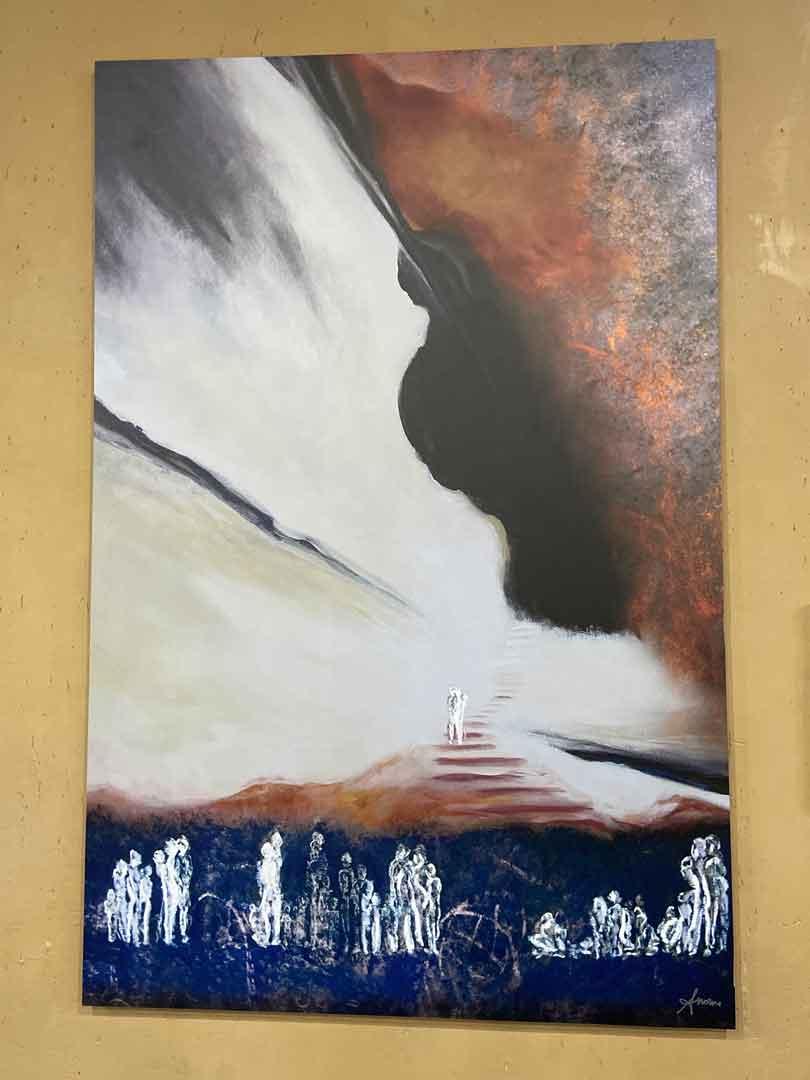
And yet Anoma does not resolve the image through despair. The figures remain. The path remains. The horizon, although obscured, has not disappeared. This refusal of closure runs through In Search of Horizon. A horizon traditionally suggests an endpoint, the place where earth and sky appear to meet. Yet it is always receding. The closer we move towards it, the further it appears to travel. Anoma transforms this physical phenomenon into a philosophical condition. The horizon becomes a future that cannot be possessed, only approached.
It is perhaps here that Deliverance acquires its greatest urgency. The work is not ultimately about the end of the world, nor is it an uncomplicated call for humanity to save it. It is about changing our position within the world.
To coexist, in Anoma’s visual vocabulary, is to surrender the fantasy of standing outside the systems upon which we depend. To float is to acknowledge that we are carried. To inhabit a raft is to understand that its vulnerability is our own. To look towards a horizon is to accept that the destination will continually recede, and that what matters is not simply where we arrive, but how we travel.
Twenty years on, Quest and Deliverance therefore do not return as completed statements. They return as unresolved questions, which may be precisely why they remain alive. Their historical moment has passed, but their questions have not. If anything, the present has made them harder to ignore.
It is an invitation to reconsider where we stand, what we have mistaken for permanence, and what forms of life might still be possible if we learn to see ourselves not above the world, but within it.
The Earth Is Our Raft
“You are not Atlas carrying the world on your shoulder. It is good to remember that the planet is carrying you.” Vandana Shiva’s words offer an illuminating entry point into The Earth Is Our Raft, where Anoma transforms the planet into a precarious vessel rather than an immovable foundation. The small human figures that recur throughout her work are significant here. Anoma uses them as markers of scale, reminders that human existence occupies only a brief moment within planetary time. Against the vastness of the Earth, the human figure is not rendered powerless, but placed within a relationship of dependence. And a passenger who damages the raft ultimately endangers everyone aboard it. The work therefore makes ecological interdependence almost painfully direct.
Searching for a Horizon at the End
In Searching for a Horizon at the End, At the base of the composition, a gathering of luminous, almost spectral figures emerges from deep blue, their collective presence suggesting humanity itself, caught within the consequences of its own actions. They appear suspended in a state of reckoning. Above them, the atmosphere fractures into soot, ember and pale openings, transforming the sky from a space of possibility into one of ecological anxiety. Humanity imagines itself as the master of nature, yet the painting reminds us that civilization exists entirely within the systems it is capable of destroying. The polluted sky is not an external landscape; it is our atmosphere. The threatened earth is not scenery; Yet the work is not entirely without hope. The figures remain, and the path towards the horizon remains visible.
Anoma does not offer salvation but leaves open the possibility of a change in direction. The horizon may be obscured, but it has not disappeared. In that fragile space between warning and possibility but to consider what kind of civilization we are building on the way there.
Coexistence
To float is to relinquish the illusion of complete self-sufficiency. The body must trust the medium that holds it, yet that surrender remains ambiguous. Floating can suggest freedom and release, but also drift, rootlessness and the absence of fixed ground. Anoma leaves these meanings unresolved, allowing vulnerability and freedom to exist simultaneously. The work consequently proposes a different relationship with nature, one based not on mastery but participation. To float is to recognize the forces larger than oneself and to move with rather than against them. Anoma’s ecological ethic is therefore not one of conquest, but of accommodation: to learn how to move within the world rather than imagine ourselves above it.