Anoma Wijewardene’s Quest: The Unfinished Work of Peace
By Thaliba Cader
If Deliverance looks outward, towards the Earth, planetary time and the fragile systems that sustain life, Quest turns inward, towards the psychological and historical terrain of a country attempting to live through violence. Conceived during the ceasefire of Sri Lanka’s civil war and in the aftermath of the tsunami.
Quest is perhaps best understood not as a conventional body of work about conflict, but as an inquiry into what conflict does to the human imagination.
It is concerned with the condition of living between rupture and the possibility of repair. Anoma herself describes Quest as being about peace and reconciliation on several interconnected levels: between human beings and nature, between societies and cultures, between individuals and, most profoundly, within the self. That final movement is crucial. The exhibition refuses the comforting assumption that peace is something that can simply be negotiated externally, between governments, armies or political representatives. It proposes instead that conflict also inhabits the individual imagination. The divisions visible in society are, in some sense, rehearsed internally through fear, prejudice, insecurity and the construction of the “other”. Anoma constructs a visual space in which the viewer is compelled to search alongside her.
Returning to Sri Lanka after decades abroad, Anoma encountered a country whose landscapes were saturated with the visible and invisible consequences of conflict.
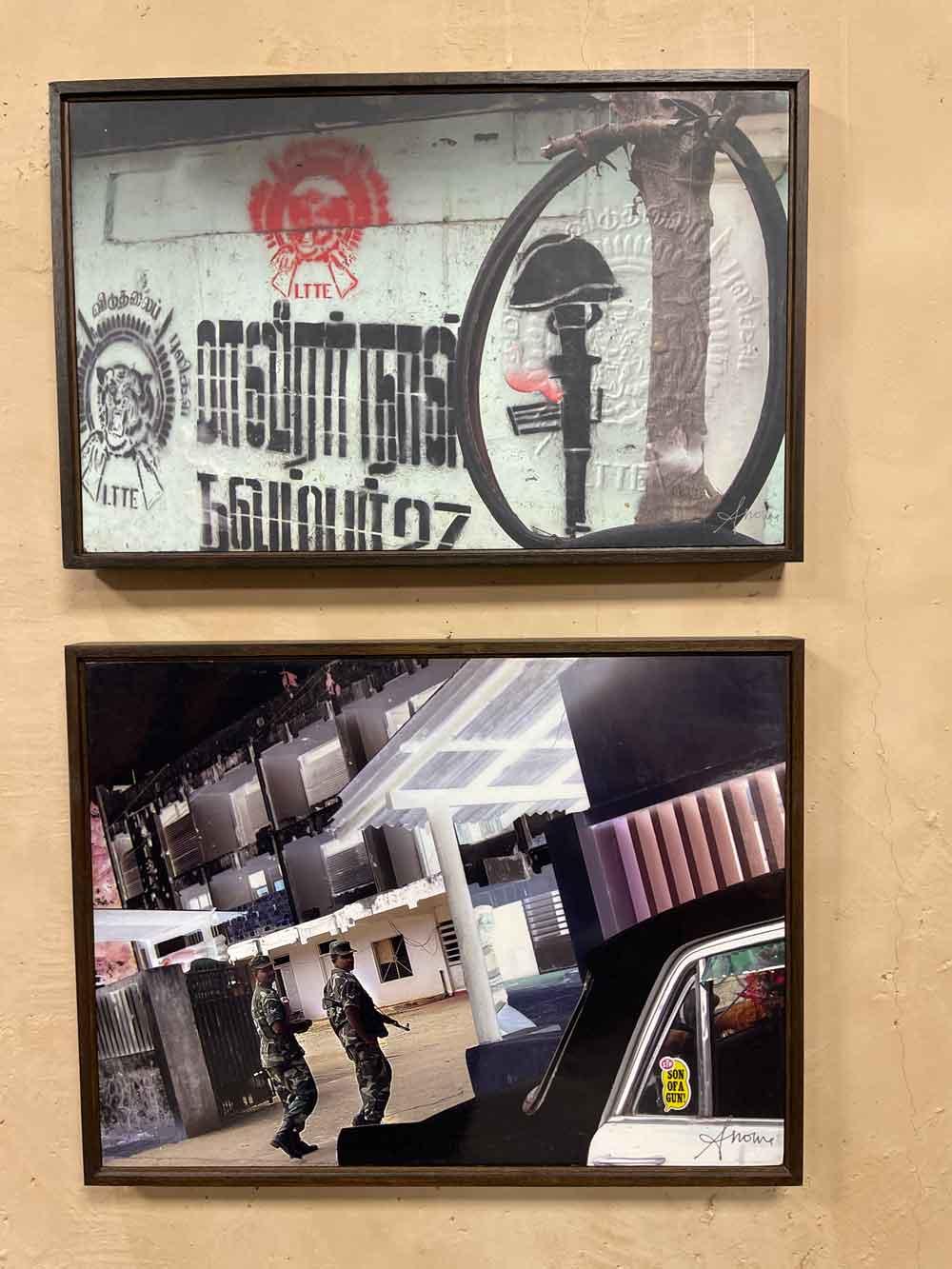
This distinction matters because the camera initially enters Quest as an instrument of listening rather than authority. Anoma was not approaching the landscape as a journalist seeking evidence or as a photojournalist constructing a record of events. She was an artist trying to comprehend what she was seeing. The resulting photographs became raw material for a second transformation. Rather than preserving the photographic image as an authoritative document, she manipulated it, sometimes minimally and sometimes almost beyond recognition.
The image therefore becomes neither pure fact nor pure invention. It occupies the unstable territory between the two. This allows her to move away from the evidentiary demands of journalism and towards something more psychologically complicated: the emotional truth of a landscape marked by loss.
This is one reason the photographs in Quest can be disturbing without becoming voyeuristic. The work does not reproduce suffering simply to make the viewer consume it.
That movement is also reflected in the exhibition’s extensive use of quotations. The words accompanying the works come from philosophers, political thinkers, writers, scholars and public figures, but Anoma is careful not to assign them as literal captions to individual images. Instead, they function as a parallel chorus. The visual and verbal components speak across one another, producing an open field of interpretation.
This is particularly significant because images of war are vulnerable to becoming exhausted through repetition.
Anoma herself recognizes the danger of being continuously exposed to images of conflict and disaster. The contemporary viewer can become brutalized by looking. Catastrophe becomes another stream of information, another photograph rapidly displaced by the next.
Quest attempts to interrupt that desensitization. It asks the viewer not simply to look, but to look again. The distinction between seeing and witnessing becomes important here. Seeing can be instantaneous. Witnessing implies duration, responsibility and a willingness to remain with what is difficult. Anoma’s images demand precisely this second kind of looking. They are not simply illustrations of suffering; they are invitations to consider what suffering does to memory, identity and the possibility of coexistence.
Anoma recalls encounters in which soldiers, civilians and others observed her trying to understand what she was doing, uncertain whether she was a journalist, an artist or something else entirely. That ambiguity is revealing.
The artist occupied an unusual position: entering difficult spaces, but without claiming to possess the stories within them.
Her position was fundamentally one of listening. Anoma’s recollections of the people she encountered reveal an important counterpoint to the statistics of catastrophe. The numerical scale of war and tsunami can be overwhelming: tens of thousands dead, hundreds of thousands displaced, homes destroyed, families fragmented. Statistics establish magnitude, but they can also flatten individuality. The encounter restores it.
This is where Quest becomes more than an exhibition about Sri Lanka’s conflict. It becomes an examination of the ethics of looking at another person’s pain. Who has the right to represent suffering? What happens when an artist enters a landscape carrying a history that is not entirely her own? How does one represent trauma without converting it into spectacle?
The collaboration behind Quest reinforces this. Anoma worked with graphic designer Kirby de Lanerolle for several years and drew upon the knowledge of political analysts, social anthropologists, writers, lawyers, multimedia practitioners and others. This interdisciplinary network matters because the artist recognizes the limits of the solitary artistic gaze. The complexity of conflict cannot be contained within one discipline.
That tension between the individual and the collective is one of the work’s deepest characteristics. Quest is simultaneously a national meditation and a private act of processing. Anoma’s statement that she was trying to understand the anxiety she lived with becomes particularly revealing. Whether the subject is war, environmental destruction or social division, her artistic process begins with an internal question: what does it mean to live within this condition?
Consequently, the exhibition does not divide the world neatly into victims and perpetrators, innocent and guilty, one community and another. This should not be mistaken for an erasure of responsibility. Rather, it is an attempt to examine the psychological architecture that allows violence to become possible in the first place.
This is particularly important because Anoma’s understanding of peace is not synonymous with silence. An armed truce is not necessarily peace. The absence of open violence does not automatically constitute reconciliation. A society can stop fighting while continuing to carry the psychological structures that made fighting possible.
This questioning structure is what separates Quest from propaganda. Propaganda gives the viewer an answer before the viewer has had the opportunity to ask a question. Anoma does the opposite. She presents fragments, contradictions, disturbing images, poetic interventions and competing voices, then leaves the viewer inside the uncertainty.
The uncertainty is productive.
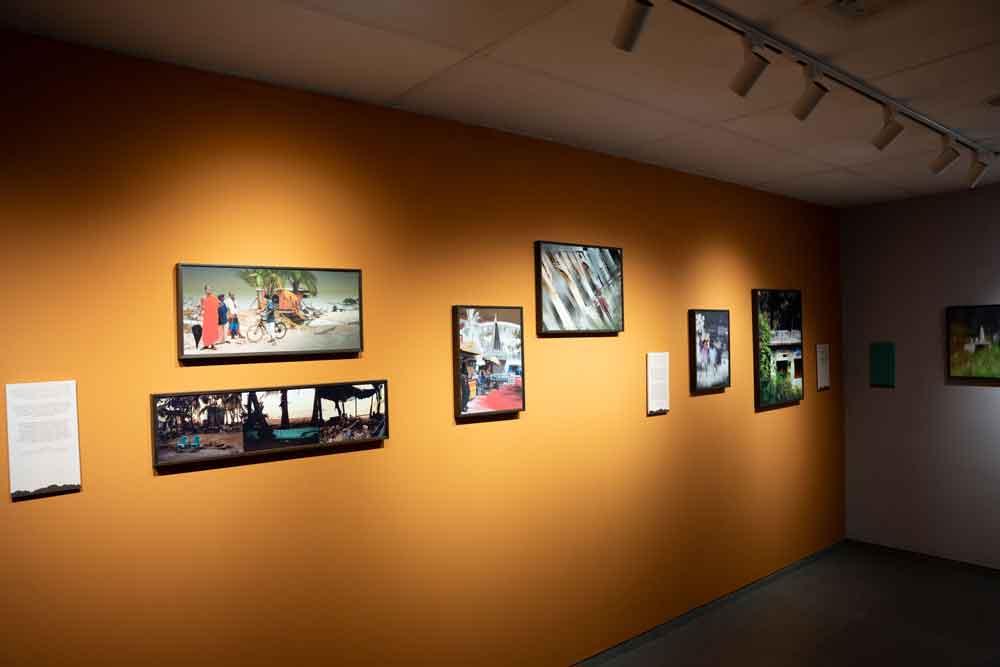
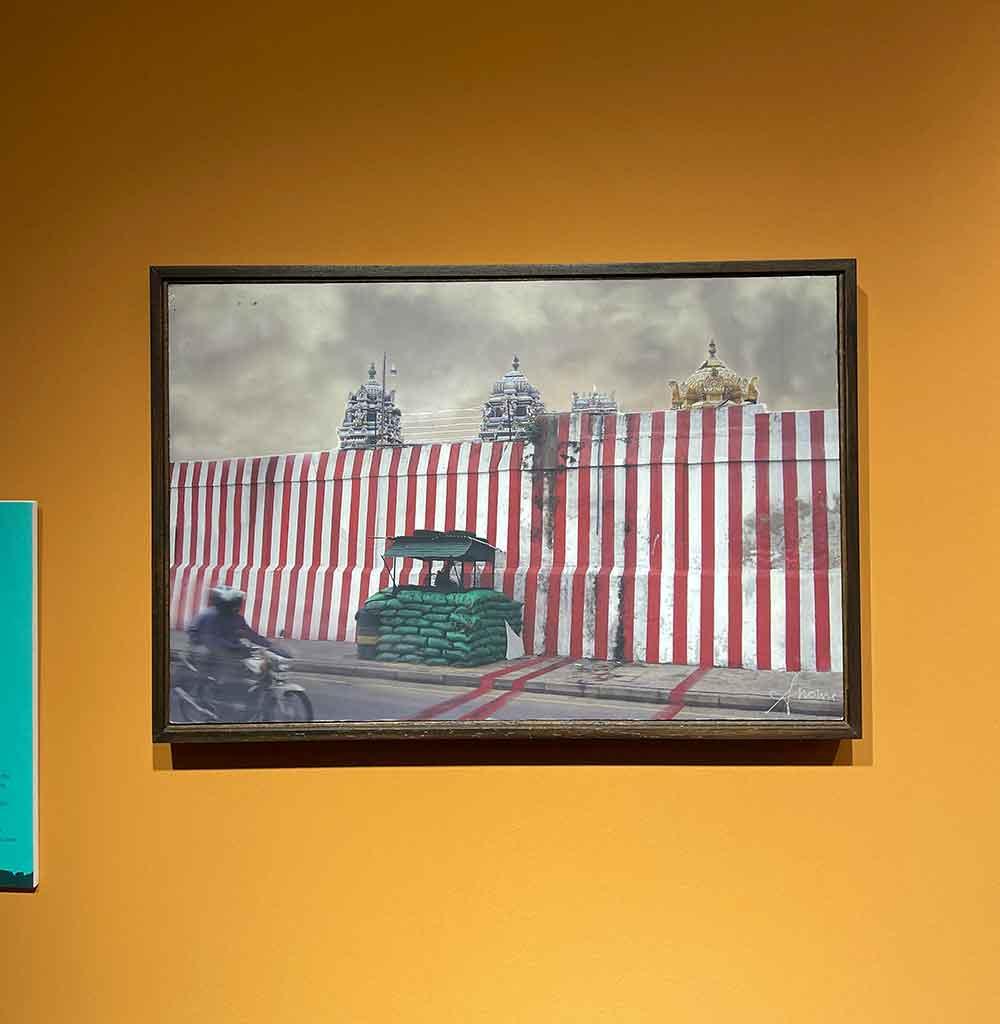
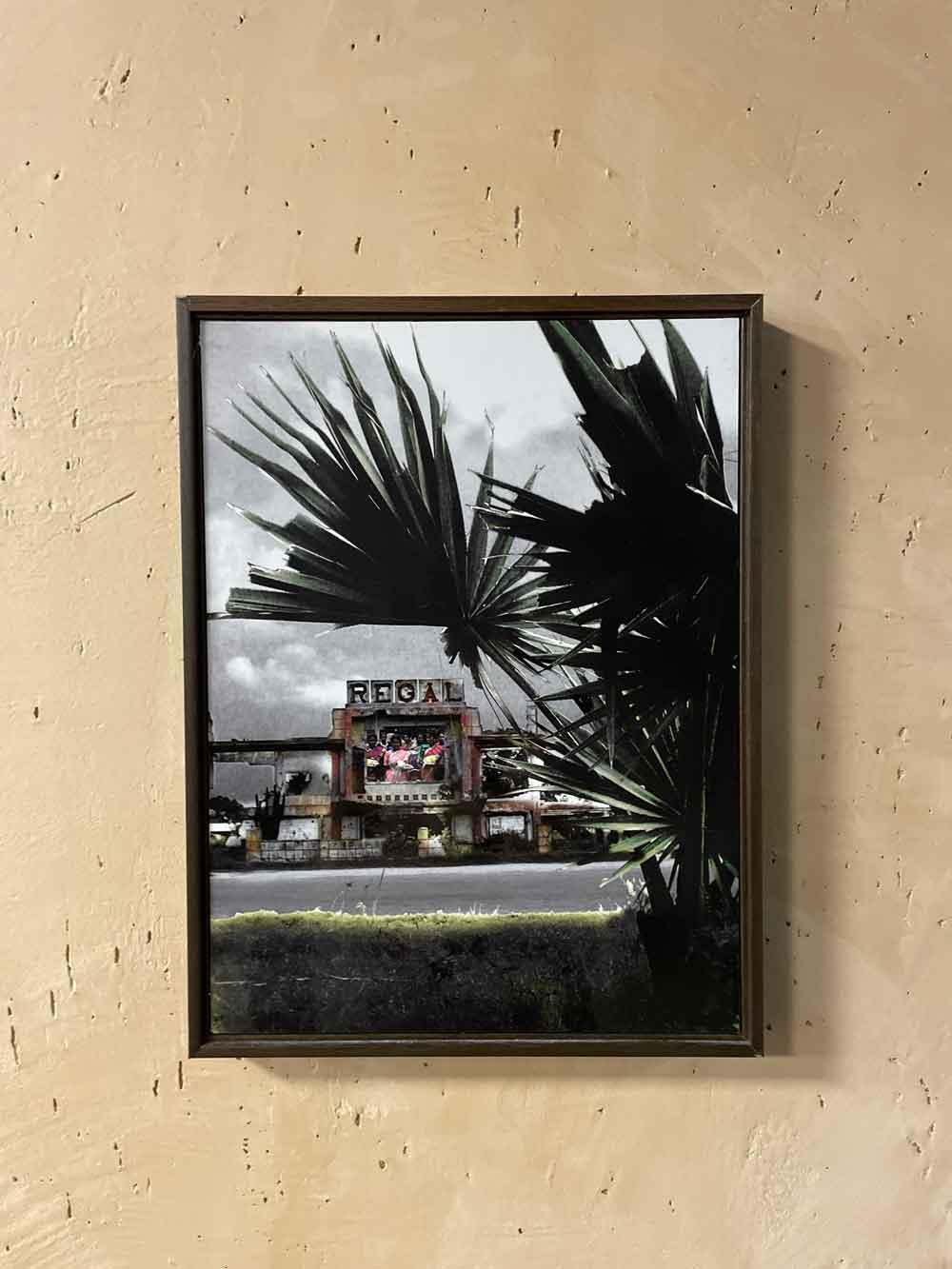
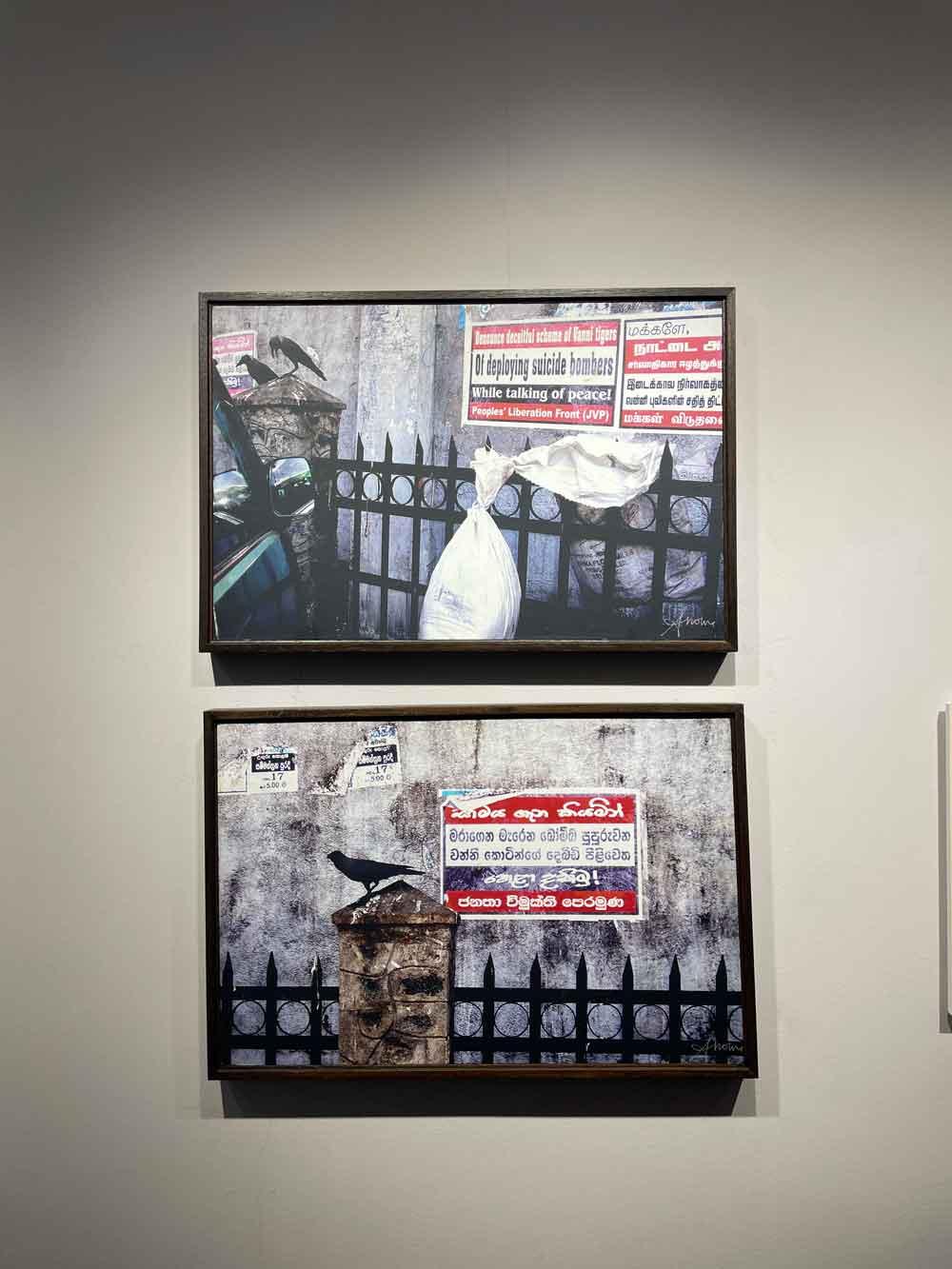
A particularly revealing aspect of the photographs is their juxtaposition. A checkpoint can exist beside a temple. Military architecture can sit within an ordinary urban landscape. A moment of tenderness can occur within a landscape of surveillance. The familiar and the threatening coexist. This is the visual language of a country accustomed to conflict.
Anoma’s manipulation of colour and form intensifies this relationship between presence and absence. A red mark, for instance, can evoke blood without literally depicting a body. A distorted landscape can communicate psychological disorientation without showing an act of violence. A fragment can become more disturbing precisely because it refuses to explain itself completely.
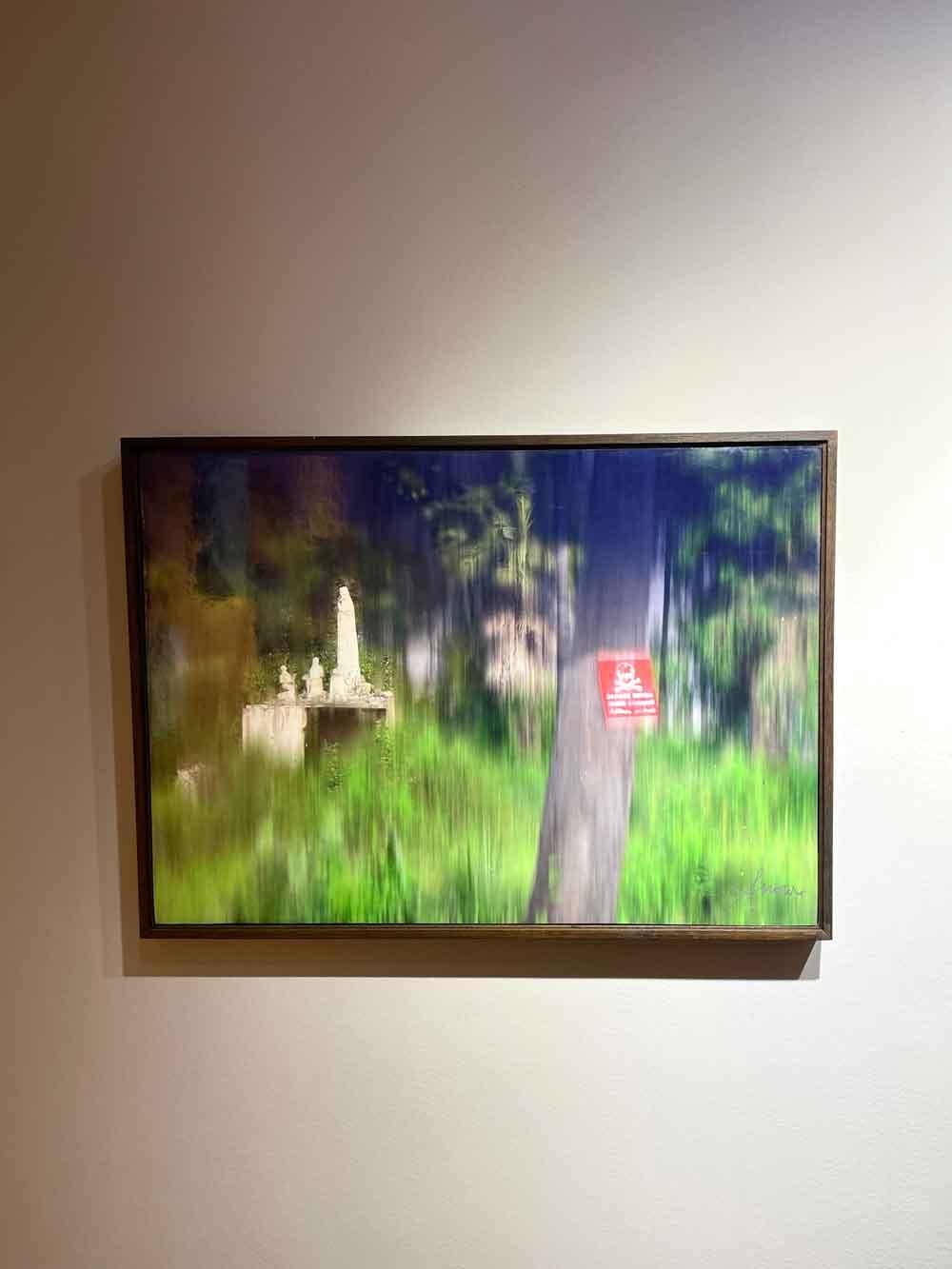
This is where her practice moves from representation into evocation. She does not need to reproduce the entire event. She gives us its afterimage.
The different elements that form part of the city become important in this particular photographic vocabulary. Through digital manipulation and a deliberate engagement with innocence, the work returns us to a deeply critical period in the island’s history, one marked by trauma. The burning of the Jaffna Library, for instance, remains a significant rupture in the historical memory of the people of this country. Its destruction was not simply the loss of a building, but an attack on knowledge, cultural memory and access to an entire intellectual inheritance. The image becomes a reminder of what happens when knowledge itself is set on fire.
“At one point, I was working in an area where I had been warned about landmines. It was probably a very foolish thing to do, but I became obsessed with getting the image I wanted. I could not achieve the particular shot from outside the space. I had to enter it in order to create the juxtaposition I was looking for. Those moments are part of the emotional and physical reality behind the work,” Anoma Wijeyawardene
It is an embodied and subjective process, one that carries an emotional vocabulary shaped by personal pain, collective pain and the hope that we might find a better way to live and love one another.
Natasha Ginwala points to another recurring image: the church as ruin, and the ways in which sites associated with faith, justice and community have repeatedly become sites of violence.
“I was thinking particularly about the church as a ruin and the ways in which sites associated with faith, justice and community have repeatedly become sites of violence. By the time I moved here, the Easter Sunday attacks had also become part of the island’s contemporary memory. The church therefore becomes a recurring site through which questions of violence, loss and hope can be considered,” Natasha Ginwala
The tsunami introduces another complexity because, unlike war, it does not possess an obvious human antagonist. Nature’s violence appears indiscriminate. Yet its consequences become entangled with pre-existing social inequalities and political divisions. Communities already displaced by conflict encountered another catastrophe.
The distinction between natural and human disaster consequently becomes less stable. This anticipates the ecological concerns that would become more pronounced in Deliverance. In Quest, Anoma is already beginning to ask how human beings exist within forces larger than themselves, whether those forces emerge from political systems, collective psychology or nature itself.
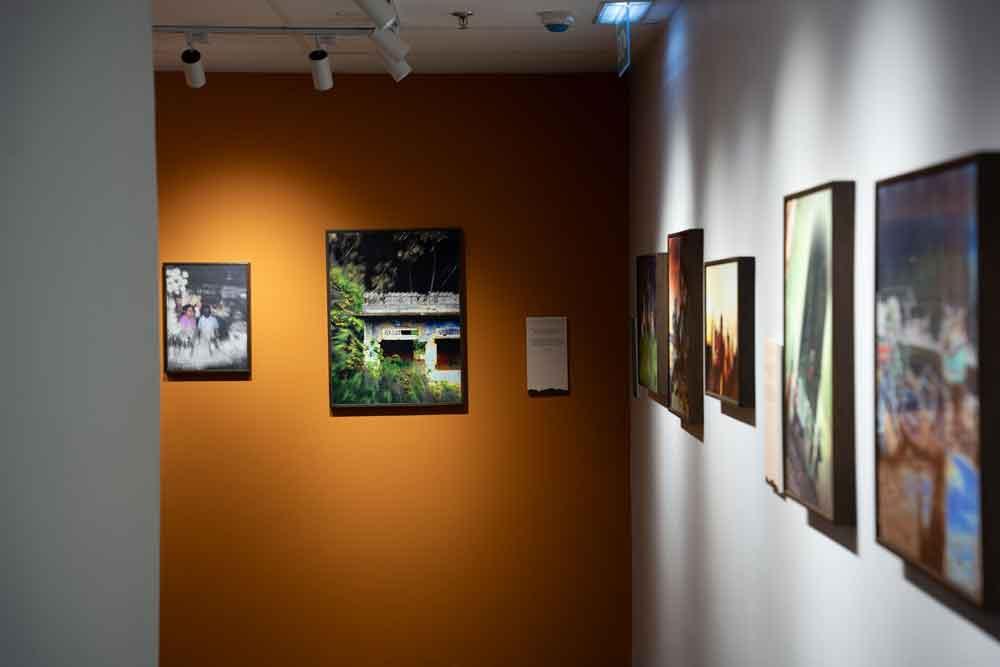
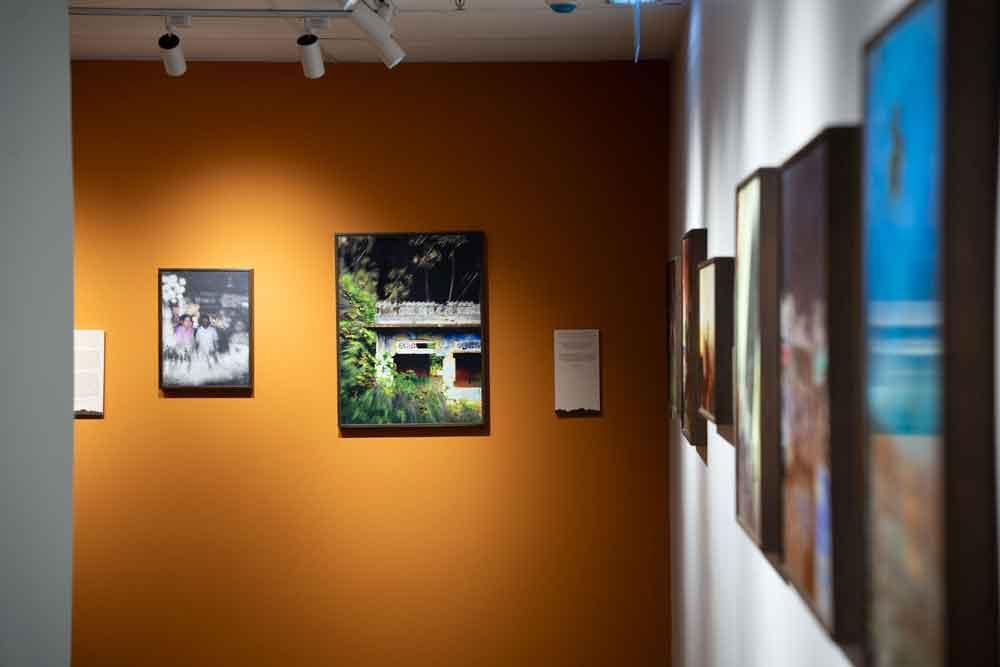
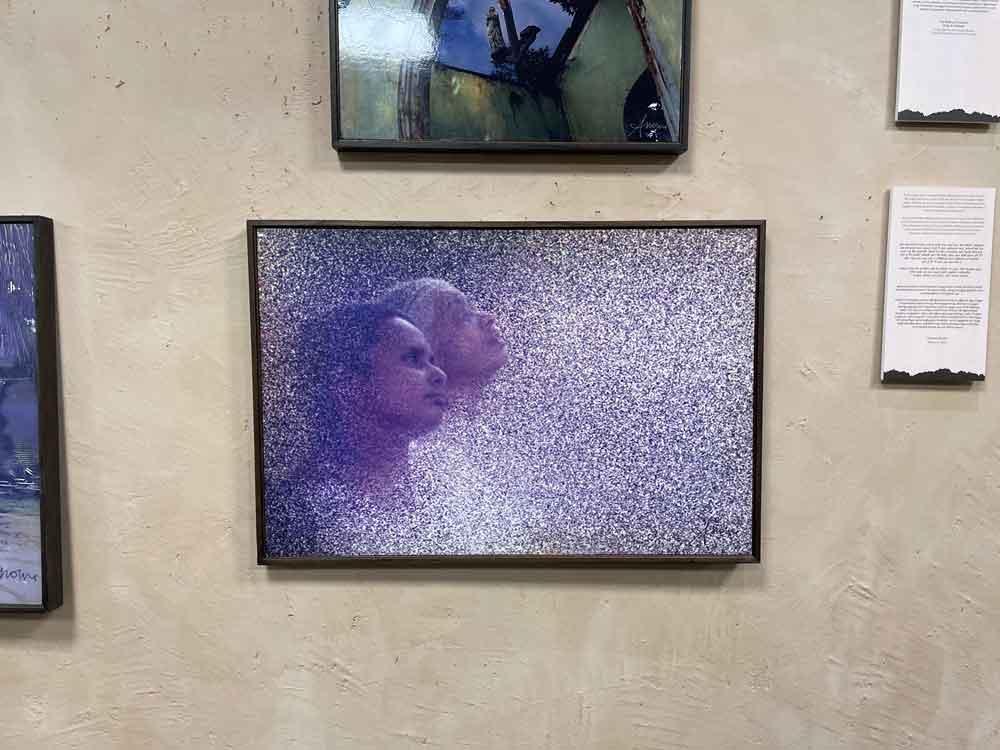
In another work, two women, one young and the other visibly older, gaze into the distance as the landscape around them dissolves into an almost crystalline abstraction. Neither the past nor the future is fully legible. Instead, the image suspends them within a space of uncertainty, where memory recedes and what lies ahead remains indistinct. Yet there is something quietly hopeful in this ambiguity. The women are not simply looking back at what has been lost; they are also looking towards what might still be possible. The work becomes a meditation on waiting, endurance and the fragile act of imagining a future.
Seen from the perspective of In Search of Horizon, Quest can therefore be understood as an early foundation for the artist’s larger inquiry. The enemy changes, the scale expands and the ecological dimension becomes more pronounced, but the fundamental question remains: how do we inhabit a world of fracture without reproducing fracture within ourselves?
In that sense, Quest is neither a memorial nor a manifesto. It is an ethical experiment in looking.
The final question of Quest therefore remains deliberately open: if the path to peace begins within the self, what do each of us do with the conflicts we continue to carry there?
The artist does not answer. She leaves us with the quest.
------------------------------------------------------------------------------
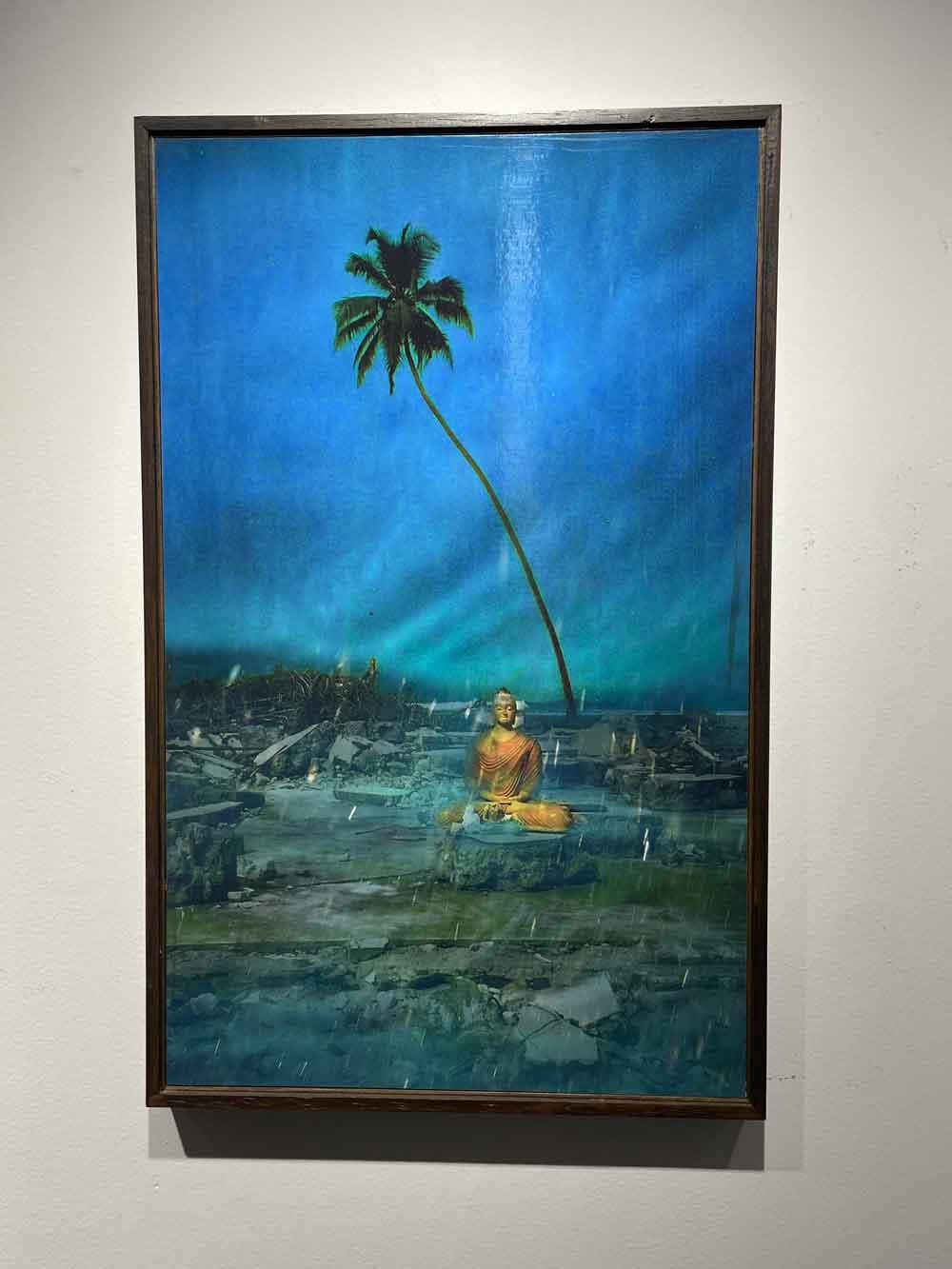
All that remained, tsunami 2004
On the southern coast, almost everything around the site had been destroyed by the tsunami. Amid the devastation, a Buddha statue remained, an almost improbable image of endurance. Anoma presents it not simply as a religious symbol, but as a quiet witness to catastrophe, its stillness set against a landscape transformed by loss. The underwater image layered over the photograph deepens this sense of rupture, turning a real landscape into something submerged and dreamlike, as though trauma itself has not entirely receded but continues to exist beneath the surface of memory. Yet the surviving statue introduces a quiet counterpoint to devastation. It does not promise easy recovery, but suggests the possibility of endurance, of finding something to stand upon after the ground has been altered. For a country repeatedly asked to rebuild after catastrophe, the image becomes less about what was destroyed than about what remains, and whether what remains can become the beginning of hope.
Land mine sign and church remains near A9 Jaffna, 2002
Checkpoint, Kovil, bike, Pettah, Colombo, 2005