The Endless Harvest
By: Devika Brendon
The title of this exhibition, which was held from 31 July to 7 August at Haputale Town Hall, is very powerful and resonant on several levels. For an agricultural society, the growing of crops is the focus of their lives. This is why the harvest festivals in many cultures celebrate prosperity and abundance and invoke divine intervention and assistance to support the growing of grain, vegetables, rice and other foods grown in the ground. The idea of an ‘Endless Harvest’ evokes a prosperous society which is nourished by dependable natural cycles of growth, and abundant food resources. The reality experienced by many people living and working in this sector is in stark contrast to this vision of plenty: economic insecurity, food shortages, and deprivation.
This is especially true of the Malaihaya Tamil community in the hill country of Sri Lanka, who were imported as labour by the British to cultivate the tea which has made Sri Lanka famous. The industry, which has brought great profit to the country and the owners of the tea manufacturing companies, has made their profits from the labour of this community, and shortchanged them in return. Colomboscope this year extended its showcasing reach to provide an opportunity for artists from this community to tell their stories in art and in voice, by creating an Exhibition which was located in the middle of the hill country. The art works and installations in the ‘Endless Harvest’ Exhibition are made out of the everyday tools and implements used by the people in their working life. It is the first time ever that artists from almost every part of the upcountry region have met in person to tell their own stories.
The artists participating in this exhibition were Adithan Sathasivam, Arulraj Ulaganathan, Dharmaraj Krishanthi, Danaraja Kishotha, Jehatheeswaran Keshavan, Jeyakumar Thangavel, Kanagadurkashini Raman, Rathnakumar Nivashini, and Priyanka Selvarajah. The project was co-organized by Colomboscope with artist-educators Arulraj Ulaganathan from Haputale and Pushpakanthan Pakkiyarajah.
Adithan Sathasivam from Nawapitiya (graduate from Jaffna University) has made paintings which connect the historical uprooting of Malaiyaha Tamils from India through forced indentureship to British-administered Ceylon, to present day migration through the story of a mother who has needed to seek employment in the Gulf, through vibrant coloured fields and a family of protagonists he relays how many upcountry families are forcefully separated to gain economic security.
It is in every way an immersive experience, and it is designed to be, because the daily experiences of this community are usually invisible to outsiders. Visual images have a direct impact on a viewer’s understanding in ways that shape other people’s experience and lived realities very intensely. I once saw a film called ‘Jarhead’ which showed a soldier who had returned from a gruelling tour of duty in the Middle East. His built-up sense of horror is shown one day after his return back home, when, feeling nauseous, he vomits sand.
The images of the tea leaves throughout this Exhibition, in their various forms and modes, seemed to me to speak of the same kind of visceral emotion - of disillusionment, of despair, of a landscape’s resources being directed for profit, and commercially utilised, and people’s energy and vitality being exploited and drained for the profit of warmongers and colonizers. In order to create this exhibition, the project actually included weekly mentorship sessions in the weeks prior to the event, to allow the artists to develop their ideas and put them into the appropriate forms to convey their ideas.
It is a powerful act of reclamation and assertion to construct this display of creativity and expression in the midst of the tea country where the displaced people were located and positioned by the British colonisers more than 200 years ago. Tea, the growing of it, the cultivation of it, the physical danger and the stress of tea plucking, of harvesting it, and delivering it load by load to be dried and processed to be sold, is evident in every aspect.
But instead of the harvest being cultivated to nourish the people who do the work, it is being cultivated for profit, and the workers are utilised as instruments towards that goal. The power of this exhibition is that the artworks portray the feelings of those whose opinions and experiences are not heard, because they have been systematically ignored and silenced, shouted down and erased by the dominant narratives of capitalism.
A young girl from the community spoke to me about her feelings about the exhibition:
‘Today, I visited an exhibition held in the Haputhale Town. The exhibition focused on the challenges and issues faced in the up-country regions. I felt very proud to have been born in the Hill Country. At the same time, I was deeply saddened by the hardships faced by the Hill Country workers.’
A young man, who had been forced to seek employment in the Middle East, and has now returned, told me with anger and sadness that he and his community were seen by the outside world as ‘rubbish people, as garbage people’.
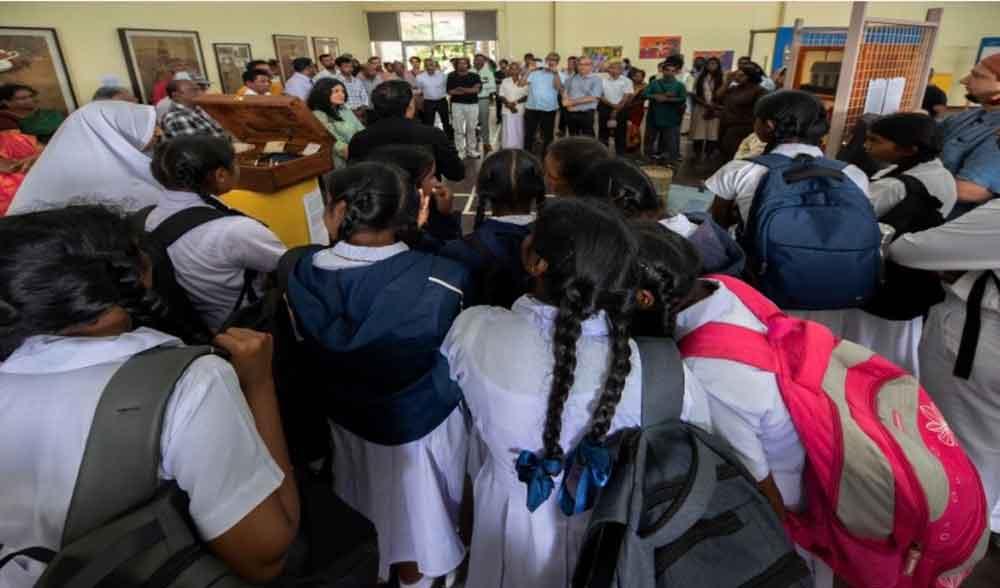
The artworks were framed by a discussion led by the artist and curators, which took place on the stage of the Haputale Town Hall. The paintings and artworks and installations were displayed on the walls and floors of the Hall, in an immersive and accessible way, so people could walk up to them, and around them, and observe every detail, grounded by the contextual discussions which were constructed around them.
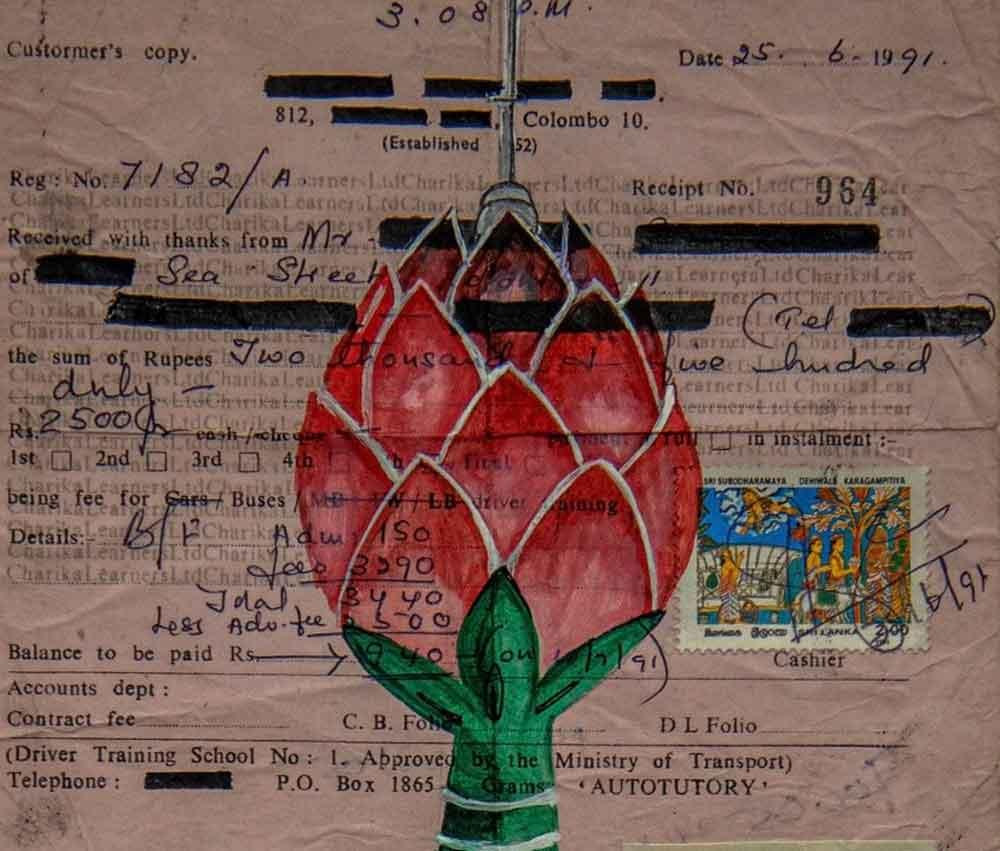
This exhibition was mindfully designed to be an immersive experience, from the literal centring on the stage of the stories of the history and cultural heritage of the Malaiyaha Tamil community to their unique experiences and perspectives of the dominant narratives by which they had been marginalized and pushed out of the frame. Here images of the lion with the sword and the Lotus Tower in Colombo a symbol of internal migration and displacement and daily commutes for jobs from the hills into Colombo, are seen only as part of a mosaic, not foregrounded.
Many of the images of people are in sepia or tea-stained canvas, making us think of how displaced and ungrounded the people feel, like shadows in the landscape of their own existence, many with their faces covered or obscured, to show their anonymity to those who observe them; but the brightly coloured ones strike with force, showing verve and resilience. The artist Jeyakumar Thangavel’s new body of sculptures creates stirring image constellations addressing acts of social erasure, extraction, and loss of individual subjectivity. Thangavel draws from lived experience, and his ancestry as a third-generation Malaiyaha Tamil artist living in Kandy. He graduates this year from Eastern University in Batticaloa. In the sculpted forms of the Roti, he addresses aspects of sexual violence, alcoholism and political extractivism.
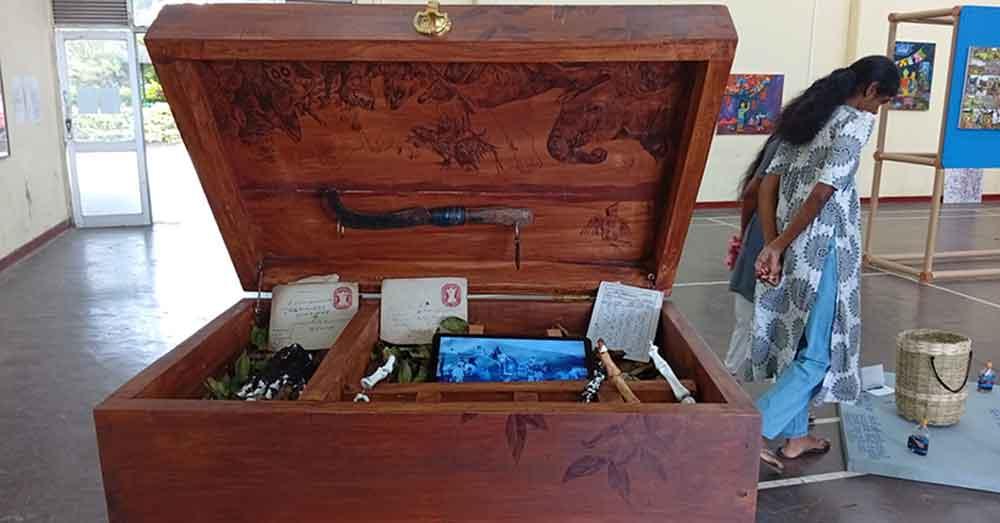
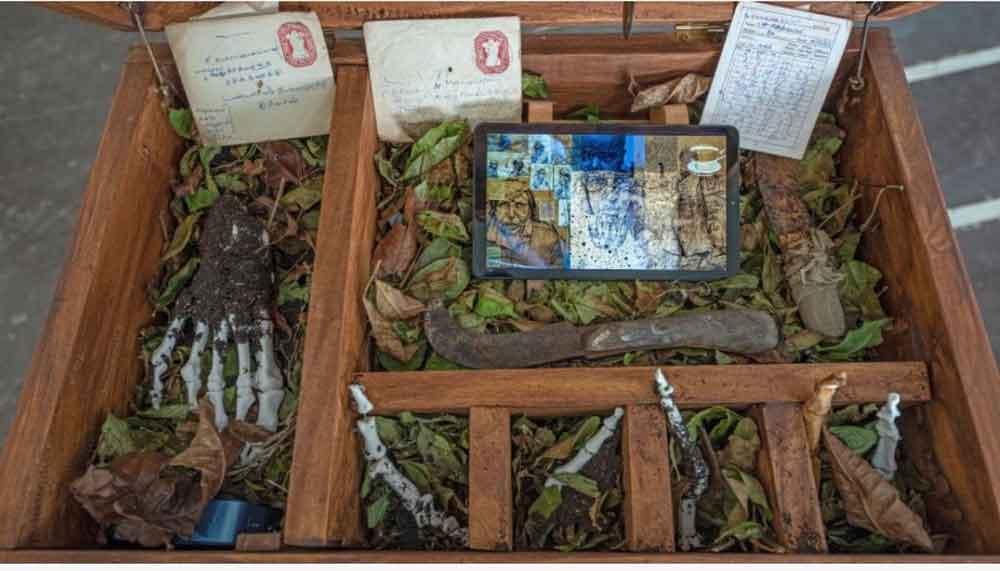
The box containing loose tea, the tea-pluckers’ cutting scythes, and models of what look like finger bones speaks of the harsh reality of the physical effort needed to fill the quota. The wooden box is a new work by Arulraj Ulaganathan, which serves as a communal archive, including letters received by the artist’s grandparents’ generation from relations in India, and colonial era video footage of tea plantations superimposed with Arulraj’s drawings. And so in this way he creates narratives of agency and grounded historicity. In the installation, the audio in this work comes from Oppari (laments) traditionally sung by older women of the hill country, in this case neighbours of the artist who keep oral traditions alive, marking celebration and mourning.
Many images show how trapped and enmeshed the people feel, their heads encased in upturned woven baskets, because the labour of their bodies is what is significant to their employers, not their thoughts or feelings, and the sense of oppressiveness and being constrained and thwarted powerfully infuses the works. These people are not in physical chains or shackles, but we see that they are nevertheless enchained and unwebbed by their economic circumstances.
As part of the public encounters, Arulraj Ulaganathan took a small group of fellow artists and visitors to his home studio located in a line house at Glenanore Estate and introduced the surrounding landscape as well as elders of his village.
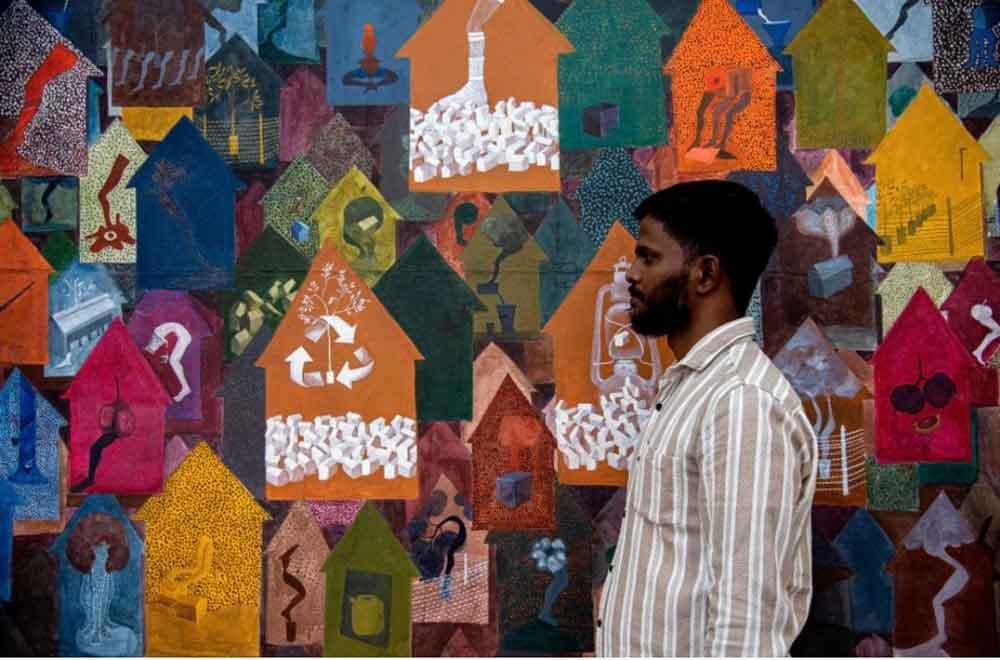
The colours of the landscape, the textures of trees, bushes, soil, grains and seeds and shapes of the mountains and hills of the tea country, and the atmosphere of the interiors of the line houses and the streets of the towns represented in the artworks, boldly present the stories visually to the viewer in multiple modalities including audiovisual forms and found objects.
In the City, and in the countries in which Ceylon tea has been famous for centuries we are presented with a very flattened and manicured vision of rolling hills like tapestries of green, with golden cups of tea foregrounded, in pristine voluminous cups, and smiling female tea pluckers seen in the background of promotional posters. The airbrushed landscapes and radiant veneers of the promotions are seen very differently by those who live and work in them. The actual terrain of the tea country is tough, and subject to torrential rain and frequent landslides and road slips. Climate change has intensified the harsh conditions and made the seasonal cycles of rain and sun less predictable. Priyanka Selvarajah is from Hatton, and was directly impacted by Cyclone Ditwah, and her work demonstrates the landslips, bus accidents, and temporary camps which resulted from it. It is also the same area adversely impacted once again by the recent rains. So, the cycle repeats.
Members of the tea plucking community are still waiting to be given a guaranteed wage of 1000 LKR a day, for a day’s work. Their lives are economically precarious, and this can be seen by the short lines of credit extended to them by the local stores. Amidst this situation of insecurity and uncertainty, they strive to establish human continuity, raising children and grandchildren, some of whom are the artists telling the stories today.
Many families in this community have been locked into a cycle of poverty and distress, which has manifested in high rates of unemployment, lack of education, alcohol abuse, sexual abuse and domestic violence. The path out of this intergenerational anguish via education is being built by a number of dedicated teachers and educationists, joining with community service groups like The Rotary Club of Colombo, and the Tea Leaf Vision Foundation, to provide ongoing support and encouragement to the younger generations of this community.
Against the landscapes, whether the hills or the towns, the human beings are often portrayed as fragmented and scathed, their expressions those of fear and anxiety. The collage form shows the experience of severed bonds and interruptions, shortfalls and disruptions of trust and disappointed hopes. This is what it means to be a marginalized person, to be cut off from the source of abundance, and from the right to access the profits of the labour you have offered.
We see images of skeletal human beings, of disparate body parts, shreds and shards of clothing and signs blowing in the mists and winds, ladies in traditional clothes surrounded by tea flowers, a telling parody of the Avurudu Kumari, teacups enmeshed in coloured threads, scissors cutting red thread ceremonially over a jigsaw puzzle, representing citizenship rights and education, and containers of all kinds: teacups, baskets, houses, bowls, boxes - but their contents spilling out, unable to be neatly packed away and pushed out of sight, or made manageable.
The throne sculpture is also a new work by Arulraj, which encodes the hierarchies of power, political neglect and malaise which generations of hill country Tamil people have been subjected to. It is a work of irony and subversion which mocks political clansmen and the nepotism of the ruling classes controlling the plantation estates. The throne is double edged in effect, as it includes a traditional seated toilet, an evacuation cavity, within it, inscribed with drawings of ballot boxes and political party symbols.
Numbers on ballot boxes and on employment tokens are what this community was reduced to, but now these are contrasted with vibrant self-portraits of the artists among the tea flowers, as a way to reclaim the land as the primary stakeholders, and denote the strength of their ancestors. Through this exhibition, many of them show their dignity, in their unjust situation.
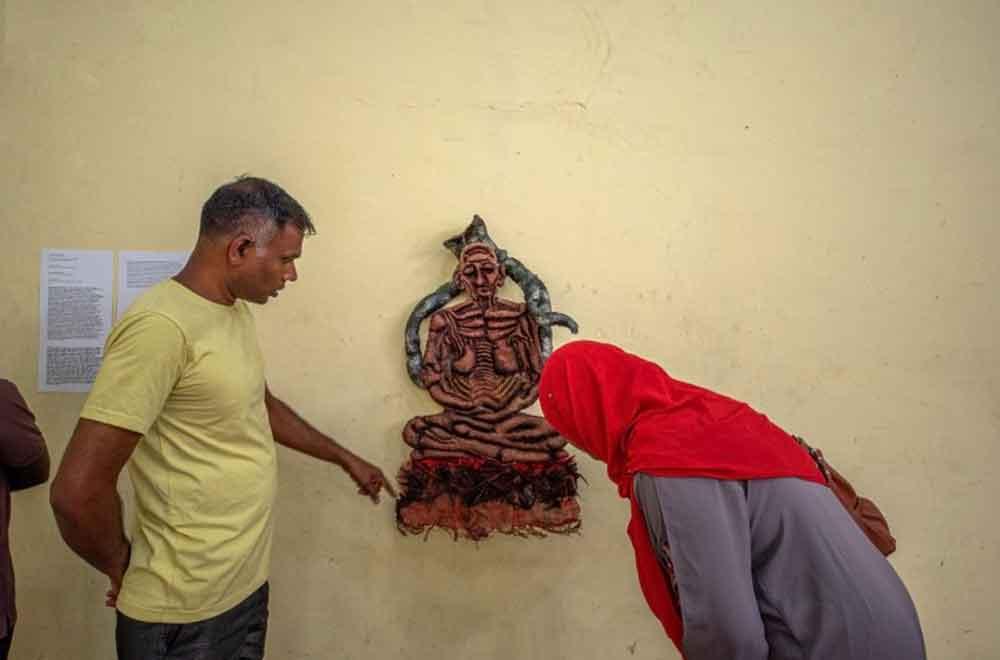
One work by Jeyakumar shows a skeletal figure meditating under tea shrub roots, which is symbolic of the fasting Buddha. He inverts the image by positioning a woman tea plucker there instead, who is denied nourishment and wellbeing, despite her daily labour, and did not choose this path, and cannot attain transcendence.
This is not just an exhibition. It is an intervention. It cuts like a transversal connecting the parallel lines of Colombo and the Malaiyaha Community. Colomboscope’s Director, Natasha Ginwala, and her dedicated team, must be recognized for their vision and commitment, to create this multi-faceted opportunity for these artists’ work to be seen, and to prompt reflection in its visitors, in the path to post-colonial recognition, of what their community has endured.
We can see both the human hope and the sense of betrayal and irony in the title of this exhibition. The engines of industry which intervened to disrupt the lives of this community need to be recalibrated and aligned with values of justice rather than commercial exploitation, to restore the meaning of abundance and prosperity to them.
Photo credits: Nayanahari Abeynayake