THE LONELIEST GENERATION: GROWING UP IN THE AGE OF DOOMSCROLLING

There is a peculiar ritual that has quietly come to define modern adolescence. Before a teenager speaks to anyone, before they sit up in bed, before they take their first sip of coffee for the day (which, increasingly, is already sitting beside the bed!), the mobile phone is already in their hand, and messages, headlines, images, videos, opinions, tragedies, jokes, strangers’ lives, and friends’ carefully curated moments all pass before their eyes in an endless stream. Psychologists have given this habit a name: doomscrolling. It describes the compulsive act of consuming large quantities of online content, often negative, alarming or emotionally charged, long after it has ceased to be useful or informative. The behaviour is not confined to teenagers of course. Adults are equally guilty. But for a generation that has grown up entirely within the digital ecosystem, doomscrolling has become less an occasional distraction and more a way of inhabiting the world.
What makes this habit particularly troubling is not simply the time it consumes but the moment in which it occurs. The hours immediately after waking are among the most valuable in the cognitive life of the brain. Neurologists often describe the early morning as a period when the mind is unusually clear and receptive. It is a time when creativity, reflection and deep concentration are most accessible. For generations before us, these hours might have been spent reading, writing, thinking quietly, studying, or even simply staring out of a window allowing the mind to wander. Such seemingly idle moments were often where insight began. Today, those same hours are increasingly surrendered to the passive consumption of an algorithmic feed.

Instead of beginning the day with one’s own thoughts, many teenagers begin with everyone else’s. A tragedy in another country. A celebrity controversy. A classmate’s holiday photograph. A political argument unfolding between strangers. A video that lasts only seconds before being replaced by another. None of it is inherently harmful in isolation. Yet together it forms a relentless stream of stimuli that demands attention but rarely rewards it with understanding.
Doomscrolling thrives on a simple psychological mechanism: the promise that the next swipe might reveal something important. Perhaps the next post will be shocking, amusing or meaningful. Perhaps the next notification will offer validation. And so the scrolling continues, not because it is satisfying but because it never quite reaches a natural stopping point. The result is a peculiar state of mental restlessness.
Teenagers today are absorbing more information than any generation before them, yet much of it arrives without context or depth. Headlines replace knowledge. Images replace experience. Opinions arrive fully formed before the mind has had time to ask whether they deserve attention at all. And so a curious paradox emerges: never before has so much information been freely available, and yet genuine understanding often feels surprisingly thin. Ask a group of teenagers what art restitution means, for example, and nine times out of ten they will assume it refers to the restoration of damaged artwork. Few realise that it refers to something entirely different: the return of cultural objects that were stolen or looted, often during periods of war or colonial rule. It is a small example, perhaps, but a telling one. Hours may be spent consuming content, yet the habit of pausing long enough to understand an idea properly is quietly disappearing.
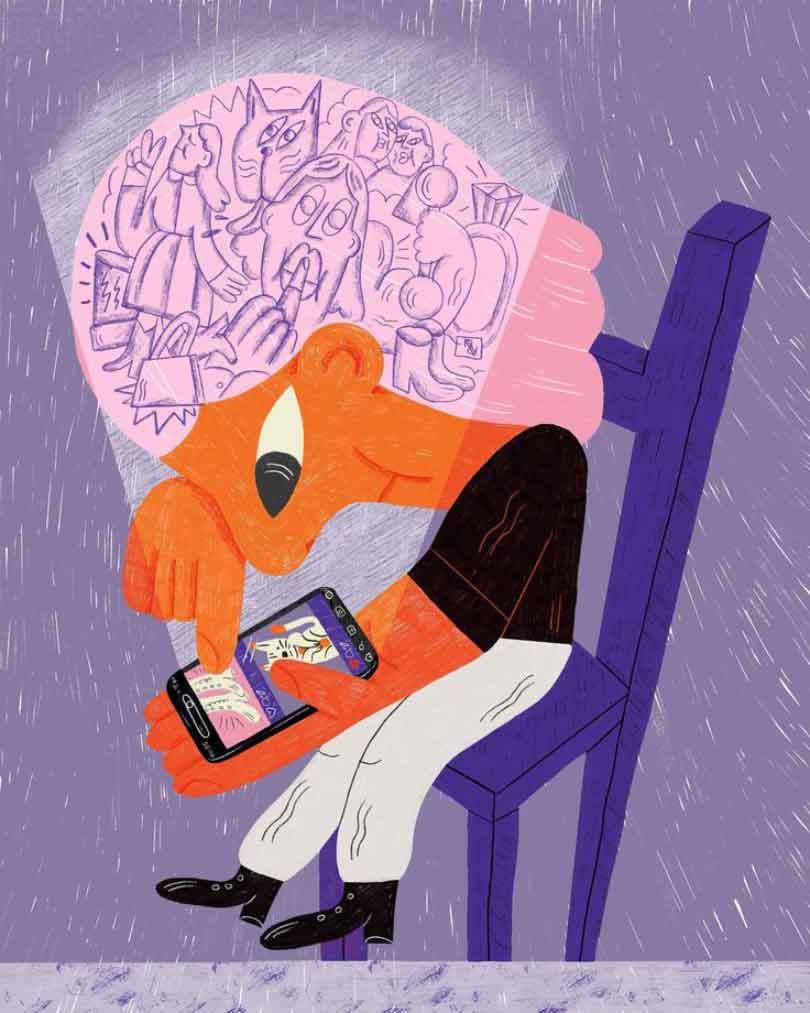
What really disappears in this process is the space required for thought. Human attention was never designed for endless streams of fragmented information. The mind requires pauses, silence, and occasionally boredom in order to process experience and form coherent ideas. When those pauses vanish, thinking becomes reactive rather than reflective. Perhaps this is why many teachers and parents observe the same phenomenon: teenagers who are constantly occupied yet strangely unfocused. Their days are full, their devices are active, but sustained attention has become difficult. Reading a book for an hour can feel exhausting, while scrolling through hundreds of posts requires no effort at all.
It is not that young people lack curiosity. On the contrary, curiosity may be more easily satisfied than ever before. Any question can be answered within seconds by a search engine. But the deeper habit of sustained inquiry - in other words, the patience required to explore an idea fully - becomes harder to cultivate when the mind is trained to move on almost immediately. The irony is that the same technologies capable of opening vast intellectual landscapes are often used merely to skim their surface.
Doomscrolling also alters how teenagers experience the world beyond their screens. When the day begins with a flood of external information, the mind becomes oriented outward rather than inward. The quiet act of forming one’s own thoughts is replaced by the constant absorption of other people’s narratives. Over time this can subtly reshape how young people understand themselves. Identity becomes something observed and compared rather than something slowly discovered.
There is another consequence that often goes unnoticed. The more time young people spend inhabiting digital spaces, the less time they spend inhabiting the messy, unpredictable world of real relationships. Online interaction can create the illusion of connection while quietly eroding the deeper bonds that sustain emotional wellbeing. Teenagers may exchange hundreds of messages in a day and still feel profoundly alone. In that sense, the most connected generation in history is also at risk of becoming the loneliest.
None of this suggests that technology itself is the enemy. Social media platforms, news feeds and digital communication are now woven into the fabric of modern life. They offer genuine benefits: access to knowledge, connection across distance, and exposure to ideas that would once have been unreachable. The problem lies not in the existence of these tools but in the absence of boundaries. When the first act of every morning is to surrender attention to a device, the day begins in a state of reaction rather than intention. The mind wakes not to create or reflect but to respond.
Perhaps the question we should ask is not whether teenagers spend too much time online, but what they are losing in the process. For the early hours of the day, usually the quietest hours, have long been where imagination begins, where difficult ideas are wrestled with, where creativity slowly gathers momentum. They are the hours in which young minds can discover what they think rather than merely consuming what others have already decided. To give those hours away to an endless scroll is not simply to lose time. It is to surrender the most fertile territory of the mind before the day has even begun – and perhaps, without realising it, to trade moments of reflection and connection for an endless stream of other people’s lives.