Has ’’Reach’’ Replaced Common Sense in Sri Lankan Marketing?
By Nuha Faiz
There was a time, when a woman in a saree selling soap on television was considered bold. When the Lux model; glamorous, unreachable, bathed in golden light, was the apex of what advertising dared to do with the female form. We watched her, we bought the soap, and nobody called it exploitation because the boundary was clear: she was selling a product, not herself. The fantasy was manufactured, yes, but it was contained. It knew its place. That was decades ago. What we are witnessing now is not an evolution of that tradition. It is its collapse. The woman selling soap has been replaced by the woman selling notoriety. The glamour model has been replaced by the performer whose currency is not beauty or talent but the algorithmic certainty of controversy. And the boundary that once contained the fantasy has not merely been crossed but been erased, paved over, and rebranded as "modern marketing." This is not about one person. This is not about one podcast, one brand deal, one tourism stunt. This is about a machinery that has learned to weaponize the female body for reach, and a culture that has grown too exhausted, or too desperate, to call it what it is.
What We Used to Understand
Sri Lankans are not strangers to the use of women's bodies in advertising. We have lived through it. We have normalized it. We have, in our own way, perfected it. The Lux girl. The shampoo commercial on Swarnavahini. The actress in the tea advertisement, smiling over a cup while the camera lingers on her face a beat too long. These were not innocent. They were calculated. They understood that desire, aspiration and the female form, when carefully lit and strategically framed, moves products off shelves. But there was a contract implicit in these images. The woman was an actress, a model, a professional playing a role. She was not the product. The product was the product. The fantasy was the fantasy. And when the commercial ended, the fantasy ended with it. You could not click on the Lux girl. You could not follow her. You could not comment on her personal life, debate her choices, or share her image with a million strangers. The distance between consumer and consumed was maintained by the limitations of the medium.
That contract is now broken.
Social media did not merely change advertising. It abolished the distinction between the performer and the performance, between the product and the person selling it. The woman in the advertisement is no longer an actress playing a role. She is a "content creator," a "personality," an "influencer", and her life, her body, her controversies, her trauma, and her notoriety are all part of the inventory being sold. The Sri Lankan market understood this transition slowly, then all at once. First came the Instagram models, the TikTok dancers, the "lifestyle influencers" whose feeds blurred the line between personal life and product placement.
Then came the brands, desperate for engagement in a saturated market, willing to partner with anyone who could deliver numbers. And then, inevitably, came the performers from industries that previously operated in the shadows; industries that had spent decades building notoriety, follower counts, and algorithmic momentum, knocking on the door of mainstream marketing and finding it wide open.
The Reach Addiction
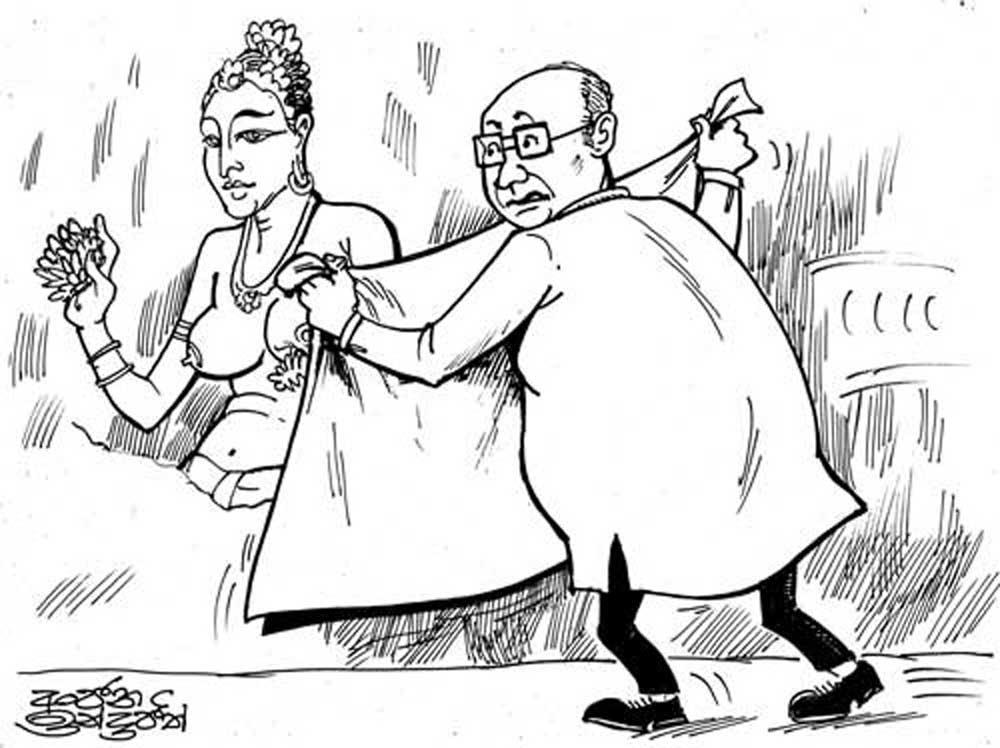
There is a disease spreading through Sri Lankan marketing circles, and its symptom is a single word: reach.
"We need reach." "This will give us reach." "Think about the reach." I have heard it in agency boardrooms, in client meetings, in WhatsApp groups where brand managers share screenshots of engagement metrics like gamblers sharing tips. Reach has become the only metric that matters, and the pursuit of reach has become an addiction that overrides every other consideration like brand safety, cultural alignment, long-term reputation, and basic common sense.
Sri Lanka's influencer marketing industry is growing, but it is growing in a market that is simultaneously shrinking in discernment. The global influencer marketing industry is projected to reach $84.89 billion in 2026. 90% of marketers believe influencer marketing is effective. TikTok Shop alone generated over $500 million in U.S. sales during the 2025 Black Friday-Cyber Monday window.
These numbers create a pressure. They create a fear of being left behind. They create a mindset where any influencer with a large following becomes a viable marketing partner, regardless of what built that following. And when an adult entertainment performer arrives with millions of followers, the addicted mind does not ask, "What built this following?" It asks, "How quickly can we convert this following into sales?"
The Sri Lankan tourism sector is particularly vulnerable to this addiction. After recording 2.36 million arrivals in 2025, a record surpassing the 2018 benchmark, the country has set an ambitious target of 3 million arrivals for 2026. Tourism revenue reached $3.2 billion, still below the $4.48 billion achieved in 2018. Average daily spend has declined from $170–180 to $148. The informal sector now accounts for nearly 40% of accommodation.
Hoteliers have expressed caution. The long-delayed national destination marketing campaign has yet to materialize. Jetwing Symphony Chairman Hiran Cooray noted that his company spends heavily on its own marketing in the absence of a coherent national strategy.
Into this vacuum of coherent branding steps the influencer economy, offering a shortcut. Why spend months crafting a national tourism narrative when you can borrow someone else's audience? Why invest in cultural storytelling when you can buy a controversy that guarantees headlines? This is the reach addiction in its purest form: the willingness to trade the soul of a brand for the temporary high of a viral moment.
The Normalization Playbook
There is a method to this madness of ‘normalizing’ everything the society condemns. It has been refined over decades by industries that understood long before Sri Lankan marketers did that the fastest way to normalize the abnormal is to reframe objection as backwardness.
Step one: Provoke.
Use a performer whose very presence guarantees controversy. The adult entertainment performer arriving in Sri Lanka does not need to do anything scandalous on arrival. Her mere presence is the scandal. Her name, her history, her follower count, these are sufficient to trigger the algorithmic amplification that every brand craves.
Step two: Frame backlash as intolerance.
When people object, do not engage with the substance of their objection. Instead, reframe them as prudes, as moralists, as people stuck in the past. "Everyone watches porn, what's the big deal?" "It's 2026, not 1950." "Sri Lanka needs to be more open-minded." These are not arguments. They are rhetorical devices designed to shame dissent into silence.
Step three: Reposition the controversy as progress.
The performer is not being promoted for notoriety. She is being "welcomed." The podcast is not exploiting her history for views. It is "starting a conversation." The brand deal is not a cynical reach play. It is "diverse representation" and "challenging stigma."
This playbook is not new. It was used by the tobacco industry to reframe smoking as rebellion. It was used by the gambling industry to reframe betting as entertainment. It is now being used by the adult entertainment industry and its marketing partners to reframe the commercialization of sexuality as empowerment.
And Sri Lanka is falling for it.
The podcast host who compares pornography to prostitution and declares both "normal" is not engaging in sociology. He is executing a softening strategy using the guise of intellectual debate to make the commercialization of sexuality seem inevitable, and therefore beyond critique. The claim that prostitution is "the oldest profession" is not historical fact; it is a rhetorical device originating with Rudyard Kipling in 1888, later weaponized by early 20th-century progressives to argue that fighting prostitution was futile. When he says, "it was normalized years ago, it will be accepted years later," he is not making a historical argument. He is manufacturing inevitability. And the audience, trained by years of algorithmic content to prefer certainty over complexity, nods along.
The Sri Lankan Context
Sri Lanka is a country whose official tourism strategy emphasizes "religious and spirituality" tourism, Buddhist circuit promotions, wellness, nature, and culture. There is a disconnect here that is not merely inconsistent. It is strategically catastrophic. You cannot market yourself as a Buddhist circuit destination and simultaneously platform an adult entertainment performer as a tourism asset. You cannot sell spiritual tourism while your social media channels are amplifying content built on sexual notoriety. You cannot claim cultural integrity while your marketing strategy treats cultural boundaries as obstacles to be overcome.
The defense that "we welcome everyone" is a category error that reveals either profound confusion or profound dishonesty. Hospitality is not promotion. A country can welcome visitors without elevating them as marketing assets. The question is not whether an individual should be allowed entry; the question is whether their notoriety should be weaponized as a tourism strategy.

And when the strategy involves not one but multiple performers; one arriving for a podcast, another reportedly scheduled for a television hosting role in July, it stops looking like an isolated incident and starts looking like a trend. A trend with a name: the commodification of controversy, the industrialization of notoriety, the transformation of scandal from risk into strategy.
What does this tell the world about Sri Lanka? It tells them that our values are negotiable. That our spiritual branding is performative. That our desperation for foreign exchange has overridden our capacity for cultural discernment. And that when given a choice between authentic cultural promotion and the shortcut of viral controversy, we will take the shortcut every time.
What We Have Lost
Let us return to where we began. The Lux girl. The saree-clad woman selling soap. The actress in the tea advertisement. These images were not innocent. They were part of a machinery that has always used women's bodies to sell products. But they operated within boundaries. The woman was an actress, not the product. The fantasy was contained, not infinite. The commercial ended, and life resumed.
What we have now is something else entirely. The performer is the product. The fantasy is infinite, looping endlessly in feeds and stories and reels. The commercial never ends, because the performer's life is the commercial. And the boundary between advertising and existence has been so thoroughly erased that we no longer recognize where one ends and the other begins. This is the glamour machine. It is not a woman selling a product, but a woman selling herself, her history, her trauma, her notoriety, her very existence as content. And the brands, the platforms, the algorithms, and the commentariat are all complicit in keeping that machine running.
Sri Lanka does not need more visibility at any cost. It needs the right visibility, the kind that aligns with its cultural identity, its spiritual heritage, and its long-term economic interests. The adult entertainment industry has spent decades arguing that it is harmless, that resistance is prudish, that normalization is inevitable. The data says otherwise. Sociology says otherwise. And the cost of capitulation, measured in mental health, relationship stability, cultural coherence, and the dignity of those trapped within the industry, is too high to accept without a fight. The tourism target is 3 million. The question is: 3 million of what kind of visitor, attracted by what kind of story, and at what cost to the story Sri Lanka tells itself? The reach addiction is real. The normalization playbook is effective. And the cost, when the bill finally comes due, will be paid not by the marketers who cashed the checks, but by the culture and common sense they sold to buy them.