Why is Vijay’s TVK Victory in Tamil Nadu a Big Scene in Sri Lanka?
BEHIND CLOSED DOORS BY NUHA FAIZ
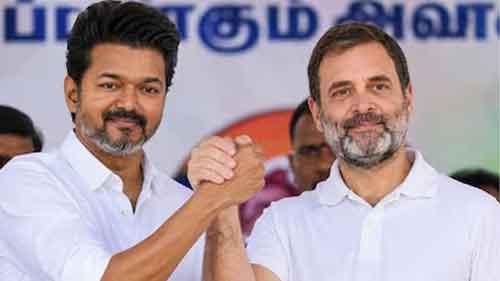
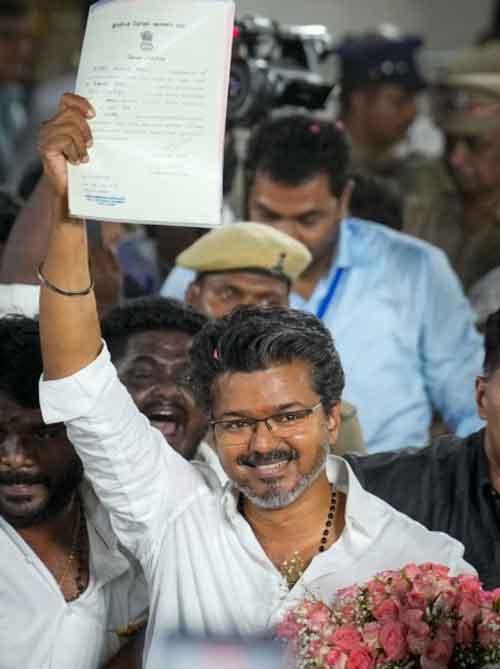
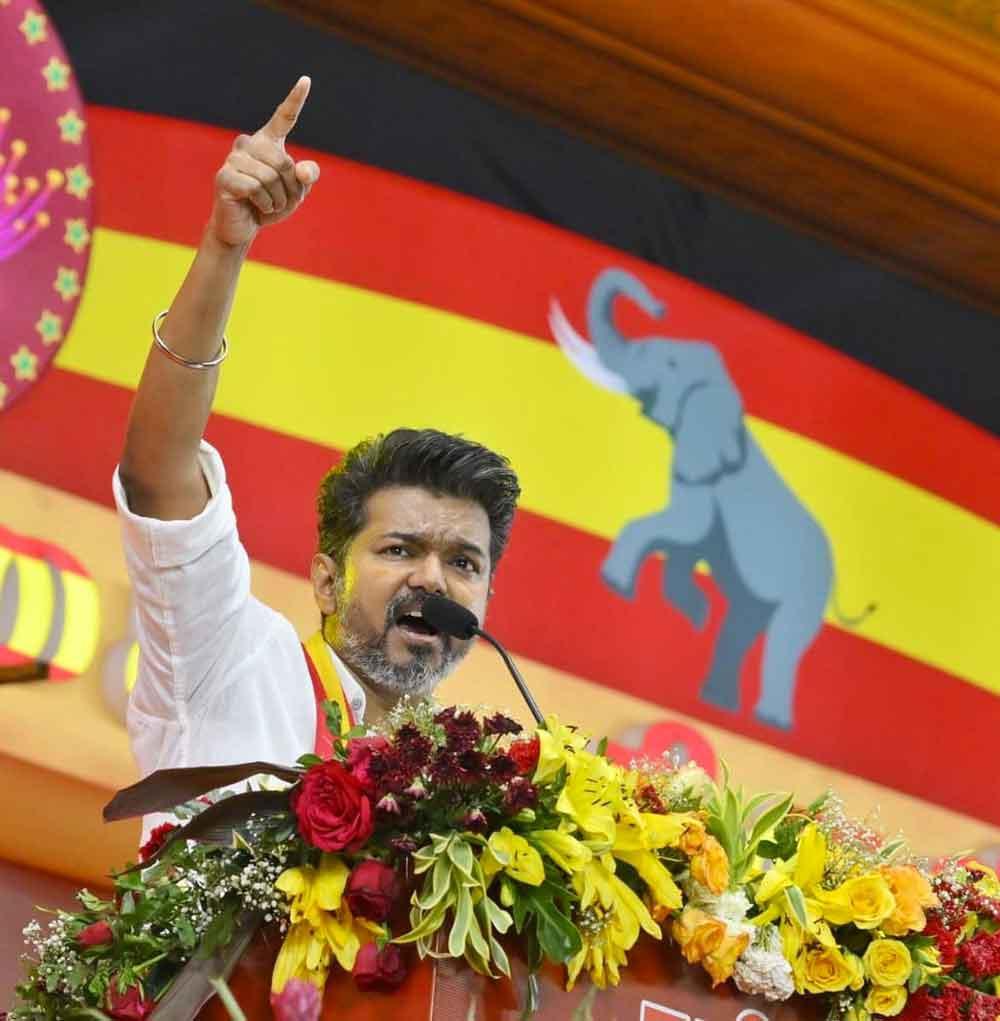
On May 4, 2026, TVK’s victory in Tamil Nadu Elections broke a 59-year duopoly. A party that did not exist two years ago won 108 seats. Its founder, the actor Joseph Vijay, is now the incoming Chief Minister of 72 million people across a 30-kilometer stretch of water from Sri Lanka's northern coast. This article is not about who is right or wrong. It is about decoding what is actually happening, what structural forces are in motion, and what they will likely produce.
The pigs do not seize power through force alone
Remember when Orwell said, ‘the pigs do not seize power through force alone, they seize it through language?’ Reading the Tamil Nadu election story through this lens, makes the structure quite clear. The word "solidarity" is the commandment being rewritten in real time. It appears in every context around Vijay's win and Sri Lankan Tamil jubilation, but it means at least three entirely different things depending on who is using it, and none of those users are required to acknowledge the others.
When Vijay says Tamil solidarity, he means the Eelam independence referendum resolution passed at his party's founding conference, his statement that Prabhakaran gave Eelam Tamils a "mother's love," and his commitment to fight for Kachatheevu. This is solidarity as a political project. When Namal Rajapaksa congratulates Vijay and expresses hope for a "stronger and more positive relationship between Sri Lanka and India," he uses the same implicit language of goodwill and shared future. This is solidarity as diplomatic positioning, from the family whose military offensive killed tens of thousands of Tamil civilians in 2009. When Tamil parties in the Sri Lankan Parliament wave TVK flags and celebrate in the chamber, solidarity is being performed as emotional allegiance that carries no policy content whatsoever.
Orwell called this doublethink: the capacity to hold two contradictory beliefs simultaneously and accept both.
The Rajapaksa congratulating the Prabhakaran-praiser. The Congress party that backed Colombo's 2009 offensive now positioned itself to support the government of a man whose party passed Eelam independence resolutions. The Sri Lankan state celebrating territorial sovereignty by racing a speedboat to Kachatheevu while protecting illegal Israeli-run businesses in Arugam Bay from local accountability. Make it make sense. Nobody announces these contradictions. They are simply absorbed into the language of "bilateral relations," "positive engagement," and "the aspirations of the Tamil people." The words mean whatever the speaker needs them to mean at that moment.
In 1984, Orwell gave this a more precise name: the Ministry of Truth, where history is continuously revised to match the current political requirement. The Kachatheevu issue is the subcontinent's most durable Ministry of Truth product. The island was ceded under a legally binding 1974 bilateral agreement. Every Tamil Nadu politician for fifty years has campaigned on getting it back. None have gotten it back. After each election the issue is filed away until the next campaign cycle, at which point it is retrieved, dusted off, and presented as urgent and new.
This has happened so many times that the performance of the demand has replaced the demand itself. Nobody actually expects retrieval. The voters know they will not get the island. The politicians know they will not retrieve it. And yet the ritual continues because, as Orwell understood, the purpose of political language is not to communicate truth but to produce the emotional state that serves the speaker's interest.
After Vijay's campaign speeches on Kachatheevu, AKD took a speedboat to the island and photographed himself there. He filed the photos. He issued the sovereignty statement. He went back to Colombo. Both performances were complete. Nothing changed. That is the system working exactly as designed.
Why Sri Lanka Must Pay Attention
The standard reassurance being offered in Colombo's diplomatic circles is this: foreign policy is New Delhi's prerogative, not Chennai's. Vijay cannot change India's policy on Sri Lanka. This is constitutionally accurate and practically incomplete. What a Tamil Nadu Chief Minister can do, and what every Tamil Nadu Chief Minister since the Dravidian era has done to varying degrees, is change the domestic political cost that New Delhi must calculate when deciding how to engage with Colombo.
When MGR was Chief Minister in the early 1980s, the central government in New Delhi did not want to arm and train Tamil militant groups in Sri Lanka. It did so anyway, because the domestic political cost of being seen to abandon Tamil kin across the water was higher than the foreign policy cost of covert support. MGR did not make that foreign policy. He made the cost-benefit calculation unavoidable. He provided the LTTE with what documented sources estimate at Rs. 110 million, against the explicit wishes of the central government, and Prabhakaran called him Anna. This is the precedent Vijay's own supporters are celebrating when they draw the MGR comparison. Sri Lanka should read it as a warning label, not a compliment. ijay arrives in government with zero obligations to New Delhi. He ran solo in all 234 constituencies, refused every pre-election alliance, owes nobody in the national coalition. He is free to be as loud as his domestic political interest requires. His domestic political interest will frequently require being loud about Sri Lanka.
What TVK Has Actually Said
There is a critical difference between things politicians say at rallies and things political parties institutionalize as formal positions. At TVK's executive committee meeting in 2024, the party passed 26 resolutions. One called for a Tamil Eelam independence referendum. Another stated that India's foreign policy on Sri Lanka should be formulated in consultation with the Tamil Nadu government. A third demanded that a Tamil be appointed as India's ambassador to Colombo. These are not improvised crowd-pleasers. They are institutional positions passed at an organizational level by the party that now governs Tamil Nadu. The demand that India's Sri Lanka foreign policy be formulated in consultation with Chennai is constitutionally unenforceable and politically potent. It will be presented to New Delhi. New Delhi will reject it. The rejection will be used by Vijay to demonstrate, for his 72 million constituents, that the center does not respect Tamil interests. The cycle is closed before it begins, and Sri Lanka is inside it whether it wants to be or not.
At a public meeting Vijay described Prabhakaran as having given Eelam Tamils a mother's love. At a Madurai rally he said it was enough to reclaim Kachatheevu so that Tamil Nadu fishermen could be safe. Kachatheevu was ceded to Sri Lanka in 1974 under a legally binding bilateral agreement. Every Tamil Nadu politician for fifty years has promised to fight for it. Nobody has retrieved it. The ritual of the demand has replaced the demand itself. After Vijay's speeches, AKD took a speedboat to Kachatheevu, photographed himself there, issued a sovereignty statement, and returned to Colombo. Both performances were complete. Nothing changed. The Kachatheevu ritual is pure wind that has survived fifty years because it serves everyone's interest to perform it and nobody's interest to resolve the underlying fishermen issue, which is real: hundreds of Tamil Nadu fishermen have been killed or detained by the Sri Lankan Navy. That documented grievance remains unaddressed beneath the theater.
The Congress Contradiction at the Center of Everything
TVK needs 118 seats to govern. It has 108. Congress won 5 and has signaled willingness to support TVK's government formation. Congress is the party whose government under Rajiv Gandhi trained Tamil militants through RAW in the early 1980s, then signed the Indo-Lanka Accord in 1987 over Prabhakaran's explicit objections without including the LTTE in the negotiations. The Indian Peace Keeping Force sent to enforce that accord was renamed by Tamil civilians in the north and east in ways that cannot be printed in polite publication. In the final phase of the war in 2009, the Congress-led UPA government in New Delhi provided diplomatic cover for Colombo's military offensive and did not use its considerable leverage to stop what was happening.
That party is now the support structure for the government of the man who called Prabhakaran a figure of motherly love. This is the whole system of South Asian politics compressed into one coalition negotiation. The language performs solidarity. The structure performs management. Anyone celebrating Vijay's win as a genuine turning point for Eelam Tamils needs to look at who is holding the government together and ask what that party's actual historical record on this question is. The answer is not encouraging.
What Sri Lankans Need to Be Watching
Not the marriage. Not the celebrity comparisons. Not which Sri Lankan politician congratulated Vijay most warmly. Those are the distractions. Watch the TVK party resolutions and whether they are formally presented to New Delhi within the first year of government. Watch whether the fishermen issue gets any actual bilateral resolution now that Tamil Nadu has institutional motivation to pursue it. Watch the BJP's behavior: they lost nothing here and gained a fractured opposition. Watch whether that translates into reduced pressure on Colombo regarding the north.
Watch the north itself. The electricity in Delft. The lands in Valikamam. The generations growing up without any material reason to believe the Sri Lankan state sees them as fully belonging to it. Romesh Gunesekera wrote a novel about a marine biologist who studies the degradation of a coral reef with great precision and cannot stop it, because studying a thing is not the same as intervening in it. The reef dies through accumulation: small neglects, each individually defensible, collectively fatal. The Vijay moment did not create the degraded reef. It is what happens when the reef has been eroding long enough that the generation growing up in the depleted water reaches for any light coming from outside.
Whether Vijay is actually that light is still open. His Congress support structure, his untested governance capacity, his own inevitable political compromises, are all legitimate reasons for caution. But Sri Lanka cannot outsource its northern governance failure to skepticism about Vijay. The question of why Jaffna celebrated on May 4 is not answered by pointing at celebrity culture. It is answered by looking honestly at what those communities have been living with for fifteen years and asking whether the Sri Lankan state has given them any other reason to celebrate anything at all.
The Only Question That Matters
When Michael Ondaatje wrote about Sri Lanka's disappeared, he was writing about a state that performs cooperation with accountability while ensuring accountability produces no consequences. The people who know where the bodies are perform helpfulness to the investigators. The investigators are moved along. The bones stay buried. The system continues.
The disappeared in Sri Lanka are not only the dead from 2009. They are the fifteen years of documentation that produced nothing. The resolutions passed and rejected. The investigations launched and stalled. The land return programs begun and paused. The accountability processes engaged and managed into sterility. The people in the north have been reading that pattern for fifteen years. They are not naive about Vijay. Many are not naive about anything. But they are living in a depleted ecosystem, and they responded rationally to the available signal. Sri Lanka's political class has a choice. It can continue performing sovereignty, performing accountability, performing concern for northern welfare, while doing the minimum required to maintain the appearance of normal functioning. If that is the choice, the Vijay moment is the least of what is coming. Or it can look at the firecrackers in Jaffna on the night of May 4 as a question being asked by citizens of this country, and try, for once, to actually answer it. The question is not about Vijay. It is not about Tamil Nadu. It is entirely domestic and entirely Sri Lanka's to answer. That is why this is a scene in Sri Lanka.