“Boys Will Be Boys” and the Quiet Damage It Leaves Behind
Marian de Silva
There is something almost too casual about the phrase “boys will be boys.” It slips into conversations without resistance, like a reflex people do not even think about anymore. It sounds harmless. Familiar. Almost comforting in the way, it shrugs things off and moves on. But that is exactly where the problem sits. Because what looks like harmless language is actually doing something much heavier. It is excusing, shaping, and quietly repeating patterns that do not just affect individuals, but entire generations.
I think what makes this phrase so dangerous is not how loud it is, but how normal it feels. No one pauses when they hear it. No one questions it at the moment. It gets used when a boy pushes too hard, speaks too harshly, crosses a line, or refuses to take responsibility. Instead of stopping the behaviour, it softens it. Instead of correcting, it explains it away. And when something is explained away often enough, it starts to feel acceptable.
That is where the shift happens. Behaviour stops being seen as something that can be changed and starts being seen as something that simply is. From a very young age, boys are handed a very narrow version of what it means to exist in the world. They are taught, sometimes directly and sometimes through silence, that emotions are something to control or hide. Crying is discouraged. Fear is embarrassing. Sensitivity is mocked or dismissed. At the same time, anger is tolerated in ways other emotions are not. Aggression becomes understandable. Dominance becomes expected. And when those behaviours cross into harm, the same phrase shows up again to cushion the impact.
It creates a strange imbalance. Boys are allowed to feel certain emotions, but not others. They are given space to act out, but not space to understand why they feel the way they do. And without that understanding, emotions do not disappear. They just change form.
What is never addressed does not go away. It builds.
So, when a boy is told again and again that vulnerability is weakness, he learns to bury it. When he is not taught how to process rejection, he may respond with frustration or entitlement. When empathy is not reinforced, he may struggle to recognize it in others. These are not traits people are born with or without. They are shaped, encouraged, or ignored over time. And this is where the phrase begins to stretch beyond childhood. Because boys grow up. They become men who carry those same lessons into relationships, workplaces, friendships, and families. A man who was never taught to communicate his emotions might default to silence or anger. A man who grew up believing his behaviour would be excused may struggle with accountability. A man who learned that control equals strength may carry that belief into how he treats others.
The consequences do not stay contained. They ripple outward. Relationships become spaces where communication breaks down. Small conflicts escalate because emotional tools were never built. Women, in particular, often find themselves navigating behaviour that has been normalized for years. Disrespect, entitlement, or dismissiveness are not always seen as serious issues because they were never treated as serious to begin with.

And yet, this is not just about how boys affect others. It is also about how this mindset quietly damages them too. There is a kind of emotional isolation that comes from being told you cannot feel fully. When boys are taught to suppress vulnerability, they lose access to a huge part of their emotional world. They may not have the language to express what they feel. They may not even recognize it. That disconnect can turn into frustration, loneliness, or even a sense of emptiness that they do not know how to explain.
It is easy to overlook this side of it because the phrase often centres around excusing behaviour rather than understanding its impact. But the truth is, limiting someone’s emotional range does not make them stronger. It makes them less equipped to handle life in a healthy way. And when that becomes generational, the effects deepen. A boy raised in this environment grows into a man who may unintentionally repeat the same patterns. Not necessarily out of malice, but out of familiarity. He raises his son the way he was raised. He dismisses certain behaviours because they were dismissed for him. He avoids emotional conversations because he was never taught how to have them.
The cycle continues quietly. No one wakes up and decides to ruin a generation. It happens through small, repeated choices. Through phrases that are not questioned. Through moments where accountability is replaced with convenience. Through the decision to let something slide instead of addressing it. And that is why changing this mindset requires more than just criticizing a phrase. It requires looking at what sits underneath it.
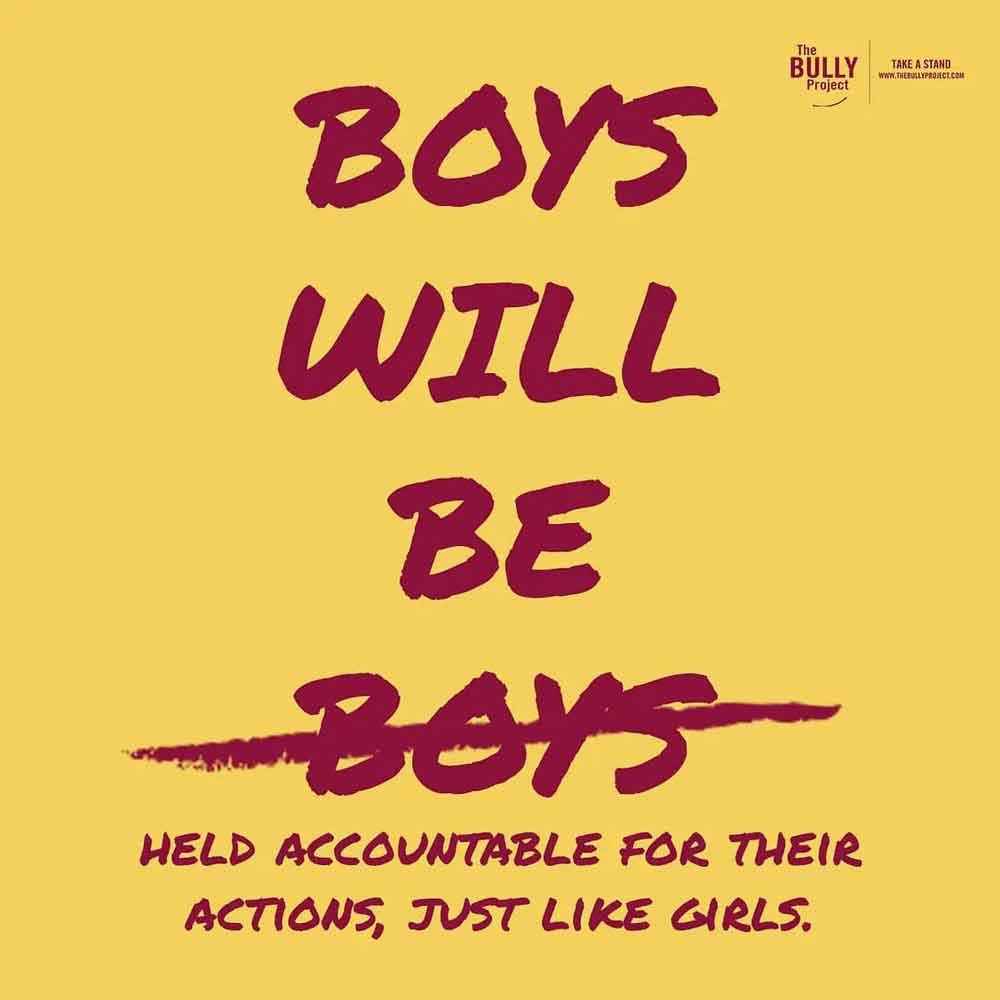
It means recognizing that behaviour is not fixed. It is learned. And if it is learned, it can be unlearned. It means holding boys accountable in ways that are consistent and fair. Not through harsh punishment, but through clear expectations. It means teaching them that actions have consequences and that those consequences are not something to fear, but something to learn from. It also means giving them the emotional tools they were often denied. Teaching them that vulnerability is not something to be ashamed of. That expressing sadness, fear, or confusion is part of being human, not a failure of masculinity. That empathy is not optional. It is essential. This shift does not weaken boys. It strengthens them in ways that actually matter. Because a boy who understands his emotions is far more capable than one who suppresses them. A boy who is taught respect will carry it into every space he enters. A boy who learns accountability will not need excuses to justify his behaviour.
And maybe that is the real issue with “boys will be boys.” It assumes limitation. It suggests that boys cannot be more than a narrow set of behaviours. It underestimates their capacity to grow, to learn, to be better. But they can. The phrase is not just outdated. It is lazy. It avoids the effort of teaching, guiding, and correcting. It replaces responsibility with resignation. And while it might make things easier in the moment, it creates much harder realities in the long run. If we want to talk about generational impact, we have to be honest about where it starts. It starts in everyday conversations. In how we respond to behaviour. In what we excuse and what we challenge.
It starts with language. Because language shapes perception. And perception shapes behaviour. So maybe the goal is not just to stop saying “boys will be boys,” but to replace it with something more intentional. Something that recognizes potential instead of limiting it. Boys will listen. Boys will learn. Boys will become what they are shown and taught. And that means there is responsibility in every moment we choose to either excuse or address something. Generations are not ruined in dramatic, obvious ways. They are shaped quietly, through repetition. Through habits. Through things that feel too small to matter until they are not. So, the next time the phrase shows up, it is worth pausing. Not because every mistake needs to be turned into something heavy, but because every pattern needs to be recognized before it becomes permanent. Because once something is normalized, it becomes much harder to undo. And the truth is, we do not need another generation raised on excuses. We need one raised on awareness, accountability, and the freedom to be fully human.