Do Not Think About the White Bear

Nichol Fernando
Have you ever found yourself trying not to think about something, only for it to become the only thing occupying your mind. Maybe it is an embarrassing moment from three years ago. A message you regret sending. A person you are trying to forget. You tell yourself to stop replaying it, to focus on something else, to move on.
Then, almost immediately, it returns. Louder this time. The harder you try to push it away, the more stubbornly it stays. What begins as a passing thought slowly becomes a mental argument: you think about the thing, then become frustrated that you are still thinking about the thing and finally think about why you cannot stop thinking about it.
This frustrating experience has a name: ironic process theory. Developed by psychologist Daniel Wegner, ironic process theory suggests that our attempts to control the mind can sometimes create the exact opposite result. When we deliberately try to suppress a thought, emotion or feeling, we may unintentionally make it more noticeable. The mind, in trying to protect us from an unwanted thought, keeps quietly checking whether that thought is still there.
Unfortunately, checking requires remembering what it is supposed to avoid. To understand this, imagine someone telling you, “Do not think about a white bear.” For the next few seconds, think about absolutely anything else. A beach. Your lunch. The sound of traffic outside. Just not a white bear.
Yet somewhere in the background, your mind must keep asking: “Am I thinking about the white bear?” Each time it checks, it has to briefly bring the bear back into your awareness. The thought you are trying to remove is therefore repeatedly reintroduced by the very system designed to remove it.
The mind becomes both the guard and the intruder. Wegner demonstrated this through what became known as the White Bear Study. Participants were asked to speak their thoughts aloud while trying not to think about a white bear. Whenever the bear entered their mind, they had to ring a bell. Despite the instruction sounding simple, the bells rang repeatedly. Even more interestingly, when the participants were later allowed to think about the bear, those who had previously suppressed it thought about it more often than people who had never been told to avoid it.
The thought had not disappeared. It had been waiting. According to the theory, two mental processes are operating during suppression. The first is the controlled process. This is the conscious part of the mind that searches for distractions: another memory, another task, another subject. It requires attention and effort. The second is the automatic monitoring process, which quietly scans the mind for any sign of the forbidden thought. Unlike the controlled process, this monitoring happens with very little effort.
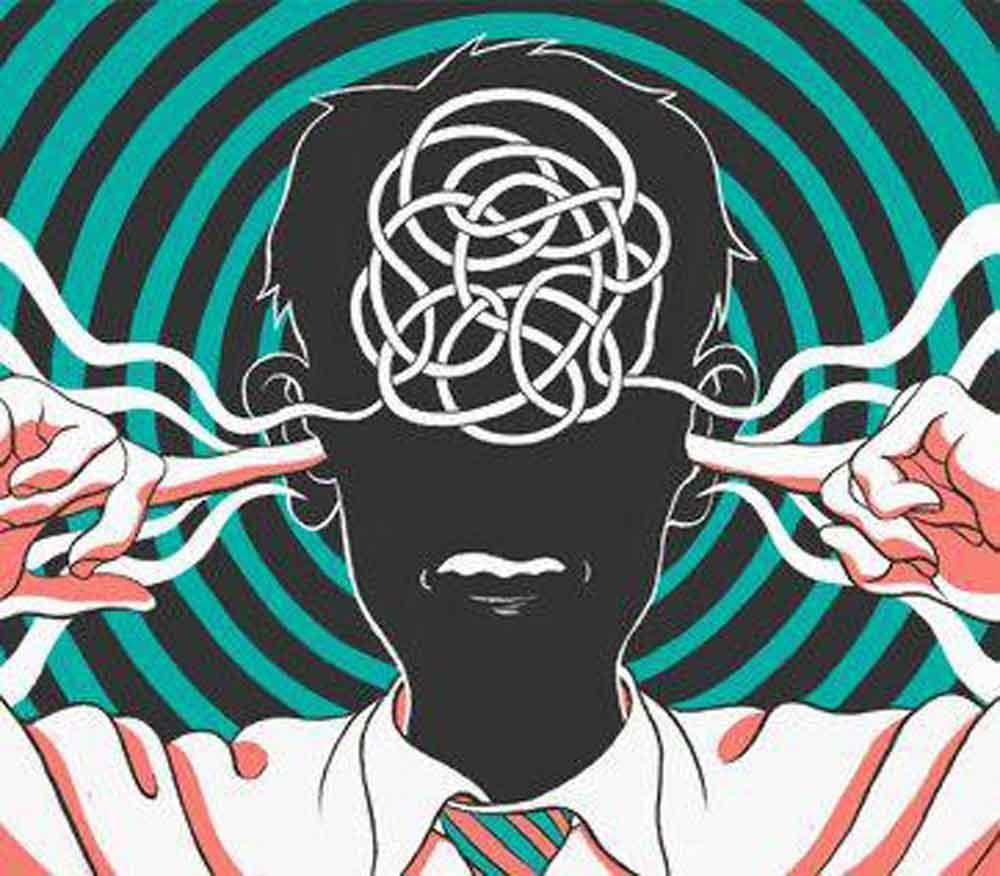
When we are calm and mentally rested, the controlled process may keep us successfully distracted for a while. However, under stress, exhaustion, time pressure or emotional overload, it becomes harder to maintain. The automatic process continues checking, but the conscious process no longer has enough energy to redirect us.
So, the unwanted thought wins. This explains why ironic effects often become strongest at the worst possible moments. A student entering an examination thinks, “Do not forget the formula”, and suddenly the formula disappears. An athlete preparing for an important shot thinks, “Do not miss”, and becomes painfully aware of every possible way to miss. Someone lying awake at 2 a.m. tells themselves, “I need to sleep right now”, only to become increasingly alert with every passing minute.
Sleep is perhaps one of the clearest examples because it cannot be forced. The more desperately we chase it, the more conscious we become of its absence. We notice the clock, the silence, our breathing and the number of hours remaining before morning. Trying to sleep becomes work, and work is rarely restful.
The same pattern can appear in our emotions. Telling yourself not to feel anxious may make you search constantly for signs of anxiety. You notice your heartbeat. You examine your breathing. You wonder whether your hands are shaking. In trying to confirm that you are calm, you collect evidence that you are not.
This does not mean we are completely powerless over our minds. It simply means that force is not always the most effective form of control. One response is to reduce mental overload. Stress and distraction weaken the deliberate process that helps us redirect attention, so rest, routine and repeated mental practices can make emotional regulation easier. Skills such as relaxation may also become more natural through practice, requiring less conscious effort over time.
Another response is acceptance. Instead of treating every unwanted thought like an emergency, we can allow it to arrive without giving it authority. A thought is not a command. It is not always a fact, a prediction or a secret revelation about who we are. Sometimes it is simply the mind producing noise.
Acceptance-based approaches encourage people to observe thoughts without immediately judging or fighting them. Rather than saying, I must not think about this, we might say, I notice that this thought is here. That small change removes some of the struggle. The thought may remain for a while, but it no longer has to become a battle.
There is also a more unusual technique known as paradoxical intention, associated with psychiatrist Viktor Frankl. Instead of running from a feared experience, a person deliberately approaches or exaggerates it. Someone struggling with insomnia, for example, may be encouraged to try to remain awake. By removing the pressure to sleep, the anxiety surrounding sleep can weaken, making rest more likely. The solution appears contradictory, but that is precisely why it can work.
Still, the goal is not to cleverly trick the mind every time it becomes uncomfortable. Becoming obsessed with controlling our thoughts more perfectly can become another form of the same problem. The deeper lesson is simpler: not every thought needs to be defeated.
There are thoughts we cannot erase by force. Memories that return when the room becomes quiet. Worries that grow when we demand certainty. Feelings that become heavier when we pretend they are not there. Sometimes the mind holds on because we keep pulling in the opposite direction. Peace does not begin when the unwanted thought finally disappears. It begins when we stop checking whether it has.