More Than a Power Couple: Trinity Rodman and Ben Shelton

A professional athlete can be surrounded by thousands of people and still feel completely alone.
The stadium may be full. Coaches may offer instructions, journalists may ask questions and supporters may celebrate every victory. Yet very few people truly understand what it means to build a life around performance: to train while exhausted, recover while travelling and remain composed when one difficult match becomes a public conversation about your ability, discipline and future.
For American soccer star Trinity Rodman and tennis player Ben Shelton, that understanding has become one of the most important parts of their relationship. Their story began in the least cinematic way possible: through an Instagram message. Rodman made the first move, telling Shelton, “You’re sick,” followed by a fire emoji. Shelton responded that she had been “sick at the Olympics too.” Rodman has since laughed at the exchange, describing the entire interaction as “cringe.” However, a week or two later, they met in person. By March 2025, they had made their relationship public on Instagram.
The beginning was simple. What followed has been more significant. Rodman and Shelton are not merely two young athletes who happen to be dating. They are both competing at levels where sport is no longer something they do; it shapes almost every part of their lives. Rodman, a forward for the Washington Spirit, became the youngest player drafted into the National Women’s Soccer League at the time when she entered the league at 18. She helped the Spirit win its first NWSL championship during her rookie season and later helped the United States secure Olympic gold at the 2024 Paris Games.
Shelton has experienced a similarly rapid rise in tennis. Ranked among the leading players in the world, he carries the additional pressure of being one of the most prominent American men attempting to end the country’s long wait for another men’s Grand Slam singles champion. Their achievements make them impressive. Their understanding of what those achievements demand makes their relationship work.
Athletes are often admired for their physical strength, but the most exhausting parts of professional sport are not always visible. The public sees the match, the goal, the trophy and the celebration. It does not always see the anxiety before competing, the frustration of an injury, the loneliness of constant travel or the pressure to recover quickly enough to perform all over again.
Rodman has spoken openly about this side of their relationship. According to her, the mental demands of elite sport can be even harder to control than the physical ones. An athlete may be able to push through a minor injury, but continuing becomes far more difficult when the mind is not in the right place.
This is where their shared experience matters. Neither has to explain why one disappointing performance can remain in the mind long after the stadium has emptied. Neither has to justify needing space after a loss or reassurance before an important match. They understand that sometimes advice is helpful and sometimes it is not. Sometimes a bad week does not need to be immediately transformed into a lesson. It simply needs to be acknowledged as a bad week. There is a quiet form of love in allowing somebody to feel disappointed without rushing to correct them.
Rodman has said that they are good at understanding when the other person needs advice and when they simply need support. Shelton has expressed a similar view, explaining that much of what they help each other manage is mental. Their relationship does not remove the pressure surrounding their careers. Instead, it gives each of them somewhere safe to place it.
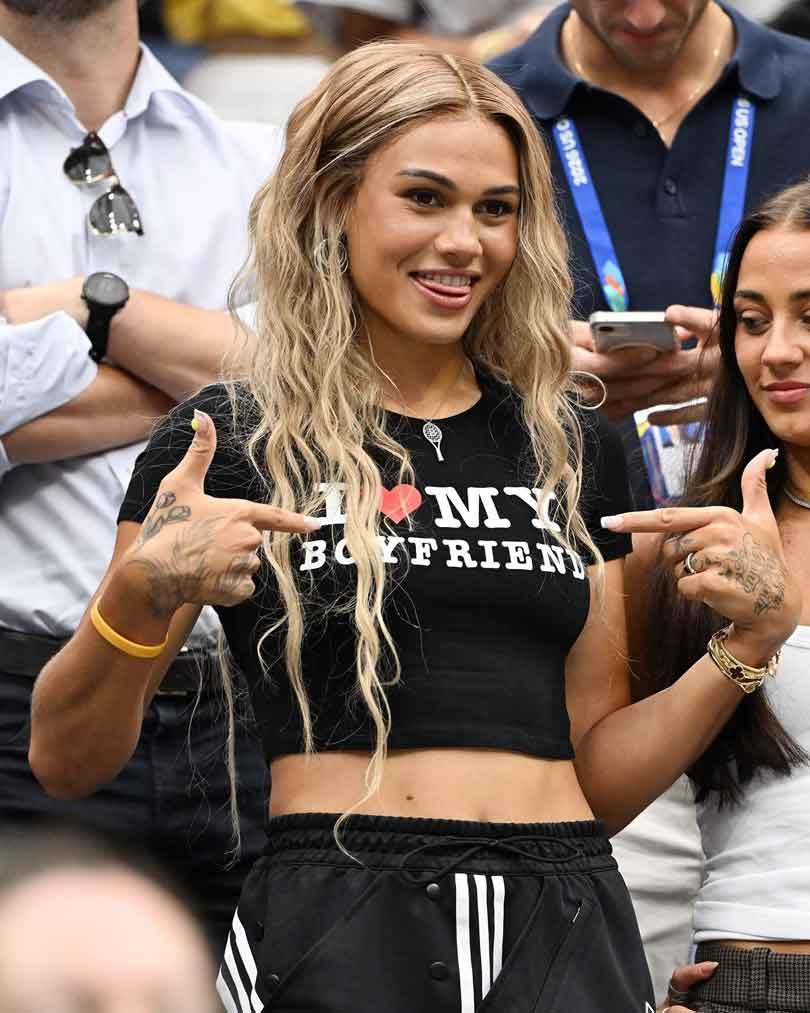
That support is not confined to private conversations. Rodman has regularly appeared at Shelton’s tennis matches, watching from the stands with an enthusiasm that is difficult to manufacture. At the 2026 US Open, she wore an “I heart my boyfriend” shirt while supporting him. After one particularly gruelling match ended after 3 a.m., she reportedly drove for five hours so that she could return to Washington Spirit practice on time.

That journey captured the reality of their relationship better than any glamorous photograph could. Supporting Shelton did not mean Rodman’s own responsibilities disappeared. She still had training. She still had a team expecting her. She still had a career that required discipline. Being present for him demanded effort, and she made that effort without abandoning what she had worked to build for herself.
Earlier that year, she travelled to Montreal following the Spirit’s 4–3 loss to the North Carolina Courage to surprise Shelton at the Canadian Open. She has described supporting him as “the best feeling in the world.” When she attended his title-winning run in Stuttgart, Shelton publicly thanked her for flying in from Brazil and called her his “good luck charm.”
It would be easy to reduce these appearances to the familiar image of the supportive athlete’s girlfriend. Rodman herself has joked about enjoying the opportunity to be “a little WAG.” Yet that label becomes inadequate when applied to a woman with an Olympic gold medal, a league championship and a demanding professional career of her own.
She is not standing beside his success because she lacks her own. She is choosing to celebrate his while continuing to pursue hers. The support also travels in both directions.
Shelton attended the Washington Spirit’s match against the Houston Dash in July, when Rodman scored twice, including the winning goal during stoppage time. After scoring, she ran towards the stands and shared a celebratory kiss with him. For once, the tennis player was the person watching and waiting. The centre court belonged to her. That mutuality matters because relationships involving two highly successful people can easily become competitive.
One person’s opportunity may disrupt the other’s schedule. One person’s victory may arrive during the other’s difficult week. Attention is rarely distributed equally, particularly when both careers depend partly on public interest. Rodman and Shelton appear to resist that competition by becoming genuinely interested in each other’s worlds. Shelton has said that Rodman has become invested in tennis, sometimes watching recordings of his previous matches at home. In return, he has become increasingly engaged with soccer.
They do not merely attend each other’s events for photographs. They pay attention. Still, understanding each other does not mean becoming indistinguishable from each other. Rodman has emphasised the importance of remaining individuals and avoiding becoming so blended together that their separate identities disappear.
That may be one of the healthiest aspects of their relationship. Popular culture often treats romantic closeness as complete emotional fusion: the same schedule, the same interests, the same social circle and an expectation of constant availability. But for two professional athletes, such closeness would be almost impossible. Their careers regularly place them in different cities, countries and even continents. There will be tournaments one cannot attend, matches one cannot watch live and important moments experienced through a screen.
The obvious difficulty is distance. The less obvious challenge is learning not to interpret distance as neglect. Their schedules require trust. A late reply may simply mean training ran longer than expected. A missed call may mean recovery, travel or preparation. Exhaustion may sound like emotional withdrawal even when it has nothing to do with the relationship. Because both understand the demands of professional sport, they are less likely to treat these ordinary pressures as personal rejection.
That does not make the separation easy. Rodman has admitted that there are moments when the reality of barely seeing each other becomes difficult. Shared experience does not eliminate disappointment. It simply gives them a better language for navigating it.
They know that absence can exist alongside commitment. There is also something refreshing about the playfulness of their relationship. After Shelton defeated Carlos Alcaraz at the US Open and failed to mention Rodman during his post-match interview, she responded with three words: “What about me?” The moment was funny precisely because their support for each other was already so visible. It did not read like a demand to be placed at the centre of his victory. It felt like the teasing complaint of someone secure enough to make the joke publicly.
Their relationship should not be idealised as perfect. Social media offers fragments, not full access, and no collection of matches, interviews or photographs can reveal everything that occurs between two people. Calling them a “power couple” may be accurate, but it can also flatten something complicated into a polished image. The more meaningful story is not that two famous athletes found each other. It is that two intensely ambitious people appear to have found a way to make ambition feel less lonely.
Rodman and Shelton understand when to offer advice, when to give space and when simply to sit in the stands. They celebrate each other without surrendering their own identities. They accept that love may sometimes look like a transcontinental flight, a five-hour drive after a match, an old tennis video playing at home or a familiar face in the crowd after a decisive goal. Anyone can support a person when doing so is convenient. The strength of a relationship is often revealed when support requires time, distance, patience and sacrifice. Trinity Rodman and Ben Shelton spend their careers competing as individuals. Yet when the pressure becomes heaviest, neither has to carry it entirely alone.