Two Words That Shook a Tour: Ed Sheeran, Macklemore and the Cost of Speaking Out
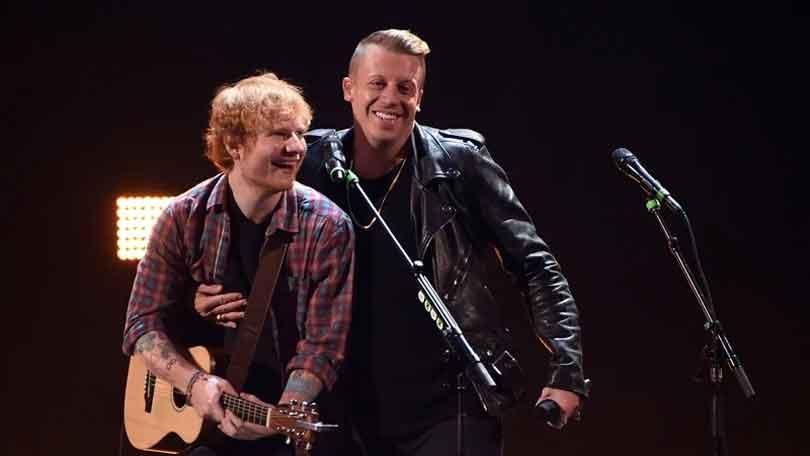
For most artists, an opening act is supposed to warm up the crowd, perform a familiar hit and leave the stage without becoming the headline.
Macklemore did something else. While supporting Ed Sheeran at two concerts in New Jersey on 4 and 5 September, the American rapper used the stage to call for a “free Palestine.” He displayed images of destruction in Gaza, dedicated a song to pro-Palestinian student protesters at Columbia University and described the death toll as genocide, a characterisation rejected by Israel. Within days, the comments had travelled far beyond the stadium. By 14 September, Macklemore was no longer part of Sheeran’s US tour.
What followed was not merely a disagreement between two musicians. It became an argument about who controls an artist’s voice, whether a concert can ever be politically neutral and how quickly moral conviction becomes negotiable when stadiums, contracts and millions of dollars enter the room.
The backlash began almost immediately. The Israeli American Council launched a petition calling for Macklemore’s removal, while StopAntisemitism accused him of forcing propaganda onto concertgoers. Pink, who is Jewish, also publicly criticised his remarks. Robert Kraft, the billionaire owner of the New England Patriots and Gillette Stadium, later confirmed that Macklemore had been banned from performing at the venue. Kraft accused the rapper of hate speech and antisemitic rhetoric, arguing that condemning Israel while ignoring Hamas promoted division rather than understanding.
Macklemore rejected the accusation. In a lengthy statement, he argued that allegations of antisemitism were being used to silence criticism of Israel. This defence exists within a particularly sensitive history: in 2014, he apologised for wearing a costume that critics said relied on antisemitic stereotypes. That earlier controversy does not automatically prove that his present criticism of Israel is antisemitic. Nor does supporting Palestinian freedom excuse genuine hostility towards Jewish people. The distinction matters precisely because collapsing the two issues protects nobody. It weakens the fight against antisemitism while making honest discussion about Palestinian suffering almost impossible.
According to Macklemore, media attention surrounding his comments prompted Kraft to contact Sheeran. Concert promoter Messina Touring Group later said that certain venues, including Gillette Stadium, were prepared to cancel Sheeran’s concerts if Macklemore remained on the bill. Sheeran maintained that the promoter made the final decision after a week of conversations involving venues, activists and organisers.
Technically, that may be true. Morally, it is less simple.
Sheeran said he respected Macklemore’s determination to stand up for what he believed, but explained that he does not use his professional platform for politics. His audience, he noted, includes young people from many different backgrounds, and cancelling concerts would disappoint fans and threaten the livelihoods of crew members who depend on the tour.
This is not an absurd defence. A major tour is not a private gathering controlled by one individual. It is a moving business involving venue agreements, insurers, promoters, employees, transport, security and thousands of ticket holders. Walking away may sound principled from a distance, but the financial consequences would not fall on Sheeran alone. Fans may lose the event they paid for, while workers with no control over the dispute may lose income.
Yet enormous fame also brings enormous influence. Sheeran is not a replaceable employee quietly following instructions. He is the reason the stadiums are full. Even if Messina Touring Group formally made the decision, it is reasonable for critics to ask whether one of the world’s most commercially powerful musicians truly had no meaningful ability to resist it. The issue is not simply who signed the document removing Macklemore. It is who possessed the power to say that a performer should not be discarded for expressing a political position.
The attempt to remain above politics was further complicated by Sheeran’s previous public support for Ukraine following Russia’s invasion. Fans such as Northern Irish ticket holder Damien Given questioned why one humanitarian crisis could be acknowledged while another had to be kept outside the concert gates. The comparison is not perfect; international conflicts carry different histories and sensitivities. However, it exposes a central weakness in selective neutrality. Once an artist has spoken on one global crisis, silence on another no longer appears entirely apolitical. It begins to look like a choice about which suffering is safe enough to recognise.
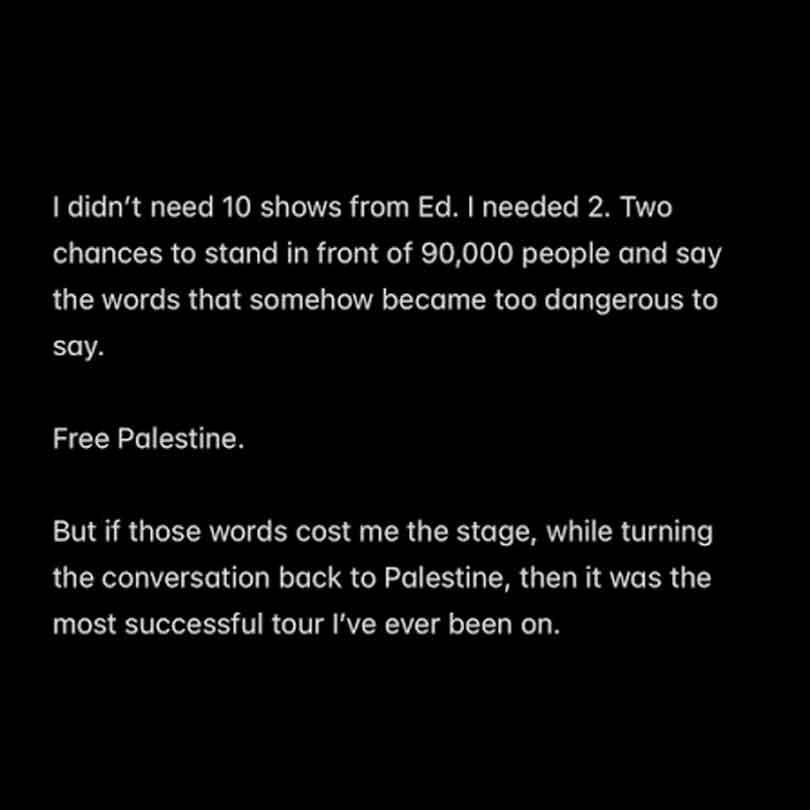
Macklemore made that choice explicit. He wrote that taking a side can cost an artist money, sponsorships, opportunities, relationships and access, but insisted that there is no neutral position between an oppressor and the oppressed. He then pledged his estimated $1 million earnings from the tour to six Palestinian organisations and challenged Kraft to match the donation. Kraft responded that Sheeran had already asked him to commit $2 million in humanitarian aid alongside a matching donation from Sheeran.
The donations are significant. For people in need, aid does not become less valuable because it also serves a public-relations purpose. However, money cannot entirely settle an argument about speech. A private donation may relieve suffering, but it does not answer whether public pressure was used to remove an artist from a stage. Charity and courage are not interchangeable currencies.
The controversy widened when every remaining supporting act withdrew. Finneas, Aaron Rowe, Lukas Graham and Beoga left the tour in solidarity with Macklemore. Rowe said he could not stand by while billionaires used their power to silence criticism of Israel. Finneas argued that artists should not be silenced for supporting the oppressed, while Beoga endorsed Macklemore’s message. Their exits transformed an individual removal into a collective protest. The departures left Sheeran preparing to resume the tour without any publicly announced support acts.
This solidarity also created a practical problem for fans. Some ticket holders bought access to a full programme, not only a Sheeran performance. With no publicly announced opening acts for the first concert after the controversy, resale prices reportedly fell below market value and demands for refunds grew. Ireland’s Classic Hits Radio even removed Sheeran’s music from its playlists after listeners expressed disappointment.
Still, the public reaction is not unanimous. Some fans view Sheeran as trapped in a no-win situation, bound by contracts and pressured by venue owners. Others see his refusal to intervene as evidence that commercial comfort mattered more than artistic freedom. Both interpretations contain part of the truth. Sheeran may not have wanted Macklemore removed, but unwillingness to cause harm is not the same as willingness to prevent it.
There is also a wider question about what audiences are owed. A concert ticket does not purchase complete agreement with every artist on stage. Musicians have always written, performed and spoken about war, race, injustice and power. At the same time, audiences are allowed to dislike being confronted with political messages at an event they attended for entertainment. Freedom of expression does not mean freedom from criticism.
But criticism is different from exclusion backed by economic force. People could condemn Macklemore’s words, challenge his framing or refuse to buy a ticket. The controversy became more serious when the owner of a major venue could reportedly help determine which political speech was permitted across a tour. When access to enormous stages depends on keeping powerful figures comfortable, censorship does not always arrive as a government order. Sometimes it arrives as a contract problem.
Sheeran’s first performance since the dispute is scheduled for Philadelphia, where pro-Palestinian groups plan to protest outside the stadium. Ten further US dates remain before the tour continues through the Americas and ends in Mexico. The music will probably continue. The argument will too.
Ultimately, this controversy is not only about whether Macklemore was right, whether Kraft was offended or whether Sheeran personally pressed the button that removed him. It is about the unequal price of speaking and staying silent. Macklemore accepted the commercial consequences of making his position public. Sheeran tried to protect his audience, crew and tour by keeping his own views private. Yet the effort to avoid politics produced the most political moment of the entire tour.
Neutrality can sound like the absence of a decision. In reality, it often preserves the decision already made by the person with the most power. Macklemore used a stadium to say two words. The response revealed just how expensive “Free Palestine” can become and who gets to send the bill.