“Bravery Is Madness, They Said” Drapetomania and the Disease of Freedom
Nichol Fernando
There are words that describe the world and there are words invented to protect it from being questioned. Drapetomania belongs to the latter.
At first, it sounds almost beautiful. The word has the rhythm of something ancient, perhaps a distant country or a feeling too complicated to translate. In its modern, informal use, it is often described as an overwhelming urge to run away: the sudden desire to leave one’s responsibilities, disappear from familiar places and begin again somewhere no one knows your name. It is the fantasy that appears during a difficult week. A suitcase packed without explanation. A train taken without checking its destination. A life briefly imagined elsewhere.
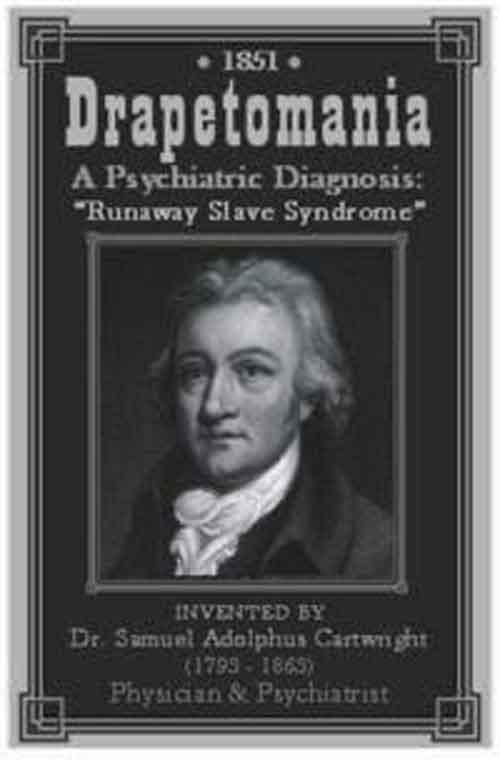
However, drapetomania did not begin as a poetic word for restlessness. It began as an accusation. In 1851, American physician Samuel A. Cartwright created the term to describe what he claimed was a psychological disorder that caused enslaved Black people to escape captivity. The word was formed from the Greek drapetes, meaning runaway or runaway slave, and mania, meaning madness. Cartwright presented his idea through the language of medicine, as though the desire to flee enslavement were not an expression of human will but a symptom requiring diagnosis.
Freedom was rewritten as illness. Resistance became evidence of an unstable mind. The person who ran was not considered rational enough to understand why they were running. The system they escaped was not placed under examination. Instead, the diagnosis was placed upon the person who refused to remain inside it.
That may be the most disturbing thing about drapetomania. It reveals how easily the language of authority can be used to make cruelty appear reasonable. Cartwright did not have to defend slavery if he could first declare that anyone who rejected it was mentally unwell. The violence of captivity could remain invisible while the desire to escape it was made into the problem.
His proposed prevention included punishment. Enslaved people who appeared dissatisfied or likely to run were to be subjected to physical violence, described as a means of correcting their supposed condition. The cruelty was given medical clothing, and punishment was presented as treatment. Drapetomania was never a legitimate disease. It was pseudoscience shaped around the needs of those in power, part of a broader history in which racial prejudice was given the appearance of scientific truth. Cartwright’s original claims and language are preserved in historical records, while the concept is now examined as an example of scientific racism.
Still, there is something almost unintentionally truthful hidden within the word. Not in the illness it pretended to identify, but in the fear that created it.
Those who controlled enslaved people understood that there was something within the human spirit they could not completely possess. They could control movement, labour, time and the body, but they could not make captivity feel like freedom. They could demand obedience, but they could not prevent the mind from recognizing injustice. Drapetomania attempted to name that refusal as madness because admitting it was courage would have exposed the moral sickness of the system itself. In a poem I wrote titled Drapetomania, I described this contradiction with the line, “bravery is madness, they said.” Perhaps that is the history of power in six words.
Whenever oppression wishes to survive, it begins by controlling language. The disobedient become dangerous. The grieving become ungrateful. The exhausted become lazy. The outspoken become unstable. The person who leaves becomes the problem, while the conditions that made leaving necessary remain conveniently unnamed.
Sometimes society does not ask why a person is running. It only asks how to stop them. This is why drapetomania still carries meaning beyond the century in which it was created. Not because the false diagnosis should be revived or carelessly transformed into an aesthetic description of wanting a holiday, but because the logic behind it has never entirely disappeared. We still live in a world that often examines the reaction before examining its cause.
A person reaches a breaking point and we criticise the way they break. Someone withdraws from an environment that is hurting them, and we call them weak. Someone refuses to accept what previous generations endured, and we call them difficult. Someone chooses peace over expectation, and we accuse them of running away. But leaving is not always cowardice.
There are times when staying demands courage. There are also times when leaving demands more. Escape can be an act of survival, a recognition that endurance is no longer noble when it exists only to preserve the comfort of those causing the pain. Not every departure is an abandonment of responsibility. Sometimes it is the first responsibility a person takes for their own life.
Yet we must be careful when giving drapetomania a modern, romantic meaning. Wanting to escape deadlines, expectations or emotional exhaustion is real, but it is not equal to escaping enslavement. To use the word without remembering its origin is to enjoy its poetry while forgetting the people whose suffering created it.
History should not become decoration. The modern urge to run away may help us emotionally approach the word, but it cannot replace its original weight. There is an immeasurable distance between dreaming of leaving one’s routine and fleeing a system that legally claimed ownership over one’s body. One is often a desire for relief. The other was a fight to reclaim personhood. Still, both can lead us towards a difficult question: who is permitted to leave?
Society often admires escape only after it has been made beautiful. We celebrate the person who leaves a harmful life once they have become successful enough to turn it into an inspiring story. We praise rebellion when history has already decided that the rebel was right. But while the escape is happening, when it is inconvenient, uncertain and frightening, we are rarely as generous.
Perhaps this is because departure exposes what staying allows us to ignore. When one person runs, everyone remaining must briefly confront the possibility that the cage is real. Their movement becomes evidence. Their refusal interrupts the comforting belief that the situation was natural, acceptable or harmless.
The runaway does more than leave. They reveal. Drapetomania was therefore never truly a description of the enslaved person’s mind. It was a reflection of the enslaver’s fear: the fear that captivity could not erase the knowledge of freedom, that obedience could not be mistaken for consent forever, and that a person treated as property might still insist upon being human.
The madness was never in the running. It was in constructing a world so cruel that freedom had to be diagnosed as a disease. Today, the word remains like an artefact pulled from beneath the language of history. It asks us to look carefully at the labels we inherit and the authorities we trust. It reminds us that a diagnosis can reveal the prejudice of the person making it more than the condition of the person receiving it. Most importantly, it asks us to reconsider the figure of the runaway. Not as someone who lacked the strength to remain, but as someone who understood that remaining was exactly what the system required of them. Drapetomania tried to turn that understanding into illness. History has returned it to its rightful name. The desire was freedom. The act was defiance. And the running was never madness.