Andrew and Tristan Tate: The Circus Called, It wants its Costumes Back!

The circus called. It wants its costumes back! At least the circus is harmless and actually worth watching. Anyway, what is better than scrolling through Instagram and seeing news posts about two men who have built entire careers around foul mouths, podcast microphones and their very loud opinions about women? One is bald, perpetually angry and apparently convinced that the world needs to hear his thoughts on masculinity. The other has a little more hair, but somehow the same level of confidence in his ability to lecture everyone else about how to live. Both have faced serious sexual assault allegations, which they deny. And yet, somehow, they have managed to become idols to a generation of boys who seem to believe that being loud, aggressive and misogynistic is the ultimate form of masculinity.
Let me get back to it again. There is something deeply fascinating about the modern "alpha male". He is everywhere. On podcasts, on Instagram, on TikTok, in five-star hotel lobbies and, occasionally, in photographs where he is inexplicably wearing sunglasses indoors, as though the sun personally offended him and has now been permanently banned from witnessing his existence. He is usually accompanied by a microphone, a cigar that burns almost as intensely as his personality, a luxury watch large enough to qualify as a household clock, a Bugatti and an opinion about women that nobody asked for. Can't save your hair? Then perhaps save no opinion about women, I would say. But, anyway he has arrived to save masculinity, apparently. The prime idol. The godly figure for boys. And naturally, what is even more interesting is that he has a uniform.
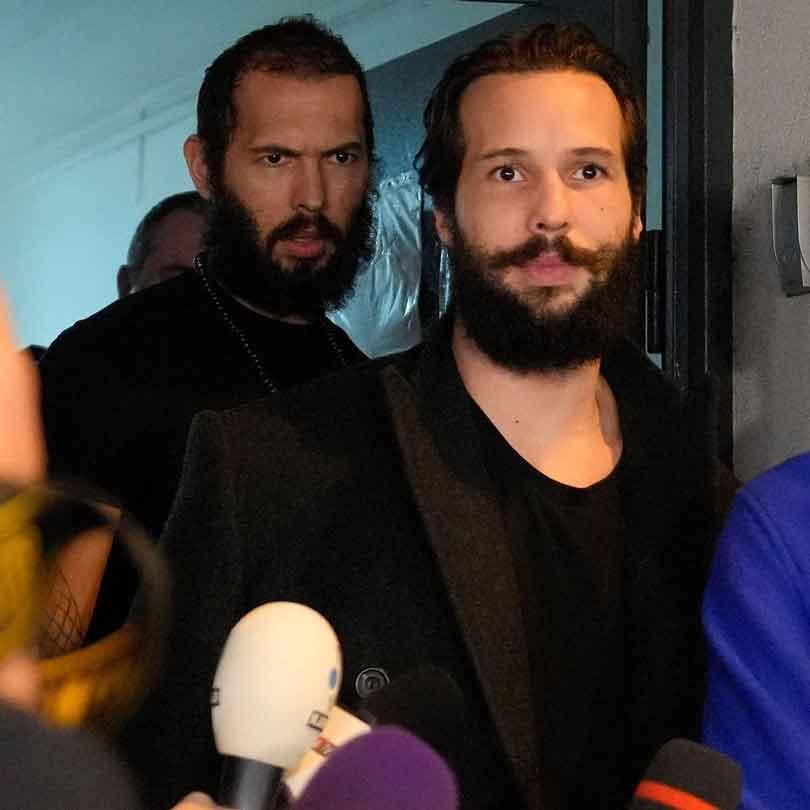
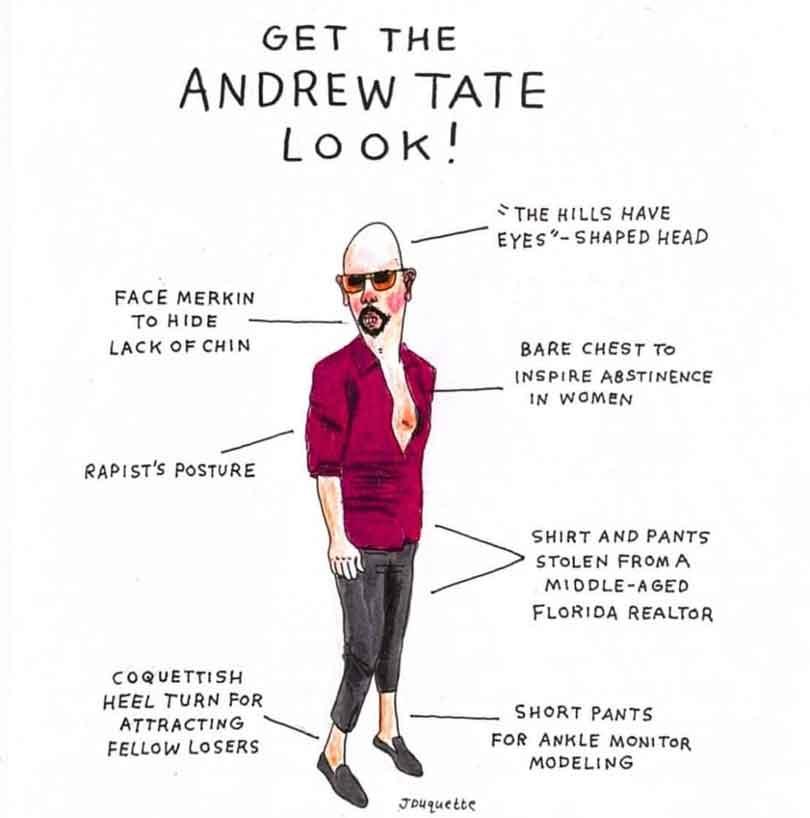
The shirt must be open. Not one button. Not two. We are talking about a neckline so ambitious that it appears to be attempting an escape. The trousers are suspiciously short and tight, the sunglasses are permanently attached, the loafers are polished to within an inch of their lives, and somewhere on his wrist is a watch that could probably tell the time in three different countries. The whole thing is less "alpha male" and more "man who has mistaken a luxury resort brochure for a personality".

An illustration by Instagram creator @misterjesseduquette, shared online, captures this particular aesthetic with glorious satire, breaking down the Andrew Tate look with the sort of brutal visual commentary that makes you wonder whether fashion has finally decided to fight back.
The funny thing about the "alpha male" phenomenon is that it is supposedly all about confidence. Yet confidence seems to require an extraordinary amount of advertising. The truly confident person generally does not need to explain every five minutes how confident they are. They do not need to announce their dominance, remind strangers that they are "high value", or produce endless content explaining why everyone else is inferior. Confidence is usually quiet. Insecurity, on the other hand, can be remarkably loud. And the internet has given insecurity a microphone.
If you look closely at men who constantly whine about women, they seem to do everything they can to achieve male validation. They love being so "homo" that they end up hating women. Well, too bad, because the very cultures and societies they have built are the ones that keep them trapped in the closet.
For years, figures such as Andrew Tate have built enormous online followings by selling a particular vision of masculinity to young men. It is a vision where success is measured in money, cars, women, physical dominance and the ability to make everyone else feel small. It is a strangely exhausting definition of manhood. Imagine waking up every morning and having to prove to the entire world that you are a man. Imagine needing the car, the watch, the mansion, the designer clothes, the podcast, the millions of followers and the carefully staged photographs just to convince strangers that you are winning at life. At some point, it stops looking like confidence and starts looking like a full-time marketing campaign.
And that is precisely where the "alpha male" industry becomes interesting. Beneath all the motivational speeches about discipline and success is a remarkably profitable business model. Tell young men that they are losers. Convince them that society has emasculated them. Tell them that women no longer respect them. Then sell them the solution. A subscription. A course. A podcast. A community. A lifestyle. A brand. It is capitalism with a superiority complex. The insecurity is the product, and the cure is conveniently available for purchase.
Of course, there is nothing wrong with encouraging men to become ambitious. Men should absolutely be encouraged to build careers, pursue education, take care of their physical and mental health, develop discipline and become responsible adults. But somewhere along the way, ambition got tangled up with misogyny. Self-respect got confused with superiority. Leadership got confused with control. Emotional strength got confused with the inability to admit that you might occasionally be wrong. Apparently, a man is no longer allowed to simply be a decent human being. He must be an "alpha". And if he is not an alpha, what is he? A beta? A loser? A man who enjoys reading? Terrifying.
The obsession with ranking men is particularly strange when you consider how little real life resembles a school cafeteria. Human beings are not wolves fighting over a forest hierarchy. Your office is not a jungle. Your relationship is not a military dictatorship. Your girlfriend is not territory you need to defend. Yet the language of dominance has become central to this online fantasy. Men are encouraged to see every interaction as a competition. Every relationship becomes a power struggle. Every woman becomes a potential threat to their status. It is exhausting just watching it.

And then there is the fashion. Oh, the fashion. The self-proclaimed kings of masculinity seem to have collectively decided that the more buttons they undo, the more powerful they become. At this point, some of these shirts are less clothing and more suggestions. The chest is out, the sunglasses are on, the trousers have mysteriously shrunk three inches, and the loafers are waiting patiently for their owner to discover that ankles are not, in fact, a substitute for personality. Perhaps that is why some of the men who idolise these figures seem to think that unbuttoning everything is somehow a demonstration of power. Apparently, when you have nothing meaningful to say, you might as well show some skin.
The entire outfit looks like a man has been told to dress "casual luxury" and interpreted it as "divorced nightclub owner". And those sunglasses. Always the sunglasses. Indoors. At night. During interviews. During conversations. Perhaps they are not sunglasses at all. Perhaps they are emotional support devices. The message seems to be, "I am so powerful that I refuse to let the natural world see my eyes." The result is a visual identity somewhere between a Bond villain, a property developer and a man who has just been informed that the yacht is delayed.
The irony is that the people who spend the most time preaching about not caring what others think often seem to spend an extraordinary amount of time carefully constructing an image for others to admire. Look at my car. Look at my watch. Look at my body. Look at my lifestyle. Look at my success. Look at me. Look at me. Look at me. It is almost as though the man behind the sunglasses is terrified that if everyone stops looking, the entire performance might collapse.
That is the uncomfortable truth about the "alpha male" persona. It is a performance, and performances require audiences. This is why social media is such fertile ground for it. The algorithm loves certainty. It loves outrage. It loves men shouting that they have discovered the secret to life in a 47-second clip filmed inside a luxury car. It loves the sentence, "Nobody wants you to know this," because apparently the secret to becoming successful has been hidden from humanity for thousands of years, and fortunately, one man with a podcast microphone has finally uncovered it.
The irony is almost too beautiful. The people who constantly complain about "cancel culture" often seem to spend an astonishing amount of time talking about the people they claim not to care about. The people who insist they do not need validation often build entire careers around receiving it. The people who preach independence create enormous online communities that depend on followers. And the people who claim to have mastered relationships often seem obsessed with reducing human connection to a scoreboard. It is a contradiction wrapped in a silk shirt.
But the consequences of this culture are not funny. The jokes are easy. The sunglasses are easy. The open shirts are very easy. But the ideology behind the costume deserves serious scrutiny.
Young men are growing up in an online environment where algorithms can repeatedly expose them to increasingly extreme content. A teenager who watches a video about fitness might soon be recommended for content about "masculinity". Then content about dating. Then content about "female nature". Then content that presents women as enemies. The pipeline can be gradual, which is precisely what makes it dangerous.
The answer, however, is not to mock every young man who feels lost. There are plenty of boys and men who are genuinely struggling. They are lonely, confused and anxious about their futures. They are struggling to understand relationships, identity and what adulthood is supposed to look like. Those are real problems, and they deserve real solutions. What they do not deserve is someone exploiting those insecurities to sell them a fantasy where their pain can be solved by becoming cruel.
There is nothing inherently weak about loneliness. There is nothing feminine about vulnerability. There is nothing shameful about asking for help. And there is certainly nothing "alpha" about treating women as lesser human beings. If anything, it takes far more strength to confront your own insecurities than to project them onto someone else.
Real masculinity, if we insist on using the word, should have room for kindness. It should have room for accountability. It should have room for emotional intelligence. It should have room for admitting mistakes. It should have room for respecting women without needing to be reminded that respect does not make you weak. And perhaps most importantly, it should have room for men to exist without constantly having to perform for one another.
Because here is the great secret that the "alpha male" industry seems strangely reluctant to reveal: you do not need to dominate everyone in the room to be a successful man. You do not need to own a supercar. You do not need a watch the size of a dinner plate. You do not need to walk around with your shirt hanging open like you are permanently auditioning for a role in The Real Housewives of Dubai. And you certainly do not need to spend your life convincing women that they are inferior to you.
You can simply be a decent person. It sounds terribly unglamorous, I know. There is no subscription package for it. No motivational course. No luxury car required. No sunglasses necessary. Just basic human decency. Perhaps that is why it has not yet become a billion-dollar industry.
The irony of the "alpha male" is that the more desperately he tries to prove that he is above everyone else, the more obvious it becomes that he needs an audience beneath him. The truly powerful do not need to constantly announce their power.
They do not need to shout. They do not need to belittle women. They do not need to turn every conversation into a hierarchy. And they certainly do not need to dress like a rejected magician who has just discovered Instagram.
So, dear alpha males, by all means, keep the watches. Keep the sunglasses. Keep the shirts open if you absolutely must. Fashion is a personal choice, and the world is already suffering enough without adding another dress code to the list. But perhaps, before giving another lecture on how everyone else should live, take a moment to ask a much simpler question: Who exactly are you trying so desperately to convince?
Because the loudest person in the room is not necessarily the strongest. The man with the biggest watch does not necessarily have the most valuable time. And the person who spends his entire life telling everyone else that he is an alpha may, ironically, be the person least comfortable with simply being himself.
Take off the sunglasses. Button up the shirt. Cover yourself up. Don't show skin. Sit down. Shut up. And, for once, perhaps the rest of us would like to see what is underneath the so-called alpha mindset and those bald heads with fragile masculinities.