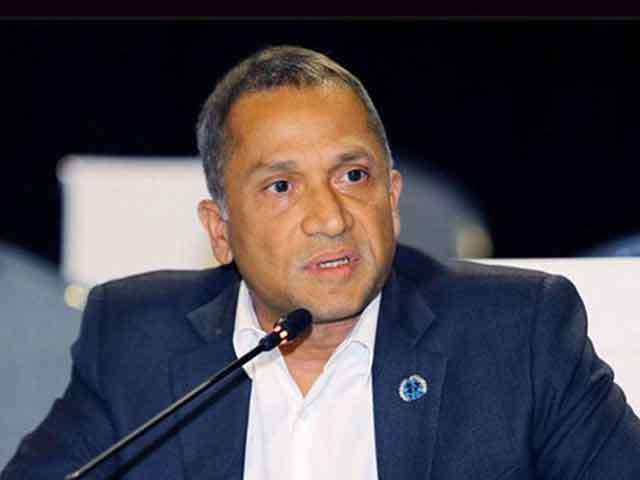
IN MELLIFLUOUS MEMORY OF MANO CHANMUGAM A PERSONAL REFLECTION
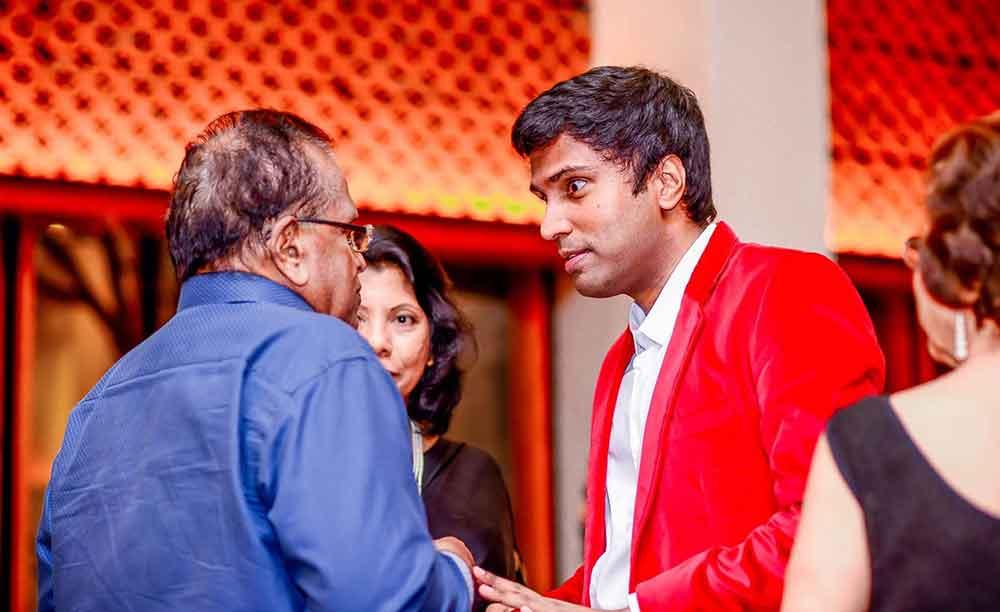
BY GEHAN A COORAY
To refer to Mano Chanmugam as the reigning Godfather of Western Music in Sri Lanka over the past half century or so would not be hyperbole. Born on November 14th 1931, the endlessly endearing and effortlessly erudite “Uncle Mano” (as he was known far and wide) was truly the Ultimate Arbiter when it came to all Classical Musicians and Singers that had any connection to the Pearl of the Indian Ocean. A much sought-after pianist himself, prior to becoming an impresario par excellence, Mano’s mere presence in the audience became the distinguishing feature of any concert or musical performance worth its salt in Colombo. He had met stars ranging from opera legend Maria Callas through Academy Award winner Vivien Leigh to philosopher and logician Betrand Russell and shared my worldview that a life worth living required the finest aesthetic sensibilities and the keenest analytical abilities.
Our paths first crossed in 2010, when my former piano and voice teacher Menaka de Fonseka and I collaborated on presenting a distilled version of Mozart’s opera The Marriage of Figaro at the Lionel Wendt Theatre. She had talked about what a grand and sophisticated gentleman Mano Chanmugam was, and that he would be attending our Opening Night performance. A week later, I had the tremendous honour of reading a review he had written for the Sunday Times, in which he said: “All praise is due to Menaka for her choice of direction by Gehan Cooray in ‘The Marriage of Figaro’” and that “Gehan Cooray as ‘The Count’ had the difficult task of directing, singing and acting but delivered all three with equal aplomb.” That was my official introduction to Uncle Mano, and those preliminary words he wrote about me have remained etched in my heart ever since, because that review was published before we had met in person and therefore, I knew how objective it was.
I didn’t realize at the time that he would become a surrogate family member over the 16 years that followed, as we connected in almost every manner that was meaningful to me - not only musically, artistically and linguistically (because he too had studied Latin and the Romance languages on top of speaking the King's English), but also spiritually, psychologically and intellectually. 2011 was the year our friendship really took off, when Mano invited Menaka and me to perform excerpts from Rossini’s The Barber of Seville at his magnificent home to mark his 80th birthday, having seen us stage all the highlights of that opera at the Lionel Wendt as well. “Hunter’s End” as Chez Mano is known, with its sweeping grand staircase, incandescent chandeliers, pipe organ and diverse grand pianos felt less like a residence and more like a temple to art, beauty and culture. Although I have since performed opera and classical music internationally in America, Italy, France and Switzerland, there is something magical about Uncle Mano’s self-designed mansion that makes singing or playing there feel like a privilege.
We quickly discovered that we were of much the same temperament, and spending time with Uncle Mano was always a major highlight of my visits to Sri Lanka from the United States. Innumerable were the hours I passed making music or conversing like there was no tomorrow with him and Neomal De Alwis, “far from the madding crowd” as it were, in our respective homes and at various holiday retreats across Sri Lanka. We could meet on a given morning at the opulent Chanmugam residence in Piliyandala, have lunch and tea (meticulously supervised by Mano’s constant companion Neomal), and proceed to have a late dinner back at my mother’s house down Ward Place or our Jetwing Colombo Seven rooftop - talking till Cinderella’s carriage had turned back into a pumpkin after midnight, all without Uncle Mano ever growing tired, feeling weak, or losing an ounce of enthusiasm for whichever topic we happened to be discussing by day or by night. The term joie-de-vivre seems to have been coined with him in mind.
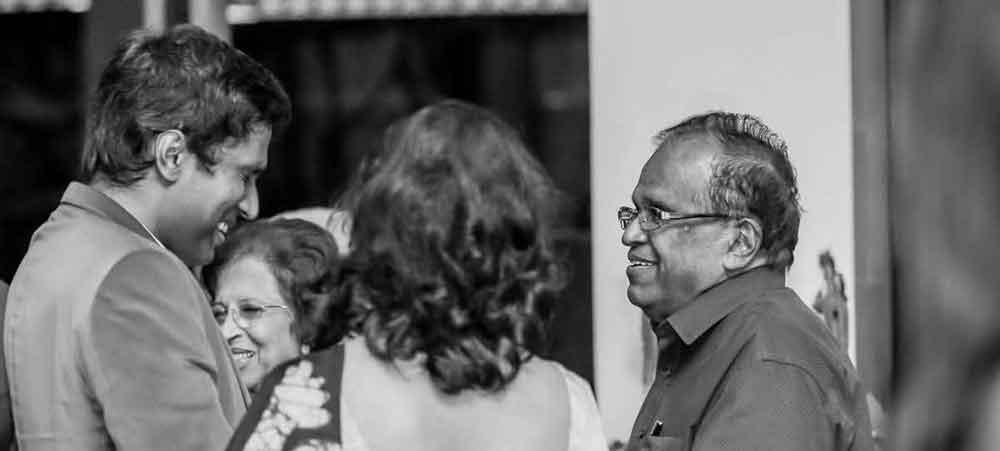
When his soul made its ascent to Heaven on March 18th this year, it felt to me like I had lost a third grandfather, because he had more than compensated for the death of my biological grandfathers for over one and a half decades. He had turned 94 last November, and yet it did not feel like it was “his time” to depart from us at all, because he had always been the South Asian equivalent of Peter Pan with a perennially boyish demeanour, a mind that was unabatingly witty and sharp, and the kind of optimism and zest for life that seem to elude even “Gen Z-ers” nowadays. In fact, I always got a kick out of asking people to guess his age when they first met him in recent years, seeing the look of astonishment on their faces when they were eventually told that he was closer to 100 than not. There was nothing physical, mental or even vocal that betrayed anything approximating his age.
I am eternally grateful to have recorded a one-on-one video interview with Uncle Mano back in 2021 as part of my “Meeting of the Minds” talk show for Daily Mirror Online, which can be viewed on YouTube. We covered everything from Theology and Philosophy to Cosmology and Science, which incidentally were only a handful of the kind of subjects we would talk about at leisure in private as well. There were so many different facets to Mano that many were simply not aware of. Long before he became such a towering and formidable figure in Sri Lanka’s cultural landscape, he had trained in the seminary and stood on the threshold of becoming a Catholic priest as a young man. Although that path did not become his final calling, the spirituality and profound faith that shaped those early years never left him. Indeed, despite his inimitably theatrical flair and unforgettably colourful personality, the Mano I knew and loved best was the private man of unfathomable depth and profundity.
It might surprise some readers to know that Uncle Mano had a distinguished career as a Nuclear Engineer in the United Kingdom – where he was proudly elected a Fellow of the Institution of Nuclear Engineers (now known simply as the Nuclear Institute). There was seemingly no end to this man’s brilliance. His connection to the U.K continued long after he returned to our motherland, as he took on the role of Sri Lanka’s representative for the Associated Board of the Royal Schools of Music in the United Kingdom. Through that platform he guided and inspired countless budding young musicians, both as performers and as teachers.
He also established the Mano Chanmugam Music Foundation, whose mission was to bring foreign artists to our shores, facilitating cultural enrichment. I still smile when I recall the excitement he felt when hosting luminaries such as Anthony Adkins and Danielle De Niese, whom I befriended thanks to Uncle Mano. In fact, I even worked with Danielle’s personal vocal coach Gerald Martin Moore in New York (who also coached Renee Fleming and Natalie Dessay), after she recommended me to him. I was barely 25 when I met Danielle, but Mano was adamant that she should hear me sing!
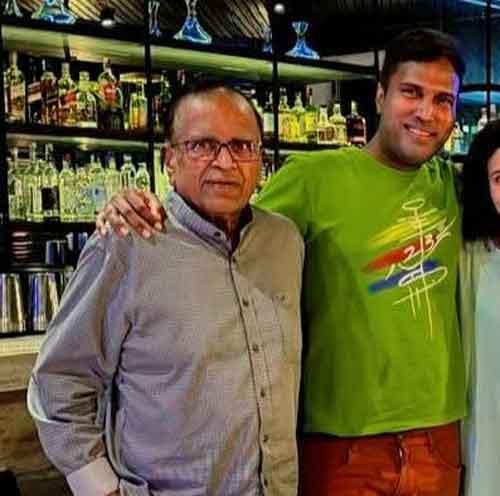
He shared my convictions that great singing is not solely about vocal technique, but also about crystal-clear diction, heartfelt communication, and an absolute, uncompromising dedication to perfection. “To profess anything – whether in music, philosophy or faith – one must study it thoroughly,” he once said, moreover. He was not amused by people who took shortcuts or glossed over the details and finer points. My mother tongue is Sinhala while Uncle Mano's was Tamil.
I will never forget how he demonstrated the three different ways to pronounce the letter "L" in Tamil. I was reminded of how certain nuances and emphases of pronunciation even in Sinhalese have been abandoned over time for the sake of convenience.
Returning to the realm of Opera, Mano was one of the precious few people who understood that even though both Mozart and Rossini composed operas with Italian libretti, for instance, one could not refer to them as “Italian Operas” indiscriminately because Mozart was an Austrian composer, and only Rossini was actually Italian in this case. Uncle Mano would distinguish what he called the ‘Latin’ temperament, flavour and culture of composers like Rossini - which might be described as passionate or hot-blooded - from the more formal, structured, relatively colder qualities of Germanic composers like Mozart (even when both geniuses set Italian texts to music).
And despite him being an alumnus of St. Peter's College, while I am an alumnus of St. Joseph's College in Colombo, it was dear old Uncle Mano who pointed out the correct way to pronounce the word Josephian. All other Sri Lankans (including every Josephian I’ve ever known) emphasize the first syllable therein, which is a defect of Sri Lankan English, whereas the correct way to articulate it is by stressing the second syllable: “Jo-SEPH-ian” (as opposed to "JO-sephian"). I daresay Uncle Mano was the last person from his generation who understood all these beautiful intricacies of language. There is no denying that “Jo-SEPH-ian” as it was meant to be said aloud sounds infinitely more melodious and elegant than the pedestrian “JO-sephian” pronunciation. Perhaps as a Heavenly Reward for clarifying this, Uncle Mano ended up being cremated on March 19th which is the Feast of Saint Joseph himself!
Mano Chanmugam was, quite frankly, the dictionary definition of versatility: a nuclear engineer turned cultural titan, a would-be priest turned savvy philosopher, a virtuoso pianist turned grandiose designer and architect. He carried himself with quiet dignity, yet his laughter could fill an entire auditorium, and his kindness, generosity and hospitality knew no bounds. Every single thing he said or did came straight from the heart, and oftentimes straight from his very soul.
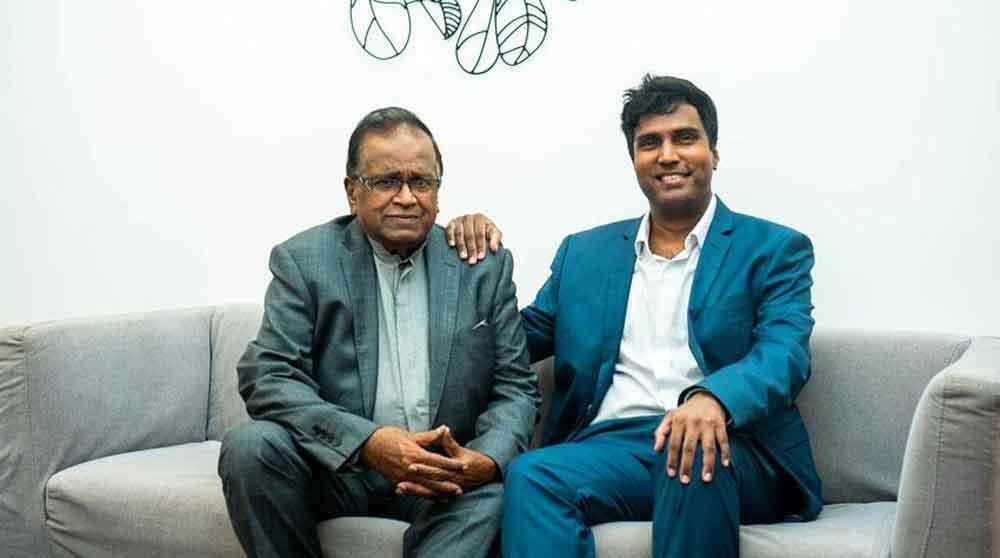
Rest in “peace and power”, Darling Uncle Mano, even though I’m quoting my (frankly superior) ‘Jo-SEPH-ian’ school anthem and not your (only so-so) Peterite anthem (if you will permit me to be so impertinent). You have left behind a legacy that will echo through Sri Lanka’s music and performing arts community for the remainder of this century and well beyond (unless the world is blown to smithereens by nuclear power first). The video of our one-on-one talk show conversation remains for now, and I will keep returning to it on YouTube for as long as I’m alive – not just to see your adorable facial and ocular expressions, and to hear your most aristocratic and operatically resonant voice, but to feel your irreplaceable warmth and be reminded of the wellspring of wisdom that made you so special and precious. When someone accused me of saying something in an entirely wrong context last year, you were quick to jump to my defence and give me the sublime benefit of the doubt by saying: “No, I assure you, Gehan is far too elegant to have said that the way you are relating it.” I promise to retain the elegance you saw in me for the remainder of my life.
With love and gratitude until we meet again in Paradise,
Gehan A Cooray
March 2026