Why Your Brain Fights Itself: The Hidden Power of Focus

By Dewmi Dodhani
Have you ever sat down with the intention of completing a single task, only to realize that your attention has already drifted somewhere else? Perhaps you opened your phone to reply to one message and suddenly found yourself scrolling through videos, reading random posts, or checking notifications twenty minutes later. Maybe you tried to study while music played in the background, conversations happened nearby, and alerts kept appearing on your screen. Even when we genuinely want to concentrate, our minds often seem determined to wander. This experience is not a sign of laziness or weakness. It reflects the way the human brain naturally operates in a world overflowing with distractions. Modern life constantly competes for our attention. Phones buzz endlessly, advertisements flash across screens, social media platforms encourage rapid scrolling, and information never truly stops flowing. As a result, the brain is continuously forced to process multiple streams of competing information at the same time.
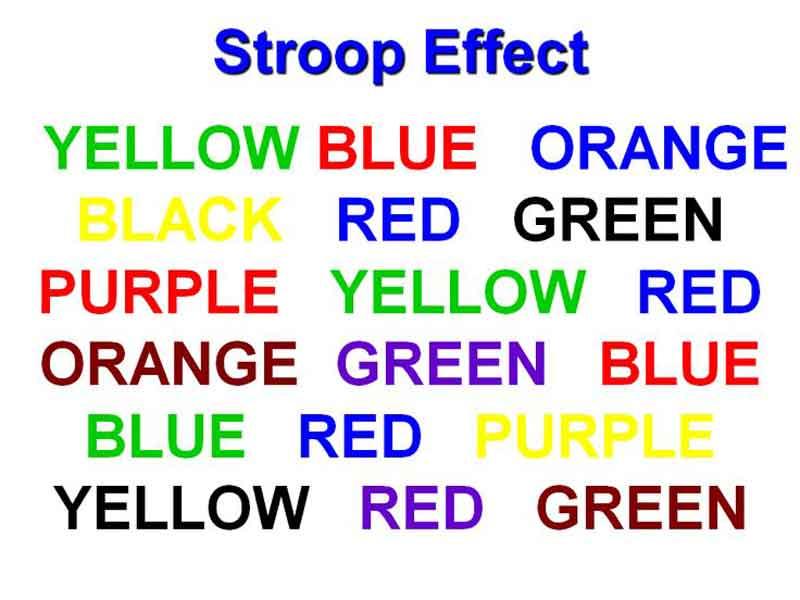
One fascinating psychological phenomenon that perfectly demonstrates this struggle is known as the Stroop Effect. Although the experiment behind it is simple, the lessons it reveals about human attention, focus, and mental conflict are surprisingly powerful. The Stroop Effect was first introduced in the 1930s by American psychologist John Ridley Stroop. His experiment appeared straightforward on the surface. Participants were shown words representing colours such as “red,” “green,” “blue,” or “yellow.” However, there was an important twist. Sometimes the colour of the ink matched the word, and sometimes it did not.
For example, the word “RED” might appear written in blue ink, while the word “GREEN” could be displayed in yellow ink. Participants were instructed to say the colour of the ink rather than read the actual word itself. At first glance, this task sounds incredibly easy. Yet most people immediately become slower and begin making mistakes. Their brains experience a brief but noticeable moment of confusion.
Why does this happen?
The answer lies in the way the brain processes information. Reading words is something most adults do almost automatically. From early childhood onward, years of reading train the brain to recognise language quickly and effortlessly. When we see a familiar word, our brains instinctively process its meaning without conscious effort. Naming colours, however, requires a different type of mental processing. Unlike reading, identifying ink colours demands more deliberate attention and control. When the written word conflicts with the colour being displayed, the brain suddenly receives two competing messages at once. One part of the brain automatically wants to read the word, while another part attempts to focus on naming the ink colour instead.
This creates a moment of internal conflict.
In simple terms, your brain already knows the correct answer, but another automatic mental process keeps interfering with it. The delay that occurs between these competing signals is what psychologists call the Stroop Effect. Although the experiment itself is small and simple, its implications are enormous because it reveals something deeply important about human attention. The brain is not nearly as effective at multitasking as many people assume. In modern society, multitasking is often treated as a valuable skill. Many people proudly describe themselves as capable of handling several activities simultaneously. Students attempt to study while texting friends and watching videos. Employees respond to emails during meetings while switching between multiple tabs on their computers. Drivers glance at navigation systems while checking messages at traffic lights. Daily life has become filled with overlapping tasks competing for mental space.
Yet psychology consistently suggests that the human brain does not truly multitask in the way people imagine. Instead of performing several tasks at once efficiently, the brain rapidly switches attention between different activities. Each switch may only take a fraction of a second, but over time these interruptions create mental fatigue, reduce accuracy, and slow performance. The Stroop Effect demonstrates how even a tiny conflict between a word and a colour can interrupt concentration for a brief moment. If such a simple mismatch can create confusion, imagine the impact of dozens of distractions competing for attention throughout an entire day. This constant battle for focus is one of the defining challenges of modern life. Every notification, advertisement, message, and social media update demands a piece of our mental attention. Psychologists often describe this as “cognitive clutter.” Just as physical clutter can overwhelm a room, mental clutter overwhelms the brain. When too many signals compete simultaneously, concentration weakens, and mental exhaustion increases.
Over time, this overload can have serious effects on productivity, emotional wellbeing, and even memory. People may struggle to complete tasks efficiently, forget information more easily, or feel constantly mentally drained. Many individuals now describe themselves as being busy all the time while simultaneously feeling as though they accomplish very little. In many cases, the real problem is not a lack of effort but a lack of uninterrupted focus. The issue appears especially significant among younger generations who have grown up surrounded by digital stimulation from an early age. Smartphones, tablets, streaming platforms, and social media applications provide endless entertainment and constant novelty. Every swipe introduces something new. Every notification creates a tiny burst of anticipation.
While technology offers enormous benefits, constant exposure to rapid information switching may also affect attention spans. Several studies suggest that heavy digital stimulation can increase mental fatigue and make sustained concentration more difficult. Many people now find it challenging to read a long article, sit quietly without checking their phones, or focus on one task for an extended period of time.
Even moments of silence have become uncomfortable for some individuals because the brain has grown accustomed to constant stimulation. The Stroop Effect reminds us that distraction is not simply a personal failing or a bad habit. It is connected to the brain’s natural tendency to respond automatically to competing information. Our minds are constantly trying to process multiple signals at once, even when we want to concentrate on a single goal. However, understanding this mental conflict also provides an important solution.
Focus is not necessarily about forcing the brain to work harder. Instead, it is often about reducing unnecessary competition for attention. Small environmental changes can dramatically improve concentration. Turning off notifications while studying, placing the phone in another room, working in a quieter environment, or focusing on one task at a time can significantly strengthen mental clarity. These changes may seem minor, but they reduce the number of competing signals fighting for attention inside the brain.
Research also shows that uninterrupted periods of concentration help improve both productivity and learning. When attention remains focused on a single activity for a sustained period, the brain processes information more deeply and efficiently. This is why many experts recommend techniques such as “deep work,” where individuals dedicate specific blocks of time to complete one important task without distractions. In many ways, focus behaves like a muscle. The more consistently it is trained, the stronger it becomes.

At first, maintaining concentration may feel difficult. A person accustomed to constant distractions may instinctively reach for their phone every few minutes or struggle to sit still while working. Yet with practice, the brain gradually adapts. Over time, longer periods of focus become easier and more natural. This idea is especially important today because attention has become one of the world’s most valuable resources. Entire industries compete to capture and hold human focus for as long as possible. Social media platforms are carefully designed to keep users scrolling. Streaming services automatically play the next episode before viewers can pause. Advertisements constantly fight for visibility. In many ways, modern technology profits from distraction.
As a result, maintaining concentration has become more than just a study skill or workplace habit. It has become a form of mental discipline. The ability to direct attention intentionally rather than constantly reacting to external interruptions may now be one of the most important skills a person can develop. The lessons behind the Stroop Effect extend far beyond psychology laboratories or classroom demonstrations. They reflect a challenge experienced by millions of people every single day. Our brains continuously balance automatic responses, distractions, competing thoughts, and endless streams of information.
The next time you struggle to focus, forget what you were doing, or feel mentally overwhelmed, remember that your brain is not broken. It is simply trying to manage too many competing signals at once. The real challenge is not eliminating distraction completely because that may be impossible in the modern world. The challenge is learning how to quiet the noise long enough to focus on what truly matters.
Sometimes, the strongest minds are not the ones capable of doing everything at once. They are the ones that know how to slow down, block out unnecessary distractions, and give full attention to a single meaningful task. In a world constantly demanding our attention, focus may be one of the rarest and most powerful abilities we still possess.