Reflections on Art, Autonomy, and Change: Omali Radhika
By: Marian de Silva
Every artist carries a story, but few tell it with the honesty, vulnerability, and depth that Omali Radhika brings to her work. Through themes of resilience, self-reconstruction, and personal freedom, her art invites us to reflect on the uncertainties of life and the strength found in navigating them. It was a pleasure to sit down with Omali Radhika to discuss her artistic journey, creative process, and the experiences that continue to shape her thought-provoking body of work.
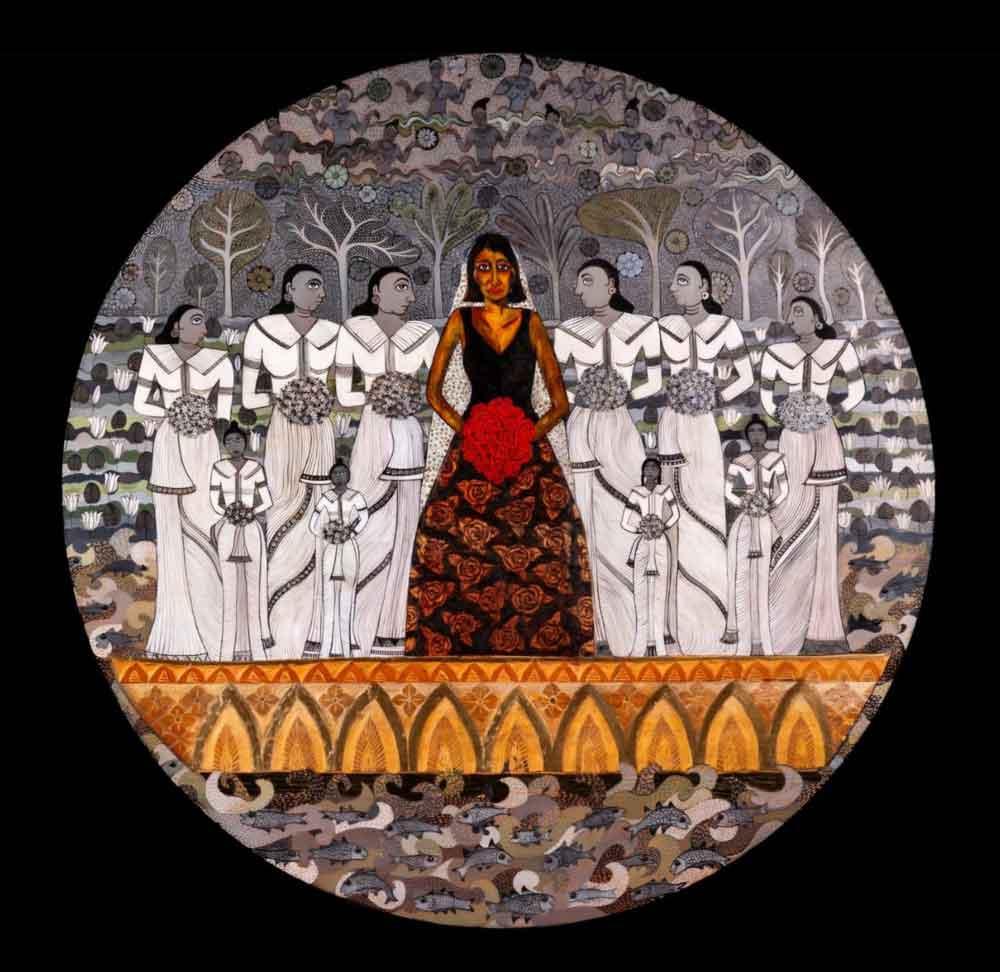
"The Journey" spans three distinct circular panels. What personal or collective journey were you mapping when you conceived this series, and where does it begin and end for you?
I did not create the artwork titled 'The Journey' to merely depict the events of my life. Instead, what I refer to as a 'journey' is how those experiences transformed my life, or rather, how certain life events reshaped it. Ultimately, this 'journey' represents the realization of reality achieved through life experiences. Thus, the reality I envisioned within my personal life is what manifests outwardly as a work of art.
The tondo (circular) format is a deliberate and uncommon choice. How does painting within a circle rather than a rectangle change the psychological relationship between the subject and the viewer?
Audiences are generally accustomed to viewing artwork within a conventional rectangular frame, which is an established psychological norm. However, I chose the circle for this art piece because every event in our lives, whether within society, throughout history, or in the future, operates in a cyclical manner. Therefore, I felt that instead of confining these creations to a rectangular frame, bringing them into a circle would more profoundly intensify and convey my artistic intent.
The central female figure carry an almost mythological stillness amid dense, chaotic surroundings. Is this woman an archetype, autobiographical, or someone specific you've carried inside you?
All three of these elements are embodied within this woman. This is not merely a depiction of a specific moment; fundamentally, it reflects my own internal essence.
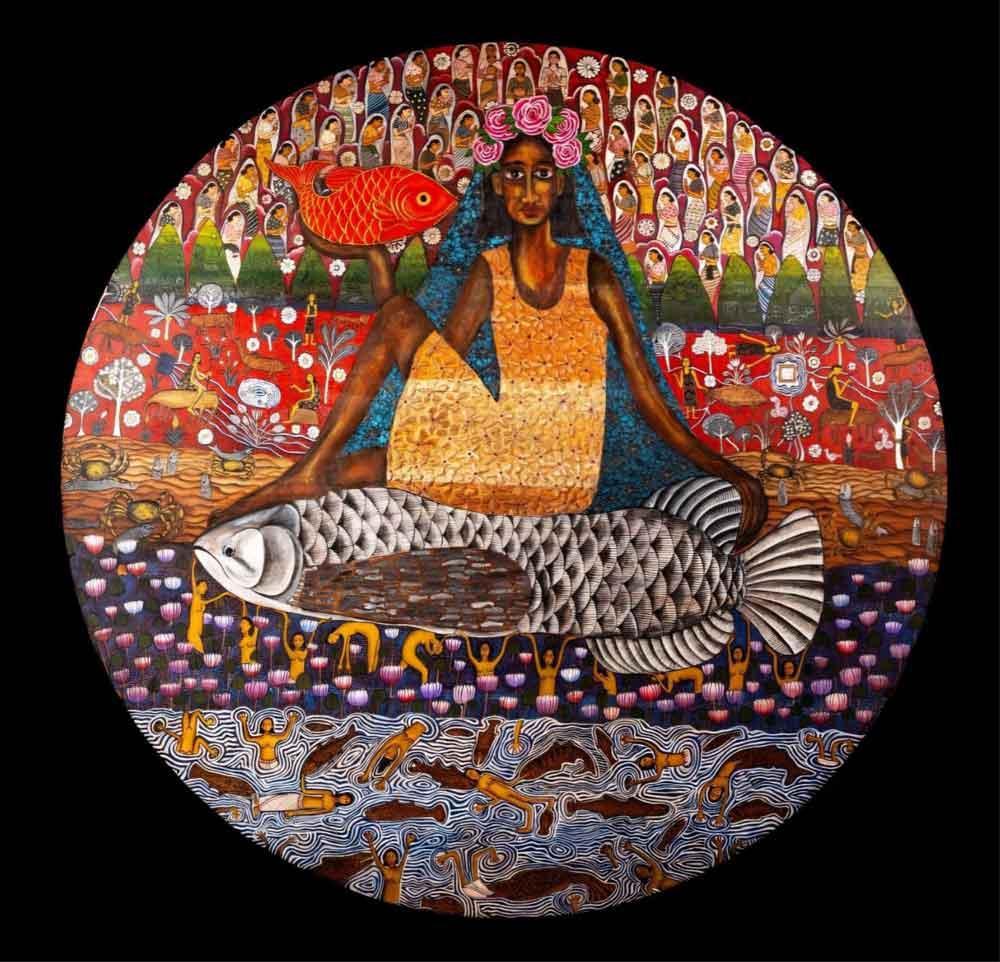
Fish appear prominently across all three works, sometimes as vessels, sometimes as companions. What do they symbolize in your personal iconography?
Fish are frequently featured in my creations, whether as a single large fish or a vast multitude of very small fish. My primary reason for incorporating fish as a symbol in my paintings is that within the South Asian context, fish already signify luck, protection, love, intimacy, and journeying. Because this directly connects to my overarching theme, 'The Journey', I have utilized the fish as a symbol to depict the emotions we experience through the constant changes and conflicts that arise as we engage with social, cultural, and political dynamics throughout this life cycle.
You carve, burn, and scrape your wood before a single stroke of paint, in those moments, are you processing something in yourself as much as on the surface?
The reason I chose mixed media for this creation was primarily my desire to present my work to the audience in a novel way. I wanted to move away from conventional mediums like canvas. To achieve this, I utilized wood as the surface for my painting. I believe that this wooden medium allowed me to express my concepts with greater intensity, enabling me to portray the diverse nature of both internal and external emotions in distinct ways. By employing various techniques such as wood carving, burning, scratching, printing, and drawing, I believe I have rendered 'The Journey' as a uniquely different experience.
In your painting, Journey I, the woman is surrounded by hundreds of tiny figures and a vast crowd. Is she leading them, escaping them, or simply existing despite them?
Particularly in several South Asian countries, the figure of the woman exists confined within a specific framework. Whether within the domestic sphere, the workplace, relationships, or broader society, everything from her choices to her attire is dictated by a cultural framework inherited at birth. Throughout her life cycle, from birth until death, the South Asian woman remains trapped within this inherited cultural mold, whether willingly or unwillingly. Through this artwork, I portray the women who, amid a vast majority remaining confined, choose of their own volition to break through that framework in pursuit of their freedom.
The colour language shifts dramatically across the three artworks, from vibrant reds and golds to muted earth tones. Was that chromatic journey intentional, and what emotional states do those shifts represent?
Yes, the colour palette in these paintings varies significantly. When selecting colors for these artworks, I chose a wide spectrum ranging from highly vibrant tones to dark shades, including various gradations of those colours.
The primary reason for utilizing such a diverse color palette within these paintings is to depict different emotional states, such as love, desire, isolation, and hope. I have used this palette to more clearly illustrate how life was transformed as a result of those emotions.
Your bio describes your practice as rooted in "process, repetition, and embodied storytelling." The density of pattern in these works feels almost meditative, do you use repetition as a form of ritual or healing?
There is no singular, definitive meaning within this piece. It may present itself as a ritual to those who perceive it that way at that moment, or it might resonate as a ritualistic experience for someone based on their own life experiences. Furthermore, the true meaning of that repetition has been left open to interpretation. If someone wishes, they can perceive it purely as a feeling. I have deliberately liberated the concept of repetition within this artwork.
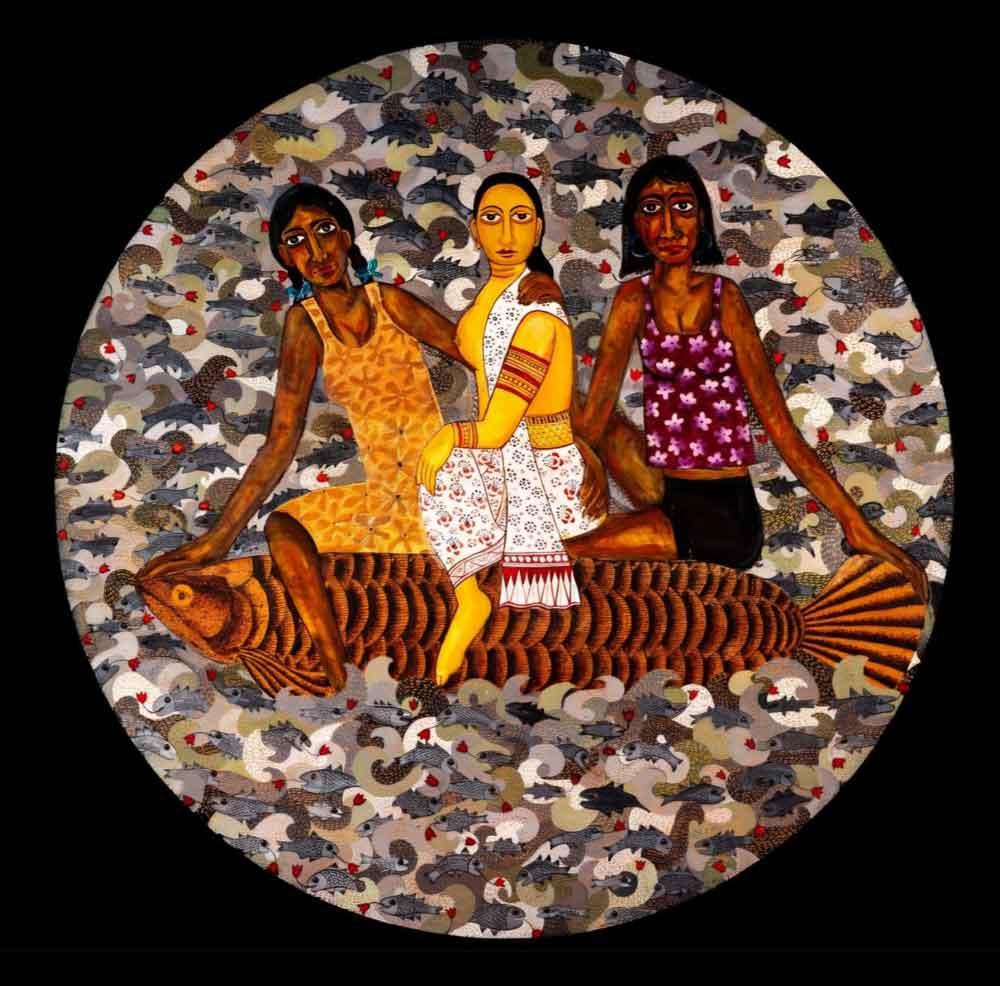
The women in Journey II stand together yet feel individually isolated. How do you navigate the tension between community and loneliness as a recurring theme in your work?
That is not quite the intention behind my piece, 'The Journey'. While it depicts experiences I have lived through, am currently living through, or anticipate facing in the future, it is not my desire to suggest that every woman is like me, or that there are others exactly like me somewhere else in the world. Instead, what I want to convey is how I translate the specific situations I encounter within my own life into my artistic expression.
You've exhibited in Seoul and Colombo. How has moving between these art contexts, regional and international, shaped what stories you feel permitted or compelled to tell?
While my subject matter is closely tied to my personal experiences, what I have brought into my artwork are realities that many women experience on a universal scale. For many Asian women, these themes might not seem particularly extraordinary because they are so familiar. However, when looking at women from Europe and other regions, this situation may differ to varying degrees. Yet, within my artwork, this does not merely represent a regional identity; it encompasses the universal woman.
There's a persistent visual grammar of water, trees, and fish that feels rooted in South Asian folklore. How consciously are you drawing from that tradition, and where do you depart from it?
Elements of traditional painting styles can certainly be observed in certain aspects of my work. I have studied the influences of traditional Sri Lankan temple murals alongside the intricate artistry found in Indian Rajput paintings, consciously absorbing them into my own artwork.
The motifs, color application, linework, and forms characteristic of traditional Sri Lankan art are visible throughout my paintings. However, when incorporating these traditional forms into my work, whether depicting human figures, trees, water, or animals, I alter them to fit my specific visual plane. Rather than replicating those traditional paintings exactly, I transform the imagery I require under the influence of traditional art to create my own compositions. In doing so, I have sought to understand tradition without becoming confined by it.
These works are priced significantly differently, Journey I at nearly double Journey II. Without reducing art to commerce, what does that reflect about the emotional weight or complexity you assigned each piece?
No, what is reflected here is that the pricing of a piece is determined by the creative depth I invest into it, alongside the interpretive space it demands. I price my work based on these specific factors, rather than for purely commercial motives.
For an artist rooted in embodied practice, how does standing before an artwork for months differ emotionally from inhabiting a live space for minutes?
These two experiences are profoundly different from one another. From the precise moment an artist engages with a piece, they spend minutes, hours, and months working in front of it to bring the concepts envisioned in their mind to fruition. Actively connecting with an artwork over an extended period creates a deep bond between the artist and the true meaning of the creation. Furthermore, the physical exhaustion endured by standing before an artwork for so long transforms emotional energy into a deeper realization, allowing the artist to feel the core of art more intensely and authentically. Through time, navigating stages of fatigue, monotony, pain, and profound joy ultimately leads to a heightened level of mental clarity. Conversely, a few minutes within a live experience offer nothing more than a momentary impression. In such a brief timeframe, a live experience evokes only a superficial sense of awe or curiosity, without demanding rigorous physical exertion. It is merely a passage of time spent within that live space for a few minutes, whether willingly or unwillingly.
When this series is complete and hanging somewhere in the world years from now, what do you most fear people will misunderstand about it, and what truth do you hope survives?
I possess a very clear and distinct understanding of this artwork and its artistic expression. Consequently, I know that I will not have to face that kind of issue. I anticipate that my creations will travel to many places around the world, which is also my personal aspiration. Furthermore, while I greatly appreciate my work being included in private art collections, having them housed in a space like a public gallery imparts a human value to the artwork that transcends its material worth. To my knowledge, several of my pieces are already on display in this manner.
One of my works is part of a permanent exhibition at a gallery in Melbourne, Australia, and another is permanently exhibited at the Odisha State Museum in India.