Navigating Sri Lanka’s Fractured Monsoons in the 2026 El Niño Shift
By Thaliba Cader
Sri Lanka has always been governed by water. Its earliest political formations were not defined by conquest or trade alone, but by the engineering of rainfall. Reservoirs, canals, and cascaded tank systems converted seasonal uncertainty into agricultural stability, allowing settlement to expand across landscapes that would otherwise have remained marginal. That system did not eliminate risk. It reorganized it across space and time. Even now, after centuries of technological and economic change, the island remains bound to a narrow climatic rhythm that shapes planting cycles, hydropower generation, and the structural stability of rural livelihoods.
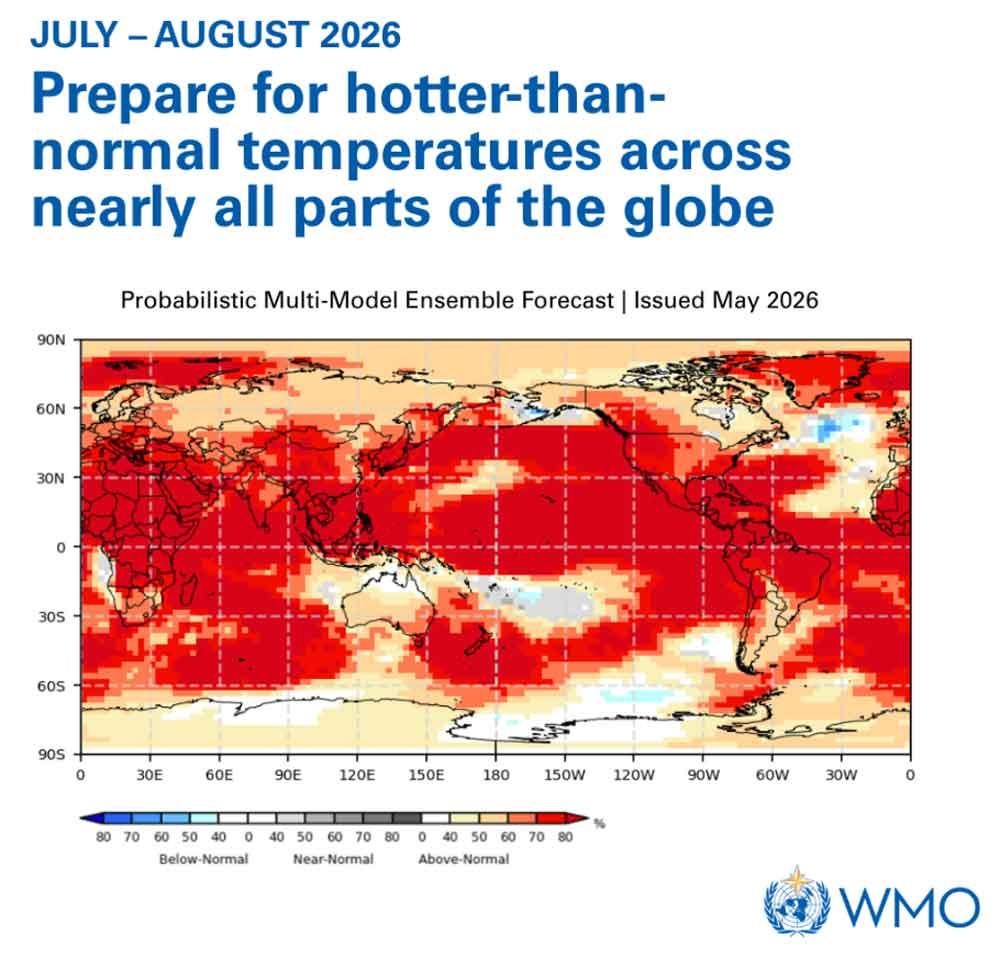
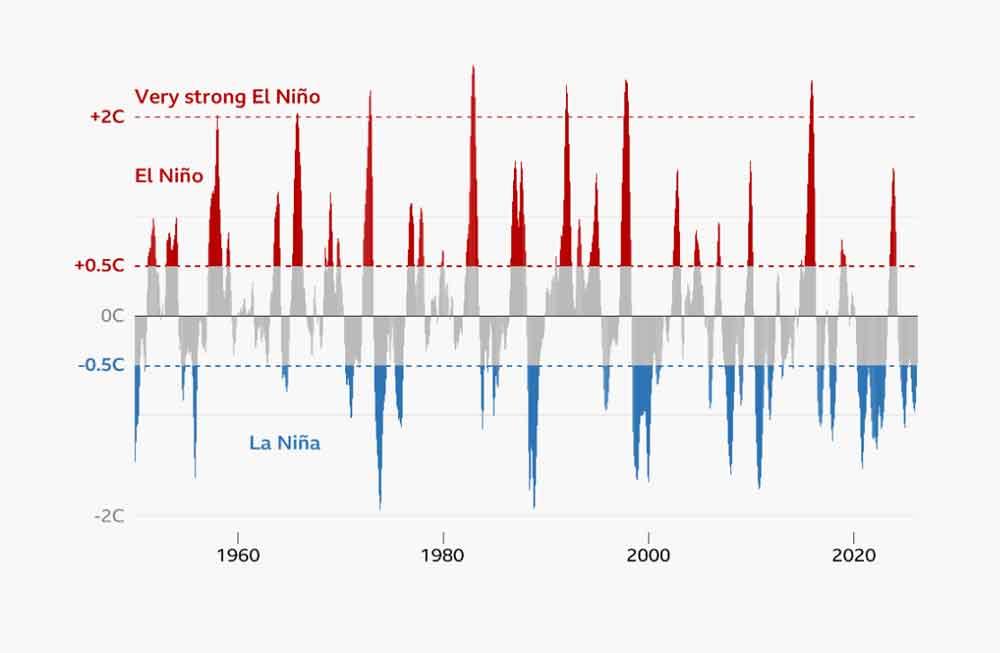
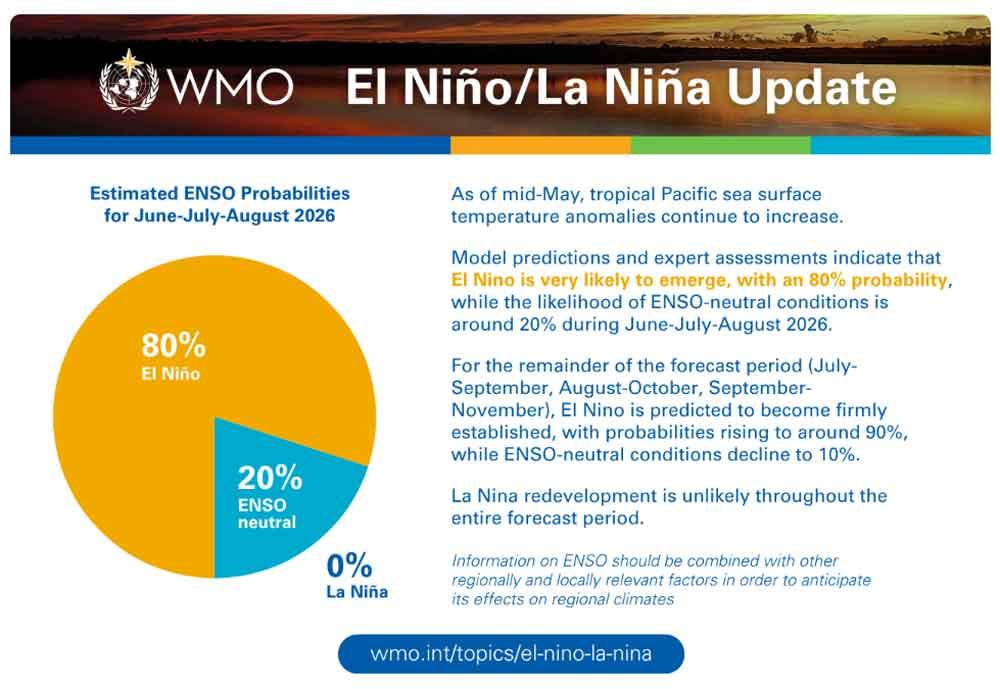
That rhythm is becoming less predictable. In 2026, the Pacific Ocean is again showing signs of transitioning into an El Niño phase. International climate centers monitoring ocean–atmosphere dynamics indicate a high probability of development during the second half of the year. The significance of this shift does not lie in novelty. El Niño is a recurring feature of the climate system. Its importance lies in timing. It is re-emerging in a period when global temperatures remain elevated and when regional climate variability is becoming increasingly difficult to interpret through historical patterns alone.
A single monsoon season now carries more possible outcomes than it once did. El Niño originates in the equatorial Pacific, but its influence extends far beyond it. At its core, it reflects a reorganization of heat exchange between ocean and atmosphere across the tropics. Under neutral conditions, trade winds push warm surface water westward, concentrating heat near Southeast Asia and allowing cooler, nutrient-rich waters to rise along the coast of South America. This arrangement sustains a relatively stable pattern of atmospheric convection and rainfall distribution across the tropics.
When those winds weaken, the system reorganizes. Warm water shifts eastward. Atmospheric pressure gradients adjust in response. Rainfall belts move with them. What begins as an oceanic anomaly becomes an atmospheric redistribution of probability. It does not simply move rain from one place to another. It changes the conditions under which rain becomes more or less likely across large regions of the planet.
Sri Lanka sits outside the Pacific system, yet remains sensitive to its signals. That sensitivity is indirect and mediated. It passes through the Indian Ocean, through monsoon circulation, and through regional sea surface temperature patterns that shape moisture availability across South Asia. For that reason, El Niño does not produce a uniform outcome on the island. It modifies tendencies rather than imposing outcomes. It shifts timing more than totals. It alters the reliability of seasonal expectation rather than replacing it with a new pattern.
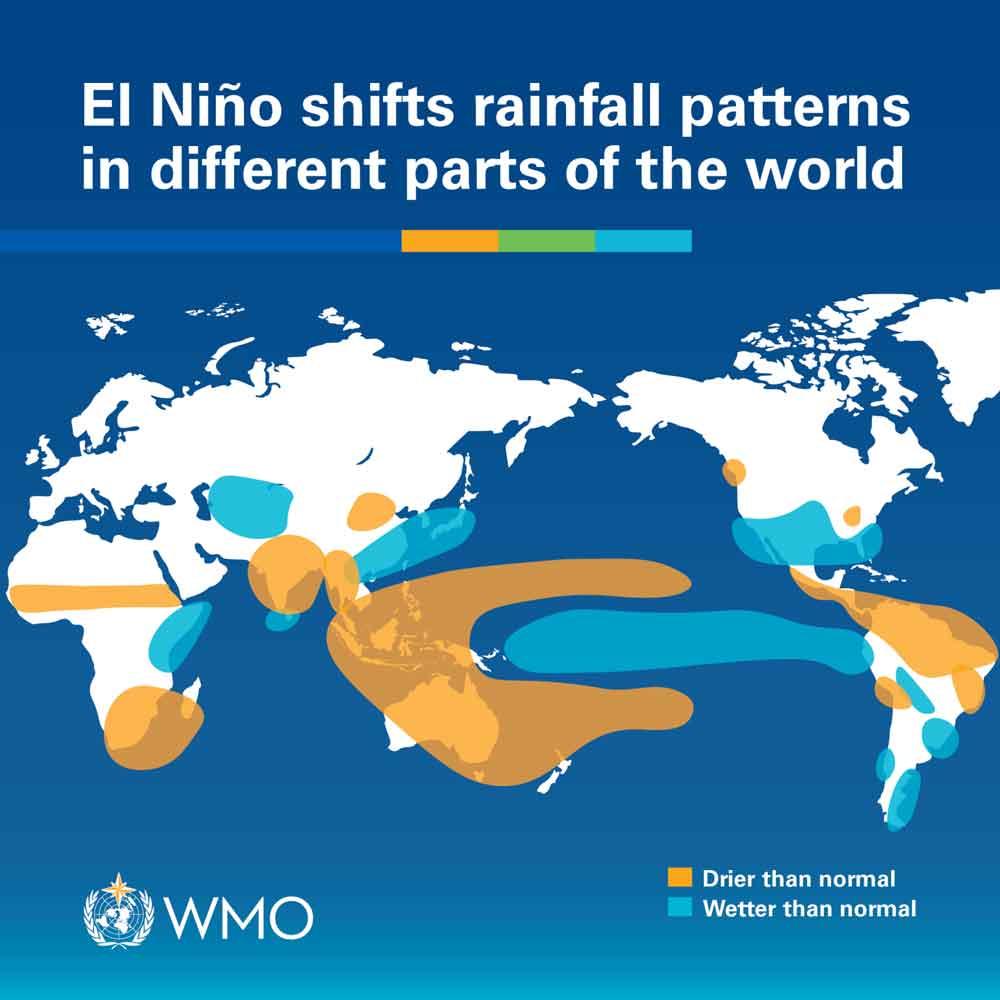
In practical terms, this variability concentrates in the monsoon cycle. During many El Niño years, Sri Lanka has experienced weaker or delayed rainfall in parts of the Southwest Monsoon season. The effect is not simply reduced precipitation. It is a redistribution of when and where rainfall arrives. Agricultural zones that depend on early monsoon onset face uncertainty in planting schedules. Reservoir inflows become less consistent. Soil moisture profiles change in ways that affect crop establishment rather than only final yield.
Later in the year, during inter-monsoonal periods, rainfall can become more episodic. Short-duration, high-intensity events become more likely, increasing the risk of localized flooding in catchments where land use change has reduced natural absorption capacity. The outcome is not a transition from wet to dry conditions. It is a tightening of extremes within a shorter and less predictable seasonal window.
A farmer in the dry zone does not experience this as a global climate mechanism. He experiences it as hesitation. The decision of when to plant paddy is rarely ideological. It is observational. It depends on the behavior of the sky over a small number of days, the moisture content of soil at a specific depth, and the level of water in a nearby tank. When those signals become less consistent, the margin for error narrows. A delayed decision can reduce yield. An early one can fail entirely. What climate models describe as probabilistic distribution is, at ground level, a sequence of risks that accumulate quietly.
This is where the structural vulnerability of Sri Lanka becomes clearer. Agriculture remains closely tied to seasonal rhythm. Hydropower generation depends on sustained reservoir inflows rather than short bursts of rainfall. Water storage systems, many of which extend from ancient cascade networks, are designed for variability, but not for volatility that clusters extremes at both ends of the season. When dry periods intensify, thermal generation increases to compensate for reduced hydropower output, raising both fiscal pressure and energy insecurity. When rainfall arrives in concentrated bursts, water management shifts from storage to damage limitation.
Public health systems respond to the same oscillation. Extended dry periods increase heat exposure and water stress. Intense rainfall events increase the likelihood of waterborne disease transmission and vector proliferation. These are not separate crises. They are linked expressions of a single hydrological instability. What complicates national planning is not El Niño itself, but its interaction with other climate drivers. Sri Lanka does not sit within a single dominant system. It is influenced by the Indian Ocean Dipole, by monsoonal dynamics, and by regional sea surface temperature anomalies that can amplify or dampen ENSO-related signals. As a result, El Niño does not function as a direct forecast. It operates as a modifier of existing uncertainty. It expands the range of possible outcomes rather than pointing toward a specific one.
This distinction is often lost in public interpretation. El Niño is frequently treated as a causal explanation for droughts or floods. In reality, it is better understood as a shift in probability space. It does not determine what will happen. It alters what is more or less likely to happen. The policy implications of this are significant. Deterministic interpretation encourages reactive planning. Probabilistic interpretation demands systems that can operate across multiple scenarios simultaneously.
Sri Lanka’s historical response to climatic uncertainty was not prediction but storage. The tank cascade systems were not built to forecast rainfall but to capture and redistribute it across time. They represent a form of infrastructure designed for variability, where uncertainty is absorbed rather than eliminated. That logic remains relevant, although the scale of current climate variability extends beyond historical baselines and interacts with new forms of economic and infrastructural dependence.
A modern version of that principle is already visible in fragmented form. Reservoir management increasingly relies on predictive modelling rather than seasonal intuition. Agricultural planning is gradually incorporating climate advisories rather than fixed calendars. Energy systems are forced into continuous adjustment between hydropower and thermal generation based on short-term hydrological conditions. These are partial adaptations to a system that no longer behaves within a stable range.
What is emerging is not a single climate crisis but a restructuring of expectation. The return of El Niño in 2026 should therefore be understood in this context. It is not an exceptional disruption of a stable system. It is a recurring mechanism operating within a climate regime that is itself changing. Its significance for Sri Lanka lies in how it interacts with existing vulnerabilities in agriculture, energy, water management, and public health, and how those systems respond when seasonal signals become less reliable as a basis for planning. The question is no longer whether the monsoon will fail or intensify in a given year. It is how often it will behave outside the range for which current systems were designed, and what kind of infrastructure, governance, and local decision-making is required when that range is no longer stable.