Looking Fine and Feeling Anything But? You’re Not Alone
WELLNESS CURATED BY ANSHU BAHANDA
What if the kind of calm we need now is not about stepping away from life, but about finding a steadier way to stay inside it? On the Wellness Curated Podcast my conversation with Andrew Markell left me thinking less about wellness as an idea, and more about what it really takes to feel clear, strong, and less easily thrown into a world that rarely lets up.
Lately, I have found myself paying less attention to how people describe their lives in polished terms and more attention to what they say when they stop trying to sound impressive. That is usually when the truth emerges. Someone says they are fine, but tired in a way sleep does not seem to fix. Someone else says work is manageable, but they snap more easily than they used to. Someone says life is good, but they do not quite feel settled anywhere in it. I hear versions of this all the time now. The details change, but the feeling, as they often say, remains the same.
That was very much on my mind when I sat down with Andrew Markell for a conversation. On paper, we were there to talk about Yiquan. In reality, the conversation opened into something much bigger. It touched pressure, the body, the limits of resilience, and the strange modern habit of carrying tension as though it were proof that we care. Andrew is a Yiquan practitioner, a trauma specialist and a co-founder of The Dawn Collective.
What People Actually Mean By “Tired”
I suspect part of the problem is that tiredness has become too blunt a word for the lives many people are living. When people say they are tired, they often do not mean they simply need more sleep. They mean they do not fully come back to themselves. They mean there is a constant undertow of strain beneath ordinary competence. They mean they can do what is needed, but it costs more than it should.
That feeling makes more sense when I think about how fractured attention has become. In 2010, A Wandering Mind Is an Unhappy Mind by Matthew Killingsworth and Daniel Gilbert, published in the journal Science, found that when the mind wanders away from the present moment, people tend to report lower happiness. That finding still feels quietly devastating because it captures something many of us now live with every day. We are not only busy. We are often half in the moment we are in and half in anticipation, replay, self-judgement, or distraction.
I think that is one reason people can feel exhausted even when nothing spectacular has happened. A perfectly ordinary day can still feel expensive when attention has been scattered, the nervous system has stayed alert, and the body has had no real chance to soften. The week begins, and already people feel tight, overstimulated, and slightly cut off from themselves. There is nothing theatrical about that. It is just how so many of us live now.
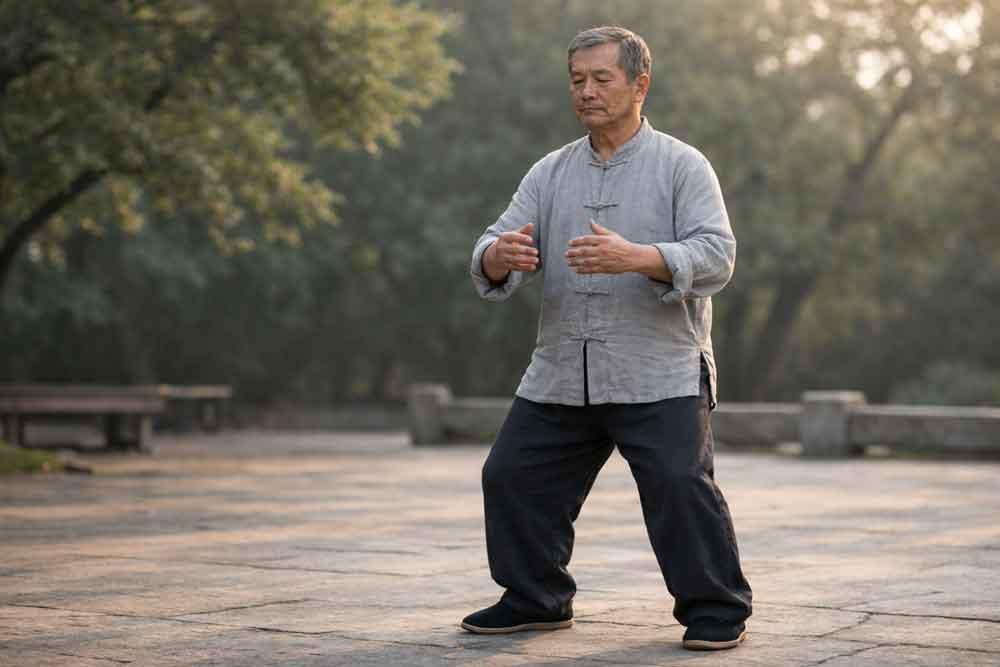
One of the first things Andrew said gave that feeling a different shape for me. “One of the unique characteristics of the Yiquan is that we train through the nervous system, we train to expand through the nervous system, and we train specifically to recruit connective tissue, tendons, ligaments and fascia.” I did not take that only as a description of a martial practice. I heard something wider in it. So much of modern life asks us to override the body and then act surprised when override becomes our default way of being.

Where Body Speaks First
What I found most useful in the conversation was not some grand promise of transformation. It was Andrew’s insistence that strain often shows up before we name it properly. It does not always begin with a crisis. Sometimes it first appears in the body, and then it moves quietly into thought.
As he put it, “You can sense into your body and recognise changes in tension, changes in breathing, heart palpitations, and of course, I think one of the most important places to begin to learn to look is when your thoughts become negative and self-defeating and self-destructive”. That felt exactly right to me. Stress does not always announce itself in dramatic fashion. Sometimes it arrives as a change in tone, in how quickly the mind turns against itself, in how much harder the day feels from the inside.
There is solid research behind that too. In 2009, Amy Arnsten’s research published in Nature Reviews Neuroscience revealed that even mild uncontrollable stress can impair the prefrontal cortex functions we depend on for judgement, attention, planning, and self-regulation.
I find that both useful and humane as it rightly shifts the focus from self-blame to awareness. A tense body sees less. It becomes quicker to assume the worst. It has less humour, less patience, and less room. That is why I keep returning to the body in conversations like this. It is not a decorative side note to emotional life. It shapes what we notice, how we interpret events, and how easily we lose perspective.
Beyond Resilience
Resilience is one of those words nobody questions because it sounds automatically good. We want resilient children, teams, relationships, and of course, resilient selves. Yet one of the sharpest moments in the conversation came when Andrew challenged that ideal. “Instead, what we ought to be training for is antifragility. And in an antifragile system, when I get attacked, when I get shook, I grow stronger.”
Resilience suggests recovery, a return to the old baseline. But what if the old baseline already depends on over-effort, poor sleep, emotional bracing, and a body that never really settles? Why do so many of us keep trying to recover back to versions of ourselves that were already overdrawn? That feels to me like one of the quieter truths of adult life. Many people do recover, but only enough to resume the same internal arrangement that depleted them in the first place. They return to function, but not necessarily to steadiness.
This is one reason I still take breathwork seriously, even though it has been repeated so often in wellness culture that some people have stopped hearing it. In 2018, Andrea Zaccaro and colleagues published evidence in Frontiers in Human Neuroscience which linked slow breathing techniques with parasympathetic activity, emotional control, and psychological well-being. That does not make breath a miracle cure, and I do not think it should be treated as one. It does remind us that the body can shift state, and that sometimes the system needs direct evidence of safety before the mind can follow.

Mental Toll of Violent World
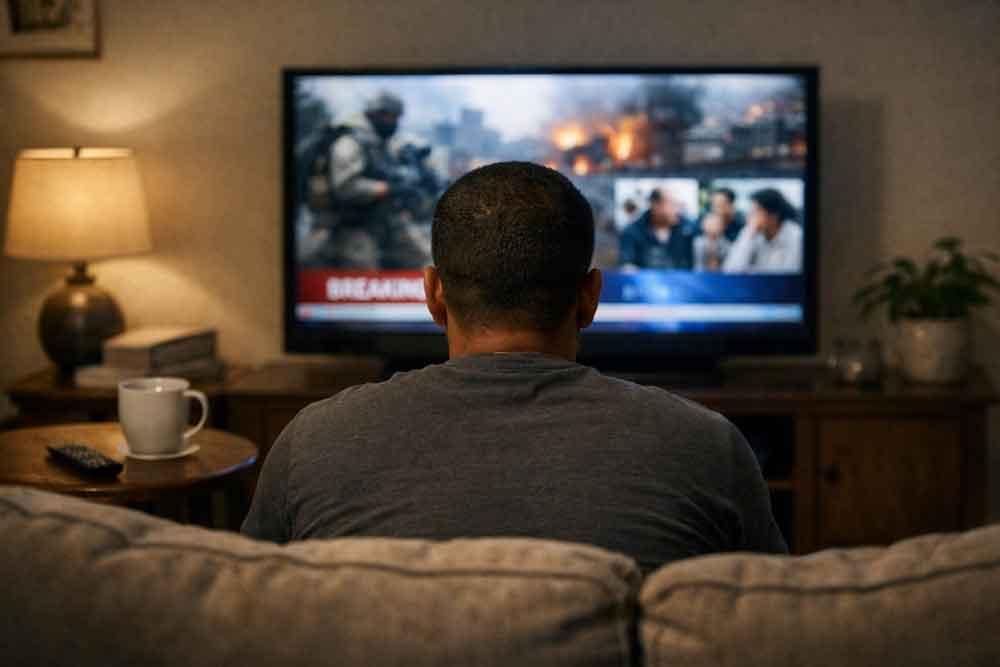
I also do not think people are carrying only private stress now. They are carrying the wider atmosphere of the world. Wars, conflict, relentless headlines, political instability, economic fear, and the sense that something heavy is always happening somewhere. Even when we are not directly in the line of fire, the mind still absorbs that atmosphere. It can leave people watchful, overwhelmed, slightly helpless, and never fully at ease in their own day.
What makes that kind of stress especially difficult is that it often has no clear boundary. It is not one problem you can solve and set aside. It lingers in the background and colours everything else. That was why one line from Andrew stood out for me. “Fear feeds on formlessness, right? Most of us, if the lion is coming at us, we’re actually not afraid in that same way we are moving to action.” He put words to something many of us feel but do not always describe well. A clear difficulty can at least be faced, a vague one, however, can spread through the imagination and quietly drain us.
What I found useful in that was not just the observation itself, but what it suggests about the lives people are living now. So much of the strain is ambient. It comes not only from what has happened to us personally, but from what we are expected to witness, absorb, and carry while continuing to function as though none of it has altered us. That is why calm cannot be something flimsy or purely private. It has to be strong enough to hold a more difficult reality.
My Takeaway
Yiquan interests me because it does not begin with the fantasy that life will become quieter. It begins with a harder truth: pressure is here, tension is here, and most of us have learnt to meet both by bracing. What it offers is not escape, but another kind of strength, one that asks the body to organise itself differently. Not to collapse, not to harden, but to hold steadier under load. In that sense, Yiquan feels less like a specialist discipline and more like a serious answer to the age we are living through.
Most of us do not need help pretending we are fine. We already know how to do that. What Yiquan offers is something more useful: a way to notice when the body has gone tight, when the mind has become hostile, and when coping has started to cost too much. It asks not only for calm, but for a steadier relationship with pressure. That is why it feels relevant now, not as a fashionable wellness fix, but as a way to stay present, capable, and less easily knocked off centre.