AnchorInside Sri Lanka’s Facebook Groups Where Men Prey on Their Own Families & Strangers

By Nuha Faiz
Disclaimer: What follows discusses and shares screenshots of child sexual abuse, incest, and sexual violence in direct terms. I have not diluted the language because I think dilution is part of why this has been allowed to fester for so long. If you need to sit this one out, I understand completely. If you're staying, take a breath first.
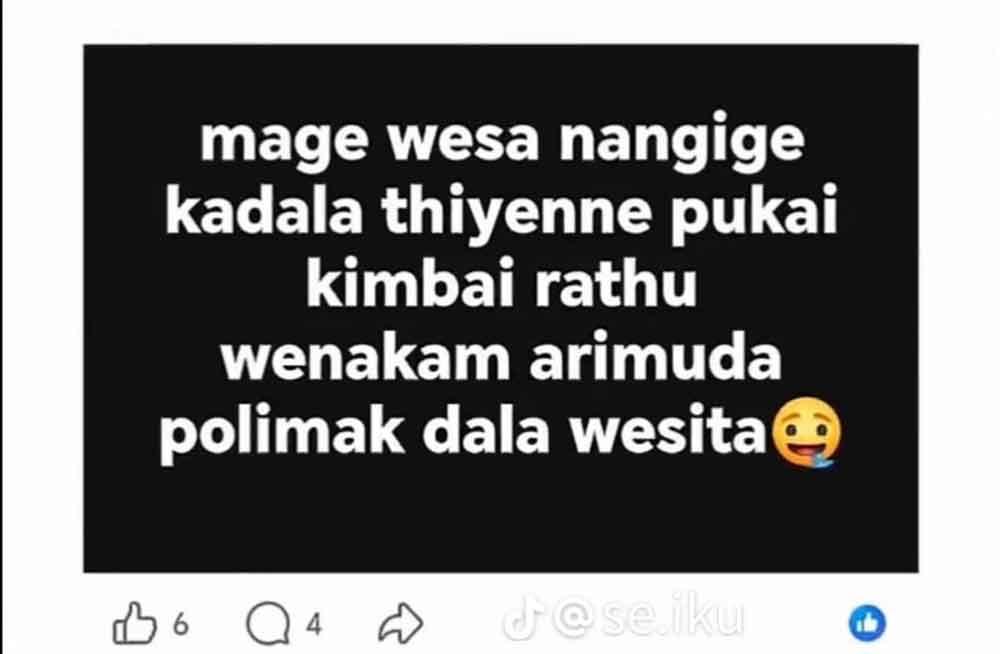
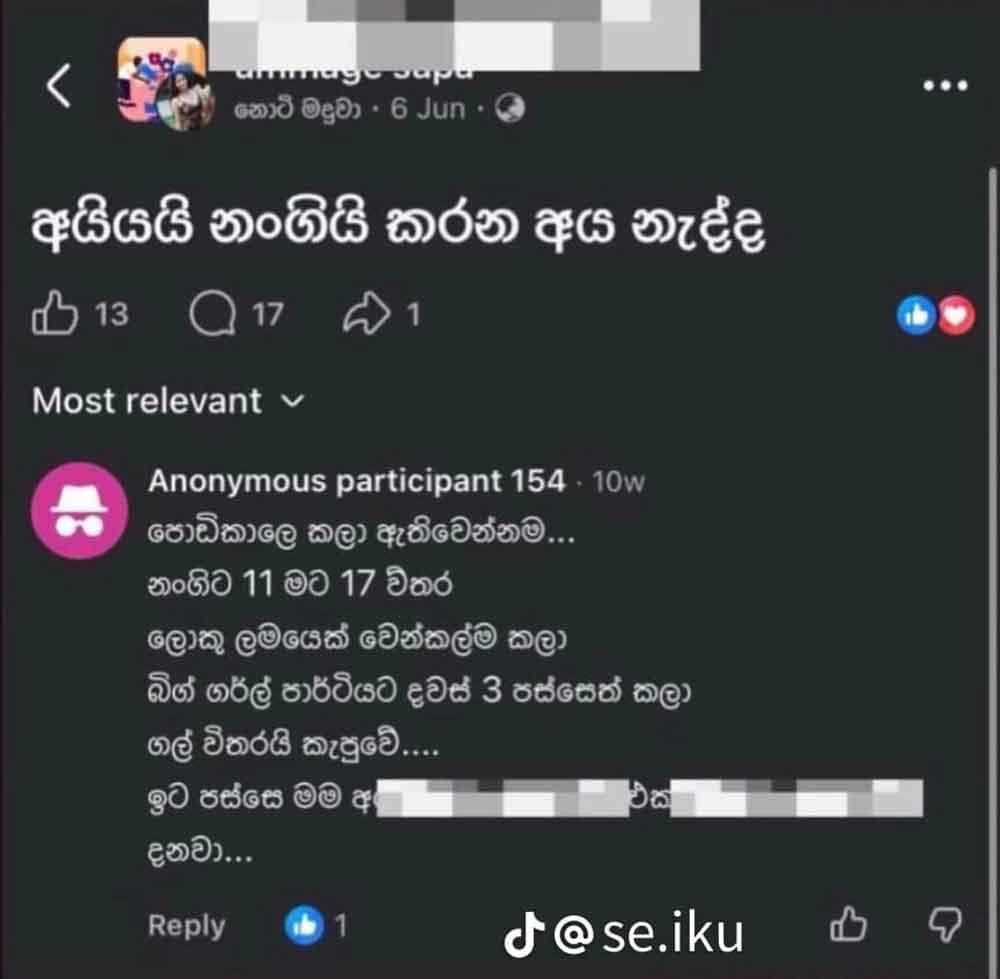
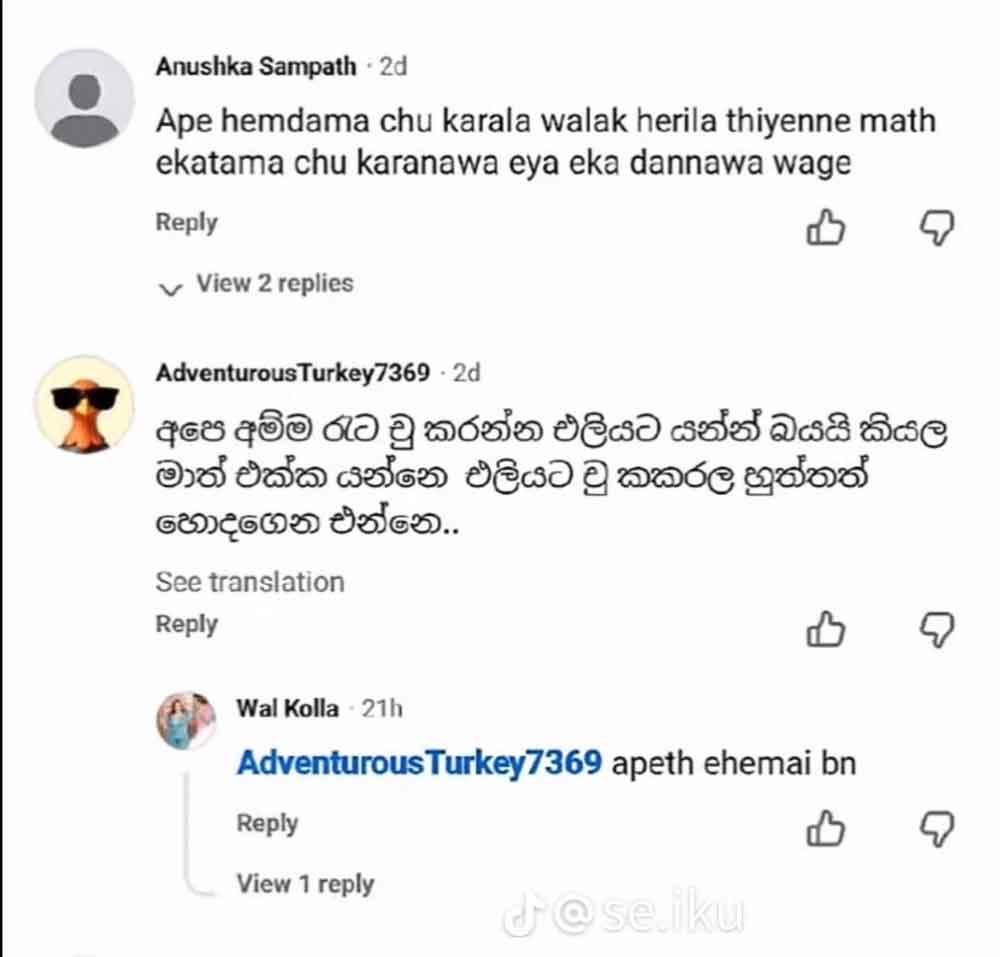
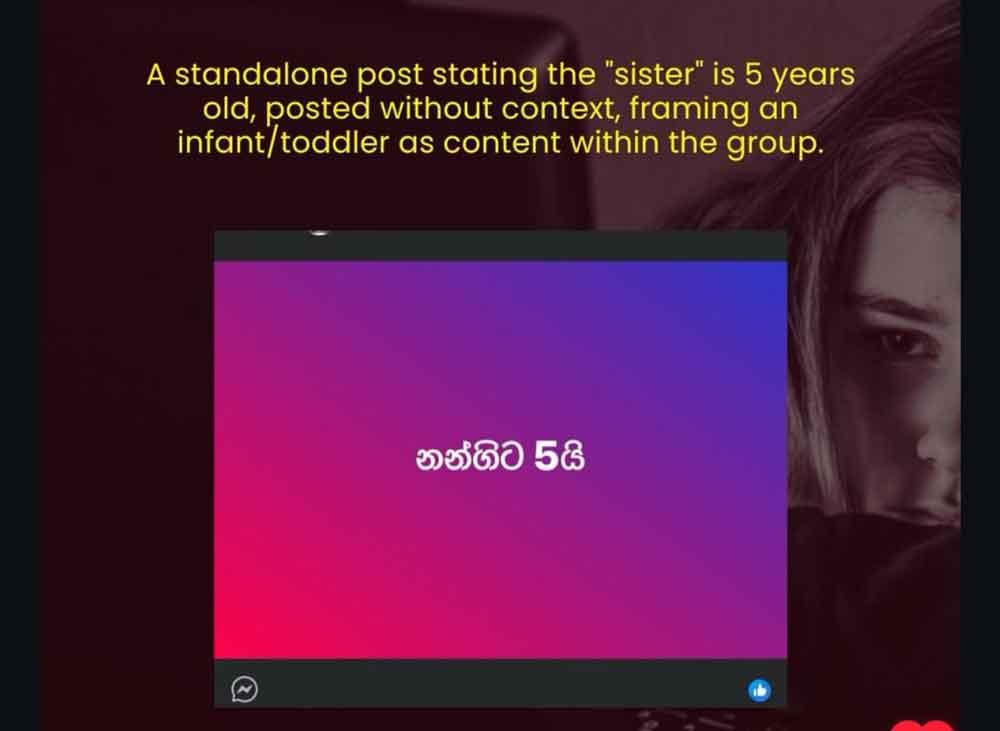
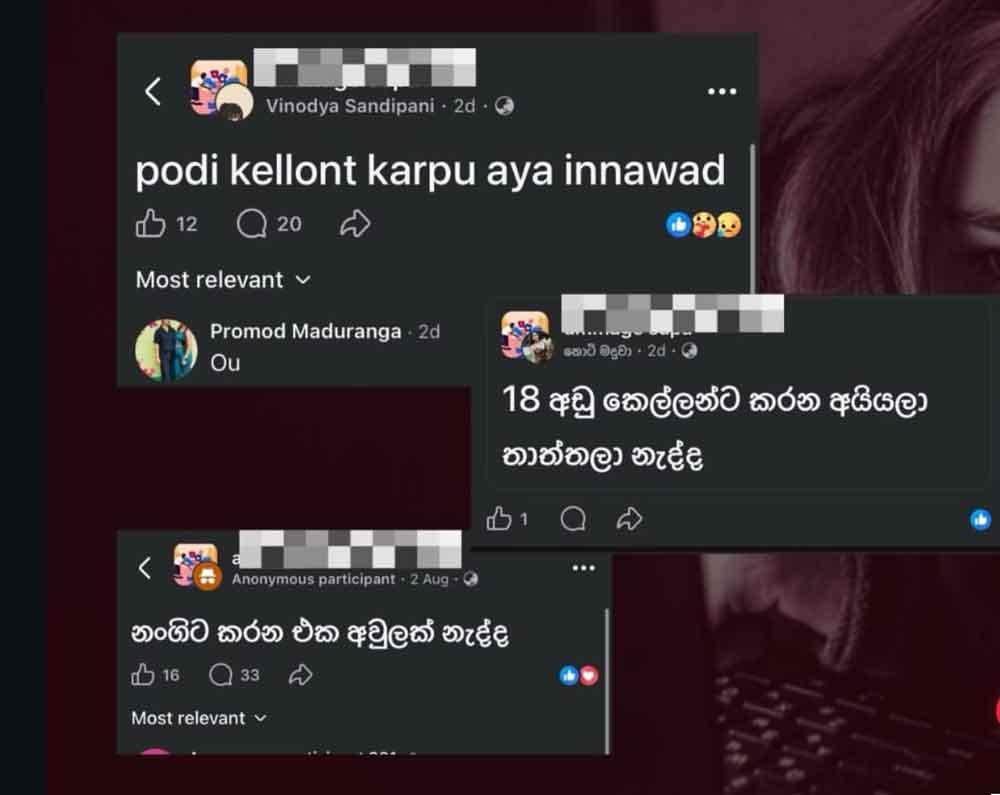
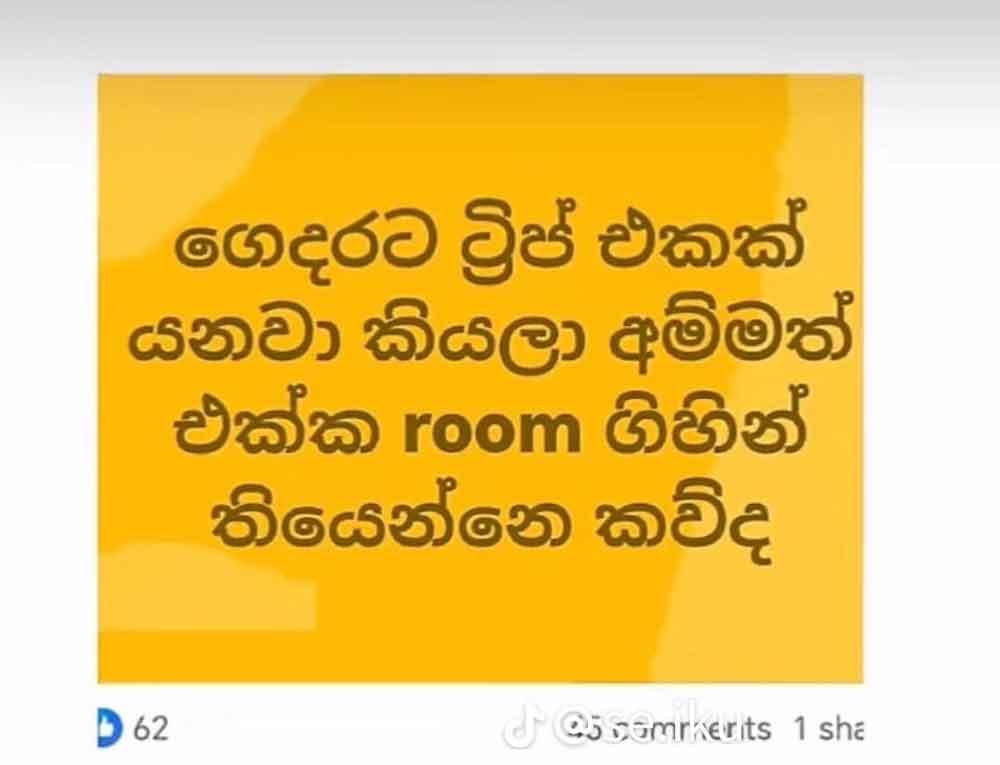
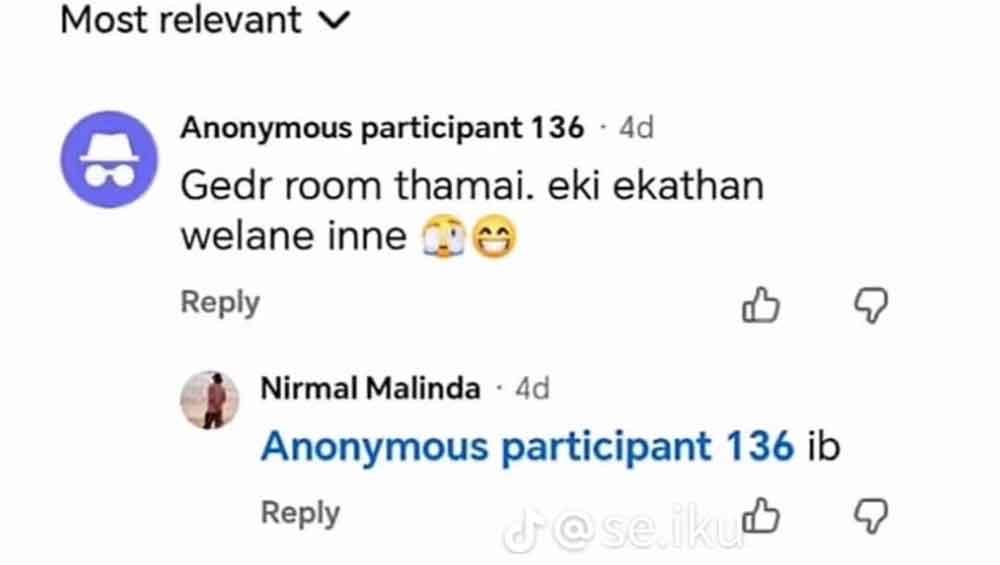
There are Facebook groups running right now where Sri Lankan men openly write about abusing their sisters, their mothers, girls as young as five. These posts gain likes and replies underneath, with men asking the group if confessing to this is "fine," and being told yes. Men describing years of abuse against a sibling almost proudly, as a story worth telling rather than a crime worth hiding.
A participant appears to sexualise a female relative who, according to the conversation, is unable to move around and remains in one place.
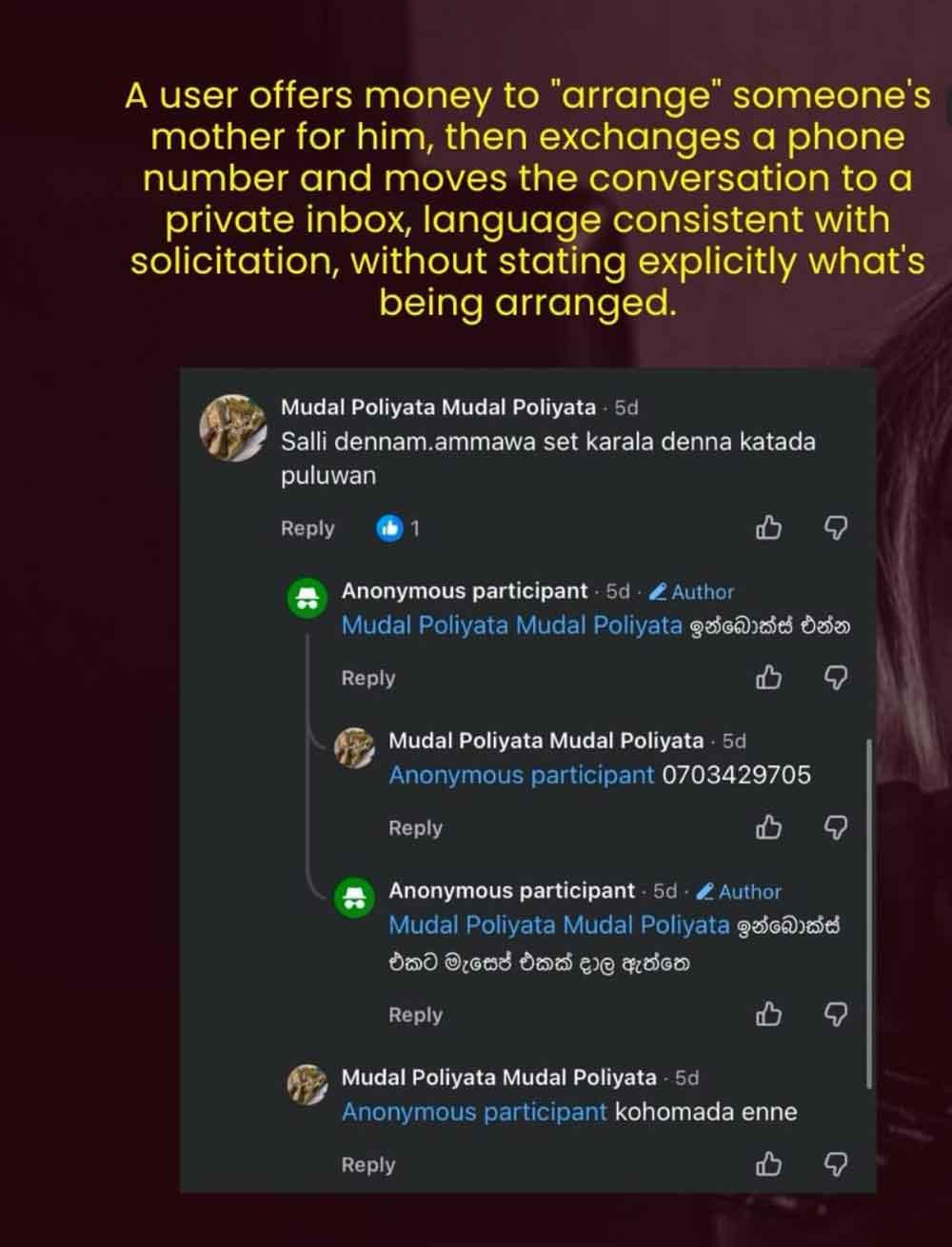
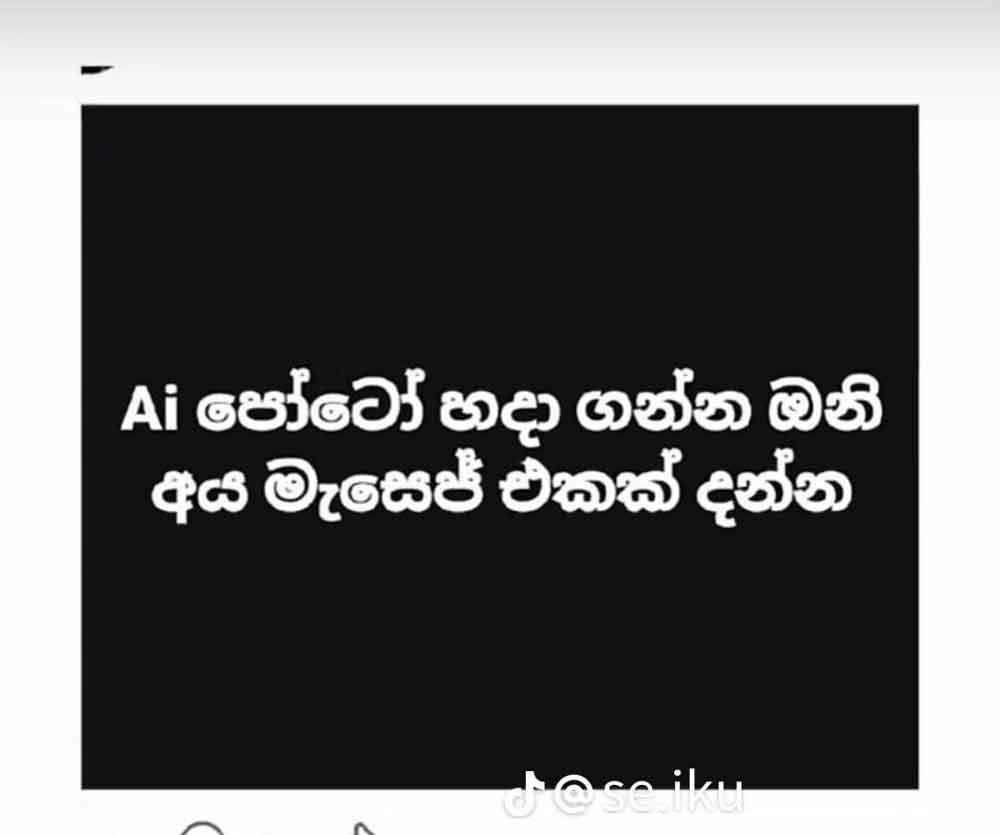
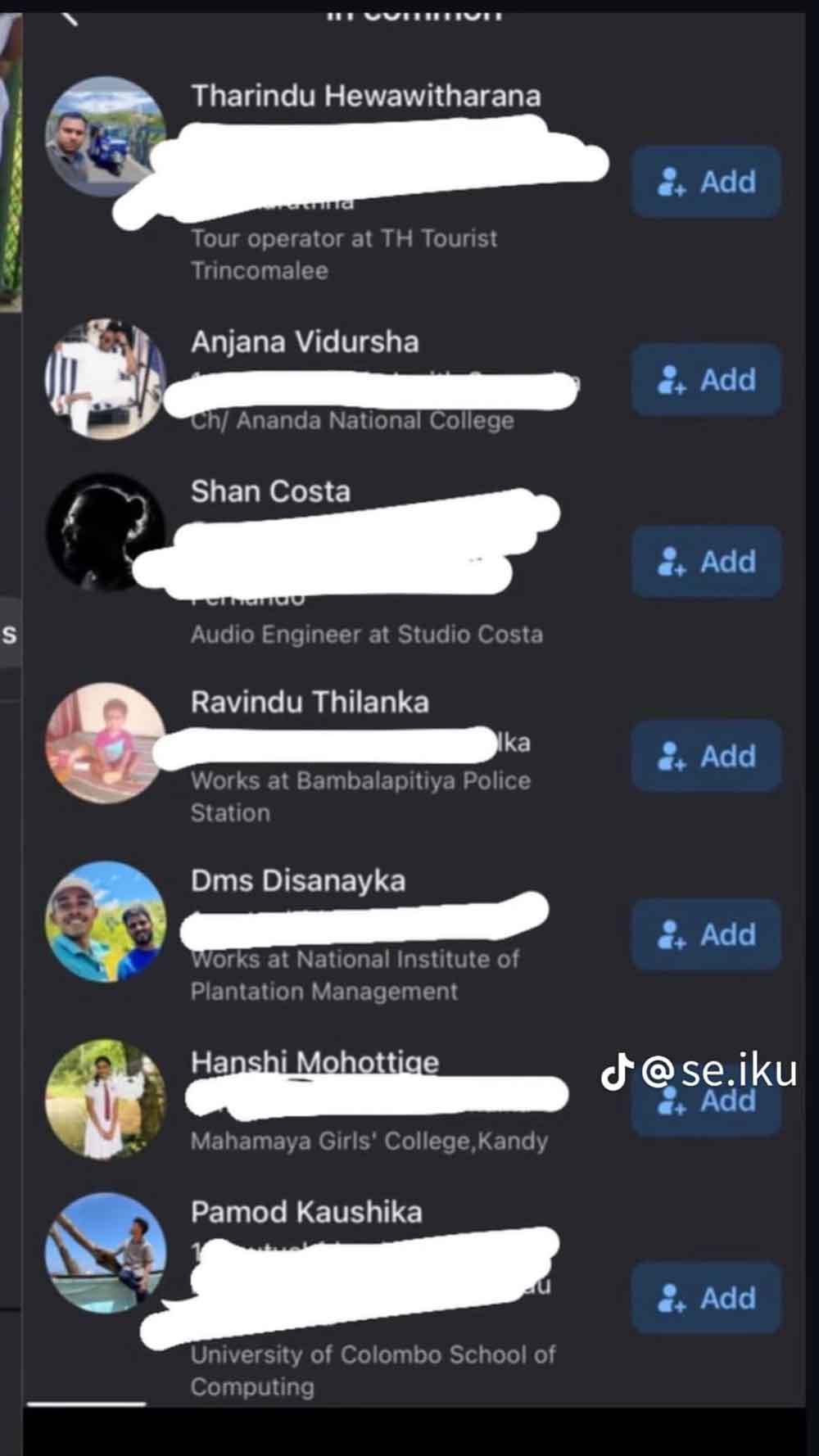
Men offering money to have a stranger's mother "arranged," swapping numbers, moving conversations into private inboxes where the actual negotiation happens. Group chats formed specifically to trade non-consensually taken photographs of female relatives, including minors.
In another post, a user asks whether there are people interested in sexually exploiting the user's mother.
I'm not going to walk through each individual post line by line, because I don't think cataloguing the exact phrasing of abuse confessions serves the reader. What serves the reader is understanding the pattern, and the pattern is that these are not isolated men typing into a void, ashamed, alone. This is networked behaviour.
Men finding each other, validating each other, escalating each other, and by every indication, returning to their actual households having had exactly this kind of harm normalised by strangers online. None of it required specialist skill to find.
Are We Becoming the Next India?
For years, Sri Lankans have quietly comforted ourselves with the idea that at least we're not India. At least our crime numbers aren't that scale. At least our headlines don't run that story every week. It let us feel like a smaller, gentler place, somehow insulated from the ugliest patterns a much larger, much more chaotic neighbour deals with constantly.
I don't believe in it anymore.
Sri Lanka's National Child Protection Authority received more than 108,000 complaints of child abuse between 2015 and 2025. In the first six months of 2026 alone, it logged 5,523 more complaints, averaging over 900 a month, including cases of commercial sexual exploitation of children. A hospital-based study out of a Colombo teaching hospital, reviewing five years of cases, found that 99.9 percent of perpetrators were male, and 94.5 percent were already known to the child personally. Not strangers. Uncles. Brothers. Fathers. Family friends. Researchers separately estimate that only around ten percent of these cases in Sri Lanka are ever reported at all, which means the visible numbers, staggering as they are, sit on top of something far larger that never surfaces.
For a country of twenty two million people to be even having this conversation, comparing ourselves against a nation of over a billion on the scale of family-based sexual violence, should be treated as a five-alarm national failure. But it is concerning that it is being skimmed past.
The Legal System
Sri Lanka's Computer Crime Act, does not formally list online child sexual exploitation as its own category of crime. It means that when investigators try to build a case against men soliciting abuse, trading images, or coordinating access to victims through Facebook, they are working with legislation that legally does not recognise the internet as a means of facilitating this specific harm.
The Penal Code, and its 1995 incest amendment, criminalises incest and rape clearly enough on paper, defining prohibited degrees of relationship in detail. But the Act predates the concept of a Facebook comment section by decades, and prosecutors are left stretching old statutes to cover new mechanisms of harm.
The National Child Protection Authority, the body meant to coordinate the state's entire response to this crisis, cannot proactively investigate these groups itself. Its role is structurally limited to receiving a complaint through its 1929 helpline, documenting it, and referring it onward to the Cyber Crime Division of the Criminal Investigation Department. It cannot go looking. It can only wait. And its independence is itself compromised by design: NCPA leadership is appointed by the President, embedding what should be an autonomous child protection watchdog inside the same executive apparatus it may need to hold accountable, particularly in cases involving people with political or institutional protection.
Once a case does reach the courts, it enters a backlog that functions as its own form of injustice. At last count, 4,289 child abuse cases sat pending before Sri Lanka's High Courts, a number that reflects not administrative delay but a structural failure to deliver timely justice at any meaningful scale. Professor Harendra de Silva, the NCPA's first chairperson, has compared the scale of this crisis to an iceberg, with two thirds of it hidden beneath what's visible. His warning, delivered years ago and no less true today, was blunt: if we keep quiet, we become passive perpetrators.
Compare all of this to what happened after Easter Sunday. Within days of the 2019 attacks, the state pulled phone records, cross-referenced accounts, traced digital footprints across multiple platforms, and made arrests at a pace that stunned international observers. That response proved, beyond argument, that Sri Lanka's institutions are capable of moving fast and thoroughly when something is treated as an actual emergency. So, what is missing here is not Sri Lanka’s capacity to act upon this, but its decision to.
Where Is the Sri Lankan Media?
The Facebook groups documented here have circulated among ordinary citizens on Instagram and TikTok for weeks now, screenshotted, shared, and discussed by hundreds of people. As of writing this, I have not seen a single major Sri Lankan news outlet report on it directly. No investigation. No follow-up questions put to the NCPA or CID. No editorial acknowledging that a story involving networked men allegedly discussing child abuse on the country's most-used platform might warrant scrutiny. That silence is not neutral. Researchers studying Sri Lanka's information ecosystem have noted that Facebook has effectively become the primary vector of news and agenda-setting in this country, shaping what mainstream print and broadcast outlets even consider worth covering. A story that never trends in the right circles never gets picked up. A story that never gets picked up never forces anyone in power to respond on record.
Meta’s Failure
Meta is not a new or untested actor in Sri Lanka's information failures. After the 2018 anti-Muslim riots, Facebook formally apologized, admitting that incendiary content left unmoderated for years, despite repeated warnings from local civil society organizations, may have directly contributed to offline violence that killed people. An independent human rights assessment the company itself commissioned found that outsourced, understaffed content moderation, combined with a shortage of local language expertise, had allowed dangerous content to spread largely unchecked. Meta's own Oversight Board has separately criticised the company's use of secret, discretionary policy exemptions in Sri Lanka, warning that undisclosed carve-outs from its own community standards are incompatible with the human rights responsibilities it claims to uphold.
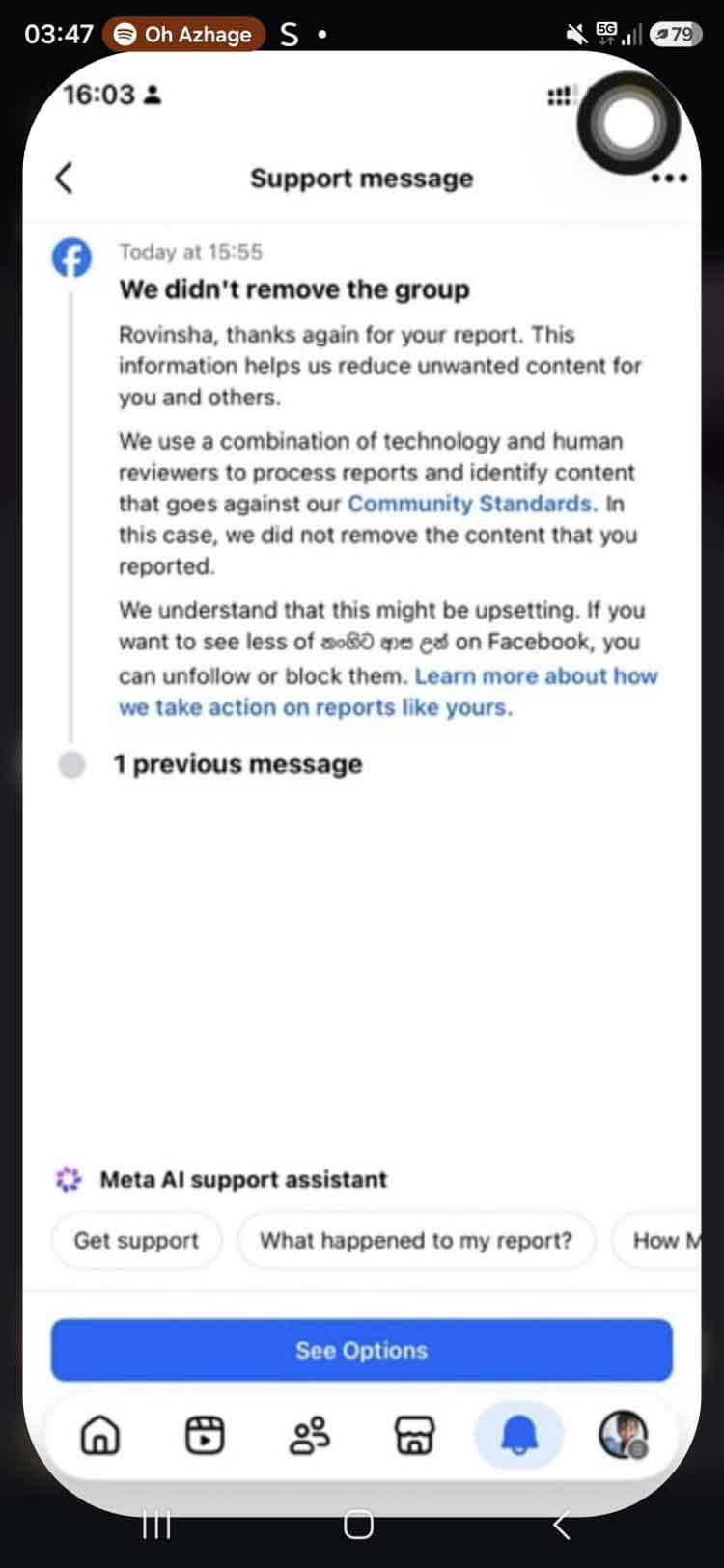
But this time, we don't have to rely on historical pattern to prove the point. We have direct evidence. A user who reported one of these groups received a written response from Meta's own support system stating plainly: "We didn't remove the group." The message goes on to explain that Meta uses "a combination of technology and human reviewers" to assess reports against its Community Standards, and that in this specific case, having reviewed it, the company decided the content did not warrant removal. The suggested remedy offered back to the person who reported a group normalising child sexual abuse was to unfollow or block it themselves.
If a report this clear, submitted through the platform's own official channel, reviewed by the platform's own stated combination of technology and human reviewers, still results in "we didn't remove the group," it tells you the actual mechanism protecting these men isn't a technical blind spot. It's a policy decision, applied consistently enough that an ordinary user can predict the outcome before they even file the report.

What We Demand
-
The legislature needs to amend the Computer Crime Act immediately to explicitly criminalize online facilitation, solicitation, and normalization of child sexual abuse and incest.
-
The NCPA needs genuine structural independence from executive appointment, along with dedicated resourcing to proactively monitor known patterns rather than waiting on individual complaints.
-
The judiciary needs a dedicated, resourced track for clearing the existing backlog of child abuse cases.
-
Sri Lankan newsrooms need to treat this as the investigative story it is, including reporting directly on Meta's documented refusal to act on reports like the one shown here, since that refusal is itself now news.
-
Meta needs sustained, evidenced, repeated public and diplomatic pressure, and this screenshot needs to be part of that pressure campaign directly. A written statement from the company's own support system saying it reviewed a child abuse-adjacent group and declined to remove it is exactly the kind of documented evidence that regulators, journalists, and advocacy groups can use to force a response Meta clearly isn't offering voluntarily.
-
Every single person reading this needs to stop assuming this is someone else's family.
-
Report the accounts you come across, even knowing now what the likely response will be, because a volume of identical written refusals from Meta becomes its own form of evidence.
-
Call the NCPA's 1929 helpline.
-
If you have any real connection to law enforcement, media, or policy, send them evidence directly, including this screenshot.
-
Do not publicize the actual group names. Call the individuals out directly in comments instead, and tag the relevant authorities.
Keep talking about this long after today. The only reason this has survived in plain sight for this long is that every institution meant to catch it, the law, the child protection authority, the courts, the press, and now, provably, the platform itself, looked away or declined to act. That only changes the moment enough of us refuse to do the same.
Screenshots and initial documentation referenced in this piece were sourced from content shared by Content creator Khaalidha Naushad on Instagram and independent anonymous TikTok pages opened solely to speak about this issue, alongside a direct report response from Meta's support system.