Tea, Memory and the Art of Transformation.
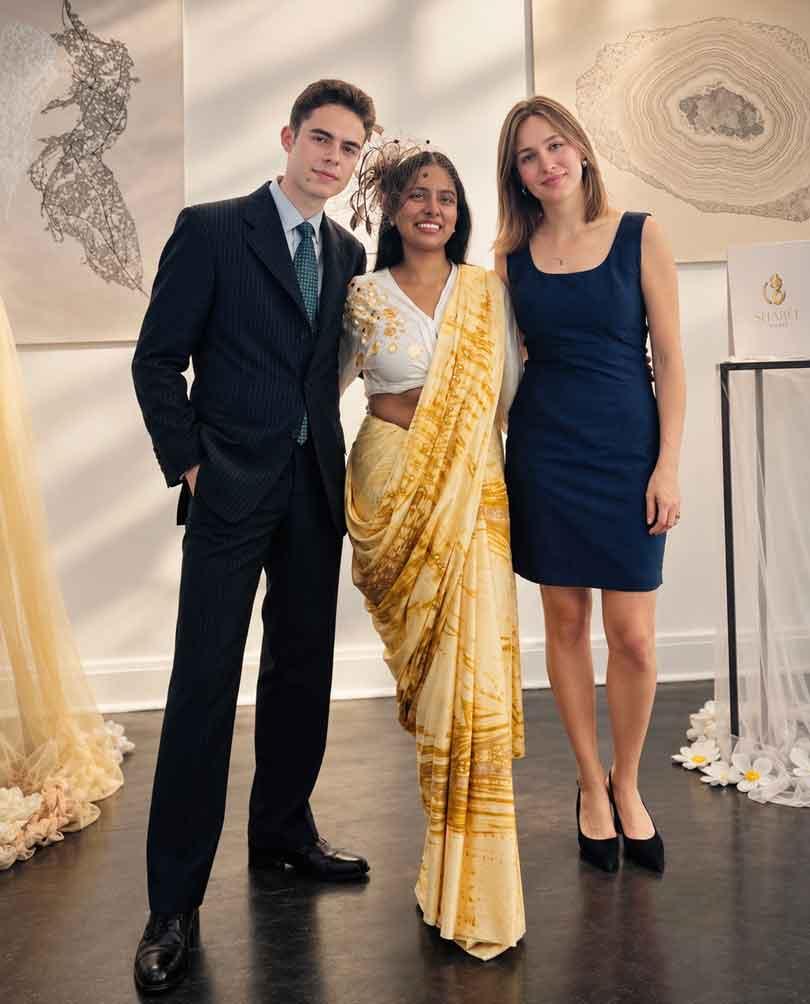
In the hills of Sri Lanka, tea is more than something poured into a cup. It is landscape, livelihood, scent, ritual and memory. For designer Shriwanthi R. Amarasinghe, known as Shri, it was part of the visual language of childhood long before it became material for her creative practice. Years later, living and working in Paris, those early impressions have resurfaced in Tea Topographies, a fashion art exhibition that turns the familiar story of Ceylon tea towards what is often left unseen. Presented at the historic Place des Vosges in Paris on the 19th of September 2026, Tea Topographies brings together fashion, craftsmanship, personal history and ideas of sustainability. Through garments made with tea dyed textiles, used tea bags, silk, tulle, crochet, appliqué and existing fabrics, Shri explores what happens when memory is treated not simply as inspiration, but as material. The exhibition begins in Sri Lanka's tea country and arrives in Paris carrying traces of both places.
For Shri, the connection to tea is deeply personal. Growing up among Sri Lanka's tea plantations, she remembers tea as the rhythm of mornings and the scent moving through the hills. At home, the ritual became more intimate. Her mother carefully brewed tea and collected floral China tea sets and lace doilies, while her father drank several cups throughout the day. After her mother's death, tea acquired another meaning. An ordinary daily habit became a vessel for remembrance. That emotional transformation sits at the heart of Tea Topographies. The clothes do not attempt to recreate the past literally. Instead, they consider how experience settles into objects and how materials can retain the feeling of lives already lived. Layers of tulle recall the contours of tea terraces. Tea stains and oxidation are allowed to remain visible, recording time rather than disguising it. Excess fabric and used materials are incorporated into garments, giving what might otherwise have been discarded another life.
There is something quietly radical in that approach. Fashion is often associated with the new, yet Shri works with return, revision and continuation. Garments from previous collections have been revisited through tea dyeing, reconstruction, embellishment and new styling. A finished piece does not necessarily represent an ending. It can become the starting point for another idea. This philosophy reflects the wider practice of Shabél Paris, the fashion art label founded by Shri. Based in Paris, the studio works across wearable art, costume, installation and storytelling, creating pieces for exhibitions, performance, film and cultural collaborations. Clothing becomes a medium through which memories and ideas can acquire physical form. Shri herself came to fashion after an earlier career in technology and followed a self-taught route into design, developing a practice that crosses art, craft, culture and experimentation.
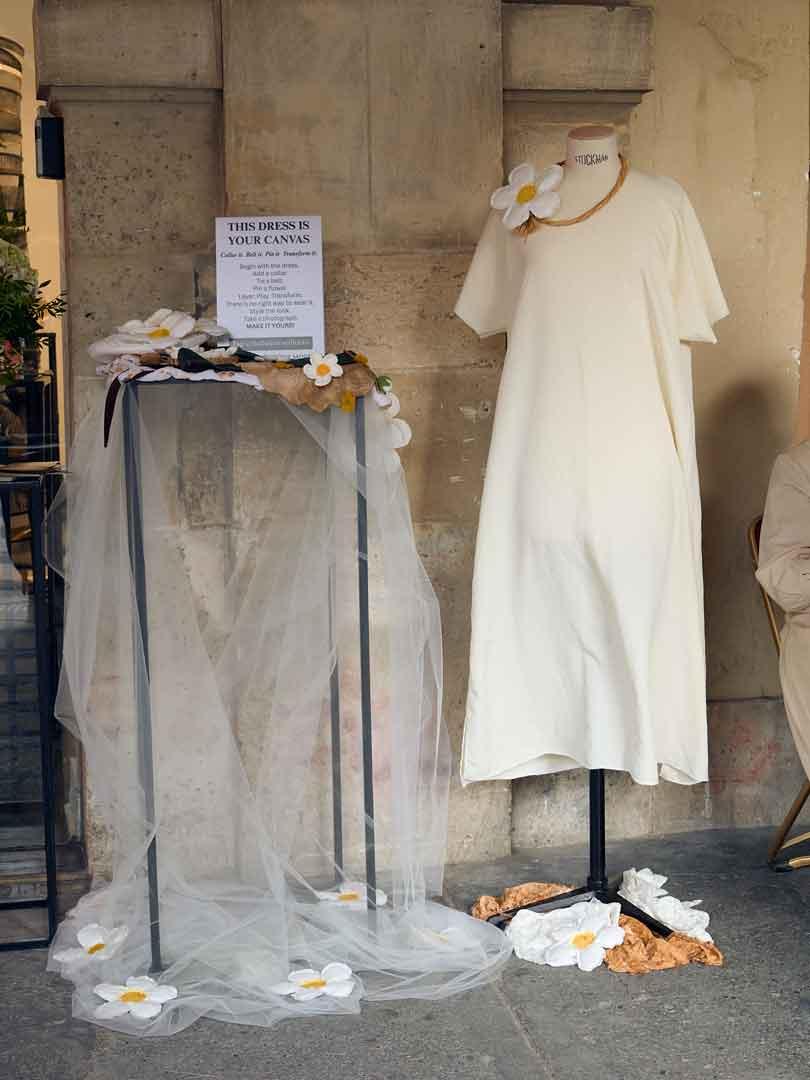
Tea Topographies is especially compelling when it looks beyond tea as a polished global commodity and towards the landscape behind it. One of the exhibition's recurring images is surprisingly modest. The tea flower, delicate and rarely associated with the drink itself, becomes a symbol of everything that can disappear behind a familiar product. For Shri, the flower carries a childhood memory. Growing up near tea estates, she regarded it as an ordinary part of her surroundings. When asked at school to name flowers, the tea flower naturally belonged on her list. Only later did she recognise how unfamiliar it was to many people elsewhere. That realisation led her to see a parallel between the flower and the people whose labour sustains the tea landscape. Both are essential, yet both can remain invisible behind the finished cup.
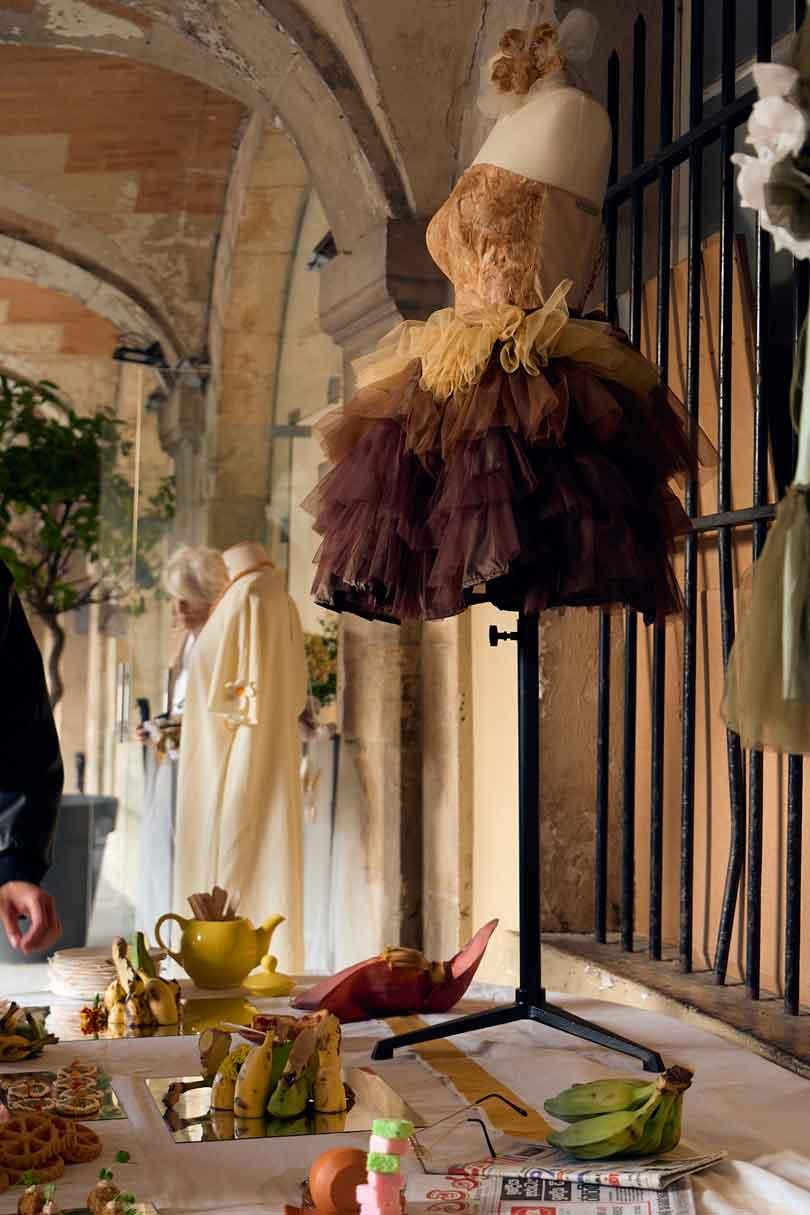
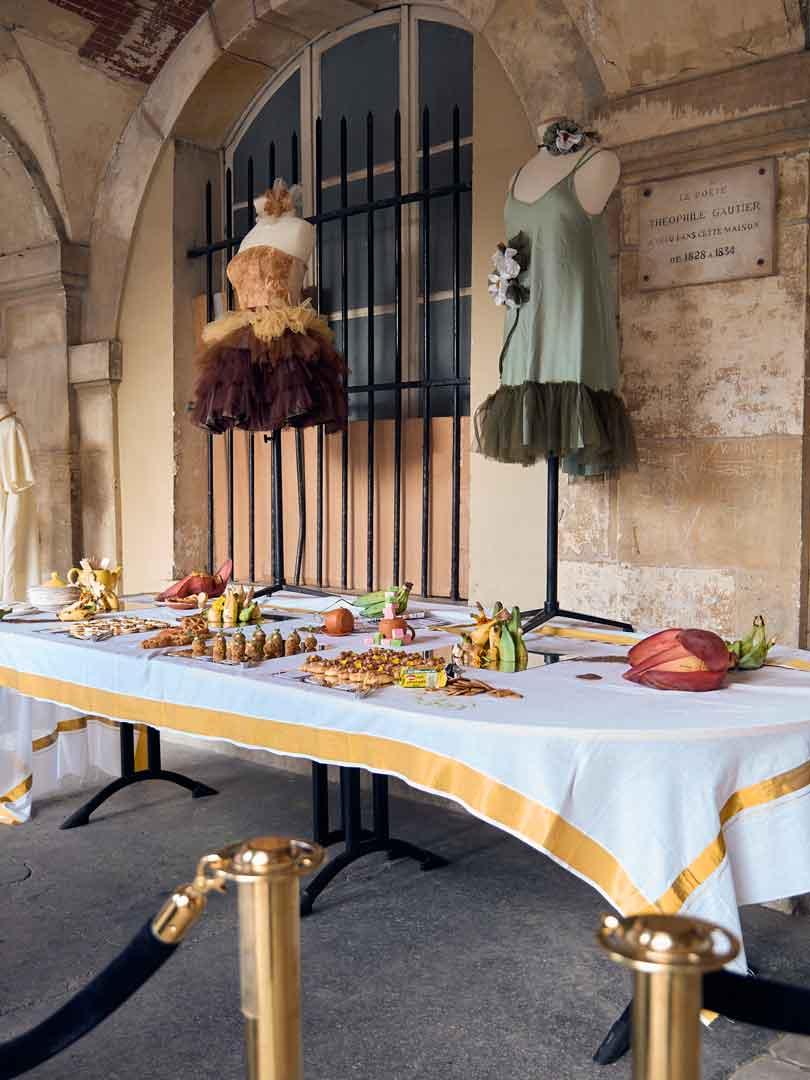
Throughout the collection, handmade tea flowers bring this idea into the garments. They were created in Sri Lanka by two artisans, Nazeera, a flower maker with a disability, and Suramya, a crochet artisan from Kandy. Their contribution gives the motif a human dimension. The flowers are not simply decorative references to Sri Lanka. They connect the work to particular hands and particular traditions of making. The visual language surrounding them is restrained and earthy. Ivory, tea green, earth brown and warm gold evoke leaves, soil, dried tea and light. On page two of the exhibition press material, a tea toned tulle garment appears with a bodice created from used tea bag material. Nearby, another reimagined look is photographed beside the Théophile Gautier plaque at 8 Place des Vosges. The juxtaposition is striking. Materials associated with everyday consumption and Sri Lankan landscapes enter the architectural fabric of Paris, creating a conversation between two places rather than asking one to disappear into the other.
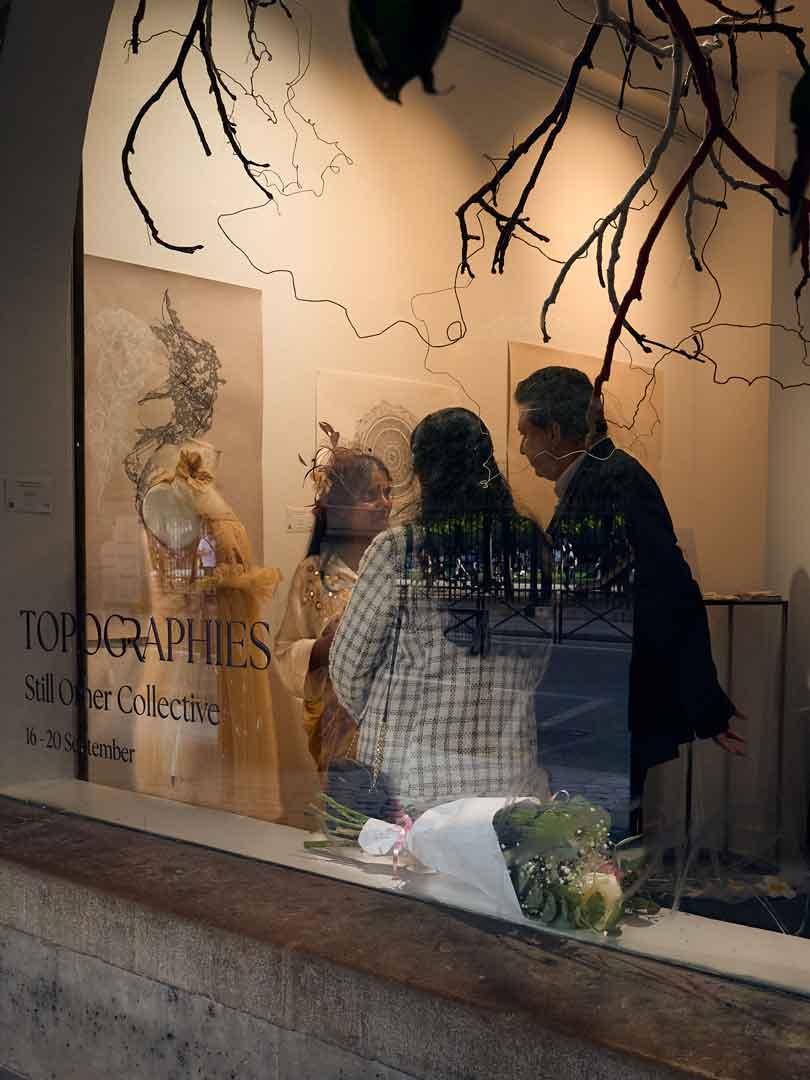
That conversation extends beyond the garments. Tea Topographies was presented alongside Topographies by Still Other Collective Paris, an exploration of South Asian lives that expanded the experience into food, ritual and gathering. Chef Prerena Dash created a menu informed by Sri Lankan teatime traditions, including kimbula banis, coconut toffee and mutton rolls, alongside bread with butter and jam, Hawaiian cookies and kokis from Sri Lanka. The table became another kind of landscape. Taanisha Gandhi, cofounder of Still Other Collective, used fresh bananas, banana blossoms and ginger to build a botanical setting filled with South Asian colour and texture. Fashion was therefore not isolated as an object to be observed from a distance. It existed alongside food, plants, conversation and the social intimacy of sharing a table. This matters because Tea Topographies is ultimately interested in connection. Its materials carry one story, its setting another, and the people gathered around it add further layers. Sri Lankan memory meets wider South Asian experience within contemporary Paris. The result resists the idea that cultural identity must remain fixed in a single geography.
Shri's own life reflects this movement. Sri Lankan born and Paris based, she describes a creative practice informed by her heritage while continually shaped by life in France. Her work does not attempt to resolve those influences into a single identity. Instead, it occupies the space between them. That position gives Tea Topographies much of its emotional texture. Paris is not merely a backdrop for a Sri Lankan story. It becomes part of the story's continuing evolution. The exhibition also created a formal moment of cultural connection through the attendance of H.E. Sugeeshwara Gunaratna, Ambassador designate of Sri Lanka to France and Permanent Delegate of Sri Lanka to UNESCO. His presence placed the personal narrative of the collection within a broader cultural exchange, as Sri Lankan craftsmanship and memory were presented in one of Paris's most historic settings. Yet the exhibition's strongest ideas remain rooted in ordinary things. A used tea bag. A flower overlooked because it is too familiar. A piece of fabric from an earlier collection. A cup prepared by a mother. A landscape remembered years after leaving it. Its sustainability is therefore not presented only as a question of reducing waste. It is also a philosophy of attention. To reuse a garment is to acknowledge that its previous existence still has value. To preserve a stain is to accept the passage of time. To turn remnants into new material is to suggest that transformation does not require erasure. In that sense, the exhibition's journey from Sri Lanka's tea landscapes to Place des Vosges is less about distance than continuity. The hills, flowers, family rituals, craftspeople and memories of one place are carried into another, changed by the journey but not abandoned. And perhaps that is the most resonant idea within Tea Topographies. Memory does not remain neatly in the past. Like tea seeping into cloth, it leaves traces. It alters what it touches. In Shri's hands, those traces become garments, flowers and shared rituals, offering a reminder that what appears ordinary may already contain an entire landscape.