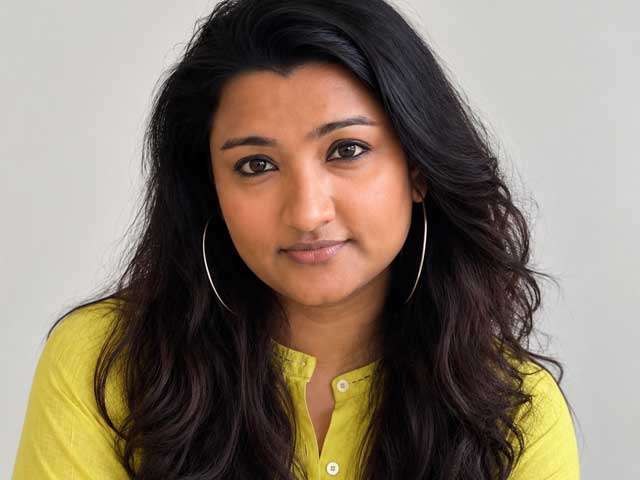
IN CONVERSATION WITH YATHRA JAYAWARDENE
BY: RISHINI WEERARATNE
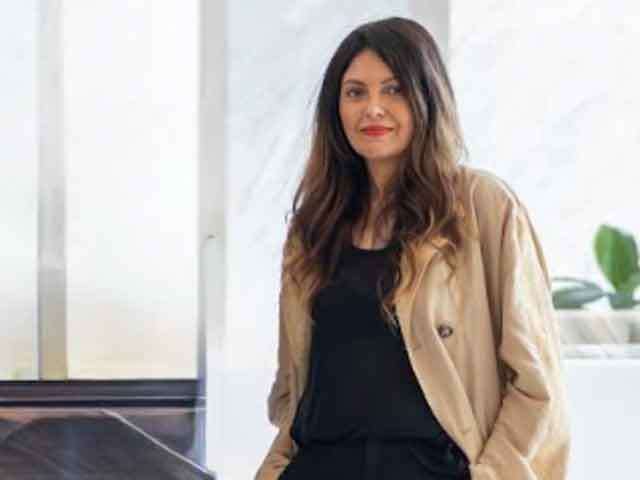
Yathra Jayawardene is an artist, creative and fashion designer I have known for nearly a decade of my life, and she possesses that rare quality of making refinement feel entirely instinctive. Gentle, kind, elegant and fiercely intelligent, she moves between Colombo and London with a quiet assurance, navigating two cities, two rhythms and a creative life shaped by both inheritance and curiosity. As custodian of her grandmother Swanee Jayawardene’s art and legacy, Yathra carries history with remarkable sensitivity, never allowing reverence to become nostalgia. Her eye is exacting, her taste impeccable, and her knowledge of art both expansive and deeply personal. Yet what strikes me most is the grace with which she wears all of it. Immensely talented and endlessly thoughtful, Yathra understands that true creativity is not simply about making beautiful things. It is about seeing clearly, preserving intelligently and knowing precisely when to let tradition so naturally evolve.
Yathra, when you say “Swanee,” what does the name mean to you personally before it means anything as a fashion label?
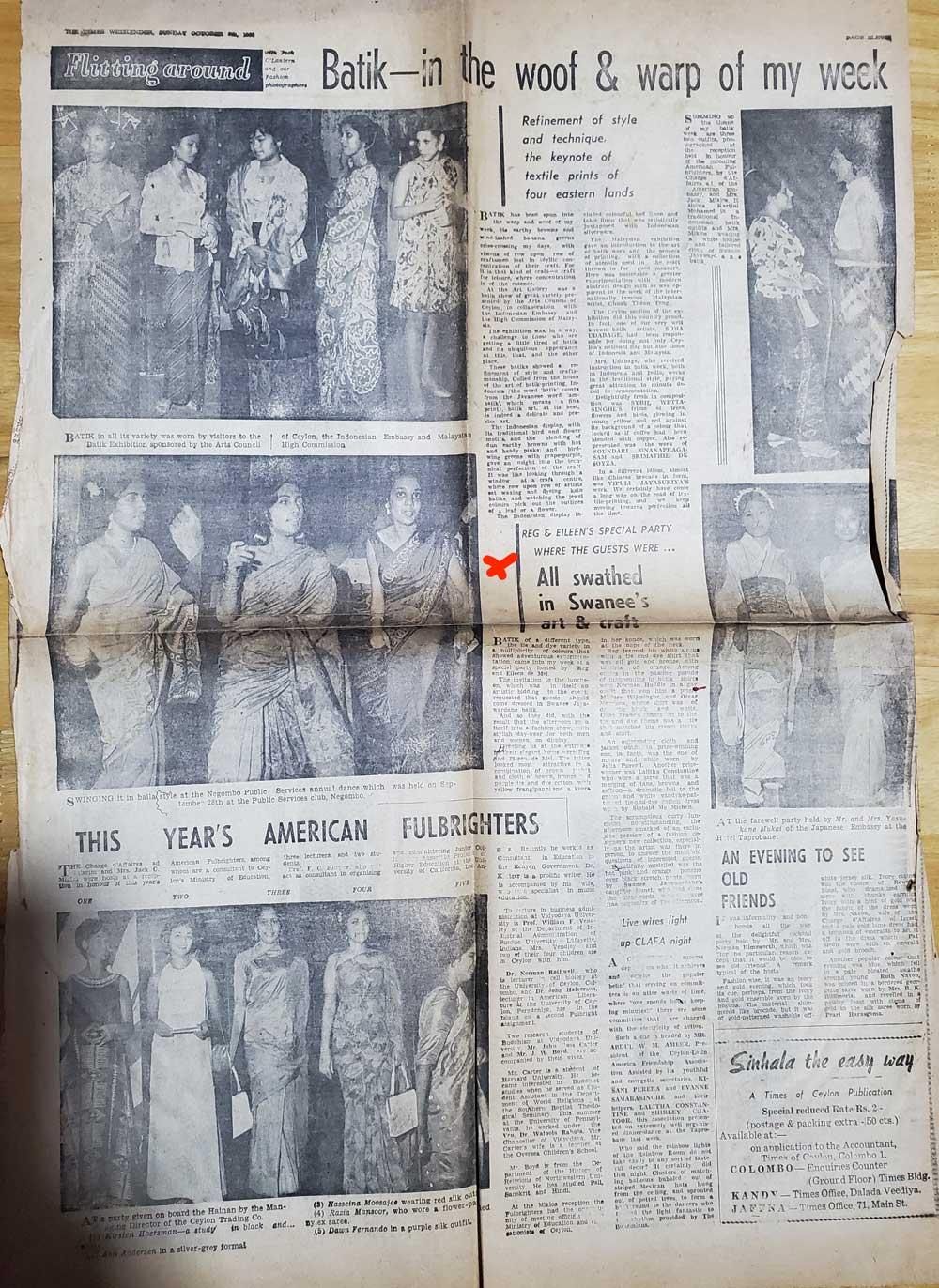
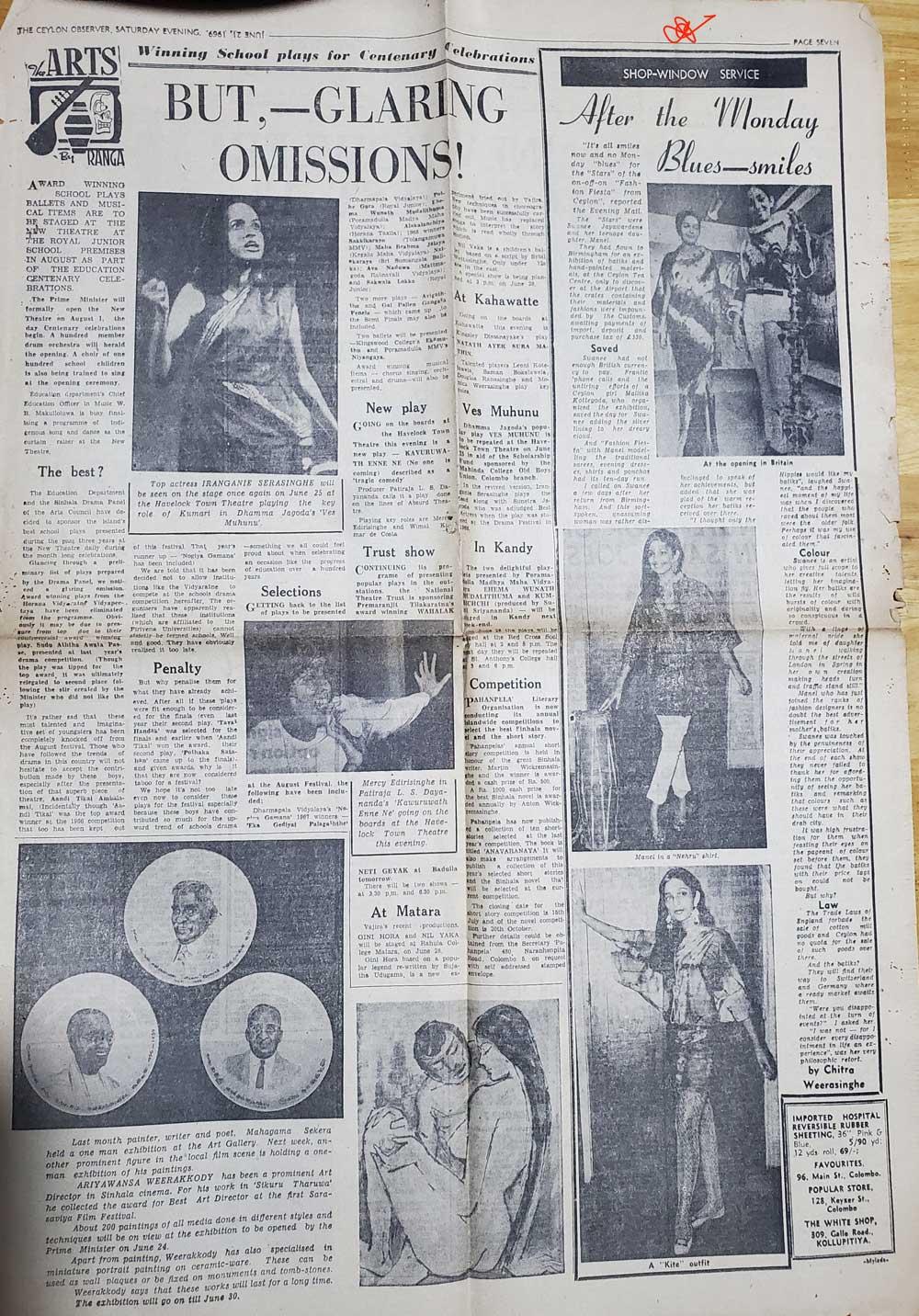
Before Swanee is a label, it is my personal compass, representing fierce conviction, authenticity and an uncompromising love for beauty. It embodies the belief that our creative voice never needs to borrow validation or chase external trends. We have an extraordinary artistic vocabulary right here in Sri Lanka. When I look at my grandmother’s life, I am in awe of that fearless momentum. In 1960, at just thirty, she exhibited at the 30th Venice Biennale during Ceylon’s modern art awakening. By 1969, she took an entirely revolutionary body of textile work to London and Birmingham, pushing tie dye far beyond traditional pebble techniques into expressive, painterly wearable art. Newspapers reported that her vibrant colours stopped London traffic, while back home, diplomatic circles held soirées specifying “Wearable Art by Swanee only.” Growing up, I saw a woman with immense artistic confidence who passed that instinct down through generations. To me, Swanee means honouring that root, trusting your eye, creating without fear and staying anchored in your identity.
You have described yourself as the custodian of your grandmother’s legacy rather than simply the designer of Swanee. What does being a custodian demand of you that being a designer does not?
As custodian, I look at the complete scope of her footprint. That means cataloguing her paintings, preserving primary documents from the 1950s onward and engaging with archivists, historians and curators. While based in London, I noticed archival gaps regarding the women actively exhibiting during Ceylon’s modern art movement. I have taken on the work of bridging those gaps, tracing primary records at institutions such as the Venice Biennale library to ensure her achievements are permanently anchored in history. That custodianship also protects her pioneering textile practice from the late 1960s, documenting how she translated fine art concepts into wearable pieces that reshaped our regional design landscape.
My role on the runway, however, is creative director. My job is to take that remarkable foundation of colour, emotion and craft and evolve it through contemporary silhouettes. The custodian protects the foundation. The creative director moves the story forward.
Your grandmother, Swanee Jayawardene, was a painter before she was a textile innovator. When you design today, do you think of the clothes as fashion, or as another kind of canvas?
Unequivocally, clothes are another kind of canvas. For our house, fabric has never been yardage simply waiting to be cut. It is an active surface. When my grandmother began experimenting with textiles, she approached cloth with an abstract painter’s instinct. She was celebrated for handling volatile primary colours and manipulating them into balance. For her, tie dye liberated emotion, while batik introduced graphic restraint and structural line work. That ethos is entirely alive today. We always design through the textile first. We ensure every length of fabric achieves that painterly, signature standard before any pattern is cut. When we gather around a newly dyed textile, we look for drama and emotional resonance, critiquing the composition from every angle under natural light. The silhouettes are then draped to let that artwork breathe and move organically with the body. Sometimes what we originally envisioned on paper evolves into something completely different on the stand, simply because we let the cloth lead.
Swanee exhibited with the ’43 Group at a time when relatively few women occupied that space in Sri Lankan modernism. How much did you understand about the significance of your grandmother when you were growing up?
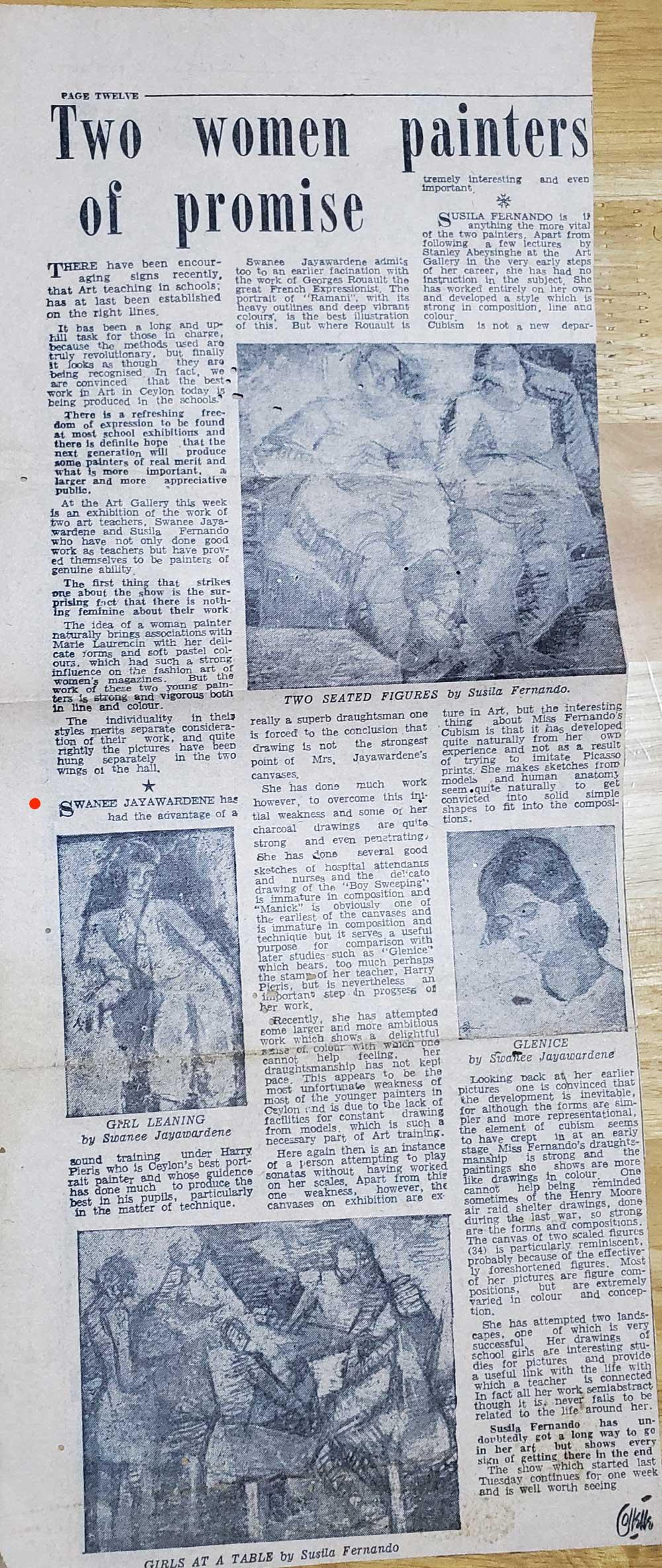
The timeline is quite meaningful. She had won awards at the Ceylon Society of Arts in her teens, but it was Geoffrey Beling who introduced her to Harry Pieris. Studying under Harry opened up the avant garde world of the ’43 Group. Following the Two Women Painters exhibition in 1954 alongside Susila Wijesuriya, both were invited to join the group as young members. She was just twenty-four and exhibited both locally and internationally with the group thereafter. Growing up, I could not grasp her historical weight. You simply see your grandmother. Yet there was always a buzz around her house, with collectors visiting and journalists interviewing her. My clearest memory is watching her paint; petite, barely five foot two, standing before monumental canvases with her easel deliberately angled away from the door so nothing broke her focus. It was only as an adult, reviewing the archives, that the scale of her life hit me; exhibiting internationally, raising three children and achieving complete financial independence purely through her talent.
Has there been a moment in adulthood when you looked at one of your grandmother’s paintings and suddenly understood something about her that you had not understood as her granddaughter?
Completely. That is the enduring power of abstract expressionism. It captures an internal psychological state, which shifts depending on where you are in your own life. Growing up, there were several paintings I avoided because they were surreal and dealt with darker human dualities. One piece featured a figure with two emerging personas. One looked monstrous and menacing, while the other was small, meek and terrified. As a child, it frightened me. In my twenties, I simply thought it looked striking.
Looking at it as an adult, I had a sudden moment of clarity. I realised she was not painting monsters. She had an unflinching, remarkably empathetic insight into human psychology. She understood that cruelty or aggression is often armour masking an insecure, frightened self underneath. People possess complex dualities, and she had the courage to look directly into those wounds and translate them onto canvas. It showed me an emotional depth I could not see as a child.
Your grandmother’s “Explosion Batik” brought together tie dye and batik in a very distinctive way. What elements of that original technique are non-negotiable for you, and where do you allow yourself to interfere and experiment?
What made Explosion Batik so revolutionary was the tension between spontaneity and control. The tie dye allowed her to unleash saturated, bleeding colour fields, while the batik introduced the graphic discipline of wax resist lines to restore structural order. It was an explosion held in balance. The non-negotiable element is the authentic craft. It must remain entirely handmade, respecting the chemistry of the dyes and the physical touch of our artisans. That rootedness is why Explosion Batik always anchors our runway collections, particularly in our sarees and statement pieces. Where I experiment is in treating it as an ideology rather than a rigid formula. My grandmother was an innovator. Freezing her technique in time would betray her spirit. Today, we treat fabric like an evolving canvas, using paintbrushes and funnels, testing unconventional dye viscosities and pairing those expressive textiles with clean, contemporary tailoring.
How do you preserve a heritage brand without turning it into a museum piece? Where is the line between respecting Swanee and allowing Yathra to have her own creative voice?
The line lies in keeping a clear distinction between the archive and the active studio. We preserve her original work so history can evaluate her uncompromised identity, while giving ourselves full permission to evolve today. If I merely reproduced her vintage garments, Swanee would become a preservation project. The pieces I design for modern runways do not mimic what she created decades ago, but they carry her core values; fearless experimentation, pure artisanal craft and effortless wearability. Within our family studio, we remain our own harshest critics. If a textile lacks vitality, we call it out immediately. If it glows, we celebrate it. My own voice enters in how those fabrics are shaped into modern form. Rather than chasing seasonal trends, I let my own surroundings and contemporary eye inform the cuts, proportions and tailoring. Respecting her legacy means carrying her rebellious energy forward.
You have previously talked about stripping colour back and letting the complexity of the batik print itself speak. What is the visual language of the collection you are bringing to the Future Craft Runway, and what has changed since your last collection?
In my previous collection, stripping colour back was an intentional exercise. Because Swanee is so celebrated for kaleidoscopic colour, it is easy for viewers to get swept up in the palette and miss the draughtsmanship underneath. Working in monochrome proved that the architecture of our prints, the crackle, line work and structure, could command the runway entirely on its own. For the Future Craft Runway, we are returning decisively to what the house is fundamentally known for; fearless, full spectrum colour. This season’s visual language celebrates multi tonal tie dyes and Explosion Batiks that balance contrasting pigments into vibrant harmony.
What has evolved is how we play with tension. Rather than choosing strictly between monochrome and saturation, we are juxtaposing both. We are punctuating intense colour fields with deliberate black and white moments, showing how pigment completely transforms the mood and presence of a handcrafted print.
What does the title or central idea of this new collection mean to you, and what should we look for when the first look comes down the runway?
The collection draws inspiration from the marine landscape, the fluid universe of ocean depths, living coral reefs and coastal elements. Because abstract expressionism is our foundation, this is never a literal translation. You will not see illustrations of tropical fish or waves. We set out to capture the sensation of the sea. When the first look steps out, I want the audience to engage with it like an abstract canvas. Look for kinetic movement; a saree capturing the feeling of frothy white surf crashing against sand, bleeding into translucent shallows before churning into choppier, deep-water blues. Elsewhere, electric pinks and purples evoke the pulse of a living reef, while sharp linear monochrome moments suggest the delicate architecture of fish scales, skeletal geometry or seaweed drifting in the current. It is an invitation to feel the pulse of the tide rather than read a literal picture.
The theme “Future Craft” raises an interesting question for a label like Swanee. What does the future of a handmade Sri Lankan craft such as batik actually look like to you?
At first glance, pairing a heritage house with Future Craft might seem like a contradiction, but Swanee was born out of radical experimentation. Pushing batik and tie dye beyond conventional boundaries was the very reason the brand existed in the first place. I often think of the Keller Report from the 1960s, which surveyed Ceylon’s craft ecosystem and highlighted our handmade traditions as our greatest natural asset on the international stage. That remains profoundly true today. The mistake has always been looking outward to imitate foreign methods rather than recognising that the world seeks the rarity of what we make by hand. True master batik requires delicate chemistry, an artist’s eye and immense discipline. Very few people in the world can execute it at this level. By investing in our artisans, testing modern silhouettes and pushing technical boundaries, handmade batik will not just survive. It can lead globally.
Batik carries a very recognisable Sri Lankan identity. Do you ever consciously resist the expectation that Sri Lankan fashion has to “look Sri Lankan?”
I have never had to resist that expectation, simply because Swanee was never orthodox to begin with. When people picture typical Sri Lankan batik, they often think of traditional decorative motifs, such as elephants or floral iconography. Swanee has never operated in that space. The visual language of our house was avant garde from day one, so breaking away from souvenir motifs was part of our origin. At the same time, I am fiercely proud that our making is rooted in Sri Lanka. The instinctive mastery of the dye bath and wax resist belongs to our local makers, an ecosystem that international fashion houses cannot simply manufacture. Where the label becomes contemporary is in the silhouette. Fashion should be borderless. When you pair an irreplaceable, homegrown craft with clean, modern tailoring, you create something that is deeply rooted yet universally relevant.
You live in London while much of the story, making and identity of Swanee is rooted in Colombo. How do you actually manage a creative business across those two cities?
It works because of close family trust, modern communication and the right team on the ground. The physical making is anchored in Colombo, guided by my family and our studio artisans. They supervise the dye baths and wax applications, ensuring our textile engineering remains completely authentic to our heritage. Managing across London and Colombo involves constant collaboration, reviewing freshly washed yardage over video, debating palettes and testing swatches, paired with frequent trips home for intensive studio workshops and fittings. Whenever the cross-continental logistics feel daunting, I ground myself in my grandmother’s reality. As an eighteen-year-old teacher at Bishop’s College, she would finish classes, come home, tuck up her saree, put on rubber boots and gloves, and work late into the night over dye baths while raising three children. If she could build an artistic revolution in rubber boots and a tucked-up saree, managing between London and Colombo is simply a matter of focus and dedication.
Has living in London changed the way you see Sri Lankan craft? Sometimes distance makes us recognise the value of things we took for granted at home. Has that happened to you?
Immensely. When you grow up surrounded by a craft, you naturally become desensitised to everyday miracles. Seeing hot wax drawn, watching artisans manage delicate dye baths and obsessing over hairline crackles was simply my everyday background. You focus on pushing for thinner lines without stepping back to appreciate how rare that skill truly is. Living in London provided that distance. In Europe, when you observe master stonemasons, sculptors or heritage leatherworkers, the culture treats them with deep institutional respect. Seeing that made something click. Our artisans in Sri Lanka operate with that exact calibre of mastery. The generational skill in our workshops is our cultural equivalent of classical sculpture. That distance replaced familiarity with immense pride. It made me realise that we are the masters of our own techniques. We do not need external validation to confirm our worth. We already possess world class artistry, and we should present it with confidence.
Conversely, what can London and the international fashion industry learn from the way things are made in Sri Lanka, particularly the relationship between designer, artisan and material?
The global fashion system often relies on rigid predictability. A designer drafts a digital tech pack and demands that manufacturing replicate it identically. What international fashion can learn from our workshops is the value of listening to the material. In artisanal craft, especially experimental tie dye and batik, the textile has its own agency. The temperature of the wax, the viscosity of the dye, the weather and the touch of the artisan’s hand all interact in real time. That dialogue continues straight onto the cutting table, where the drape and weight of the finished cloth often dictate an entirely new silhouette. The greatest lesson our craft offers is fluidity; honouring the artisan’s instincts and making room for happy accidents.
You studied Business Management before formally training in fashion. Has that business background become more important now that you are responsible not only for designing, but for sustaining a heritage label?
It provides the pragmatic balance to a deeply creative lineage. In my family, artistic expression is second nature. Creative pursuits run across generations. The wonderful thing about pure artists is that they get entirely lost in the creation. When you are driven purely by an aesthetic vision, time disappears. You will happily spend days refining a single dye tone or brush-mark until it feels right. But fashion runs on strict schedules and real-world deadlines. While part of my mind is dreaming alongside our studio about colour palettes and silhouettes, the managerial side is mapping production capacity, setting delivery windows and calculating timelines.
There is an extraordinary three generation story here, your grandmother creates the artistic language, the family preserves it, and you are now taking it into another era. Do you ever feel the weight of that inheritance, or is it more liberating than burdensome?
It feels liberating. It is like a visual shorthand we were all born speaking. Growing up immersed in art and colour trains your eye without you realising it. What takes others deliberate effort comes naturally to us. I can glance at freshly dyed fabric and instantly tell where the balance falters or what adjustment will bring it together. That shared instinct is an incredible foundation. That does not mean our studio is quiet. We are each other’s fiercest critics. If a dye batch turns out dull, we will openly despair over how uninspired it looks. But when a fresh length comes out of the wash looking radiant, we celebrate together. I value my family’s opinion deeply, while trusting my own vision to make the final call. Whether I am archiving my grandmother’s paintings or spending late nights over the cutting table, draping around an imperfection on a piece of cloth to create a silhouette for myself, I love every minute of it. When you have that much passion for the craft, legacy never feels heavy.
Swanee was not only a designer. She painted, taught, experimented with textiles and helped introduce batik into art education. Do you think today’s separation between “artist,” “fashion designer” and “craftsperson” would have made much sense to her?
Historically, there was an institutional divide. Fine art and textile design were often treated separately. But for my grandmother, those external categories simply did not matter. First and foremost, she was an artist. At nineteen, while teaching art at Bishop’s College, she was already introducing batik into the school curriculum through student exhibitions. When she later developed wearable art, it was not to fit into an industry niche. It was because fabric was an expressive medium for her hands. Within the ’43 Group, her peers recognised that creative power. When Ivan Peries visited, he traded two of his drawings for two of her batik sarongs, a pure exchange of artistic admiration and respect that I am reminded of every time I see those drawings hanging in my aunts’ homes. To her, labels were things the outside world applied later. That was proven in her final years. When she became too frail to stand at her easel, she simply picked up knitting needles because her fingers still worked. She bought armfuls of vibrant wool and knitted intricate, colourful sweaters for the whole family in sweltering Colombo. That is a true artist. You create with whatever strength you have, without worrying about what category you fall into.
If your grandmother could be sitting in the audience at the Future Craft Runway and see this collection come down the catwalk, which look do you think she would immediately recognise as belonging to her world, and which one might surprise her?
I think she would recognise the entire collection immediately. We all share a visual language, and that artistic signature runs through every piece. What would surprise, and frankly disappoint her, is if anything walked down that runway looking safe, predictable or ordinary. My grandmother was an unapologetic modernist. Bold cuts or contemporary silhouettes would not shock her. She would expect nothing less than evolution. But if a garment looked like ordinary fashion lacking an artist’s touch, she would have dismissed it on the spot.
When this show is over and people leave Mercedes Benz Fashion Week Sri Lanka, what is the one thing you want them to understand about Swanee that they did not understand when they walked in?
I want them to look beyond the immediate runway impact and appreciate the exceptional layers of technical discipline, original authorship and colour mastery within the work. First is the sheer technical skill. Achieving hairline, whisper thin wax lines requires artisan control that cannot be rushed. It is not standard commercial batik. It is fine draughtsmanship in hot wax. Second is authorship. Every print is homegrown. They are personal artistic expressions translated onto fabric. Finally, I want them to recognise the difficulty of chromatic harmony. Pairing two contrasting colours is straightforward. Balancing six or seven complex pigments in a dynamic print while maintaining elegance requires an intuitive, painterly eye honed over decades. When the lights come down, I hope the audience sees wearable fine art. I want them to get lost in the marine atmosphere of the collection, wondering whether a monochrome pattern echoes coastal rock structures or if a rich dye wash captures an ocean trench, and leave appreciating the profound artistry behind the Swanee name.
What is next for Swanee and for Yathra? Where do you see the brand and yourself ten years from now?
The journey ahead will always move along two parallel tracks; custodianship of the archive and creative direction for the brand. On the archival side, my commitment is to ensure Swanee Jayawardene’s fine art legacy receives the international scholarship and recognition it merits. She was a pioneering South Asian female modernist who broke barriers within the ’43 Group and at the Venice Biennale, even without her textile work. For the brand, my ambition is slow, uncompromising luxury, positioning Sri Lankan artisan craft alongside the world’s finest art and craft. Personally, I want our Colombo studio to remain an experimental haven where young artisans gain mastery, pride and viable futures. Ten years from now, I want to look back knowing we did not just preserve an inheritance. We proved that a family led, handmade craft from Sri Lanka can thrive purely on its own artistic merits.
Venice Biennale 1960 documents
file:///C:/Users/news/Downloads/re_yathrajayawardeneimages/Venice%20Biennale%201960%20documents.pdf
43 group exhibition 1959
file:///C:/Users/news/Downloads/re_yathrajayawardeneimages/43%20group%20exhibition%201959.pdf
43 group exhibition 1957
file:///C:/Users/news/Downloads/re_yathrajayawardeneimages/43%20group%20exhibition%201957.pdf
43 group exhibition 1956
file:///C:/Users/news/Downloads/re_yathrajayawardeneimages/43%20group%20exhibition%201956.pdf
43 group exhibition 1955
file:///C:/Users/news/Downloads/re_yathrajayawardeneimages/43%20group%20exhibition%201955.pdf