After the Sublime How the internet learned to monetise awe.
There is an old philosophical problem that feels strangely contemporary at this point. For centuries, writers struggled to describe what philosophers called the sublime: those rare encounters with the world so overwhelming that language momentarily fails. Standing before an immense mountain range, watching the sea during a storm, looking up at the night sky before electric light diluted the darkness, one experiences something that refuses immediate explanation. It exceeds utility. It interrupts ordinary thought. The sublime does not ask to be consumed. It asks us to stop.
 Modern life has become remarkably efficient at eliminating that pause.
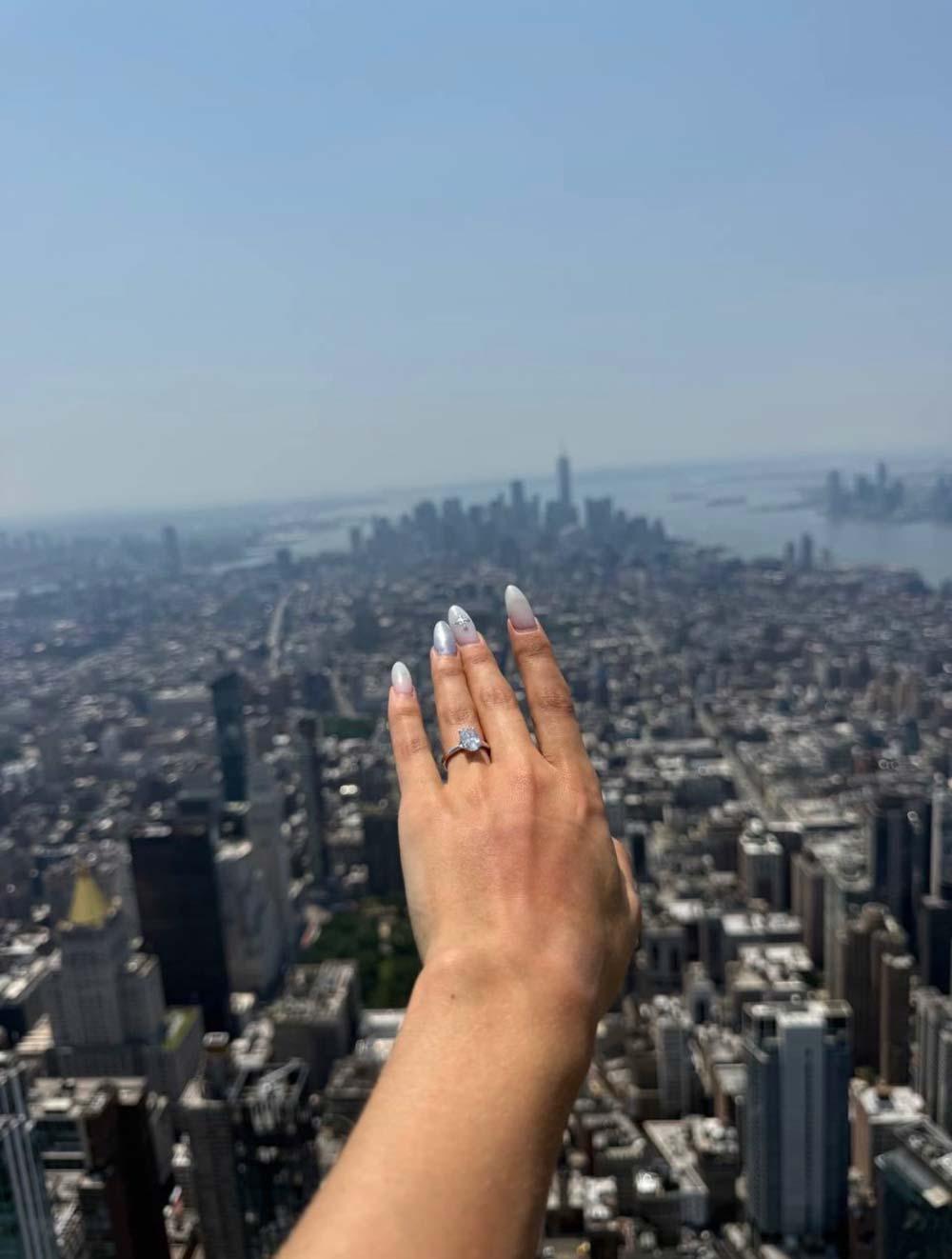
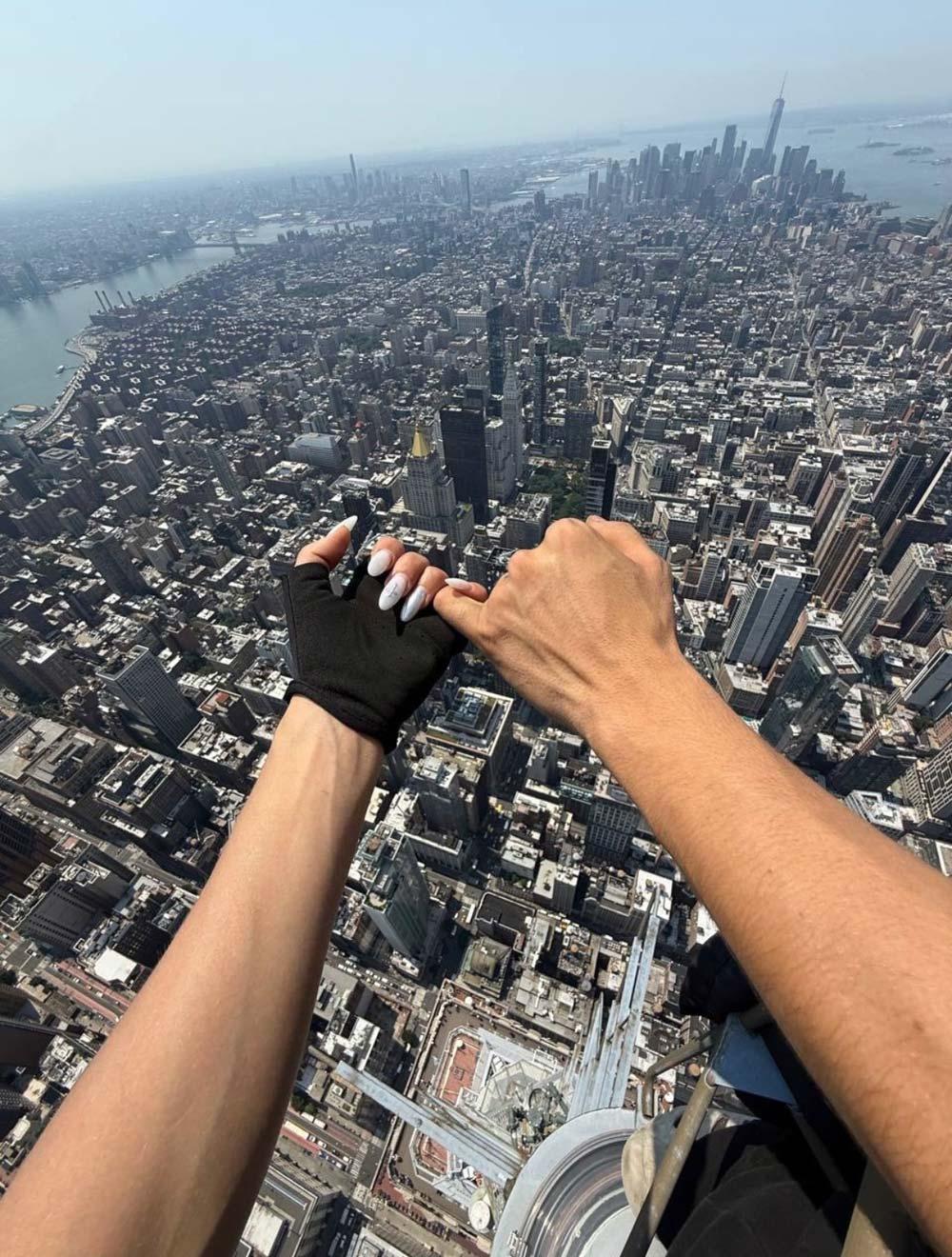
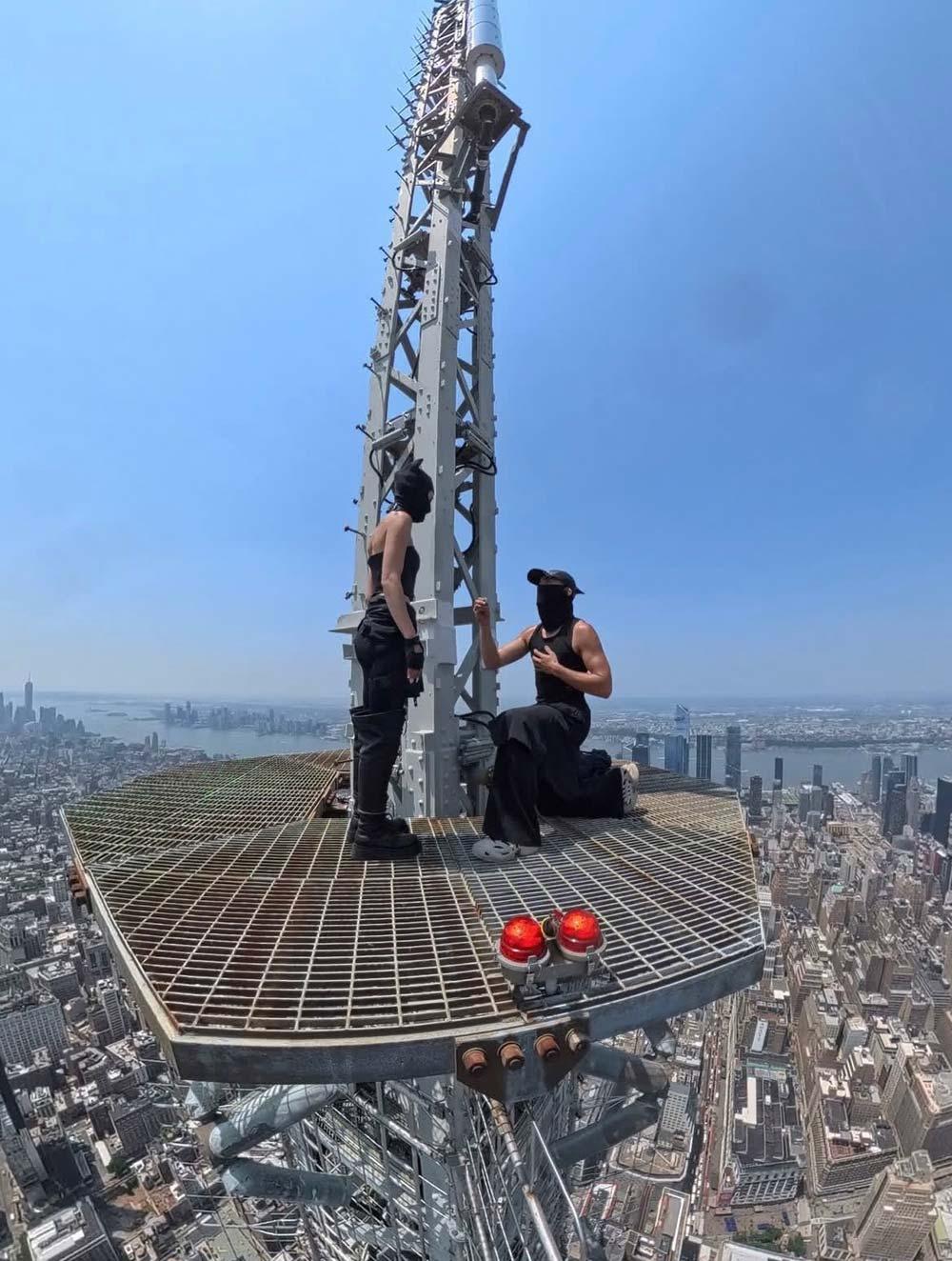
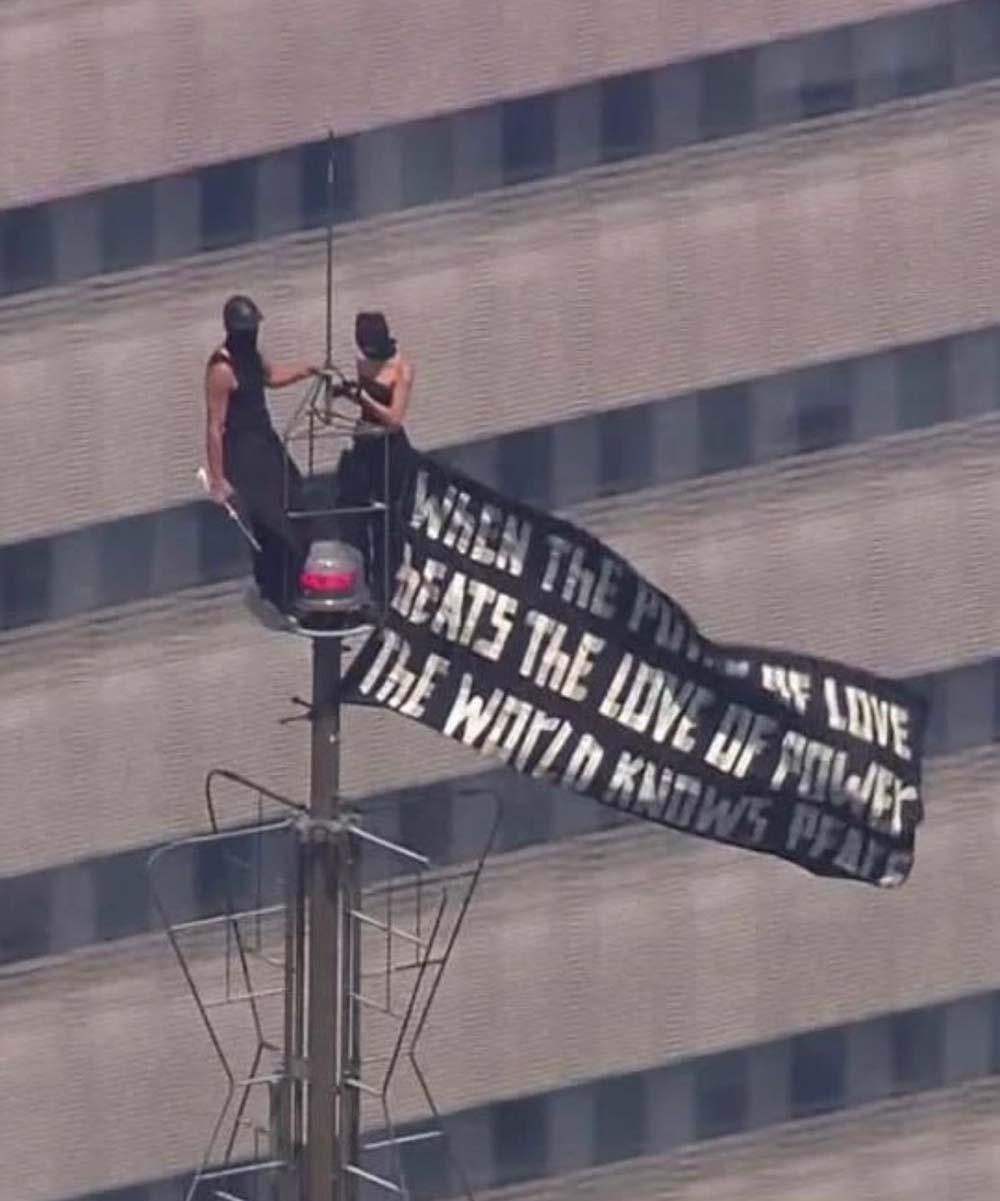
On the first of July, a photograph began circulating online that seemed, if only briefly, to recover something of that older sensation. Angela Nikolau and Ivan Kuznetsov had climbed the broadcast antenna of the Empire State Building. Suspended more than fourteen hundred feet above Manhattan, they unfurled a large black banner bearing a simple sentence: "When the power of love beats the love of power, the world knows peace." Whatever one thinks of the wisdom of such an undertaking, the image possessed an undeniable physical gravity.
The photograph seemed to demand an older kind of attention. One looked first at the height, then at the impossibility of the climb, and only afterwards at the sentence itself. The image was not merely about peace. It was about risk. It reminded us, almost involuntarily, that some statements still require people to place themselves in genuine danger.
That quality did not survive the week.
Within hours, versions of the same photograph began appearing across social media with the banner digitally erased and replaced. Food chains announced promotions. Financial apps offered discounts. Retail brands discovered that the empty black rectangle was an ideal place to display a slogan. The original message disappeared beneath an avalanche of marketing copy so quickly that one could almost believe the photograph had always existed for commercial adaptation.
 Advertising has always borrowed from culture. It has borrowed from literature, music, painting, cinema and politics. There is nothing particularly novel about commerce recognizing a compelling image. What feels new is the disappearance of any interval between an event and its commodification. Once, an image had time to become memory before it became merchandise. Today those two processes occur almost simultaneously. The photograph enters the world already carrying the possibility of becoming an advertisement.
This acceleration has consequences that extend well beyond marketing. It changes our relationship with meaning itself.
The internet is often described as an information network, but it increasingly behaves as a machine for reducing differences. A wedding photograph, footage of a natural disaster, a declaration of political resistance, a celebrity scandal and an advertisement for fried chicken all occupy the same dimensions on the screen. Each competes for the same fraction of attention. Each is measured by identical metrics of visibility, engagement and circulation. What disappears is proportion. The feed gradually teaches us that every image belongs to the same moral category because every image passes through the same technological architecture.
This is perhaps why the reaction many people felt was not simple annoyance but something closer to grief. The irritation had little to do with the quality of the jokes. Some of them were perfectly competent examples of social-media marketing. The discomfort lay elsewhere. It arose from watching an image that still seemed to possess symbolic weight being treated as though it were merely unused advertising space.
That transformation reveals something peculiar about late capitalism. Markets have always sought new territories, but digital culture has expanded the frontier beyond physical space into symbolic space. Not only our labor and our leisure, but increasingly our emotions, our rituals and even our astonishment are drawn into systems of commercial exchange. There are remarkably few experiences left that cannot, within hours, be translated into promotional material. The market has become less interested in selling products than in occupying consciousness itself.
This habit of imitation is often dismissed as harmless marketing, but it carries an unspoken assumption: that originality is unnecessary so long as recognizability can be achieved quickly. The result is a curious form of cultural dependency. Local experience becomes secondary to global virality. The streets outside the office window matter less than whatever image happens to be circulating elsewhere. A country with its own political history, humor, anxieties and visual language gradually learns to speak in borrowed idioms.
Perhaps the greatest casualty of this process is not originality but reverence. Every civilization depends, in one form or another, upon recognizing that certain experiences deserve to remain disproportionate to everyday life. We preserve monuments, observe silences, write elegies and create works of art because we intuitively understand that some moments cannot be adequately translated into ordinary exchange. The internet does not deliberately destroy that instinct. It simply renders it economically inefficient. The pause required for contemplation produces fewer measurable returns than the speed required for participation.
The tragedy, then, is not that brands borrowed a photograph. It is that we have built a culture in which almost nobody expects them not to. The absence of restraint no longer surprises us because the logic behind it has become ambient. We have accepted, almost without noticing, that every image is potentially available for commercial occupation, every public gesture potentially convertible into engagement, every symbol potentially awaiting sponsorship.
The photograph of the climbers remains extraordinary, regardless of what one thinks of the act itself. Yet what lingers in the mind is not the ascent but the speed with which the ascent disappeared beneath a layer of digital improvisation. Somewhere above Manhattan, two people carried a sentence into the sky. Down below, millions looked up just long enough to decide what else might fit inside the rectangle.
That may be the defining image of the internet age, not the climb itself, but the replacement of its meaning. Somewhere between awe and advertising, we misplaced the ability to leave certain things as they should be. Because I fear it was actually just pure literature.