On the ‘Not All Men’ Debate Around Rape Academy

Every time a woman talks about male violence, someone says ‘not all men’. And they are correct. Not all men attend rape classes on Telegram. Not all men buy sleeping liquid for 150 euros from a man in a Spanish exclave. Not all men film their unconscious wives and sell the livestream for twenty dollars a viewer. Not all men. But in February 2026 alone, the website at the centre of this story received 62 million visits. That is not the dark web. That is a mainstream pornographic website, indexed by search engines, accessible on every phone globally and in Sri Lanka, hosting over 20,000 videos of men filming women who are unconscious. And it is just one website.
In March 2026, CNN published the findings of a months-long undercover investigation into what they called an “online rape academy.” The phrase belongs to Sandrine Josso, a French lawmaker and herself a survivor of drug-facilitated assault. The communities she described operate like a curriculum: tips on dosage, on detection avoidance, on filming, on sharing, on getting away with it. They have students. They have mentors. They have alumni who have graduated to running their own operations.
The Numbers
In 2023, Pornhub alone received 42 billion visits. Pornhub has approximately 130 million daily visitors. Seventy-seven percent of men between the ages of eighteen and twenty-four watch pornography at least once a month. Sixty percent of adult men watch it at least once a week. The average age of first exposure is eleven years old. The global pornography industry is worth approximately 97 billion dollars. Pornographic websites receive more visitors every month than Netflix and Amazon combined.

130 million daily visitors to Pornhub alone. The average first exposure: age 11.
Now. Of those billions of visits, of those hundreds of millions of daily viewers, what percentage is watching content that depicts violence against women? Research from the Journal of Sexual Medicine found that mainstream pornography teaches, in the words of scholar Robert Jensen, that women always want sex from men and that any woman who initially resists can be persuaded by force. A 2021 peer-reviewed study found that mainstream pornography and incel communities share a common language. Not different ecosystems. The same one.
The ‘sleep content’ communities uncovered by CNN did not drop from the sky. They grew in soil that had been cultivated for decades. Pornography that normalises sedation, that frames unconscious women as aspirational content, that categorises assault under tags like #passedout and #eyecheck and awards it 50,000 views. A community that evolved from watching to doing. And a platform that called itself ‘a moral free file host where anything legal is hosted forever’ and looked the other way.
Not all men. But the soil was prepared for all of them.
Three Women Who Woke Up
I want you to know their names, because the way these stories get told, the women tend to disappear into statistics and the men get paragraphs. So.
Zoe Watts. Devon, England. Married for sixteen years, four children, came home from church on an ordinary Sunday in 2018 when her husband confessed. He had been crushing their son’s sleeping medication into her bedtime tea, tying her down, raping her, and photographing it. She had been grateful for the tea. She was tired at the end of a long day, and she did not have to make it herself. She told CNN she never thought to worry about the person she lay next to. She is still struggling to call what happened to her by its name. Her ex-husband is serving eleven years.
Amanda Stanhope. Wigan, England. For five years, she would fall asleep mid-evening and wake up in different clothes with bruises she could not explain. On the occasions she woke during the assault and asked her partner to stop, he told her she was imagining things. That she was on too much medication. That she was crazy. She knew something was happening. He changed her reality until she almost stopped trusting what her own body was telling her. Her former partner was charged with rape and sexual assault. He died by suicide before the trial.
Valentina. Northern Italy. She does not use her real name. After twenty years of marriage, she found videos her husband had filmed of himself, and of her, unconscious, after he had used alcohol and sedatives. She told CNN that she had no marks, no memory. That she was lucky to have found the videos, because without them she would have had nothing. “I can’t conceive of the fact that a woman could be treated like slaughterhouse meat,” she said. “Because in the end, that’s what I was.” Her husband was sentenced to eight years. Valentina is still making friends with her nightmares.
Three women. Three countries. Three men who found their instructions, their validation, and their community online. And three women who had to rebuild their sense of reality from scratch, because the person they trusted most had been quietly dismantling it.
The Architecture of Permission
The question I cannot stop returning to is not ‘why do men do this’ but ‘what told them they could.’
Because someone did. The internet has been running a permission structure for years. It is in the pornography that frames sedation as fantasy. It is in the communities where men call this a hobby and receive not condemnation but tips. It is in the websites that host it under ‘safe harbour’ protections from a 1996 American law written before social media existed, laws that protect platforms from liability for what their users upload, laws that have been used to shield companies that profit from footage of women being assaulted in their own beds.
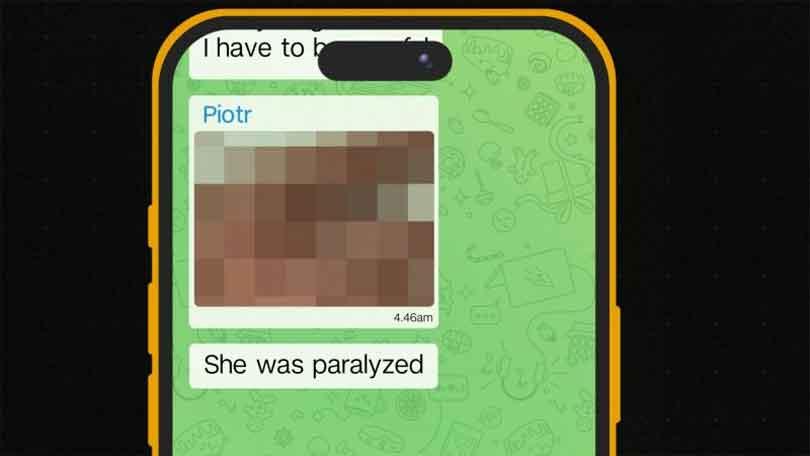
The Telegram group at the centre of the CNN investigation had nearly a thousand members. Piotr, the Polish man whose messages CNN documented over months, spoke openly about what he was doing to his wife. He shared his address. He gave dosage advice to other men. He was not afraid. The internet had told him he had nothing to fear.
And the terrifying part is that the psychologist who assessed half of the men convicted in the Pelicot trial, the case where a French man drugged his wife and invited seventy strangers to rape her over ten years, described the online community these men formed as meeting their ‘narcissistic’ needs. A sense of brotherhood. Belonging. Mutual reinforcement. The same structural psychology as every other radicalisation pipeline. The same mechanics that built every other extremist movement. Applied here to the bodies of women sleeping in their own homes.
And Then There Is Sri Lanka
I need to tell you something you may already know, and if you do not, I need you to sit with it.
In Sri Lanka, a man can drug and rape his wife, and it is not a crime. Section 363(d) of the Penal Code exempts husbands from rape charges unless the couple is already judicially separated. I wrote about this two weeks ago. I am writing about it again, because the CNN investigation and this law are the same story told from different angles.
The online rape academy teaches men how to drug their partners. Sri Lankan law tells those men, should they ever be caught, that what they did to their wives was not rape. The academy provides the method. The law provides the defence.
A 2025 UN Women and UNFPA study found that nearly one in three women in Sri Lanka has personally experienced technology-facilitated gender-based violence. Over half felt unsafe online. The websites and Telegram groups documented in this investigation are accessible on every phone, on every mobile network, in every district of this country. We have 20 million social media user identities and a 2024 Online Safety Act that researchers have described as lacking ‘precise definitions and clarity in enforcement.’ We have no legal definition of marital rape. We have a National Child Protection Authority that received 8,746 complaints last year, including hundreds of sexual abuse cases involving children. And we have a government that in 2024 drafted a marital rape bill, watched it become politically inconvenient, and quietly withdrew it.
The infrastructure for this abuse is not somewhere else. It is here. It has been here. We have simply been very careful not to name it.

Not All Men. But Enough Men.
I am tired of having the ‘not all men’ conversation. Not because it is wrong. It isn’t. But because it has become, over years of repetition, a way of ending a conversation that needs to keep going.
Not all men use these websites. Not all men drug their partners. Not all men think it is acceptable to rape a sleeping woman. Correct. But enough men do that a global industry supports them. Enough men do that a Telegram group of nearly a thousand users operated openly for months. Enough men do that three investigators from CNN spent months documenting it and came back with more material than they could publish. Enough men do that Gisèle Pelicot had to waive her right to anonymity and sit through three and a half months of public trial for the world to believe her.
The women paying for this are not paying with their comfort or their feelings. They are paying with their bodies, with their sleep, with their capacity to trust the person lying next to them. Zoe Watts paid with a four-year legal process that saw her children bullied at school. Amanda Stanhope paid with her innocence about people. Valentina paid with nightmares that live just behind her bedroom door.
The question is not whether you are one of those men. The question is whether you are one of the people who keeps making the world safe for them.
If you or someone you know is experiencing sexual or domestic violence: National Helpline — 1938