Luck, Habit, or Fear?

By Noeli Jesudas
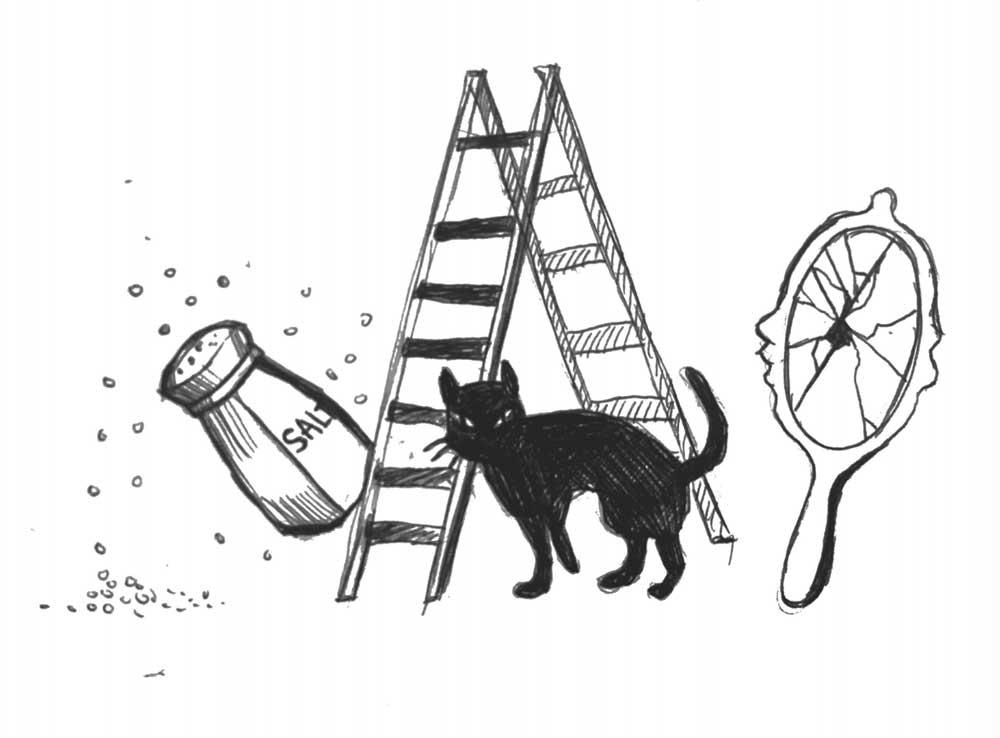
You don’t believe in superstitions. Not really. And yet, you still pause for a second before walking under a ladder. You say “touch wood” mid-sentence like punctuation. You feel a tiny, irrational discomfort when a black cat crosses your path. It’s subtle, almost automatic, these small rituals stitched into daily life, performed without ceremony, without full belief, but never entirely dismissed. Superstitions don’t demand devotion. They survive on habit.
Take knocking on wood. It slips into conversation so casually you barely notice it. “Everything’s been going well, touch wood.” Tap, tap. Done. No deep thought, no pause for reflection. But the origin is far less casual. Some trace it back to ancient pagan cultures that believed spirits lived in trees. Touching or knocking on wood was a way to call on those spirits for protection, or to thank them for good fortune without attracting envy from darker forces. Others link it to early Christian traditions, where wood symbolized the cross, and touching it became a quiet act of seeking protection. Either way, what began as a gesture loaded with belief has now become conversational muscle memory. You don’t necessarily believe something bad will happen if you don’t do it. But you’d rather not risk it.
That “just in case” mindset is the real engine behind most superstitions. They thrive in the grey area between logic and uncertainty. Avoiding black cats is a perfect example. In medieval Europe, black cats were often associated with witchcraft and bad omens, partly because of their nocturnal nature and the general suspicion of anything that moved unseen in the dark. Fast forward to now, and most people would laugh at the idea that a cat could bring bad luck. But still, when one crosses your path, there’s sometimes that flicker of hesitation. Not fear exactly. More like a mental note: that felt unlucky. It’s less about belief and more about inherited instinct, passed down quietly through generations.
Then there’s the idea of “touching gold” or surrounding yourself with something considered lucky. In some cultures, gold represents purity, prosperity, and divine protection. It’s not uncommon to see people instinctively touch a chain, a ring, an earring or even a religious pendant during moments of uncertainty, before an exam, during a stressful conversation, or when hearing unexpected news. The object itself isn’t magical. But it becomes a physical anchor, something to hold onto when outcomes feel out of your control.
That’s really what all of this comes down to: control. Or at least, the illusion of it. Life is unpredictable in ways that are often uncomfortable to admit. You can prepare and plan, yet still be caught off guard. Superstitions step in as small, manageable actions that make uncertainty feel less overwhelming. They don’t promise outcomes. They give you something to do. And sometimes, that’s enough.
What’s interesting is how these habits adapt rather than disappear. You’d think in a world driven by data, logic, and constant information, superstitions would fade out. But they don’t. They just change form. People don’t necessarily avoid ladders anymore, but they hesitate before sending a risky text. They don’t fear curses, but they avoid “jinxing” something by speaking too soon. The language evolves, but the instinct stays the same. Even the word “jinx” itself has become part of everyday vocabulary, less mystical, more casual, but rooted in the same idea that saying something out loud can somehow interfere with its outcome.

There’s also a social element to it. Superstitions are rarely practiced in isolation. They’re shared, mirrored, and reinforced through everyday interactions. Someone says, “Don’t say that you’ll jinx it,” and you instinctively retract your statement. Not because you fully agree, but because it feels easier to go along with it than to challenge it. It becomes a kind of unspoken agreement, small behaviors that everyone understands, even if no one fully believes.
And then there’s routine. The quiet repetition of certain actions until they become part of how you move through the world. Sitting in the same seat, wearing a “lucky” outfit, following the same order before doing something important. These aren’t always labelled as superstitions, but they operate similarly. They create a sense of familiarity in moments that might otherwise feel uncertain. You don’t question them because they work, not in a scientific sense, but in the way they settle your mind.
What makes everyday superstitions so interesting is that they don’t need to be rational to be effective. Their power isn’t in changing reality, it’s in shaping how you experience it. Knocking on wood doesn’t alter your luck, but it might ease the quiet anxiety that comes with acknowledging something good. Avoiding a black cat doesn’t prevent misfortune, but it gives you a moment to feel like you’ve sidestepped something unknown. Touching gold doesn’t guarantee protection, but it offers a sense of grounding when things feel uncertain.
It’s easy to dismiss these habits as outdated or illogical. But that misses the point. They’re not really about luck. They’re about navigating uncertainty in small, human ways. They exist in that space where logic doesn’t quite reach, where instinct, culture, and habit quietly take over.
And maybe that’s why they’ve lasted this long. Not because people truly believe a black cat can ruin their day or that a piece of wood can protect them, but because these actions offer something simple and immediate: a sense of reassurance. A pause. A moment of control in situations where control is limited.
So, you knock on wood. You avoid saying things out loud too soon. You hold onto small rituals that don’t fully make sense. Not out of fear, but out of familiarity. Because even in a world that runs on reason, there’s still space for these quiet, irrational habits. And these are just some of the obvious ones. There are dozens more we follow without even naming them, wearing something “lucky” on a big day, making silent wishes at 11:11, taking small signs as reassurance that things might go right. Not all superstitions are about avoiding the worst; some are about quietly hoping for the best. They sit in the background of everyday life, unnoticed but present, less about belief, more about comfort in the unknown.