
Just Giorgia Chemical castration for sex offenders

By Thaliba Cader
In the gilded halls of the Palazzo Chigi, power is increasingly wearing a feminine yet uncompromising face. Giorgia Meloni, Italy’s first female Prime Minister, has spent the last four years performing a high wire act that has defied every prediction of an early political collapse. By May 2026, she has successfully transitioned from a perceived far-right firebrand to the undisputed doyenne of European conservatism. Her most audacious move, the legislative institutionalization of chemical castration for sex offenders, reveals the true nature of her project. It is a sophisticated biopolitics that merges state-enforced morality with a modern, curated image of female authority. This development marks a significant departure from the post war European consensus on human rights and bodily integrity, signaling a new era where the state reasserts its role as the ultimate guardian of social order.
To understand why Meloni remains a figure of intense fascination to a global audience while passing laws that make civil libertarians’ shudder, one must look at the concept of femonationalism. Meloni has successfully co-opted the language of women’s safety to advance a nationalist, high-security agenda. Unlike the old guard of the European right, Meloni does not speak of patriarchy; she speaks of protection. By approving chemical castration for rapists and pedophiles, she has effectively neutralized the feminist left’s monopoly on women’s rights. In her narrative, the ultimate pro-woman stance is not just legal equality but the physical incapacitation of those who threaten the female body. This is the Meloni Doctrine: the state as a protective, maternal force that wields the needle and the law with equal precision.
 The approval of the technical commission in late 2024, followed by the finalized legislative framework in 2025, was a masterclass in political maneuvering. By making the procedure voluntary, which involves offering reduced prison sentences in exchange for hormone-blocking treatment, Meloni’s government has threaded a complex legal needle. By positioning the treatment as a choice, the administration argues it avoids the cruel and unusual prohibitions of Article 27 of the Italian Constitution and the European Convention on Human Rights. The administration has leaned heavily on medical pragmatism by citing successful models in various international jurisdictions. Meloni frames the policy as a data-driven solution to recidivism rather than a medieval punishment. This is the intelligence behind her brand of populism. It is not an emotional outburst but a calculated restructuring of the social contract where physical safety is traded for bodily autonomy.
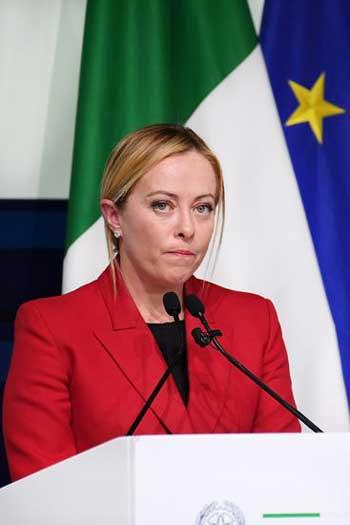
In 2026, Meloni’s global brand is her most potent weapon. Her aesthetic evolution is a critical part of this world-class political strategy. She has moved from the underdog of the youth wing to an icon of power dressing diplomacy. When she stands next to world leaders, her style, characterized by monochromatic Armani suits and a no-nonsense Roman bob, projects a specific type of competence. It is an aesthetic that suggests she is modern enough to lead a G7 nation but traditional enough to protect its soul. This visual branding makes her support for chemical castration feel like a surgical necessity rather than a radical whim. She has made the extreme look professional, wrapping a hardline security policy in the velvet of high fashion and diplomatic decorum.
Meloni’s Italian Model is currently being exported across the Atlantic and throughout the European Union. From revamped nationalist movements in France to conservative circles in the United States, the world is watching Italy’s experiment with biopolitical punishment. The brilliance of Meloni’s approach is its scalability. She has proven that a right-wing leader can maintain high approval ratings by focusing on the gut issues of the electorate, such as child safety and national identity, while maintaining a sophisticated, pro-NATO, and pro-market facade. This allows her to alienate fewer moderate voters than her predecessors while still delivering the radical outcomes that her core base demands.
The intersection of technology and governance has also played a role in the consolidation of her power. In early 2026, Meloni leveraged her personal experience with AI-generated deepfakes to pass comprehensive digital identity laws. These laws were framed as a defense of individual dignity, but they also expanded the state’s ability to monitor and verify digital activity. Much like the chemical castration policy, these digital measures were presented as a form of protection. Whether the threat is a digital predator or a physical one, Meloni’s government presents itself as the only shield capable of withstanding the chaos of the modern world. This creates a feedback loop where every new societal threat justifies a further expansion of executive authority.
Beneath the curated social media presence and the sharp suits lies a profound ethical question that will define the rest of her term. By inviting the state into the biological functions of the individual, Meloni has opened a door that may be difficult to close. Critics argue that voluntary castration is the thin end of a wedge. If the state can offer a deal for hormone suppression today, there is a fear regarding what biological corrections it might offer for political dissent or social non-conformity tomorrow. The opposition views this not as a safety measure but as the first step toward a sanitized authoritarianism. They suggest that the focus on the most reviled criminals is merely a way to establish a legal precedent for state intervention in the human body.
The intellectual framework of the Meloni administration is also deeply rooted in her long standing affinity for fantasy literature, specifically the works of Tolkien. In 2026, her rhetoric often evokes the struggle between light and shadow, positioning Italy as a bastion of tradition in an increasingly unmoored world. This narrative framing allows her to present the chemical castration policy as a heroic act of purification. To her followers, she is not just a Prime Minister but a symbolic defender of the hearth. This mythological layer of her leadership provides an emotional armor that protects her from the dry, technical criticisms of human rights lawyers and constitutional experts.

Furthermore, her economic policies have remained surprisingly orthodox, which has kept the markets calm even as her social policies grow more radical. This combination of fiscal conservatism and social biopolitics is what defines the new liberal conservative synthesis. By maintaining the trust of the European Central Bank and international investors, Meloni ensures that her domestic social experiments are not interrupted by financial crises. She has learned the lesson of previous populist leaders who were undone by market volatility. Instead, she has built a foundation of economic stability that serves as a launchpad for her cultural and judicial reforms.
Giorgia Meloni has mastered the gray zone of 21st-century politics. She is a leader who can trend on digital platforms for her wit and fashion while simultaneously presiding over the most radical shift in Italian criminal law in decades. Her approval of chemical castration for those she terms the monsters of society is more than just a law; it is a statement of intent. It tells the world that the New Italy is a place where the state is once again the ultimate arbiter of morality. As we look toward the 2027 elections, Meloni stands as the most successful right-wing politician of her generation. She has proven that one does not need to choose between being a global icon and a hardline nationalist. She has chosen, quite simply, to be Giorgia.
As the decade progresses, the legacy of this administration will likely be judged by the efficacy and the morality of these biopolitical interventions. If recidivism rates drop and public safety improves, Meloni may find her model adopted by centrist governments desperate for solutions to violent crime. However, if the legal challenges in European courts succeed, or if the policy leads to unforeseen medical consequences, the iron matriarch may face a reckoning. For now, she remains the most compelling figure in the European project, proving that a polished image can carry the weight of the most heavy-handed policies. The needle and the suit remain the twin pillars of her reign, and the world continues to watch with equal parts admiration and alarm.