IS AN OUT-OF-BODY EXPERIENCE A RETURN TO YOURSELF?
What a hypno-psychotherapist, a radio man and twenty-three years of dream journals
taught me about consciousness.
A man lies in bed and hears a commotion outside. He drifts up, passes straight through the wall,
and sees a fox rummaging through the bins. Then he returns to his body, gets up, walks to the
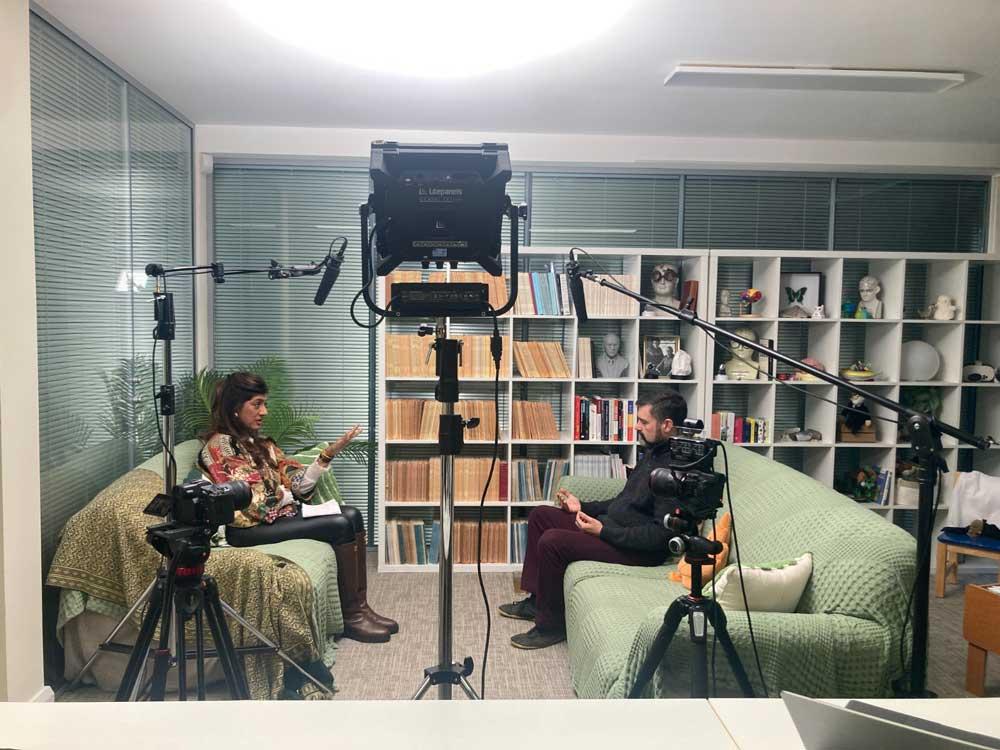
window, and there it is. The fox. Still rummaging. Do you believe him? I travelled five hours north from London to ask him in person, and to see the Centre for Liminal Studies for myself. We talked for hours. We talked about God, guides, the afterlife, the process of dying and a lot more. And still there were things I did not get to ask. What did he make of Inception, where Leonardo DiCaprio climbs inside other people's dreams? That one is for next time. I went in with a question of my own. Is leaving your body a way of escaping yourself, or of returning to yourself? Here is where I landed: the leaving was never the point. Out of body, Luigi asked to be taken somewhere he could learn about himself. Every road led back home.
NOT WHO YOU WOULD EXPECT
Luigi Sciambarella does not claim to be a mystic. He is a UKCP-registered hypno-psychotherapist and clinical supervisor, a board member of The Monroe Institute in the USA, and a director of the Centre for Liminal Studies in the UK. I know him well. I have worked with Luigi personally. We have done podcasts together, and he has even conducted the manifestation course at Wellness Curated. And he writes everything down. For about twenty-three years, he has kept a near-daily journal of his experiences. A scientist’s discipline turned on the inner world. It began at seven, when he woke and saw his grandmother, who had died. His brother saw her too, that same morning. Years later, practising deep self-hypnosis at university, a violent vibration ran through him like a train, and he floated up and saw his own body lying in bed. He was not scared. He was curious. There are many such stories. At a Joe Dispenza retreat in Mexico, a lady travelled to South America to visit her cat in her meditations. A friend said, ‘you need to read Bob Monroe.’
THE RADIO MAN WHO THOUGHT HE WAS DYING
Robert Monroe was a radio businessman who, in 1958, began having spontaneous out-of-body
experiences. He assumed he was ill. His doctor friends told him to rest. Then he decided that if it was not killing him, he would find out what it was. His book Journeys Out of the Body, published in 1971, brought the phrase into everyday language, and his research grew into The Monroe Institute in Virginia. You may have heard the CIA was involved. Luigi set me straight: the famous 1983 document was written by an Army officer, then stamped and later declassified by the CIA. It was not the Institute's work. Now let me play devil's advocate, because you should ask what I asked.
OBJECTION ONE: IT IS JUST YOUR BRAIN
In 2002, a Swiss team led by Olaf Blanke passed a weak current through a patient's right angular
gyrus. She described falling, then seeing herself lying in bed from above. Blanke's theory: the
experience arises when the brain fails to combine signals from the body.
Luigi does not fight this. He calls an out-of-body experience a sensory illusion, on purpose. Your body, he explained, is a mental construct. Ask someone to draw theirs and they will get it wrong. But here is his point. What the lab produces is a feeling of floating, of being a few feet away from your body. What people describe afterwards is something else entirely: travelling to other places, meeting other beings, whole landscapes. A brain stimulator can shift where you feel your body is. It cannot explain the journey.
OBJECTION TWO: PROVE IT
Nobody has. In 1968, psychologist Charles Tart hid a five-digit number above a sleeping woman, and she named it on the fourth night. Critics pointed to lose controls, and it was never repeated. The AWARE study placed hidden images in hospital resuscitation rooms. Nobody reported seeing them. The experience is real to those who have it. Whether anything leaves the body remains open.
OBJECTION THREE: IT WAS ONLY A DREAM
Perhaps. But lucid dreaming, knowing you are dreaming while it happens, is firmly established.
Researchers have shown that dreamers can signal from inside a dream by moving their eyes in
agreed patterns. And a Harvard study found we spend around 47 percent of our waking hours
daydreaming. When you think you are here, you often are not. What fascinated Luigi was not whether a state was "real", but what it could do. In lucid dreams he met difficult people from his waking life, stepped into their perspective, and woke with a new way to communicate. A psychotherapy lab, built from sleep.
THE ISLAND AND THE SEABED
My favourite image from our conversation is Luigi's island. Above the water is your conscious
self. Beneath it lies your unconscious, down to the seabed, which is your personal dream world.
But islands do not float. They are connected at the bottom, in what Jung called the collective.
Where your island meets the seabed is a blurred, liminal edge, and that is where classic out-of-body experiences happen. Monroe offered another picture: radio. The signals are all around us right now. We are simply not tuned in. Train yourself to turn the dial, and other layers of reality are there to be found, without leaving the room.
AND THEN I WAS BLOWN AWAY.
Sitting there, I kept thinking: I have heard this before. Much of what Luigi described echoes the Vedic tradition, which has explored these ideas for thousands of years. That reality is shaped by where your attention rests. That waking, dreaming and deep sleep are different states of consciousness, with something beyond all three, as the Mandukya Upanishad describes. That the self is far more than the body. That there is an unmanifest oneness from which all form arises, which we call Brahman. When I said this to Luigi, he told me he comes at it from the Western scientific side, and that we meet in the same place. How is that even possible? A hypno-psychotherapist in England, a radio man in Virginia, and texts written millennia ago, all pointing the same way. I do not have an answer. But I am still thinking about it.
WHY AM I SO FASCINATED BY ALL THIS?
People often ask me why I keep going back to these questions. Ancient wisdom. Other
dimensions. What happens when we die. Why not just stay with the things we can see and
measure? Here is my answer. There is one thing that occupies more of my thoughts than anything else: spirituality and consciousness. Breathwork, meditation and music are the mediums through which I try to understand them. Each is a doorway. The breath slows the body until the mind goes quiet. Meditation lets you watch the mind itself. Music, a raga or a single sustained note, can take you somewhere words cannot. And I am not alone in this. Luigi's work with sound at The Monroe Institute is built on the idea that what we hear can change the state we are in. Why does it fascinate me so? Because the big questions never go away. Who am I when I am not my body, my job, my passport, my title? I have been travelling for years, and I have learned that home is a feeling, not a place. If that is true, then what exactly is the self that carries it? Spirituality is the only field that takes that question seriously. Because science and spirit keep meeting. Luigi is a clinician who journals his dreams like a lab scientist, and he ends up in the same place as texts written thousands of years ago. I no longer believe they are rivals. They may be two languages for the same truth. And because we see so little. Luigi told me that out of everything our senses take in, the conscious mind catches only a grain of sand on a beach. If that is so, how much are we missing? So, what else is out there? I do not know. I have explored angels, extraterrestrials and other dimensions on the podcast. I have asked about guides, God and what comes after life. Some answers made me gasp. Others only made the questions bigger. I do not need to believe everything. I hold it lightly, with curiosity, and I keep listening. And the strangest thing is this. The further I look outward, the more it all points me inward.
TRY IT GENTLY
If you are curious, Luigi's advice is to start with safety, not spectacle. In over twenty years he has never felt in danger. What he has met are environments that reflect his own state. If you are anxious, the landscape shows it. Monroe spent half of his first book terrified before realising the fear was his own.
To begin:
- Keep a dream journal beside your bed and write before you move.
- During the day, check a digital clock, look away, and look back. In a dream, the numbers
- change.
- Try the free guided meditations on the Monroe Institute's YouTube channel or its Expand app.
- If experiences disturb your sleep or frighten you, speak to a doctor or therapist.
A FRIEND CALLED BILL
I knew Bill too and remember him fondly from the time we worked together. He had a particularly soothing voice, so calming during meditation. Luigi shared the story of Bill's passing, and what happened in the days that followed. I will not tell it here. It belongs in his voice, and it changed how he sees death. All I will say is the line he left me with: Nobody dies alone. I think that may be the most comforting sentence I heard all year.
WHAT HE WANTS US TO REMEMBER
When I asked what we had not covered, he did not talk about techniques. He said: Be less hard
on yourself. Self-development, he warned, can become ego polishing. Another thing you are not good enough at. We do not come here broken, needing to become whole. We come with what he called original perfection, and everything else hides it. It is a remembering, not an achievement. So, is an out-of-body experience a return to yourself? After all those hours, I think the answer is yes. The edges of consciousness are closer than we think. And the journey, always, is a return to yourself. If you haven't heard the podcast, please go and listen to it. It is absolutely mind-blowing.