Why Does An Invisible Man’s Name Carry More Weight Than Her No?

How disappointing is it that sometimes, an invisible man gets more respect than the woman standing right there? A woman says, “I have a boyfriend,” and suddenly the conversation changes. “Oh, okay.” She says, “I’m married,” and the response is often even quicker. But when she simply says, “I’m not interested,” “No, thank you,” or “Please stop,” somehow that answer can become negotiable. It is a strange reality. The woman is physically present. She is speaking for herself. She is clearly communicating what she does and does not want. Yet, in some situations, it seems that her refusal only becomes legitimate when it is attached to another man.
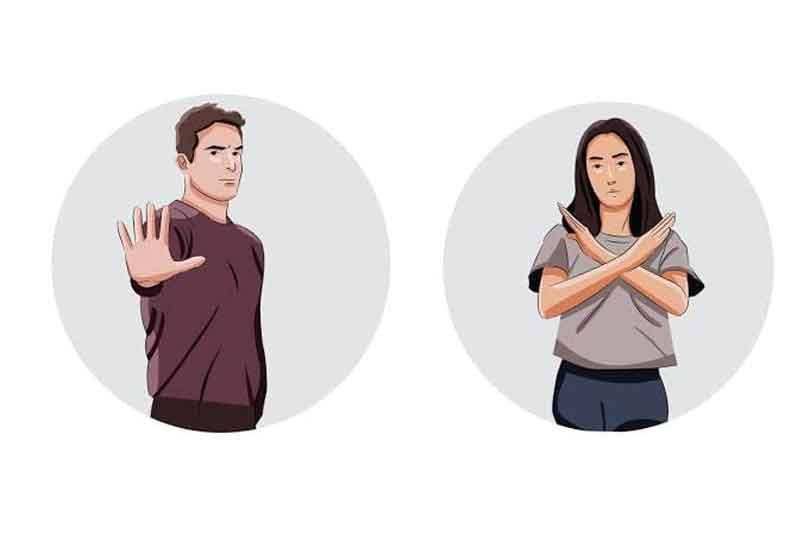
“I have a boyfriend.”, “I’m married.”, “I have a husband.” Notice how these statements are often treated differently from “I’m not interested.” The first set appears to provide an explanation that some people consider acceptable. The last one, apparently, leaves room for discussion. And that is where the real problem lies.
This is not about saying that every man behaves this way. It is not about suggesting that women are always right or men are always wrong. It is not even about dating specifically. It is about a much broader idea that exists in everyday interactions: why is a woman’s decision sometimes considered more valid when another man is attached to it?

Think about how often women are advised to use a boyfriend, husband, brother or even an imaginary partner as a shield. A woman might say, “Just tell him you have a boyfriend. Men understand that.” But why should she need one? Why does “I don’t want to” not carry the same weight?
There is something uncomfortable about the fact that women sometimes feel safer saying, “My husband wouldn’t like that,” rather than simply saying, “I wouldn’t like that.” It quietly shifts the authority away from the woman herself. Her boundary becomes easier to accept when it is presented as another man’s boundary. Of course, sometimes saying “I have a boyfriend” is simply the easiest way to end an uncomfortable conversation. It can be a practical response, especially when someone has already ignored a more direct refusal. Women should be able to use whatever makes them feel safest. The issue is not the woman choosing those words. The issue is the person who refuses to respect her until she uses them.
Because there is a difference between rejection and disrespect. If someone approaches you and you say no, they may feel disappointed. That is normal. Nobody is entitled to another person’s interest, attention or affection. Rejection is a part of life. We all experience it in different forms. But disappointment does not give anyone the right to keep pushing.
There is a tendency to treat persistence as romantic. We see it in films, hear it in stories and sometimes even joke about it. The person keeps trying, the woman eventually “gives in,” and the persistence is presented as proof of genuine interest. Real life is not a romantic comedy. Sometimes no means no. Sometimes “I’m not interested” is not the beginning of a negotiation. Sometimes there is no hidden reason that needs to be discovered. Sometimes a person simply does not want what is being offered and that should be enough.
What becomes particularly revealing is the difference in reactions when a woman mentions another man. Suddenly, the boundary becomes understandable. She is no longer viewed as someone making an individual decision. Instead, the assumption becomes that she is unavailable because she belongs to someone else. That distinction matters. A woman does not need to belong to another man to be unavailable to you.
She does not need a boyfriend to justify declining a date. She does not need a husband to justify refusing a number. She does not need a father or brother to make someone think twice before crossing a line. Her own decision should be enough. Perhaps this is where we need to examine what some of these reactions actually reveal.
When someone respects a woman’s “no” only after hearing about another man, it can suggest that they do not fully recognise her autonomy. The invisible boyfriend suddenly becomes the authority. The invisible husband becomes the reason she cannot be approached.
It almost creates the impression that the question is not, “Does she want this?” Instead, it becomes, “Does another man have a claim over her?” That is a very different question.
And this is not just about romantic advances. The same attitude can appear in smaller, everyday situations. A woman may be told she is “too sensitive” when she establishes a boundary, yet be expected to respect someone else’s boundaries without question. She may be encouraged to be polite even when someone is making her uncomfortable, because being firm might make her seem rude. Women are often taught to soften their refusals.
- “Sorry, I have a boyfriend.”
- “Sorry, I’m married.”
- “Sorry, I’m busy.”
- “Maybe another time.”
Sometimes there is a whole paragraph of explanation wrapped around a two-letter word. No. Perhaps we need to make that word less uncomfortable. A respectful person does not need a detailed explanation to accept someone’s refusal. They may not like the answer, but they accept it. They move on. They do not demand a reason, challenge the decision or search for a loophole and most importantly, this standard should apply both ways.
Men can be rejected. Women can be rejected. Nobody owes another person attraction simply because they were approached politely. Nobody owes a conversation, a date, a phone number or a second chance because someone else is interested.
There is also something worth acknowledging here. Not every man who asks, “Do you have a boyfriend?” is deliberately disrespecting women. Sometimes it is simply a question about availability. The problem begins when the answer to that question determines whether the person's “no” deserves respect. That is the part worth questioning.
Because imagine how different the interaction would be if we simply believed people when they told us what they wanted. She says, “I’m not interested.” “Okay. Have a good day.” That is it. No argument. No persuasion. No wounded ego. No attempt to prove why she should change her mind. Just acceptance. It may sound incredibly ordinary, and that is exactly the point. Respecting someone's boundary should not be extraordinary behaviour.

A woman standing in front of you should not need an invisible man standing behind her for her words to matter. Her relationship status is not what gives her the right to say no. Her being someone's girlfriend, wife, daughter or sister does not determine the value of her boundaries. She is allowed to say no because she is a person and that is the simplest thing we need to remember. A woman does not become more unavailable because another man loves her. She was already entitled to decide for herself.
So the next time someone says, “I’m not interested,” maybe we can resist the instinct to ask why, or whether there is someone else, or whether she might change her mind. Maybe we can simply listen. Because the most respectful response to a woman saying no should never have been, “Does she belong to someone?” It should always have simply been, “She said no.”