VERSAILLES DOESN’T PAY OUR FUEL BILLS

GROUND TRUTH BY DAMINTHA GUNASEKERA
The ink on the Versailles memorandum was barely dry when Iran declared the Strait of Hormuz closed again. Its military cited Israeli strikes on Lebanon as ceasefire violations and called the renewed closure the "first step" in its response. The US disputed the claim, saying traffic continued to flow. But the fact that this is already contested, within days of signing, tells you everything you need to know about the durability of what was agreed in Paris. Sri Lanka was not out of the woods the day the deal was signed. It is certainly not out of the woods now. On June 17th, Trump and Macron stood in the Hall of Mirrors at Versailles. A memorandum of understanding between the United States and Iran was signed, ending four months of conflict that had blocked the Strait of Hormuz, the narrow waterway carrying roughly 27% of the world's seaborne oil. Markets celebrated. Oil prices fell. The imagery was deliberate: grand halls, historic weight, the suggestion of a turning point.
But Sri Lanka's economy does not run on imagery. It runs on fuel prices, interest rates, and whether tourists can get a flight through Dubai. And on all three counts, the damage from the months before Versailles is still working its way through the system.
The bill is already in the system
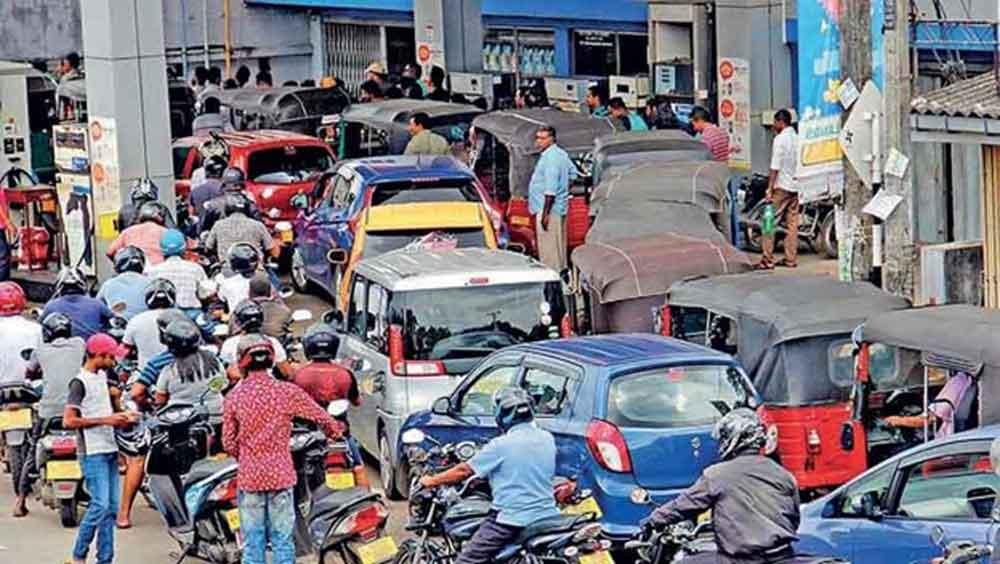
When the conflict erupted on February 28th, Sri Lanka had to keep its economy running. The Ceylon Petroleum Corporation bought fuel, significant volumes at crisis-level premiums, because there was no alternative. The government has not covered the full per-litre loss on those purchases through its on-budget subsidy. That means CPC has to pass the cost through to consumers over time. So even as global crude prices ease when the Strait is open, your pump price will not fall in parallel. What you pay at the petrol station this week is partly a reflection of what Sri Lanka paid for fuel in March and April, at the height of the crisis. A ceasefire changes the global headline. It does not change that bill.
The uncertainty premium
There is a second factor keeping prices elevated, and Saturday's events have made it considerably worse. This deal nearly collapsed multiple times over four months. What was signed at Versailles is a 60-day memorandum of understanding, not a permanent settlement. The hardest issues: Iran's enrichment levels, frozen assets, and missile programmes, remain entirely unresolved. The memorandum called for the immediate end to military actions by Israel in Lebanon and the full reopening of the Strait without tolls for at least 60 days. Israel has continued striking Lebanon. Iran responded by declaring the Strait closed again. The framework did not survive its first week.
Importers and commodity buyers across South Asia understand this intuitively. The rational response to a fragile deal is not to relax, it is to absorb. To rush in Gulf supplies while they are available, before the next flare-up. That demand surge creates price volatility even as the headline situation appears to improve. The foreign exchange and balance of payments benefits of a ceasefire will take weeks, possibly months, to show up in the data, and that assumes the ceasefire holds, which at the time of writing, it demonstrably does not.
What three months of disruption actually cost
Let us be precise about the economic ledger, because the narrative of relief risks obscuring damage that remains very much on the books. Inflation jumped from 2.2% in March to 5.4% in April, breaching the CBSL's 5% target, and remained at 5.5% in May, the highest reading since early 2024. The CBSL responded with a 100-basis point rate hike on May 26th, raising the overnight policy rate to 8.75%, the biggest increase in four years, reversing more than a year of accumulated easing in a single decision. The rupee fell sharply, briefly touching LKR 354 to the dollar from around LKR 310 at end-March. Petrol rose to LKR 420 per litre and diesel to LKR 405 per litre as of early May.
These are not abstract numbers. They are in every grocery bill, every business loan, every household that had just started to recover from 2022.
The transit bridge that broke
The dimension of this crisis that received the least public attention in Sri Lanka was tourism, not because the numbers were small, but because the mechanism was invisible to most people. Over 60% of high-spending tourists from Europe and North America reach Sri Lanka through Middle Eastern transit hubs: Dubai, Doha, Abu Dhabi. When Gulf airspace closures disrupted those hubs, the transit bridge broke. A traveller in Frankfurt did not need to fear Sri Lanka specifically, Sri Lanka was entirely safe throughout the conflict, but the routing disappeared, the surcharges became punishing, and the psychological barrier of a region at war did the rest.
Tourist arrivals fell 19.7% year-on-year in March. April was worse, down 22.3%, the lowest monthly figure since May 2025. Those were peak northern winter travel months. That revenue is gone permanently. No ceasefire recovers a hotel booking that was never made. May brought genuine recovery, 145,745 arrivals according to the Sri Lanka Tourism Development Authority, the highest figure ever recorded for that month, up 9.6% year-on-year. The European summer season is building. But March and April are already written off, and with the Strait in question again, the confidence of long-haul travellers planning forward trips will take another hit.
What a real reset would require
None of this is an argument for despair. A diplomatic agreement that stops a war is better than the alternative. The fact that it is already fraying does not make the attempt wrong, it makes the structural lesson more urgent.
Sri Lanka imports nearly all of its fuel. It has almost no domestic energy buffer. Every geopolitical decision made in Washington, Tehran, or Tel Aviv moves directly into Sri Lankan fuel prices, electricity costs, inflation, and the livelihoods of people who had nothing to do with any of it.
Energy independence is not an environmental slogan. For a country like Sri Lanka, it is an economic survival strategy. Every step away from imported fuel dependency is a step toward insulating ordinary Sri Lankans from the next shock. And as this week has demonstrated with painful clarity, there will always be a next shock.
Versailles was a moment. The Hall of Mirrors, the handshake, the history. But moments do not pay fuel bills. The deal lasted 72 hours before the Strait was declared closed again. The bill from the months it was blocked is still on the table. And the lesson, the one we keep refusing to fully absorb, is still waiting to be learned.
About The Writer: Damintha Gunasekera is a political affairs professional and Senior Aide to a Member of Parliament. He writes on Sri Lankan politics, economics and global affairs. The views expressed are his own and do not represent any institution or employer. Follow South Asia Explained on Instagram and TikTok by scanning the QR Code below.