Fame Game Featuring Corinne Almeida
By Thasmina Sookoor
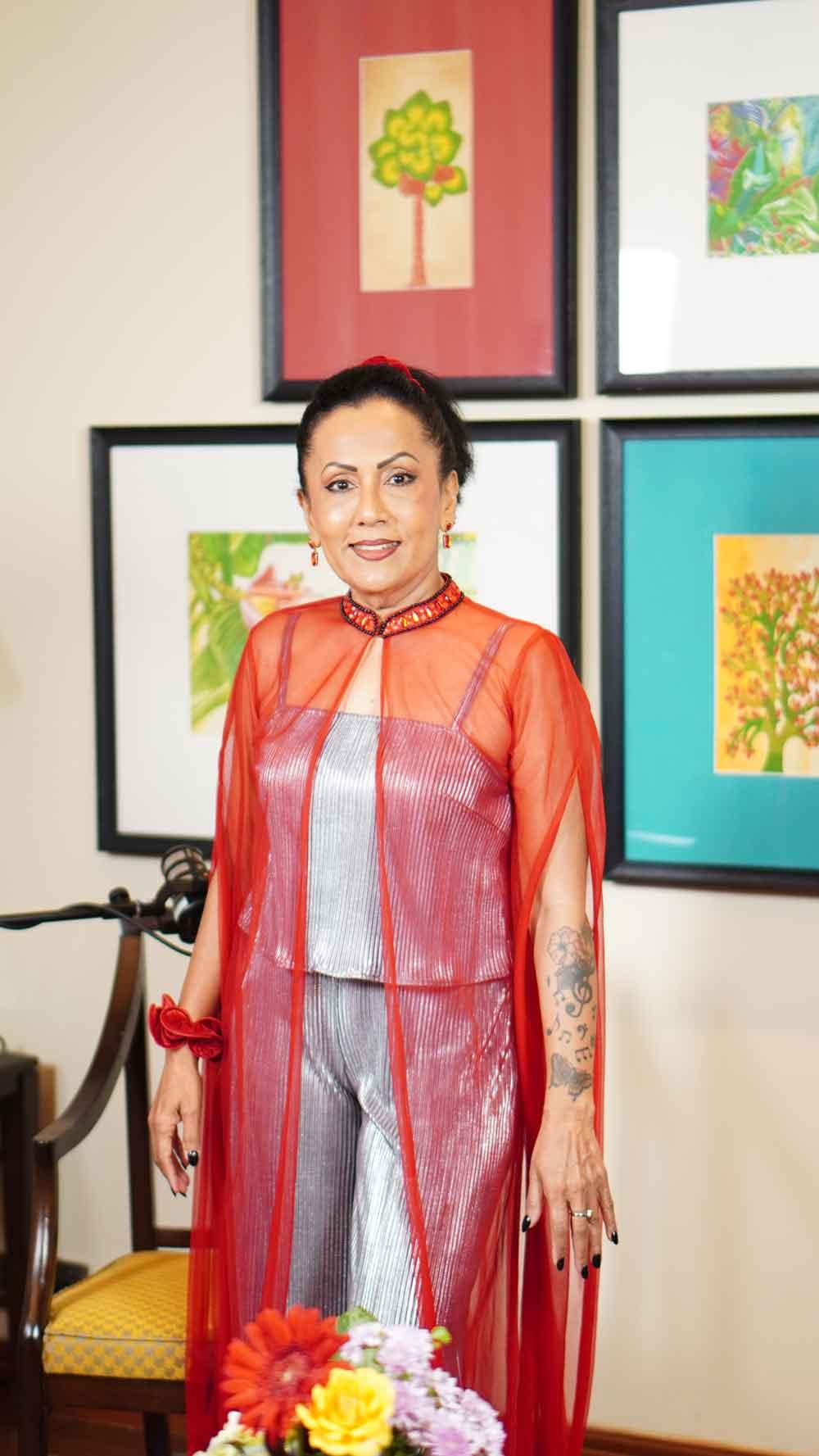
Corinne Almeida has been a familiar presence in Sri Lanka's entertainment industry for decades. A singer and performer who began her musical journey at a very young age, she has witnessed significant changes in the industry, from the days of live performances and albums to an era dominated by social media and digital platforms. In a candid conversation on Fame Game, hosted by Kumar de Silva and Rozanne Diasz, Almeida reflected on her childhood, her long career in music, her journey into yoga and meditation, and the personal changes she has experienced over the years.
Q: You studied at All Saints' College in Borella before moving to St. Sebastian's. What do you remember about your school years?
A: I honestly do not remember too much about my years at All Saints' College because I was very young at the time. However, I still meet people from the school and remain familiar with many of the members of the OGA. I spent the first part of my schooling at All Saints' College and the second part at St. Sebastian's Convent. I remember my years there much more clearly, and I am still very much in touch with the OGA. I try to do as much as I can for the school in whatever capacity I can. It is nice to maintain that connection.
Q: You are now also a qualified yoga instructor. How did yoga become such an important part of your life?
A: I started yoga in 2017. I found it extremely helpful and began to experience the benefits not only in my body but also in my mind. Eventually, I wanted to take it one step further and decided to undergo teacher training. It was a significant decision because I had to turn down a number of professional engagements. I knew beforehand that I was going for the training, so I chose not to accept certain gigs. I considered it an investment in myself. I wanted to experience it and see how far I could go. I did well and completed the training, and today I am a yoga instructor. I have not started teaching professionally because of my work and travelling. However, when I meet people in smaller gatherings, I often share some of the messages and lessons I have learned through yoga.
Q: What did your yoga training in India involve?
A: It was very interesting and also very challenging. I really enjoyed the experience. The training took place during a period when I was actually very busy with work. November and December are important months professionally, but I had already planned for the training and made the necessary choices. I wanted to do something for myself. I wanted to make that investment in myself and see what I could learn from it.
Q: You often say that people should "listen to their bodies." What exactly do you mean by that?
A: You cannot rush yoga. You need to understand your own limits.
I might be a yoga instructor, but another person might be able to perform certain poses better than I can because they may have greater flexibility. Everybody is different. You have to know your limits and understand where you should stop. If you keep pushing yourself beyond what your body can handle, you can hurt yourself. Especially when you are learning a pose for the first time, you need to understand your body. You should follow what the teacher teaches but also recognise your own limitations. That is why I always say that you have to listen to yourself.
Q: What inspired you to begin this journey?
A: Nobody specifically inspired me. I was going through a period in my life when I was looking for answers, particularly in relation to a relationship. At that point, I felt that this was the direction I needed to take. From that moment onwards, there was no stopping. Meditation became part of my morning routine. Discipline is extremely important to me, and I consider myself a very disciplined person. One of the biggest things I have learned is that your breath is the most important thing in your life. If you inhale and do not exhale, you are gone. It takes only a few seconds to understand how important the breath is. People often do not realise that.
Q: How has this journey changed you as a person, as a singer, mother and performer?
A: It has elevated me. It has elevated me to a level where I am much more aware of everything and everyone around me. I have also learned to live a more disciplined life. We all have to face death one day, but until that day comes, we do not have to live without awareness or spend our lives suffering unnecessarily. You have to take care of yourself and your body. You have to learn unconditional love and forgiveness. Forgiveness is extremely important, including forgiving ourselves for things we have done in the past. We are only human. We have all made mistakes and experienced things that we may not be proud of. When you become more aware, you learn to accept those experiences and forgive yourself. The past is the past. It is gone.
Q: You also emphasize gratitude. What does gratitude mean to you?
A: Saying "thank you" is a very powerful thing. When you wake up in the morning, before your feet even touch the floor, say thank you for another day and for the breath you have. There are millions of people around the world who do not wake up after going to sleep. So when you wake up, you can simply say, "Thank you. I am alive for another day."
Q: What does your daily routine look like?
A: I do not have one fixed waking time. After waking up, I meditate. I have also been following a meditation programme through Sadhguru's app. I do breathing exercises and my own meditation as well. I close my eyes, connect with my breath and allow my thoughts to come and go. You should not become attached to every thought. Sometimes your thoughts are pleasant and sometimes they are not. But you do not have to fight with them. After meditation, I have warm water, sometimes with lemon. I do not drink tea or coffee. Then I do yoga. I normally spend about an hour doing yoga. A regular class can be an hour and a half, but because I meditate and do my breathing exercises separately, I spend around an hour on the physical practice. Even at night, depending on what time I return home after a show, I meditate again before going to bed. Sometimes I get home at three, four or five in the morning, and sometimes earlier. But I still try to make that time for myself.
Q: Has this journey changed your personality?
A: I see a remarkable difference in myself. I am still the bubbly, energetic person people know. I still raise my voice and speak when I feel something needs to be said. But my tone is different. Earlier, I could be more aggressive or arrogant in the way I reacted to things. Today, I still speak up, especially when I believe something is right, but I do it in a calmer and more diplomatic manner. That change is very visible.
Q: You have been singing for many years. What is new in your musical journey?
A: I released a new song about three days before this interview. It is called Vayamukovinaava. I am still interested in creating and releasing new music, even after all these years.
Q: There are so many singers today, particularly because of social media. Is there enough space for everyone?
A: I believe there is space for more people. I do not think it is about someone being pushed out of the industry. It is about the quality of the work. The world is evolving, and we have to accept that. However, not everyone sustains a long career. There is always something new coming up the next day. Sustainability is therefore important. Some artists remain in the industry for a long time, while others come in, do something and disappear.
Q: How have you managed to sustain your own career for so long?
A: You have to keep reinventing yourself. It is not simply about having a good voice as a singer. There are other qualities that matter. Discipline, punctuality, dedication and commitment are all important. When you put those qualities into practice and do your job properly, people notice.
Q: How many songs have you recorded over the years?
A: I do not remember the exact number. I recorded two albums quite early in my career and have done many individual songs since then. Even at this age, I am still interested in doing new songs and creating original material. One thing I notice today is that some younger performers may have released one or two songs, but when they perform on stage, they often sing other people's songs. I am not blaming the artists for that. I think organisers also have a responsibility to give artists opportunities to perform their own original material.
Q: Do you have a favourite among your own songs?
A: I like all my songs. I cannot choose one favourite because I love all of them.
Q: Which song became your biggest hit?
A: Without a doubt, the Reda hette song created by Rajiv became a major hit.
Q: Do you mind other singers performing your songs?
A: Not at all. I have said openly that they are welcome to sing them. We are not going to be in this industry forever. If other people continue singing our songs, one day the younger generation may discover them and learn that these were songs created and performed by us. I am very comfortable with that. We came into this world with nothing, and we will leave with nothing. Whatever we have while we are here, we should enjoy and make the most of it.
Q: How do you maintain your appearance and energy?
A: Yoga has a lot to do with it. It is about oxygen and blood circulation within the body. I do not use very expensive creams or complicated products. I have things such as castor oil, almond oil and argan oil at home. Internal wellbeing matters a lot. When you take care of yourself internally, it reflects externally as well.
Q: The entertainment industry can involve criticism, backstabbing and personal attacks. How have you dealt with that over the years?
A: Before 2017, before I started this journey, I reacted to things differently. I saw things differently. Today, I do not worry about backstabbing. If somebody wants to do that, they can do it. I have learned that you should not give another person the power to manipulate you. I compare it to giving somebody the remote control to your television. Why would you hand them the remote and allow them to change your channels? You should keep your remote for yourself.
-------------------------
After decades in the public eye, she continues to perform, record music and engage with audiences, while also placing increasing importance on health, discipline, gratitude and contentment. Her message is perhaps best summed up by the principles she repeatedly returned to during the conversation: take care of yourself, understand your limits, protect your peace and, above all, learn to look inward.