THE MAKING OF BARBARIAN AND THE EMERGENT ‘OTHER’
By Anargi Jayakody
For centuries, few words have carried greater moral certainty than barbarian. It is a term that appears almost self-explanatory. The barbarian is uncivilised, violent, irrational and cruel. He stands beyond the boundaries of ordered society, threatening the achievements of civilisation with ignorance, chaos and destruction. From Greek historians describing the Persians to Roman chroniclers confronting the Goths, from medieval Europeans writing of pagans and infidels to nineteenth-century imperial administrators speaking of "savages," the barbarian has always appeared as civilisation's unmistakable opposite.
Yet history has an inconvenient habit of unsettling the categories we take for granted. The closer one examines the barbarian, the more elusive he becomes. The Goths who once threatened Rome eventually commanded its armies. The Franks, dismissed as uncultured tribes beyond the Rhine, laid the foundations of medieval Western Europe. The Vikings, whose longships inspired terror along the coasts of Christendom, established kingdoms from England to Sicily and became patrons of churches, monasteries and law. Even the Mongols, frequently remembered in European memory only for conquest and devastation, governed the largest contiguous empire in human history with remarkable administrative sophistication, facilitating commercial exchange and diplomatic communication across Eurasia on a scale previously unimaginable.
Such transformations expose an uncomfortable truth. The barbarian was never a permanent historical identity. Yesterday's barbarian repeatedly became tomorrow's emperor, king or lawgiver. If the category could change so dramatically, perhaps the question historians ought to ask is not who the barbarians were, but why civilisations have always seemed to need them.
The answer lies in a simple but profoundly important observation. Civilisations rarely define themselves solely by what they are. More often, they define themselves by identifying what they are not. Every society constructs boundaries between order and disorder, refinement and vulgarity, virtue and vice, familiarity and strangeness. These boundaries are seldom merely geographical. Long before frontiers are marked upon maps or walls erected across landscapes, they exist within the imagination. Every civilisation first constructs a moral frontier before it constructs a physical one.
The barbarian therefore tells us remarkably little about those who supposedly stood outside civilisation. Instead, he reveals the anxieties, ambitions and ideals of those who created him. The history of the barbarian is, above all else, the history of civilisation attempting to explain itself.
This is not to suggest that ancient societies simply invented fictional enemies. The Persians existed, as did the Goths, Huns, Mongols and countless other peoples who confronted expanding empires. Nor does it deny that violence, conquest and cultural conflict were genuine features of the ancient and medieval worlds. Rather, it suggests that the labels attached to these peoples carried meanings extending far beyond objective description. "Barbarian" functioned less as an ethnographic category than as a moral and political judgement. It distinguished those considered to embody civilisation from those believed to exist beyond its boundaries.
Indeed, one of history's great ironies is that the qualities associated with barbarism have shifted continuously while the category itself has endured. To the Greeks, the barbarian spoke an unintelligible language. To the Romans, he threatened imperial order. Medieval Christendom increasingly identified the outsider through religious difference. European colonial empires clothed barbarism in the language of race, science and progress. In the modern world, the vocabulary has changed once again. We speak less frequently of barbarians than of rogue states, extremists, terrorists or failed societies. The terminology evolves with each age, yet the intellectual mechanism remains strikingly familiar. Every civilisation continues to distinguish itself by imagining an opposite.
This pattern raises a question extending far beyond the history of any single empire. If societies across vastly different cultures repeatedly create figures standing outside civilisation, perhaps the barbarian is not simply a historical actor at all. Perhaps he is a recurring political idea. Perhaps the barbarian is civilisation's mirror, reflecting not the character of outsiders but the values that societies wish to believe define themselves.
The story begins, appropriately enough, in ancient Greece, where a single word intended merely to describe unfamiliar speech gradually evolved into one of history's most enduring political and cultural concepts. The history of the barbarian begins not with violence but with language. The Greek word barbaros (βάρβαρος) was originally a remarkably unremarkable term. Most classicists agree that it was onomatopoeic, imitating the sound of foreign speech as "bar-bar," unintelligible to Greek ears. In its earliest usage, it simply denoted those who did not speak Greek. The distinction was linguistic rather than racial, and certainly not yet a universal judgement upon character. Homer himself employs the adjective barbarophōnos ("of foreign speech") only once, describing the Carians fighting alongside Troy. The word carries little of the moral contempt that later generations would attach to it.
Language, however, rarely remains merely language. The fifth century B.C. transformed the meaning of barbaros. The Persian Wars were not simply military contests between city-states and empire. They became, in the Greek imagination, a defining struggle over the nature of civilisation itself. Athens' victories at Marathon and Salamis acquired significance far beyond strategy or politics. They were remembered as triumphs of freedom over despotism, moderation over excess, rationality over irrationality. The barbarian ceased to be merely the foreign speaker. He became the embodiment of everything Greece believed itself not to be.
It is here that one encounters the extraordinary power of historical narrative. Herodotus, often celebrated as the "Father of History," did not present the Persians as caricatures devoid of sophistication. On the contrary, he admired many aspects of Persian government, military organisation and royal administration. Yet even within his remarkably balanced account, Greece and Persia emerge as contrasting political worlds. Greek liberty is repeatedly juxtaposed with Persian monarchy, civic participation with imperial command, measured deliberation with the perceived extravagance of eastern courts. Whether these distinctions reflected historical reality in every respect is almost beside the point. What matters is that they provided Greece with a language through which to understand itself.
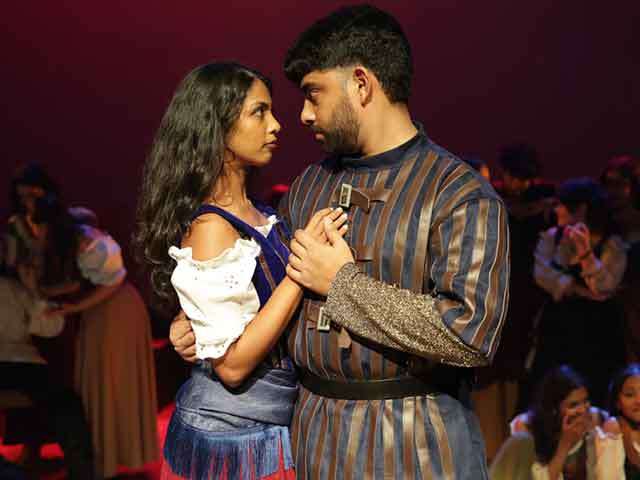
Aeschylus' Persians, first performed in Athens scarcely eight years after Salamis, offers perhaps the clearest example. It is remarkable not because it vilifies the defeated enemy, but because it grants the Persians dignity and tragic depth. Xerxes is neither monster nor fool; he is a tragic ruler whose overreaching ambition invites catastrophe. Yet the drama simultaneously reinforces an implicit contrast between Greek restraint and Persian excess. The defeat of Persia becomes more than a military event. It becomes a moral vindication of the Greek political order.
The barbarian, then, was never simply discovered. He was interpreted.
Modern historians have long recognised that the Greek distinction between Hellene and barbarian was neither fixed nor absolute. Individuals could cross cultural boundaries. Foreigners settled within Greek cities. Greeks themselves served Persian kings as physicians, soldiers and diplomats. The relationship between Greece and Persia was one of continuous exchange in trade, diplomacy and artistic influence. Greek architecture borrowed from Egypt and the Near East; Greek coinage emerged within wider eastern economic networks; philosophical ideas travelled across the eastern Mediterranean. Civilisations that imagined themselves distinct were, in practice, profoundly interconnected.
This tension is precisely what makes the concept of the barbarian so revealing. The more porous the boundaries of civilisation became, the more energetically those boundaries were articulated in language. The category of the barbarian was not merely a description of difference. It was an attempt to stabilise identity in a world where identities were constantly interacting, borrowing and changing.
One need not look far to see how effective this intellectual strategy proved. Once the distinction between Greek and barbarian had been established, it became capable of absorbing almost limitless variation. Persians, Thracians, Scythians and countless other peoples, despite their immense differences from one another, could all be grouped beneath the same conceptual umbrella simply because they occupied the opposite side of the Greek imagination. Diversity among outsiders became less important than the function they collectively served. They defined, by contrast, what it meant to be Greek.
This is the first great lesson in the history of the barbarian. Civilisations seldom begin by asking, "Who are they?" More often, they ask, "Who are we?" The outsider becomes the answer to an internal question. The barbarian is not merely someone beyond the frontier; he is the figure against whom civilisation rehearses its own virtues.
The Romans inherited this idea almost wholesale. Yet in doing so they would expose a contradiction that lay dormant within the Greek conception itself. For Rome would discover, often to its own surprise, that barbarians could become Romans, generals, senators and even emperors. The category that had once appeared so self-evident would begin to unravel from within.
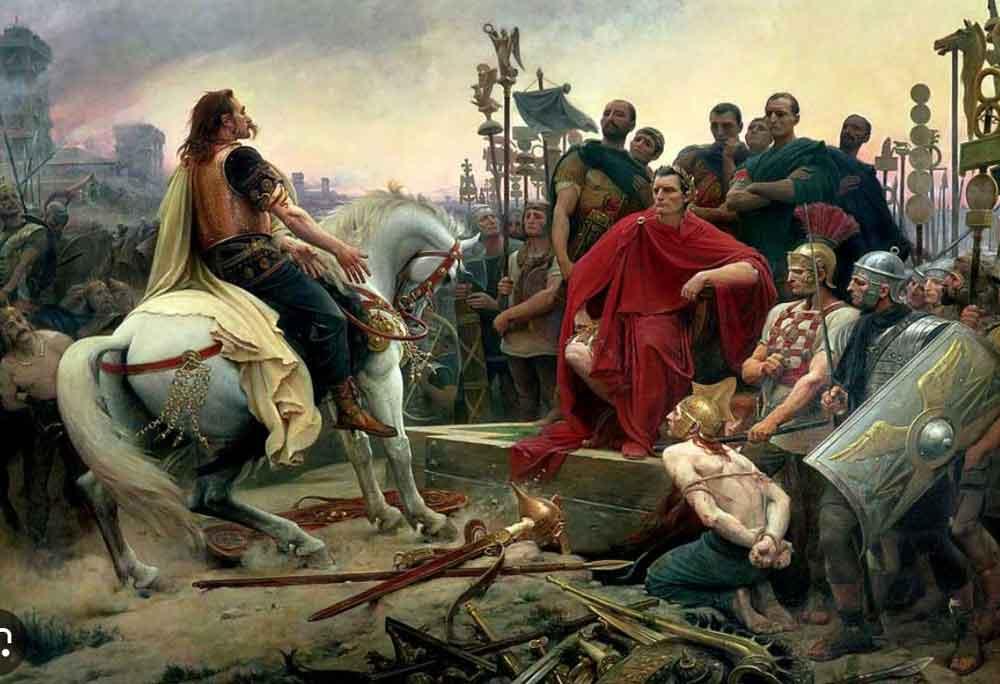
If Greece gave Europe the word barbarian, Rome exposed its greatest contradiction. The Roman Empire inherited much of the Greek intellectual vocabulary. Latin simply adopted the Greek barbaros as barbarus, and with it came the assumption that civilisation ended where Roman order ceased. Beyond the Rhine lay the Germans; beyond the Danube the Goths, Quadi and Marcomanni; further east the Huns; to the south the desert peoples whom Roman writers often portrayed as existing outside the ordered world of the Empire.
Roman literature, much like its Greek predecessor, frequently contrasted the disciplined citizen with the untamed outsider, the ordered city with the wilderness beyond its frontiers. Yet Rome differed from Greece in one crucial respect. It was not merely a civilisation. It was an empire.
Empires possess a remarkable capacity for absorbing those whom they first oppose. Unlike the relatively bounded world of the Greek polis, Rome expanded by incorporating peoples of astonishing ethnic, linguistic and religious diversity. The empire that imagined itself the guardian of civilisation steadily became one of history's most multicultural political entities. Syrians governed provinces in Britain. Spaniards ruled from the imperial throne. North Africans became philosophers and bishops. Illyrians commanded armies. Citizenship itself, once the privilege of a narrow Italian elite, gradually expanded until the Constitutio Antoniniana of A.D. 212 extended Roman citizenship to virtually every free inhabitant of the empire.
The existence of such diversity immediately complicates the very notion of the barbarian. If civilisation depended upon ancestry, Rome should have collapsed under the weight of its own inclusiveness. Instead, it flourished precisely because Roman identity proved remarkably adaptable. To become Roman was less a matter of blood than of participation. One entered the Roman world by adopting its laws, serving in its armies, speaking its languages, embracing its institutions and recognising the authority of the emperor. Roman civilisation was, at least in principle, something that could be learned.
This flexibility explains one of the greatest paradoxes of late antiquity. Many of the very peoples whom Roman writers habitually labelled barbarians spent generations defending the empire rather than destroying it. Gothic federate troops fought alongside Roman legions. Germanic commanders occupied the highest military offices in the imperial administration. Men born beyond the imperial frontier rose to become indispensable servants of the Roman state.
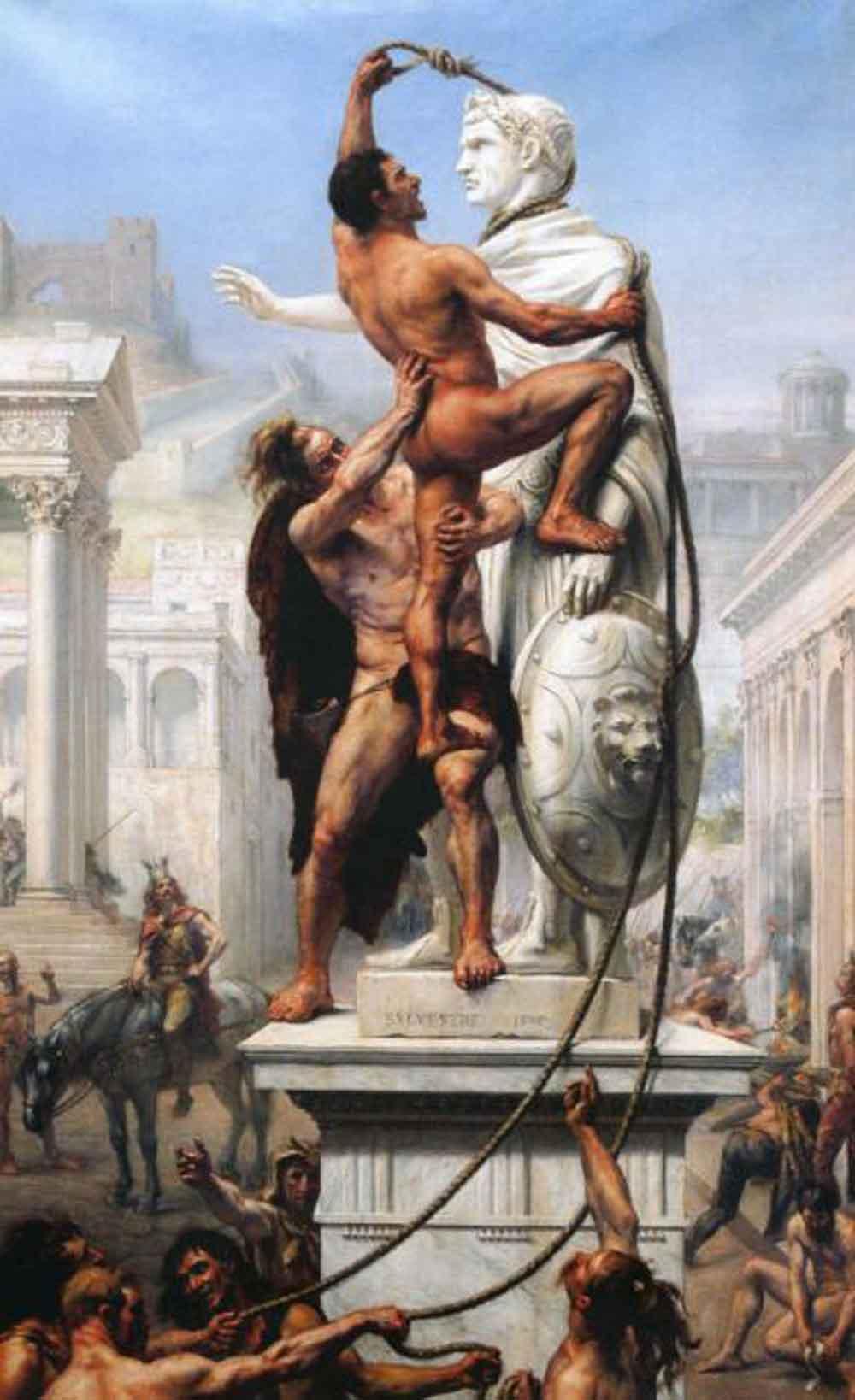
Few figures illustrate this contradiction more clearly than Stilicho. Born to a Vandal father but raised entirely within the imperial system, Stilicho became magister militum and effectively governed the Western Roman Empire on behalf of the young emperor Honorius. For years he represented perhaps the single most important defender of Roman authority against both internal rebellion and external invasion. Yet despite his unquestionable loyalty to the empire, his ancestry repeatedly provoked suspicion among Roman elites. His enemies found it convenient to portray him as fundamentally foreign, and following his execution in A.D. 408, anti-barbarian violence erupted across Italy, driving thousands of Germanic soldiers into the ranks of Alaric. Ironically, Rome's fear of the barbarian helped create the very catastrophe it feared.
Nor was Stilicho exceptional. Ricimer, himself of Suevic and Gothic descent, dominated Western imperial politics during the fifth century, appointing and removing emperors with extraordinary authority. Theoderic the Great, educated in Constantinople and steeped in Roman political culture, later ruled Italy while consciously preserving Roman law, administration and senatorial institutions. To call such men barbarians is historically accurate only in the sense that Roman writers employed the label. It tells us remarkably little about their actual political or cultural worlds.
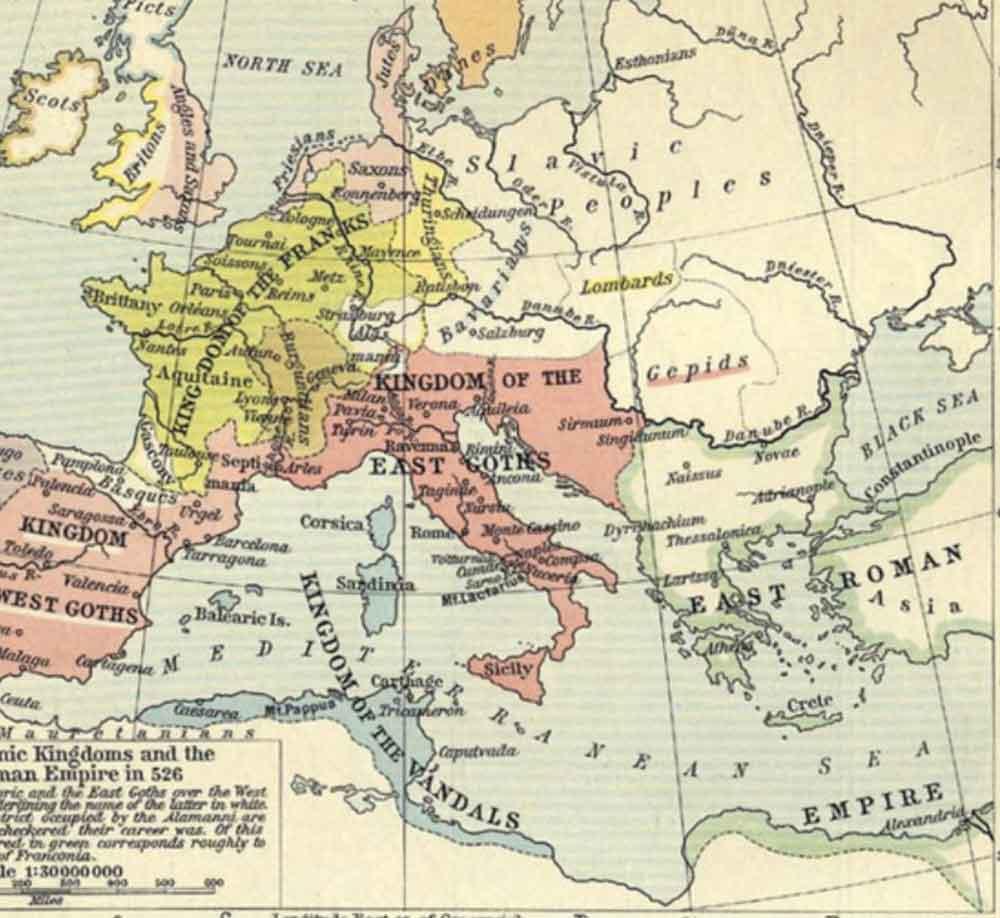
Indeed, by the fifth century the distinction between Roman and barbarian had become increasingly unstable. Many so-called barbarian kingdoms did not seek to abolish Roman civilisation. They sought to inherit it. The Visigoths maintained Roman taxation, Roman law and Roman administrative practices. The Franks adopted Latin Christianity and eventually presented themselves as legitimate heirs to the imperial tradition. Even the Ostrogothic kingdom in Italy consciously preserved the institutions of the Roman state. Far from rejecting civilisation, these rulers competed to claim its legacy.
This raises an uncomfortable question. If barbarians governed Roman provinces, employed Roman administrators, worshipped in Roman churches and legislated through Roman legal traditions, at what point did they cease to be barbarians? Was barbarism an inherited identity, or merely a label that outlived the realities it purported to describe?
The answer reveals the true nature of the category. "Barbarian" had never functioned as a stable ethnographic description. It was a relational concept, meaningful only in opposition to Roman identity. As long as Rome imagined itself the embodiment of civilisation, those beyond its political order could be designated barbarians. Yet the moment those outsiders entered the imperial world, the boundaries became porous. The frontier that had appeared so clear upon maps proved remarkably difficult to sustain in practice.
Roman history therefore offers an important correction to the Greek conception of the barbarian. The outsider was not permanently excluded from civilisation. On the contrary, he could be assimilated, transformed and eventually become one of civilisation's principal custodians. The barbarian was never simply the enemy beyond the frontier. He was often the future citizen, the future general and, occasionally, the future emperor.
It is precisely this instability that makes the concept so enduring. The barbarian was never defined solely by what he was. He was defined by what civilisation needed him to represent. As Rome changed, so too did its barbarians.
The same pattern would emerge independently in another great civilisation. Thousands of miles from the Mediterranean, imperial China developed its own vocabulary for distinguishing the ordered world from those beyond it. Rome therefore leaves us with a lesson extending far beyond the history of the empire itself. The barbarian was never simply a Roman phenomenon, nor had it ever been exclusively Greek. Rather, it was one expression of a far more enduring historical impulse. Every civilisation, however different its language, religion or political institutions, has sought to distinguish the ordered world from the world beyond it. Some drew the boundary through language, others through law, faith, custom or political allegiance. The vocabulary differed, but the intellectual instinct remained remarkably constant.
It is this broader pattern that makes the history of the barbarian so compelling. One need not search for the word itself to find the idea. Look closely enough at almost any civilisation and one discovers an equivalent figure standing at the margins of its moral imagination: the stranger who embodies disorder, the outsider against whom the community measures its own virtues, the people beyond the frontier whose existence helps define the civilisation within it. The names change, the frontiers shift, and the criteria evolve, but the underlying mechanism endures. The barbarian, it seems, has never belonged to Rome alone. He has belonged, in one form or another, to civilisation itself.