Man vs Baby
- Watch Man vs Baby on Netflix
- Rating: 3/5
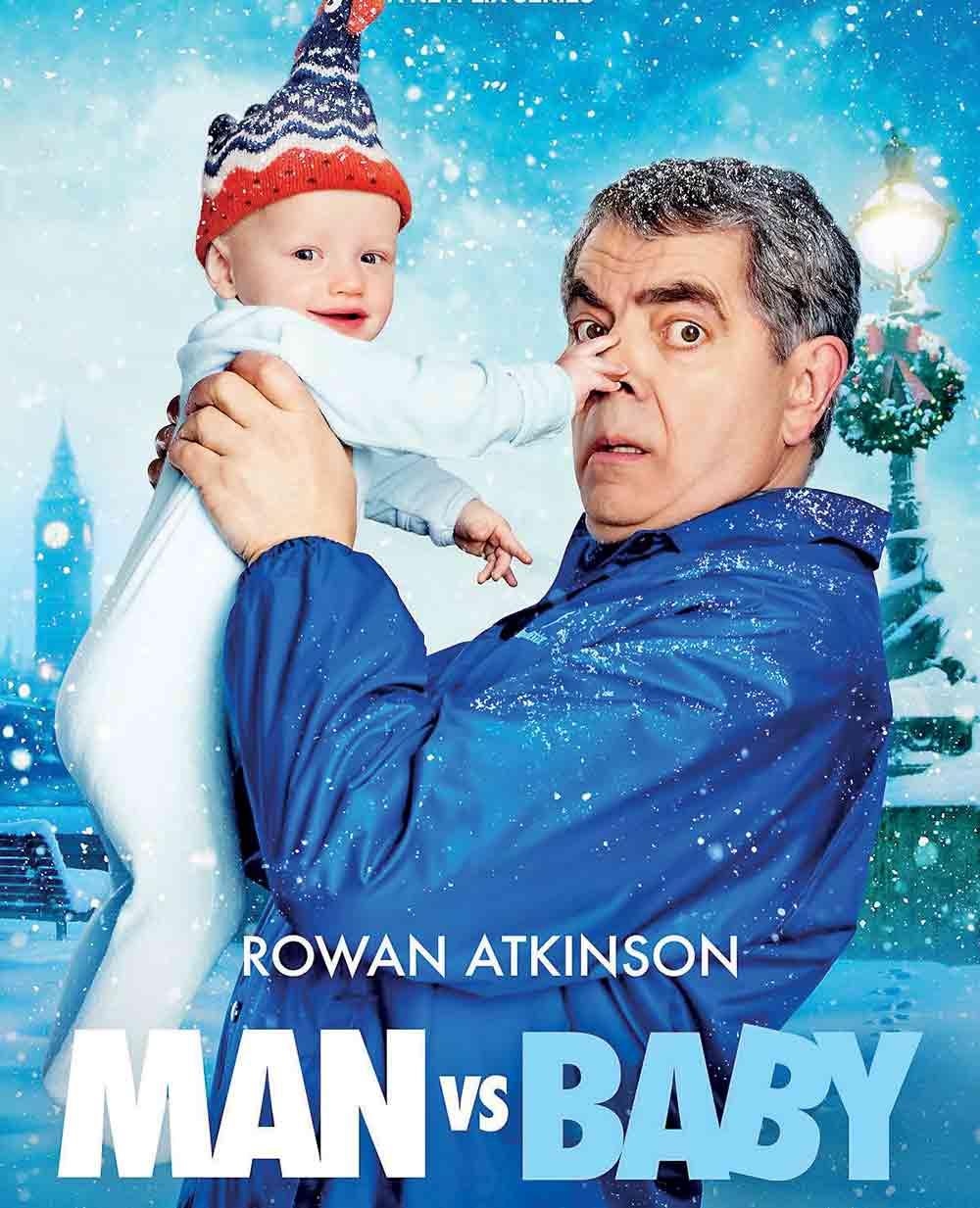
 Man vs. Baby is introduced as a British comedy television miniseries that serves as a spiritual continuation of Man vs. Bee (2022). Created once again by Rowan Atkinson alongside William Davies, the series returns to a familiar formula: placing an ordinary, socially awkward man in an extraordinary situation and allowing chaos to unfold through a series of small, escalating mishaps. Rowan Atkinson reprises his role as Trevor Bingley, a character defined by good intentions, poor judgment, and an uncanny ability to turn even the simplest responsibility into a disaster. While Man vs. Bee revolved around Trevor’s obsessive battle with a single insect inside a futuristic house, Man vs. Baby shifts the focus to a challenge that is far more personal and emotionally loaded—looking after an infant.
From the outset, the series makes its intentions clear. This is not a sharp satire or a reinvention of Atkinson’s comedy style, but rather a gentle, family-friendly piece of entertainment designed to be easy to watch and broadly appealing. It is especially positioned as a holiday-season offering, prioritising warmth, sentimentality, and simple humour over bold storytelling or biting jokes. The tone is deliberately safe, aiming to evoke smiles rather than laughter and comfort rather than surprise.
Following the calamitous events of his previous housesitting job, Trevor Bingley somehow finds himself trusted with another high-end property—this time, a luxurious London penthouse. As before, the setting is pristine, expensive, and full of things that can go wrong in the hands of someone like Trevor. However, the true complication of this new assignment does not come from smart technology or fragile interiors, but from the sudden presence of a baby who becomes Trevor’s responsibility. Whether through misunderstanding, poor communication, or sheer bad luck, Trevor is left alone to care for an infant despite being clearly and completely unqualified for the task.
The comedy of Man vs. Baby is built almost entirely around Trevor’s lack of preparedness for childcare. Feeding times, safety concerns, sleeping routines, and general baby-proofing all become obstacles he struggles to overcome. Each episode presents variations on the same basic idea: Trevor attempts to do the right thing, misunderstands the situation, and makes everything worse. His efforts to keep the penthouse clean and undamaged while also ensuring the baby’s well-being provide the foundation for most of the show’s physical humour. Rather than escalating into outrageous slapstick, the series keeps these situations relatively contained and low-stakes, reinforcing its gentle, non-threatening tone.
Narratively, the series is extremely simple. There is no overarching villain, no major external threat, and no dramatic conflict pushing the story forward. Instead, the episodes are structured around a sequence of small incidents and misunderstandings that arise naturally from Trevor’s incompetence and anxiety. This approach keeps the focus squarely on character rather than plot. Over time, Trevor begins to show signs of growth, learning patience and developing a sense of responsibility that he previously lacked. These changes are subtle rather than transformative, but they form the emotional backbone of the series.
The final episode places the story firmly within a Christmas setting, leaning into festive imagery and themes of togetherness. Trevor prepares a holiday meal as familiar faces from his life arrive, including people who remind him of his past failures and unresolved responsibilities. Rather than building toward a large comedic set piece, the ending opts for a softer, more emotional resolution. The emphasis is on connection, forgiveness, and personal improvement rather than laughter. The result is a conclusion that feels calm and reflective, though some viewers may find it underwhelming due to its lack of energy or payoff.
Rowan Atkinson dominates the series as Trevor Bingley, carrying most scenes almost entirely on his own. His performance relies heavily on physical comedy, precise timing, and expressive facial reactions rather than witty dialogue or elaborate jokes. This style will feel immediately familiar to anyone who grew up watching Mr. Bean. Long pauses, exaggerated confusion, and silent frustration are used to generate humour, and Atkinson’s mastery of these techniques remains evident. There is a nostalgic quality to his performance that will likely resonate with long-time fans, offering a reminder of a more traditional form of visual comedy.

Supporting roles are kept to a minimum, ensuring that the spotlight rarely shifts away from Trevor. Claudie Blakley appears as Jess, Trevor’s ex-wife, whose presence adds emotional context to the story. Through her interactions with Trevor, the series hints at his past mistakes and missed opportunities, reinforcing the theme of responsibility that runs throughout the show. Alanah Bloor plays Maddy, Trevor’s daughter, whose involvement further deepens the focus on family and care. Although these characters do not receive extensive development, they serve an important function in grounding Trevor’s arc and reminding viewers that his actions have emotional consequences.
One of the greatest strengths of Man vs. Baby is the comfort it offers. The episodes are short, move at a steady pace, and never demand much concentration from the audience. Even when the story feels thin, it rarely becomes tiring or frustrating in the moment. As a piece of family entertainment, the series succeeds in being accessible to viewers of all ages. There is nothing offensive, controversial, or challenging in its humour, making it suitable for shared viewing. The Christmas atmosphere adds an extra layer of warmth, positioning the show as something to put on during the holidays without expecting deep engagement or emotional intensity.
However, the same qualities that make the series easy to watch also limit its overall impact. Man vs. Baby never fully develops into the show it seems to hint at. The absence of real conflict means that many episodes feel directionless, drifting from one small mishap to the next without building momentum. The comedy is intentionally subdued, but this often results in scenes that feel flat rather than charming. Many of the situations are predictable, and the humour rarely evolves beyond its initial premise. Over time, this repetition can become noticeable and slightly frustrating.
The finale, despite being the longest episode, exemplifies these issues. Instead of delivering a satisfying conclusion or a memorable comedic sequence, it unfolds quietly and without urgency. While the emotional intentions are clear, the execution lacks energy, leaving the ending feeling somewhat uneventful. For viewers expecting a stronger payoff or a more ambitious final act, the conclusion may feel disappointing.
Visually, one of the most criticised elements of the series is the use of baby effects. At times, these effects are noticeably artificial, breaking the illusion of reality and drawing attention to the mechanics of production. Instead of enhancing the comedy or emotional moments, these visuals can be distracting, pulling viewers out of the scene. In a show that relies heavily on physical interaction and visual believability, this weakness undermines some of its most important moments.
The story itself is extremely thin, stretched across episodes that often feel padded rather than purposeful. There is very little sense of progression, and almost no tension to keep viewers invested from one episode to the next. Scenes frequently rely on similar types of mistakes or misunderstandings, offering little variation or escalation. As a result, the series can feel repetitive, especially for viewers hoping for clever writing, layered humour, or memorable dialogue. Those expectations are unlikely to be met here.
By choosing to play everything safe, Man vs. Baby avoids taking creative risks. The humour never pushes boundaries, the emotional beats are easy to predict, and the overall structure feels overly cautious. While this approach ensures broad accessibility, it also limits the show’s ability to stand out in an increasingly crowded television landscape. There is little here that feels fresh or surprising, even by the standards of Atkinson’s previous work.
Ultimately, Man vs. Baby offers mild, pleasant entertainment rather than a standout comedy experience. It provides a gentle reminder of Rowan Atkinson’s talent for physical comedy and his enduring screen presence, but it does not fully capitalise on those strengths. Once the final episode ends, the series fades quickly from memory, leaving behind a sense of warmth but little lasting impression. For viewers seeking light, undemanding holiday viewing, it may be enough. For those hoping for something more inventive or impactful, it is likely to feel like a missed opportunity.